For those not well acquainted with Costa Rica (or who do not follow this blog with an open atlas), the Osa Peninsular is on the South Western coast of Costa Rica, about 210km south of Quepos (where the walk ended). It is a classic “peninsular”, jutting out from the main landmass of the country and largely uninhabited.
We arrived by bus to Puerto Jiminez a few days ago late in the evening. This small town, which is on the eastern side of the peninsula, is the southern gateway to Corcovado national park and was described as being less touristy than the northern gateway at Bahia Drake, which is on the pacific coast. It’s a pleasant, sleepy little town which lived up to its billing. Just 5 minutes or so to walk from one end of the main street to the other. We did not see many tourists and, although tourism was clearly it’s main industry, it also feels like a proper, working town. We spent the next day sorting, planning and relaxing. Then we set the alarm for 4.20am (yes – not a typo) and got up to walk the short distance to the pier to join an overnight trip to the Corcovado National Park, leaving at 5.30am.
The current national park has a facinating and complex history, with competition between three groups in the 1960s and 1970s, namely a company that owned the land and wanted to exploit it for forestry and agriculture, squatters who had come to the land and were prospecting for gold and about a thousand scientists who realised the unique biodiversity of the area and campaigned to ensure that it could remain as a national park with unspoilt forest, resplendent with huge amounts of wildlife. In short (and fortunately for today’s visitors) the scientists won. They used their political connections to argue that this was too important a resource to be exploited and that Costa Rica’s future lay in eco-tourism. The President supported them and the company did a major land swap with the government, which enabled a national park to be created in 1976. It still took several years, lots of money and some force to eject the squatters (who had political support from the Costa Rican Communist Party – and that may not have wholly helped their cause), but the vast majority of the primary forest was saved for nature, science and eco-tourism. Today, secondary forest has grown up in the last 50 years around the coast which had been cleared for either agriculture or prospecting, and the wildlife is just as abundant there is deeper in the jungle.
There are no roads to the park so we caught a fast boat – with two impressive outboard motors – from Puerto Jiminez to the ranger station area on the western side of the peninsular. The boat ride was fine in the bay area but it got a bit bumpy when we got around the point and out to the main sea. We saw dophins close up and sea turtles, with the boat stopping whenever there was anything interesting to see. After an hour and a half we got to the coast but there is no jetty, so it was a case of getting off the back of the boat into the water, and wading to the shore. There were about 20 tourists in our boat and several other boats as well, so it was all a bit of a scrum to get to the beach.
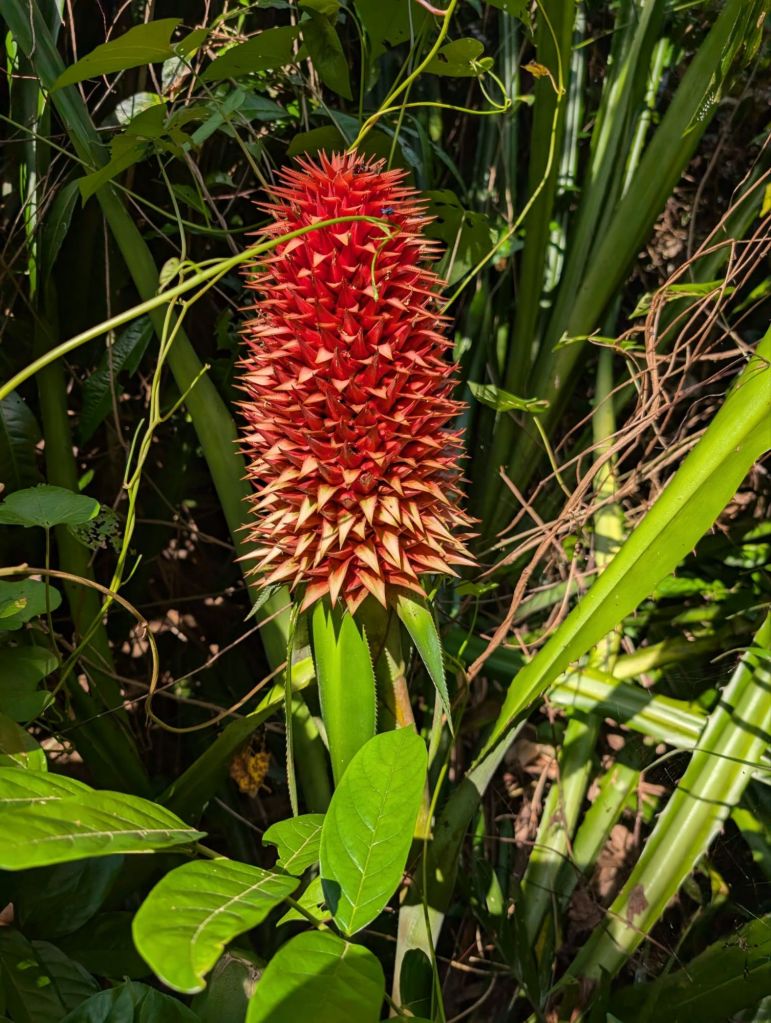
Once ashore, we changed into our boots, got our bags checks for impermissible items (such as food or single use plastic) and then met up with our guide, Fraser. Then he began the first of 4 walkabouts in the forest. Becoming an approved forest wildlife guide in Coast Rica is a serious business. They study for years and develop a range of skills before being allowed loose on tourists like us. The guides are astonishingly knowledgeable about the animals, birds, reptiles and the flora, as they lead small groups around the well marked trails. The vast majority of the forest is off limits to tourists, although there is lots of science done here. The tourists as given a small glimpse into the world of the jungle in exchange for paying (not small amounts) for the privilege – and it is a privilege. This pays to create local jobs, but also pays to ensure the remainder of the forest is protected. The economics are complicated but appear to work reasonably well.
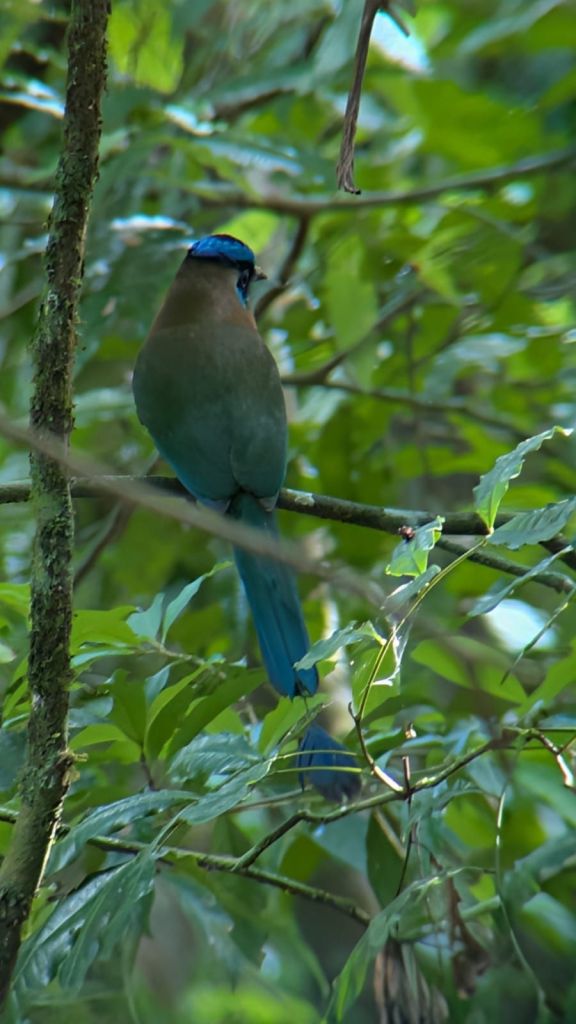
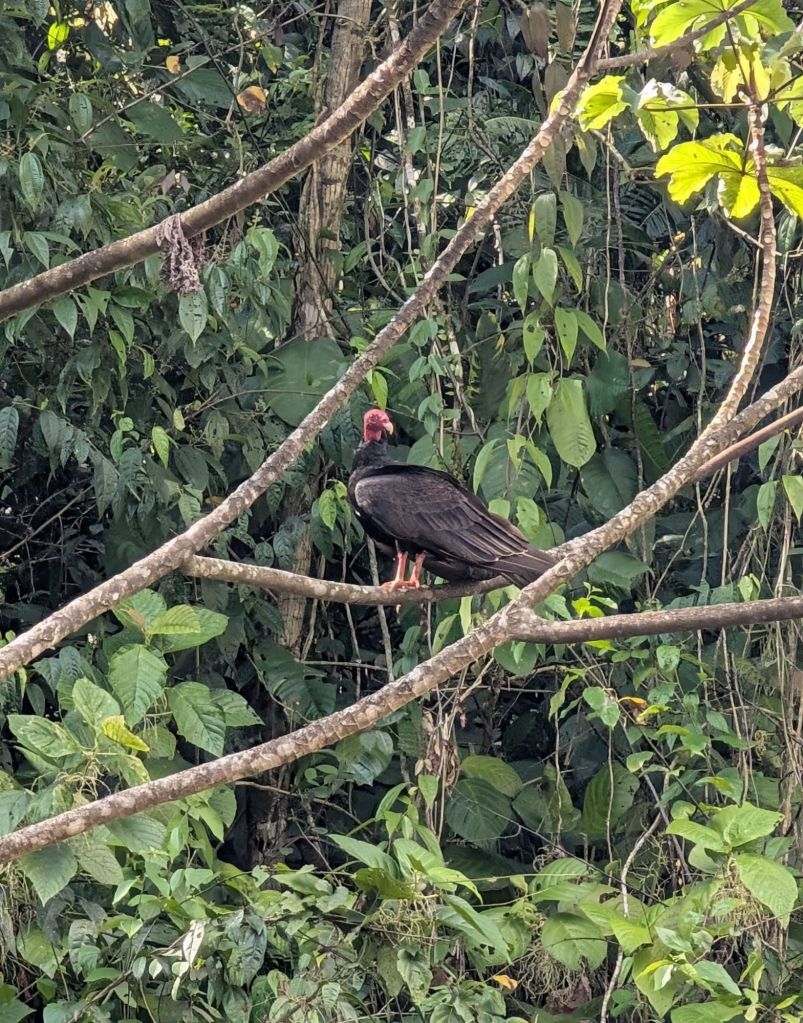
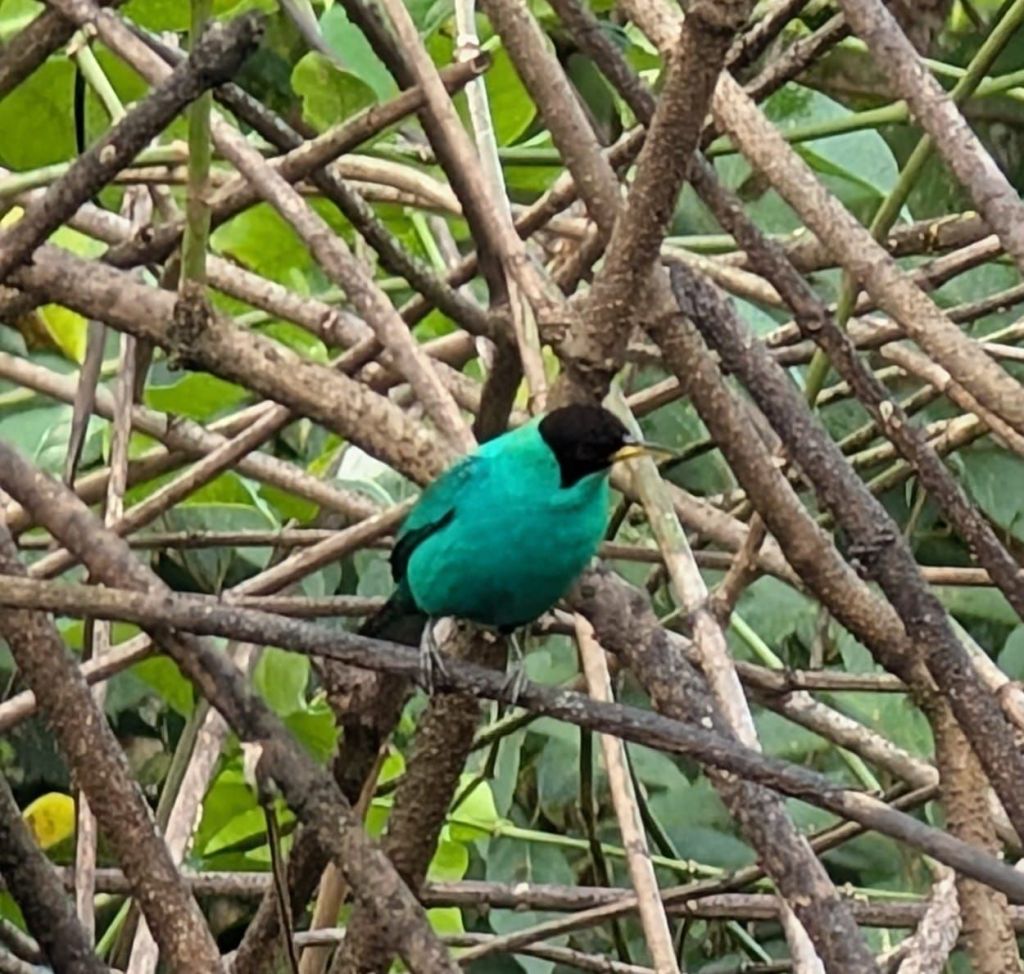
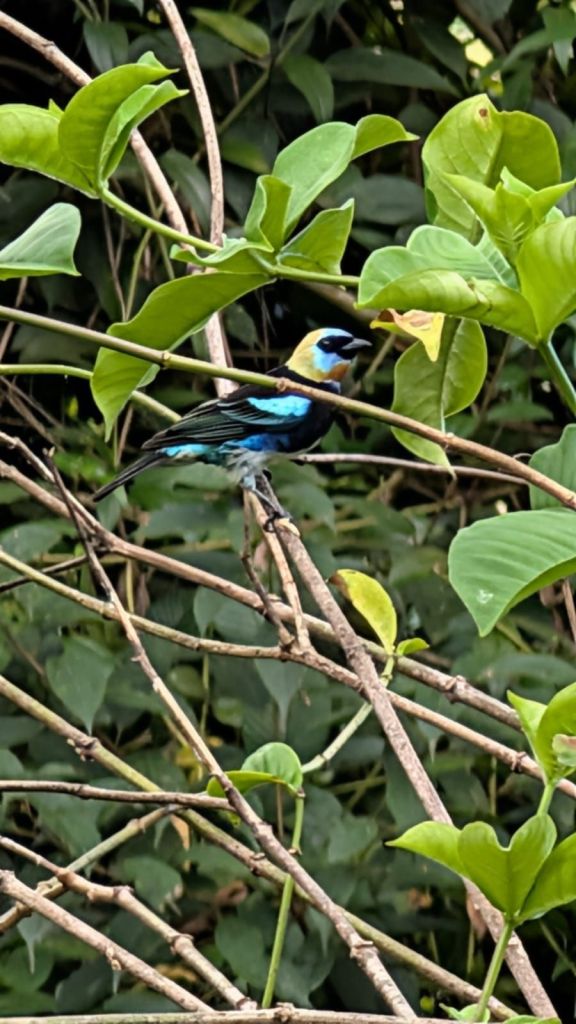
Fraser (like all the guides) carried a birders’ “scope” with him at all times, mounted on top of a tripod. This meant that when he heard a bird sound he would listen carefully, locate the bird amongst the dense foliage, set up the scope pointing at the bird and then allow us to peer through the scope to see the birds. I am in awe at this skill because the birds were nearly always impossible to see with the naked eye and I found it hopeless to look for them with my binoculars – all I could see was trees. But with his assistance, we saw a vast range of colourful birds including Flycatchers, woodpeckers and humming birds.
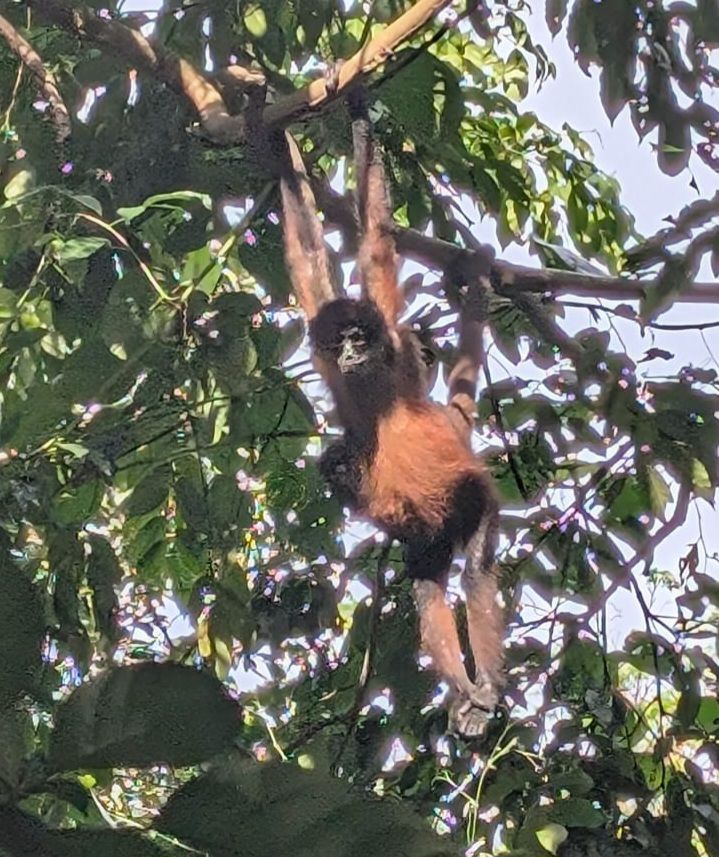
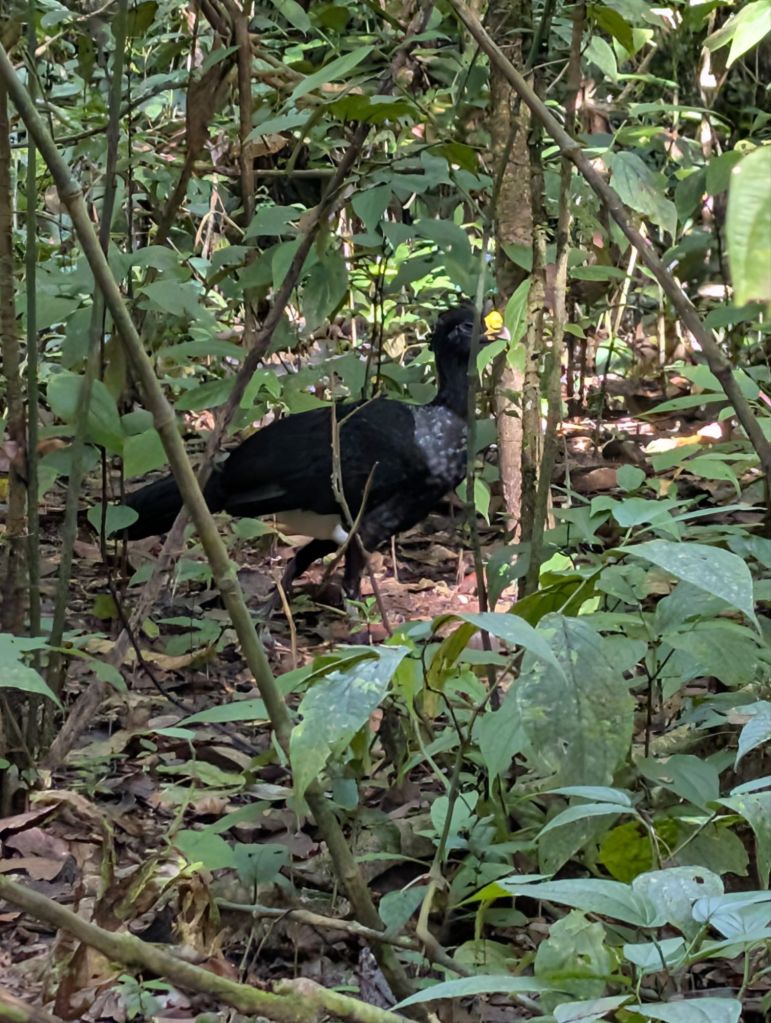
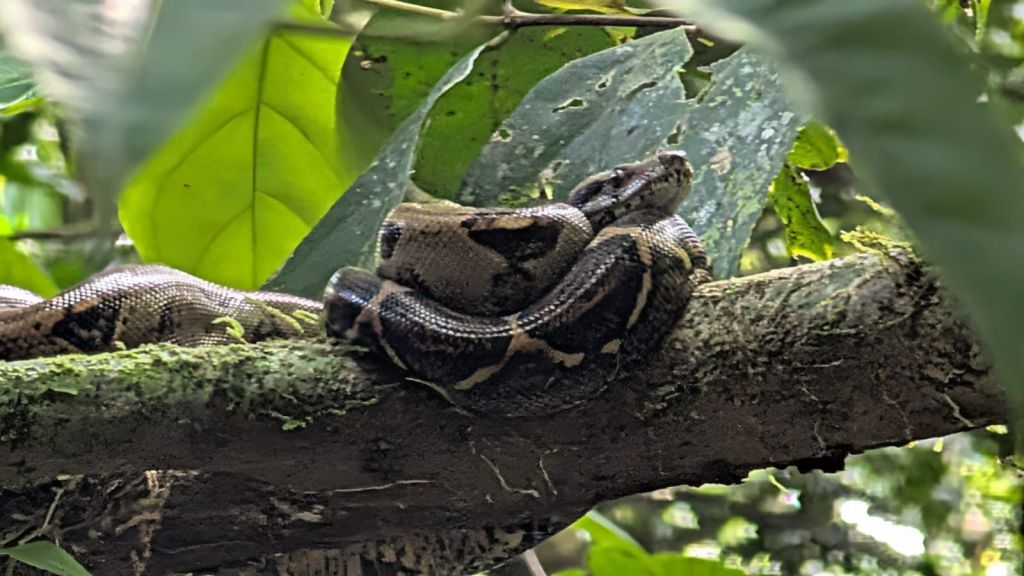
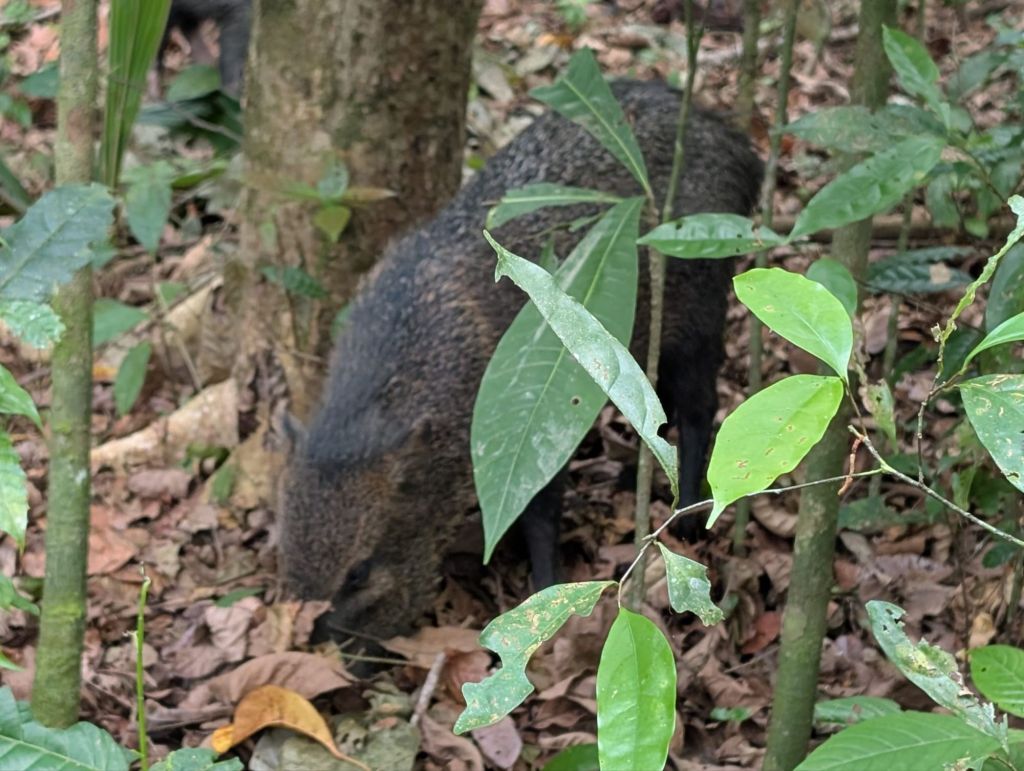
We also saw a variety of animals on the floor including agoutis, wild boar (native species), spotted wood quail, various types of hens, and many more. We saw a ‘baby’ Boa Constrictor, perched on a branch next to the path which was ‘only’ a meter long – we were jolly glad not to see a full size adult! I think we saw all of the four types of monkeys in Costa Rica (the Mantled Howler, the Capuchin, the Squirrel Monkey and Spider Monkey). The Howlers lived up to their names with loud calls which they get by having an internal reverberation system (a hole in the hyoid bone, which sits behind the vocal cords, which amplifies their calls 20 fold)
By 11am we were sweating buckets and tired, and Fraser took us along a path to the ranger station, where we were due to eat and spend the night. The arrangements here were “primative” to say the least. There were “showers”; cold water coming out of a pipe with no nossle. Hugely welcome nonetheless and extremely refreshing in the hot humid environment! The large bunk rooms could house up to 100 people overnight but were surprisingly comfortable, in the open air and each with its own mosquito net.
We had lunch, snoozed after our early start and then went out again at 2.30pm. The day trippers had left by then so we were down to just 4 people with Fraser, our guide – ourselves and a delightful honeymooning young couple from Boston. Myrthe was from the Netherlans but doing a PhD in the colon cancer centre at Harvard and David was a Brazilian/American working for a start up. We got to know them a bit over the couple of days and learned lots from them.
The small group meant we could go at a more leisurely pace, pausing to allow time for the animals to amble through the trees or on the forest floor and taking our time over the things we were interested in.
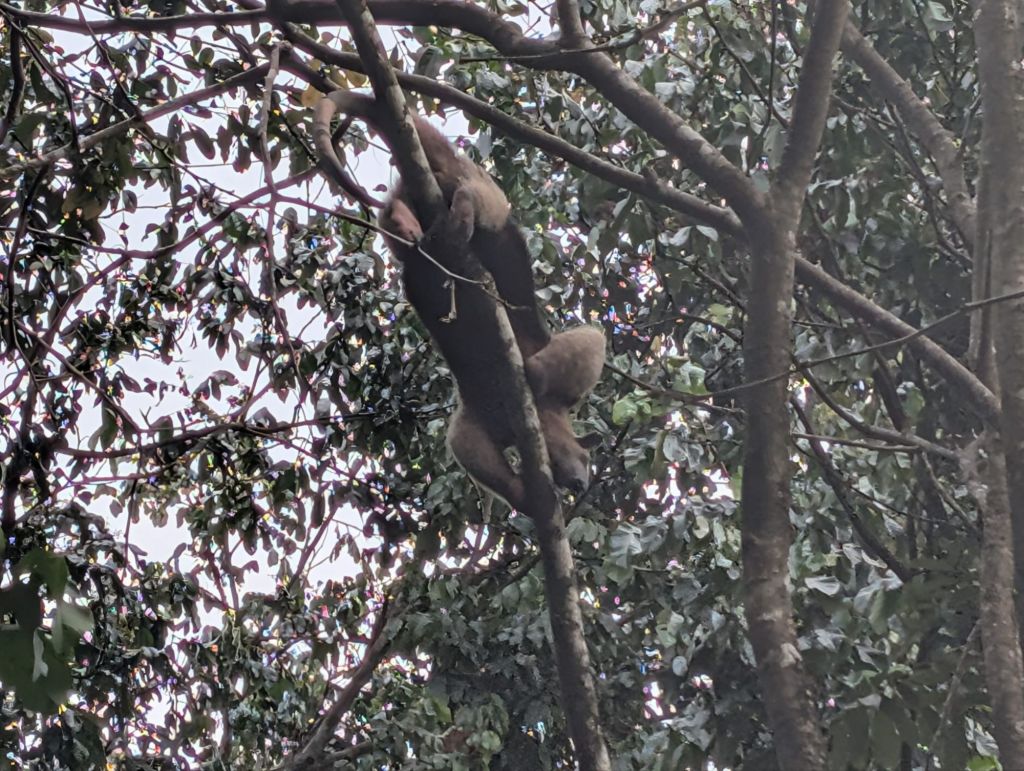
The highlight of the afternoon was following an anteater’s progress through the trees and then watching it descend to the floor. It was a beautiful creature, maybe a metre long, and totally at ease in the high trees, going from branch to branch. Then it elegantly descended, totally ignoring about 20 tourists who were following its progress with camera phones.
We watched the sun go down over the water and saw spoonbills and white ibis wading in the water and ‘formation flying’ from flocks of pelicans. Then we ambled back to the ranger station in the encircling gloom. Supper was ready when we got back and we were in bed by 7.30pm, with all the centre lights going out at 8.
The sense of lights out at 8 made sense as the first alarms in the bunk room started at 4am, with most people getting up in the next half hour. Coffee was available at 4.30 (at exhorbitant cost but we were happy to view this as a contribution to the work of the national park – and a necessary caffeine boost). At 5am we were off again with Fraser – this time in the dark. The four of us paced behind in the eirie forest, with the noise of the Howler’s echoing in the distance, following Frasers powerful torch beam. We were on the trail of the elusive Tapir – a shy, noturnal inhabitant of the forest. Our destination the river where we had ended the previous day, in the hope that we would see a Tapir coming down to drink. We arrived just as the first glimmers of light shone on the clouds. As it got lighter and ligher, more and more groups arrived, but we were all to be disappointed on this occasion as the Tapirs weren’t playing ball. In a ‘good’ week only 2 or 3 sightings are made so not altogether surprising. We tramped back to the lodge for a welcome breakfast.
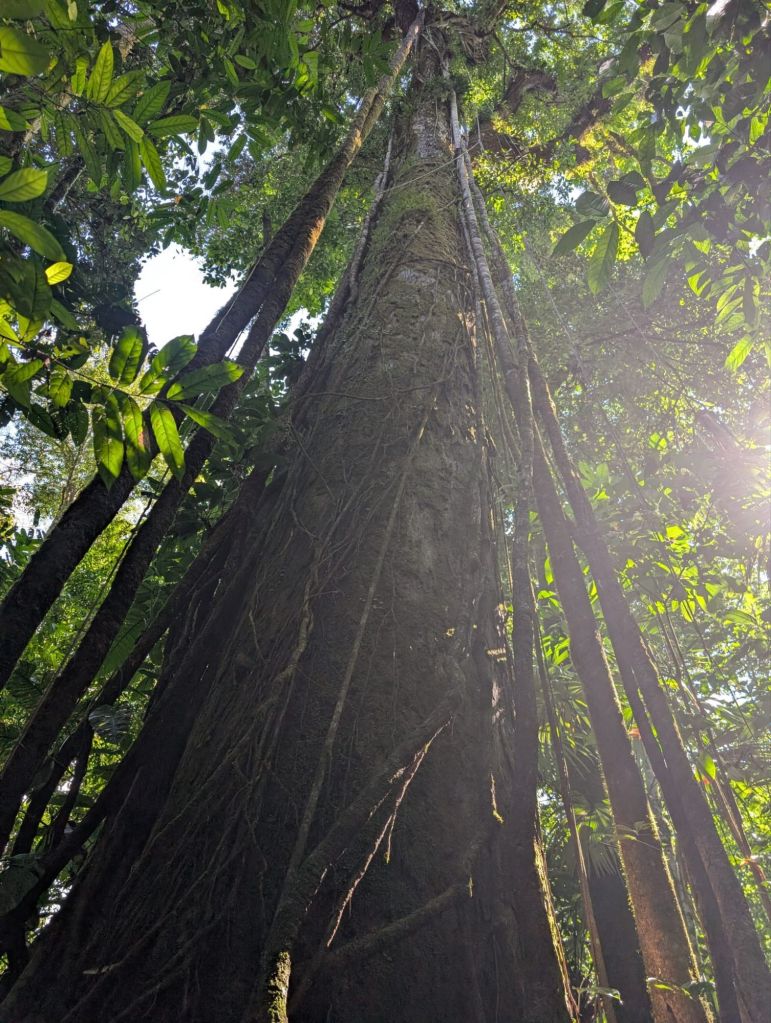
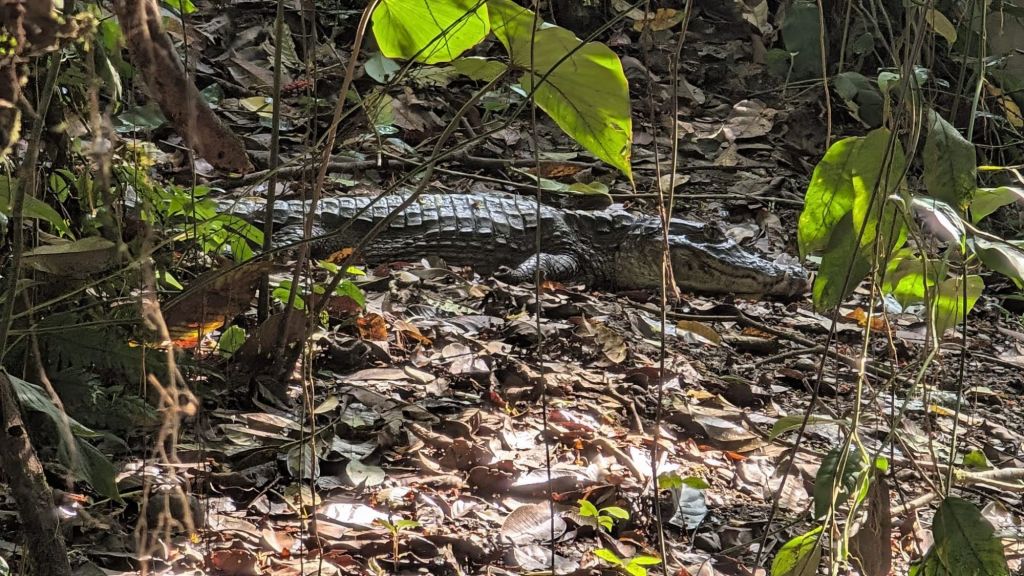
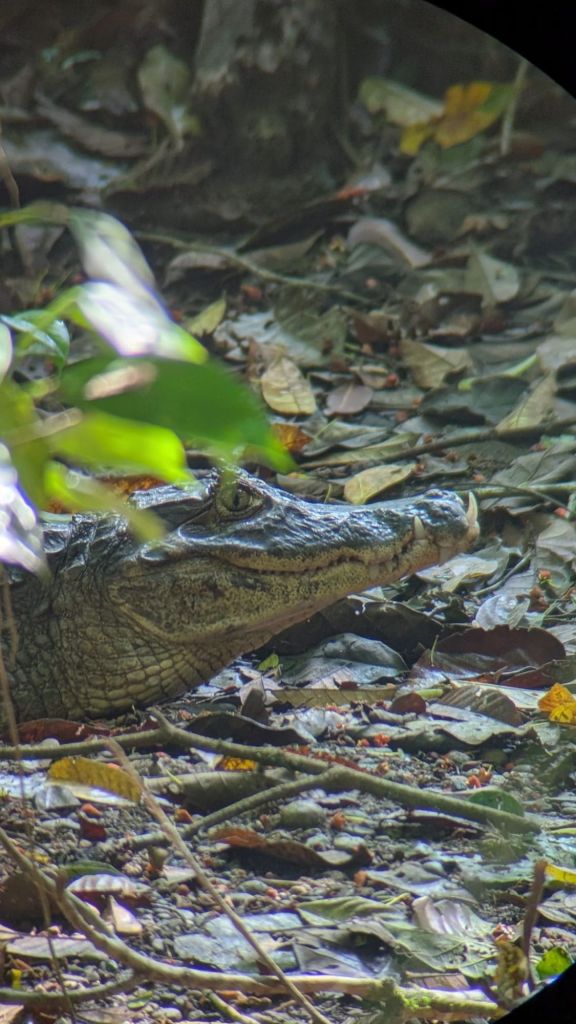
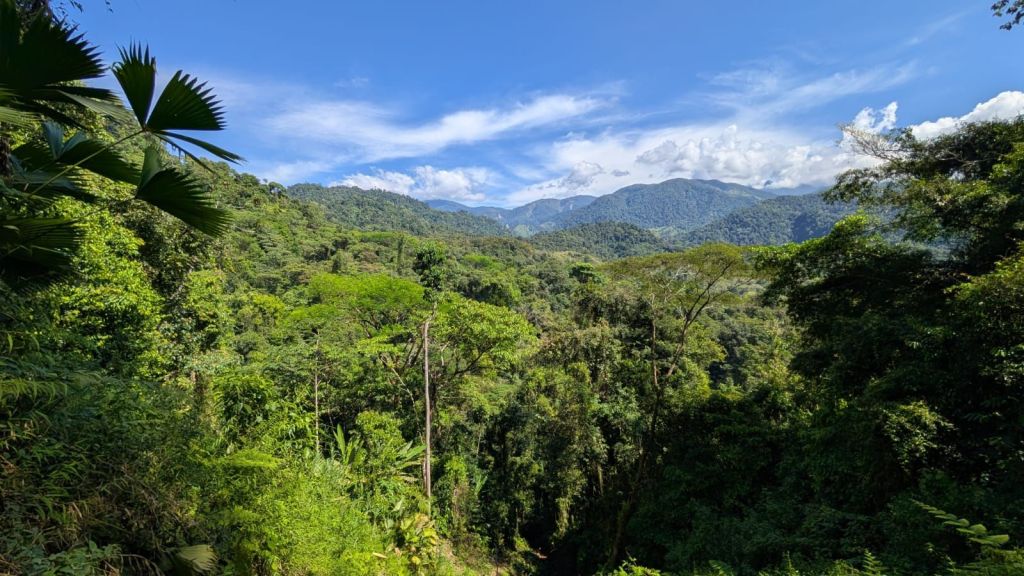
8.30 saw the start of the day’s main hike – this time in primary forest (ie forest that has never been cut down or planted by humans). This was much denser forest, with a huge variety of trees and other plants – and a very muddy trail. Near the start we watched a stationary Caiman – a “small” form of crocodile but still over a metre long. This is croc-country and swimming in the creeks is discouraged for obvious reasons.
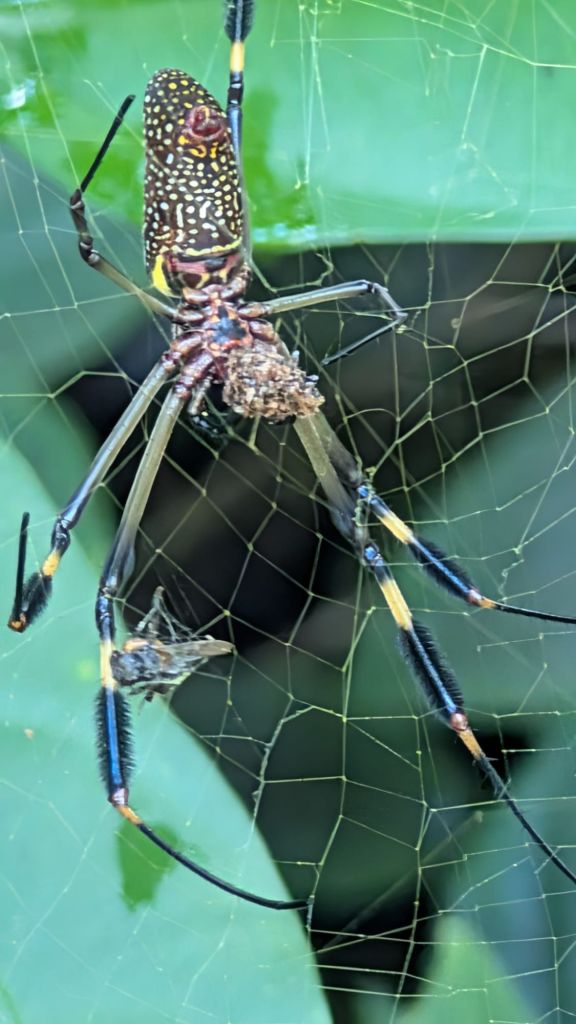
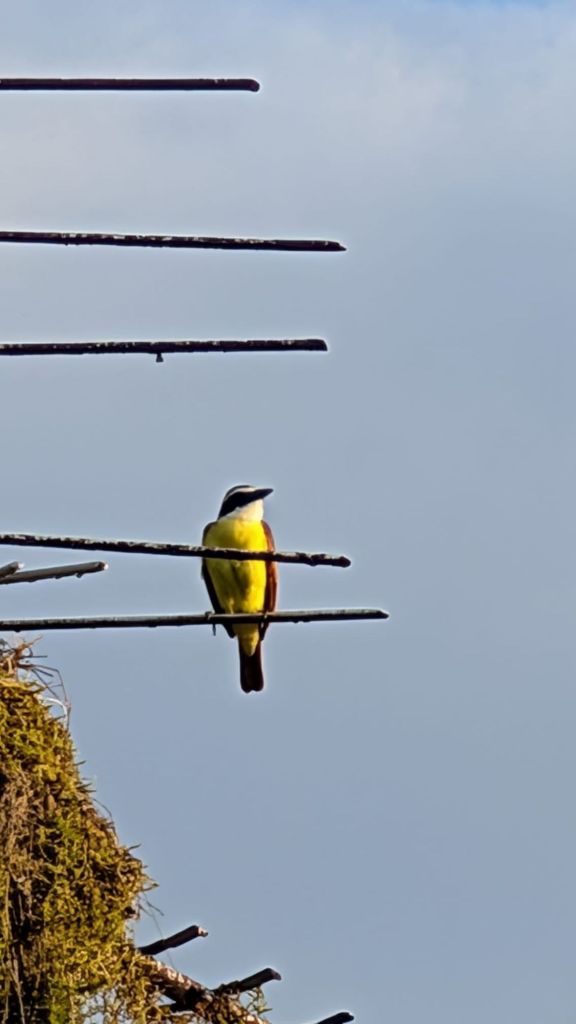
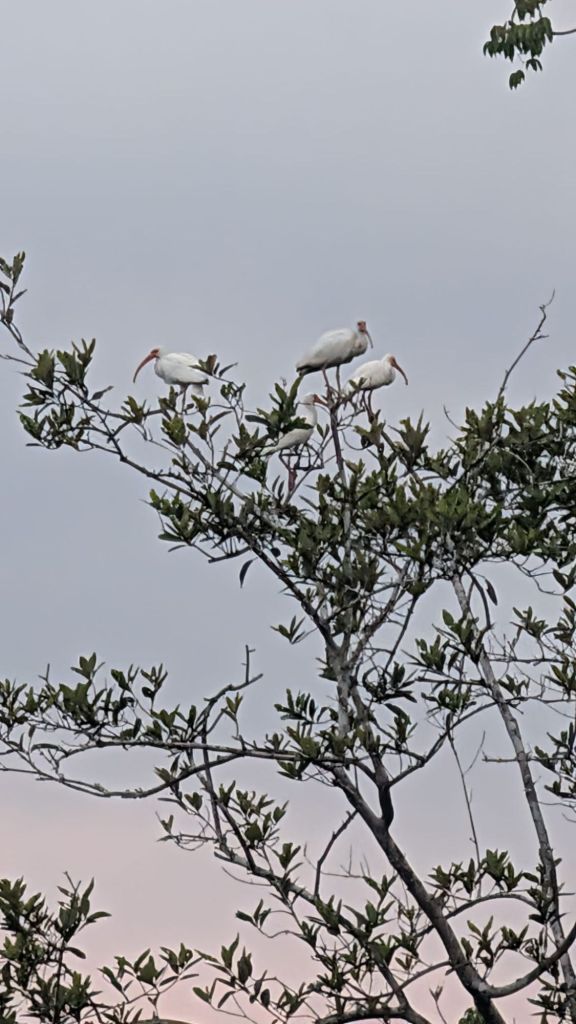
Wildlife sightings in primary forest are much less frequent because of the density of the flora but we still saw squirrel monkeys, several birds, including woodpeckers and hummingbirds, a beautiful golden orb spider on a web and a less beautiful tarantula deep within a hollow tree trunk (thank goodness). Fraser was a fount of knowledge about the vegetation and trees. In the secondary forest, the fast growing Ficus (Fig) species have grown into large trees over the 50 years sine the start of the national park but in the primary forest we saw 1000 year old Espavales trees – often entwinned with huge giant Ficus vines that were almost as old.
The end of the hike brought us back to the Lodge for a brief rest and to pick up the rest of the luggage before the short stroll back to the boats to take us out of the park. Just before we got there we had another view of an anteater high in the trees.
The scrum to get back on the boats was even worse than the arrival – all tour groups, from both Bahia Drake ad Puerto Jiminesz, are scheduled to leave at the same time. As the boats backed onto the shallows the different groups were trying to identify which boat they should be wading out to. In spite of the chaos, we all managed to clamber on to the right boat for the bouncy speed boat ride back to Puerto Jiminez.
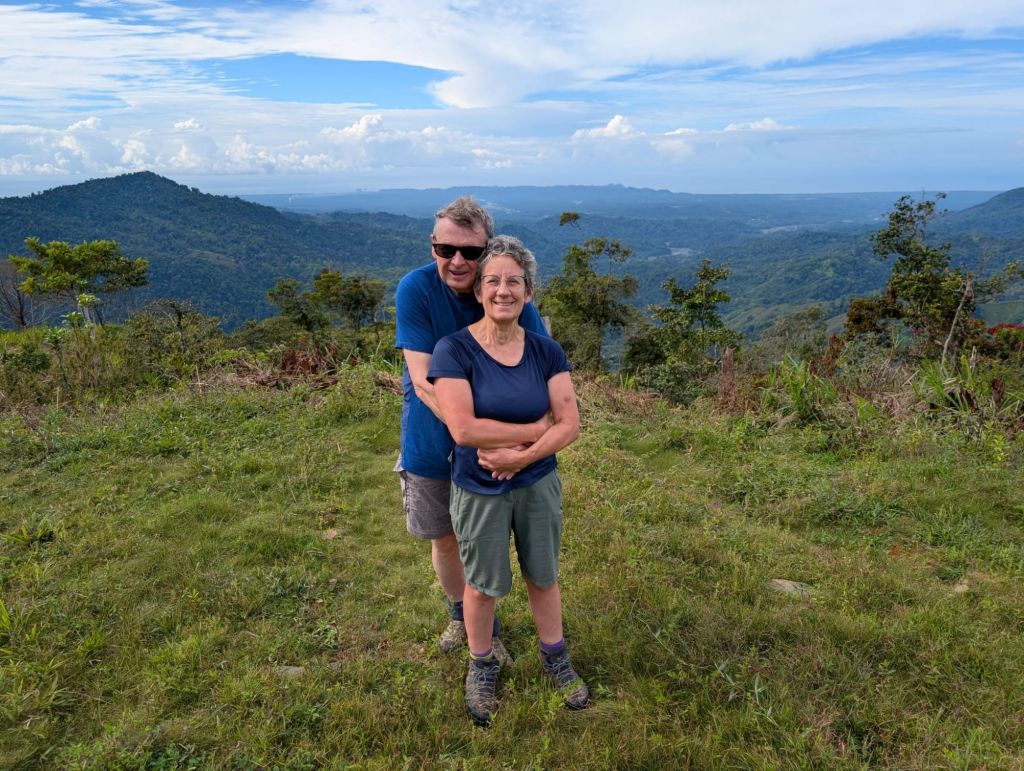
This was a couple of days that will stay in our memories for a very long time. We have proved to ourselves that we are not too old or soft to rough it (a bit) and the rewards are immense.









 The Slow Cycling Blog