Hi all. Bernie seems to be under the weather, so we have decided to get a bus to Hanoi over the next few days and get her back to full strength. No one need to be worried but, as this is a cycling blog and we are doing no cycling, we’ll take a break from posting for a few days.
More posts will follow when the bikes wheels start turning again.
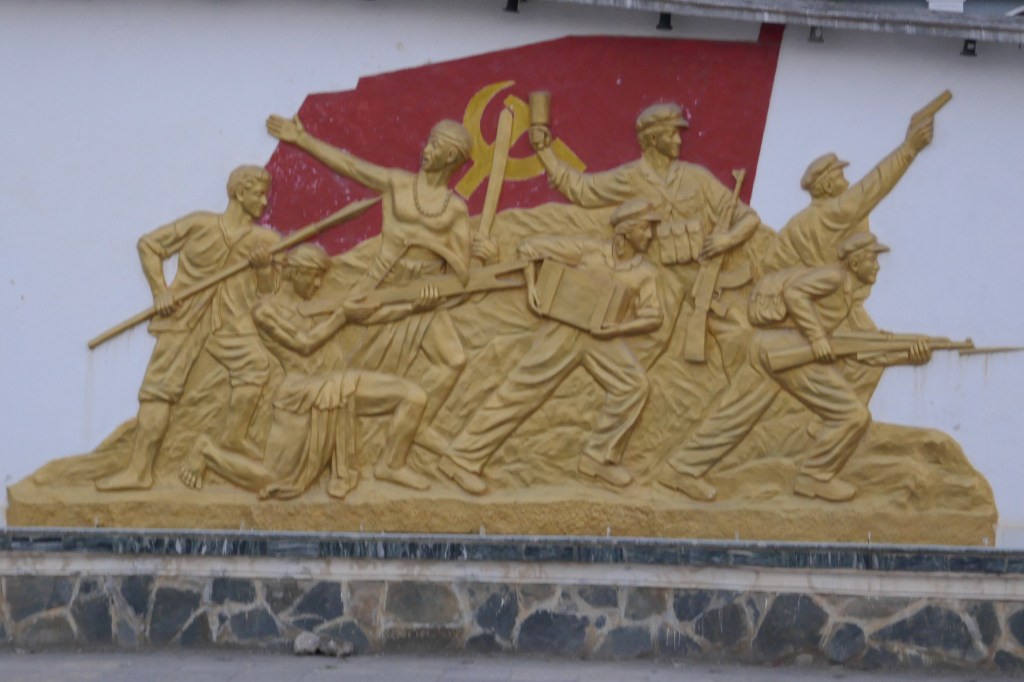
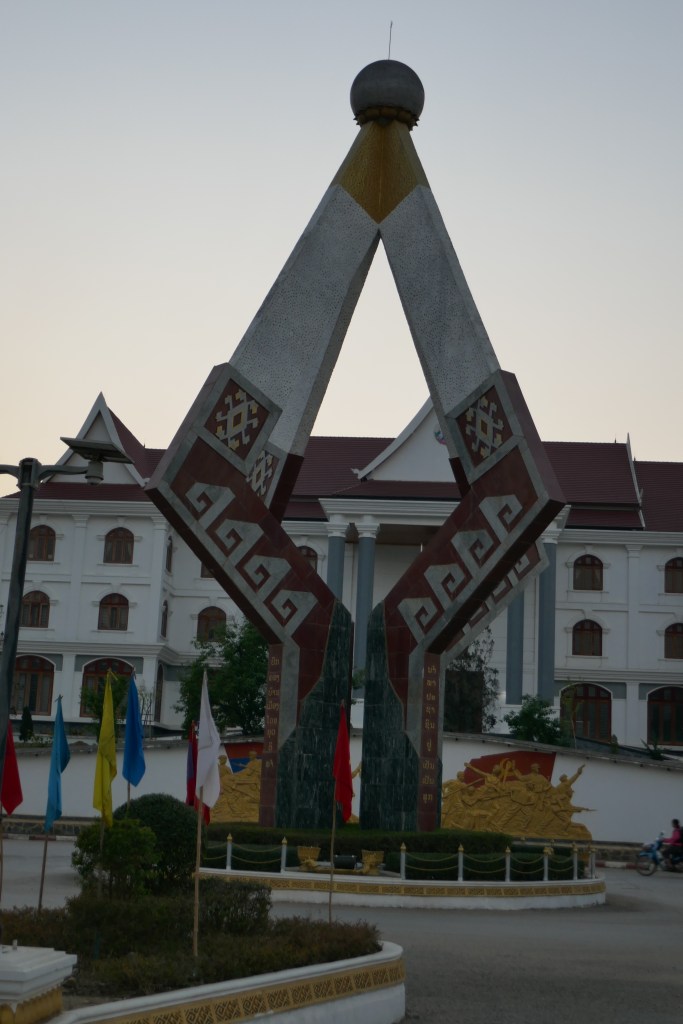
So we have reached Sam Nuea, just 80km from the Vietnam border. It is a town with a “soviet” feel to it with a monument to the victory in the last war (against the Amercians that ended in 1973). It is the last major place in Laos and we soon we hope to cross into Vietnam to start our third country on this tour of South East Asian countries. And then, after visiting Hanoi, start to work our way south towards Ho Chi Minh City. After that it will be a flight home and back to Shropshire for the spring. That is still a month away but the time has flown by and it is weird to be thinking about the last leg of this amazing journey. But, to put it in perspective, we still have more than double the time people get for a 2 week holiday – so no complaints at all.
However, today is a chance to reflect on what we have seen and experienced over the last few weeks. So this is a blog with some reflections on Laos.
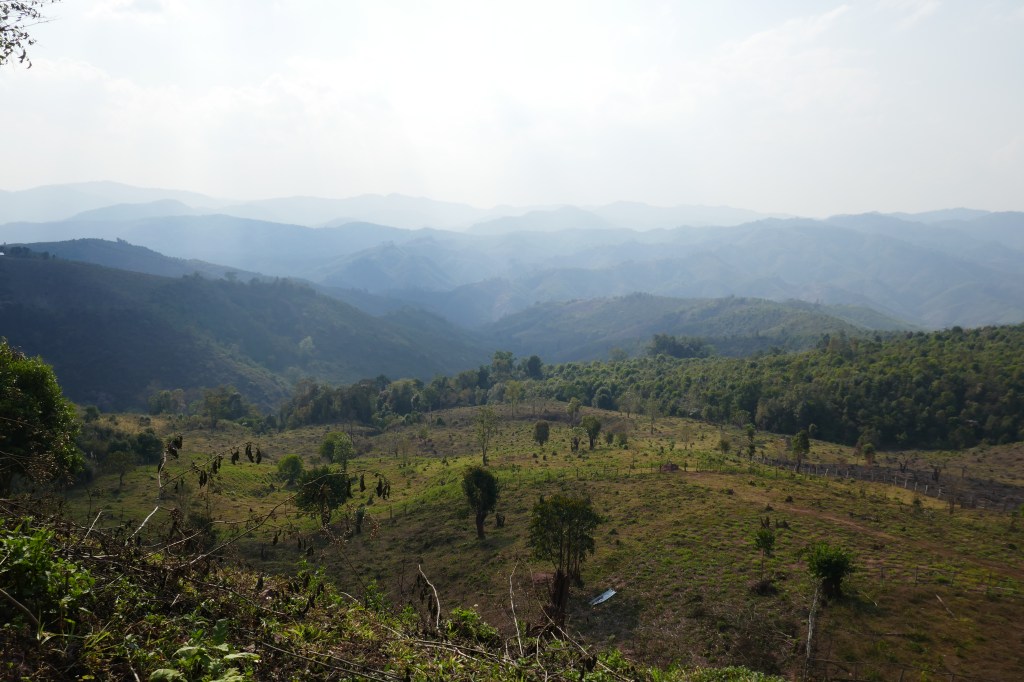
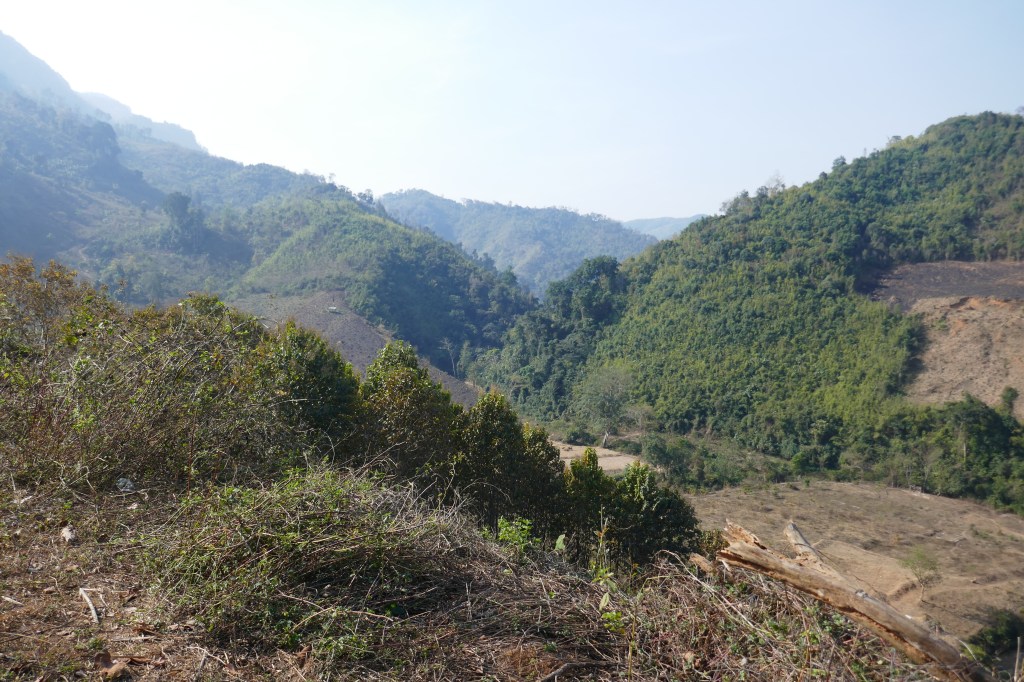
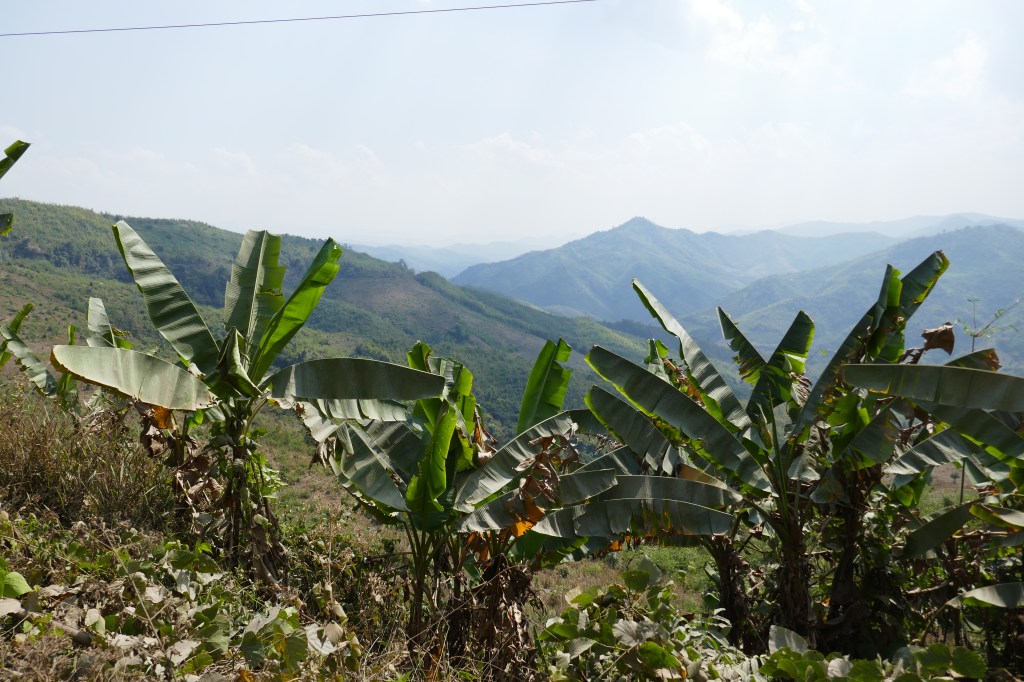
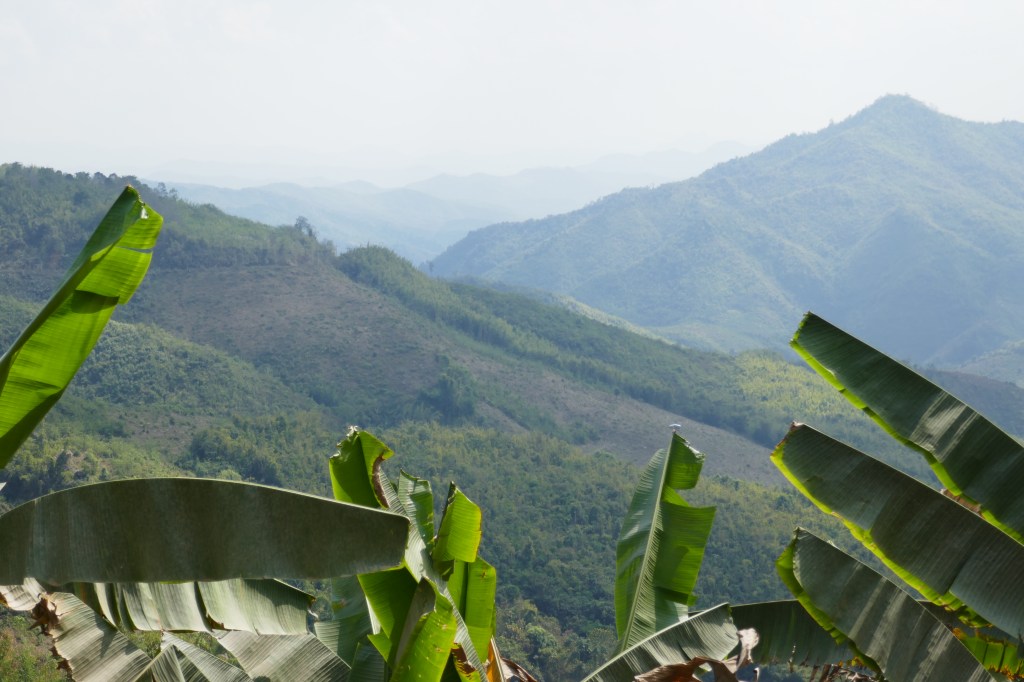
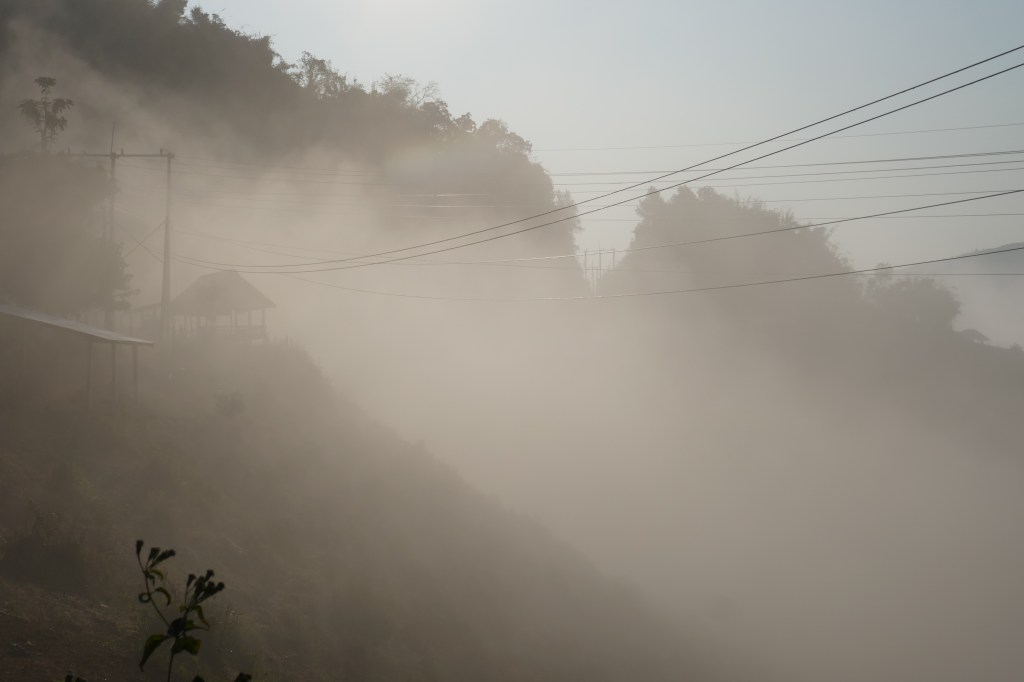
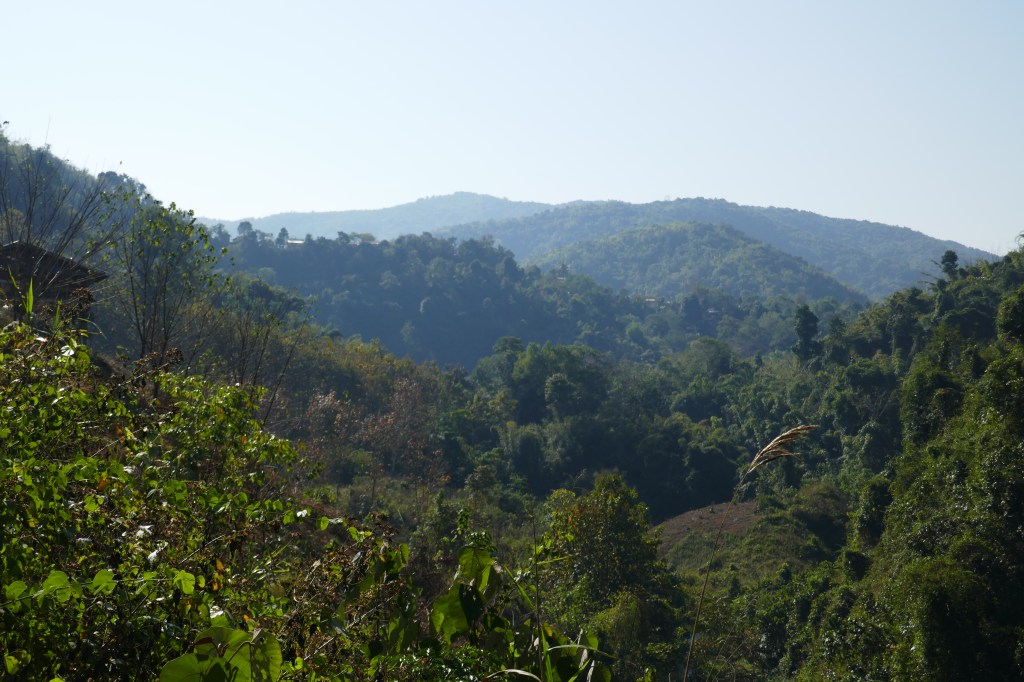
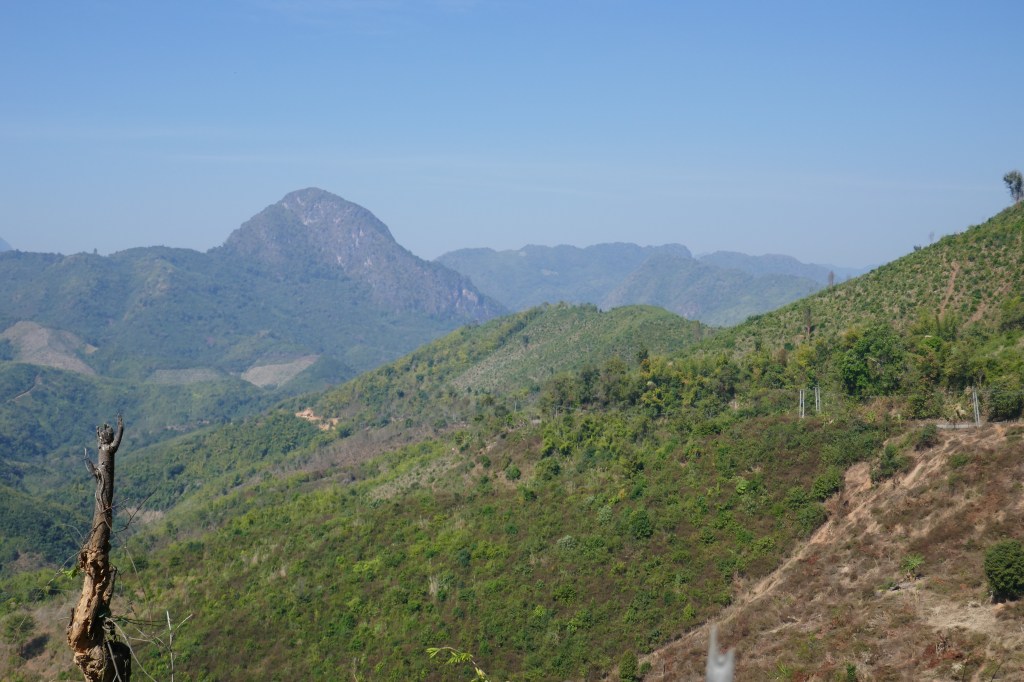
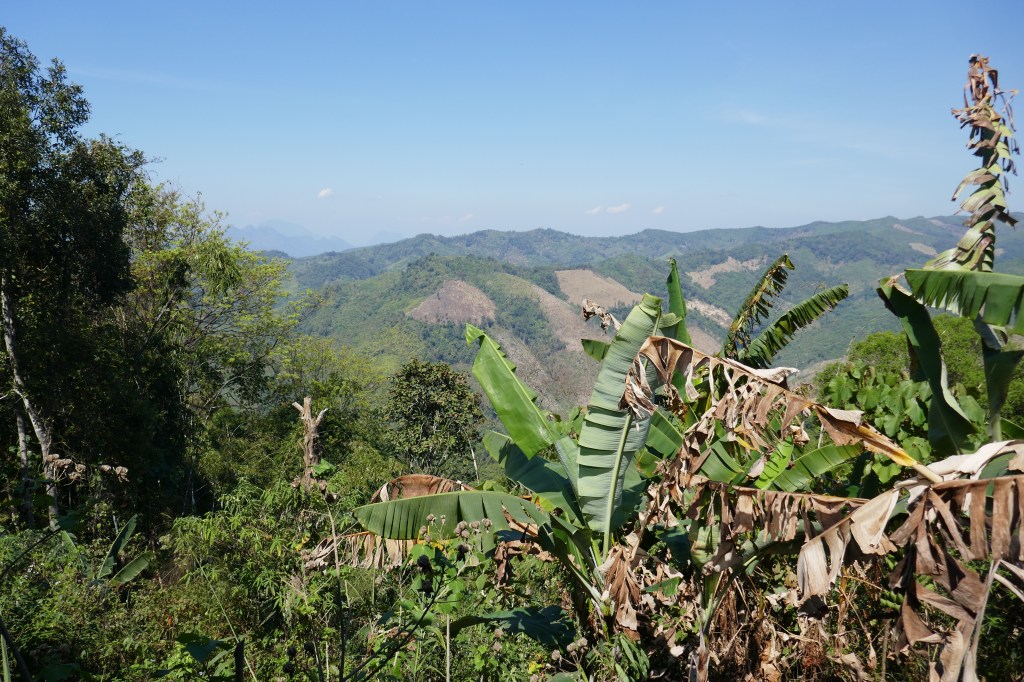
The bus journey today took us along a road we would have loved to cycle but the gradients and the remoteness were beyond us. The road followed a ridge with spectacular views on both sides. It would be unfair to the views to say it was “more of the same” mountain views but it was both fantastic and not that different to the mountainous views we have enjoyed over the past week or so. We passed two heavily laden touring cyclists on mountain bikes going slowly near the top of one of the climbs. They looked much younger than us and, although we both had a touch of envy (as it would have been a beautiful road to cycle), we felt that we made the right choice in bypassing yet another set of serious climbs on roads which were a toss up between tarmac and sand.
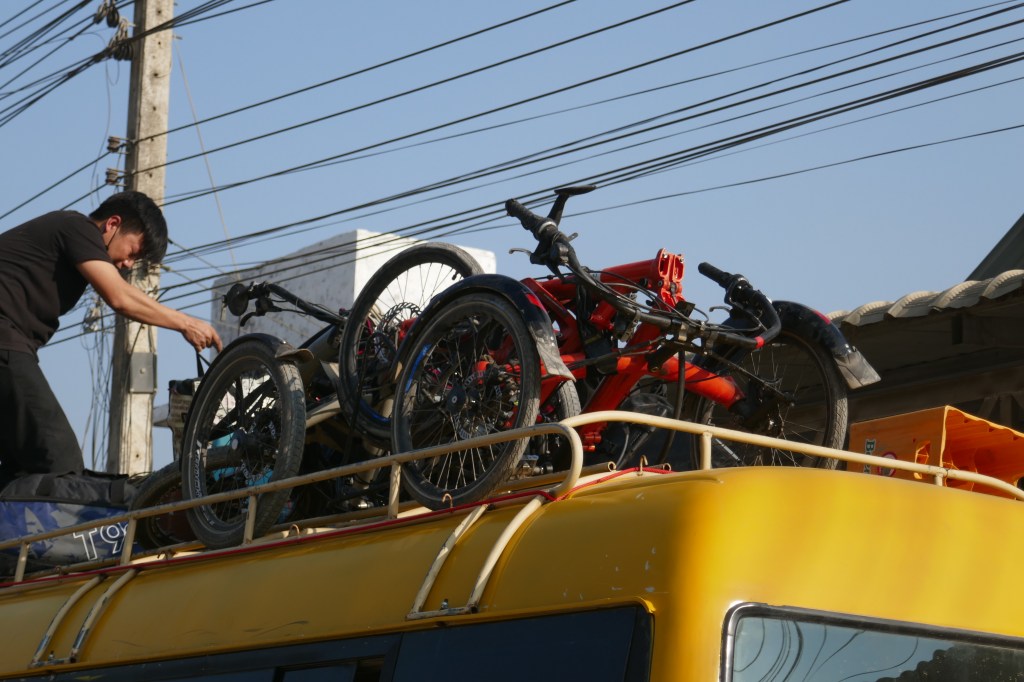
Getting the folded trike on to the bus
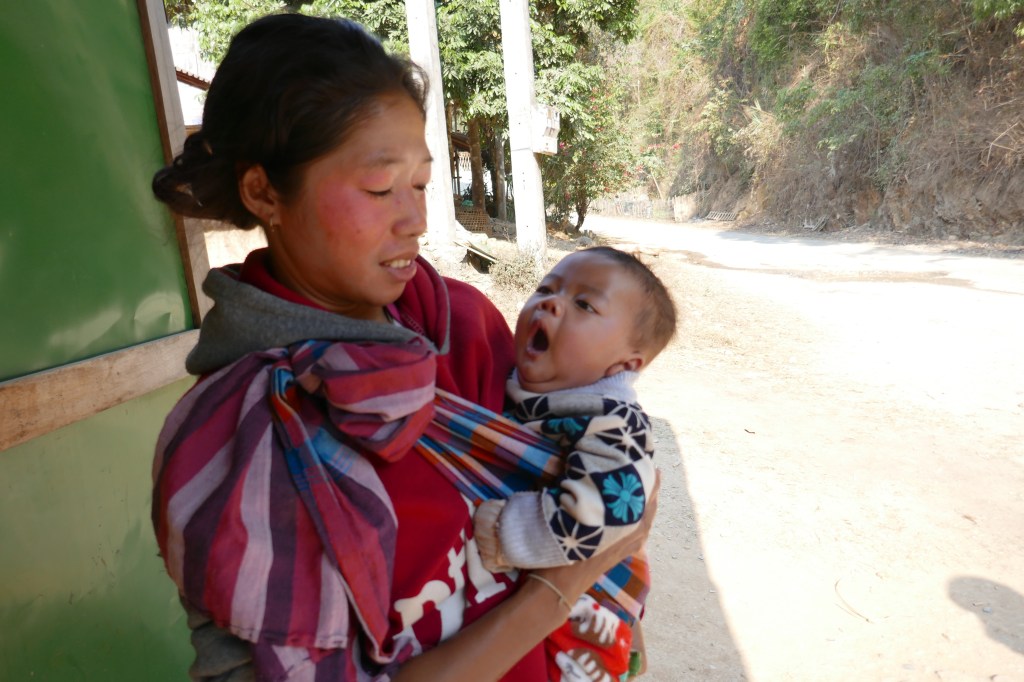
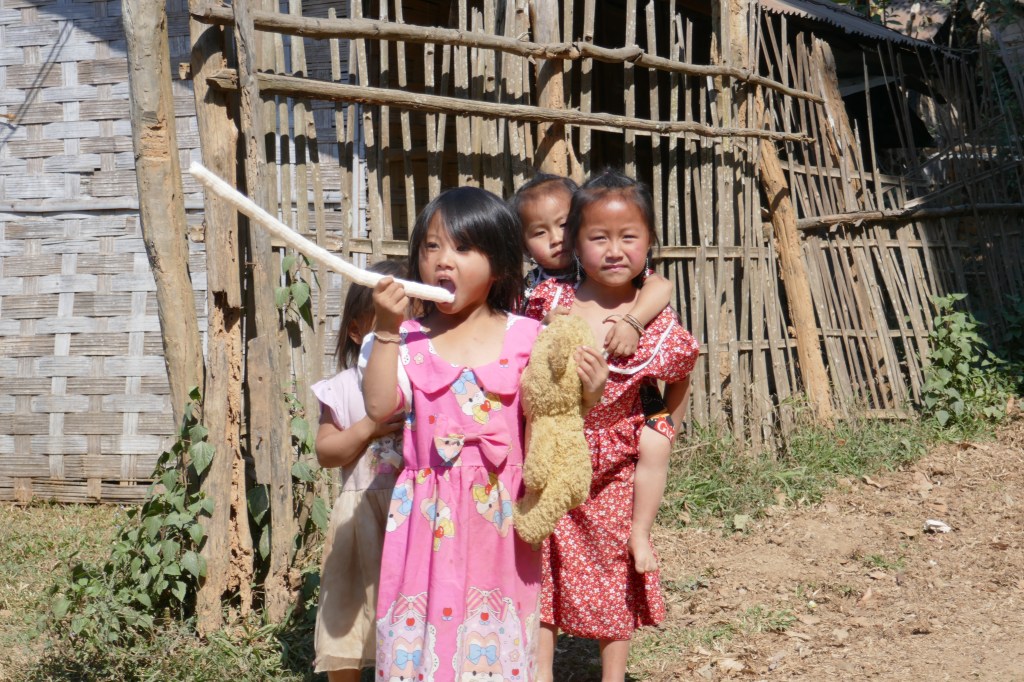
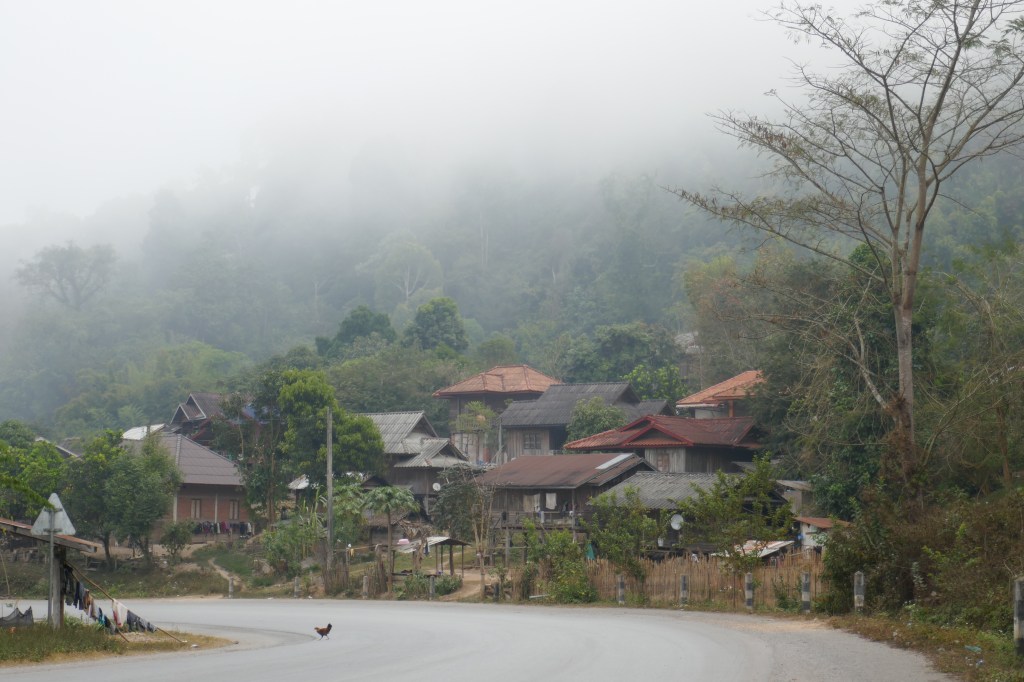
The road took us through a series of villages – with huge numbers of children on the side of the road. Life in Laos happens out in the open. It often seems the job of children under 10 to look after the babies – both boys and girls – as we saw young children with babies stapped to their backs. There also appears to be under-employment on display, with lots of adults sitting around, especially at this time of year. I suspect the countryside will spring into life in the wet season and everyone will be in the fields. But at this point in the annual cycle, there seems less to do and there is lots of sitting around open fires, at all times of the day.
Travelling through the mountainous jungle areas here shows up a tension between the needs of the growing population and the needs of the fragile jungle environment. Laos has about 7.5 million people, and the number is growing – by about 1.4% per year. In crude terms, the population is growing because, for 1000 people each year, 23 children are born and only 6 people die.
Although this is a poor country, its economy is said to be growing at about 7% a year and the number of people in poverty is slowly falling year by year. The Lao government claims 100% of people have access to electricity which may be a slight exaggeration, but power pylons followed every road we cycled taking electricity from village to village. However there is no system for waste disposal and the constant levels of discarded plastics are an obvious problem.
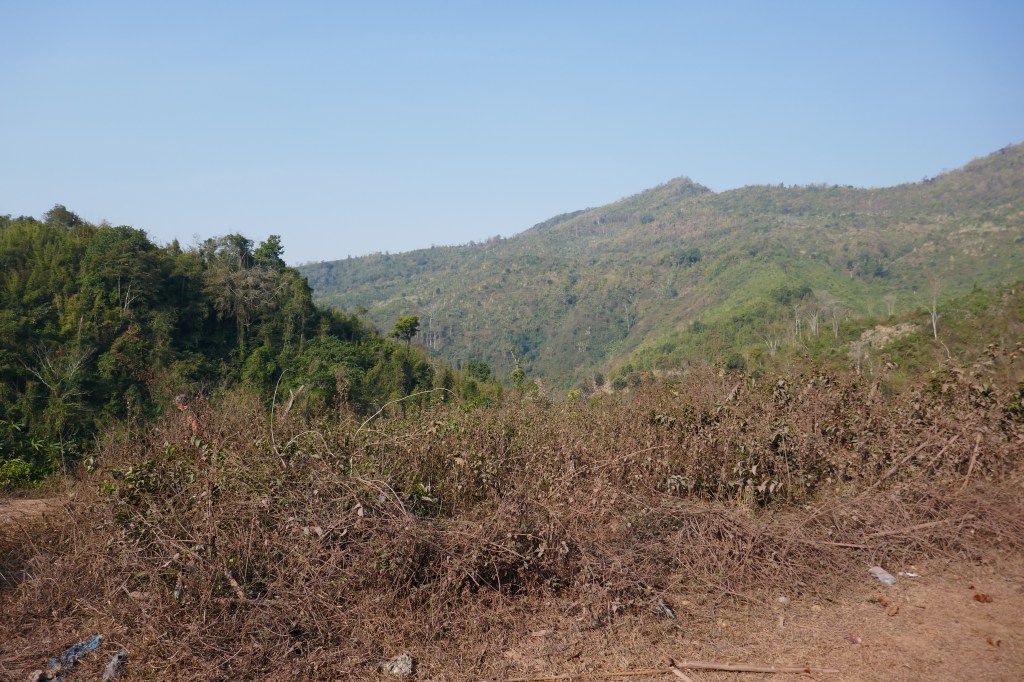
As we cycled we saw areas of the jungle being cut back to provide new farmland, probably to grow vegetables and fruit (mainly oranges and bananas). It was depressing to see columns of smoke as new areas of jungle were cleared. We wonder how much natural jungle will be left in future decades, but there are large national parks and their presence may be stopping localised deforestation in those areas. The jungle we have cycled through is home to a wide variety of species of birds and animals, and is also part of the earth’s lungs to counter effect global warming. But we suspect Laos gets only very limited benefits from the wider good that its forests deliver to the world. That is something where there are different perspectives in international climate change conferences, but it really comes home to us here.
Laos people are some of the most helpful, friendliest and most welcoming we have come across anywhere in the world. When they see our trikes, huge smiles spread across the faces of both children and adults. They may well be an element of them laughing “at” us, because what we are doing must seem utterly bizarre to them. I can imagine them thinking “Where is the engine?” or “Can’t they afford a motorbike?” But equally we are made very welcome cycling through their country, and there is an appreciation of the physical effort involved in cycling – lots of thumbs up and “very goods” called out to us as we pass.
Finally, a canine observation. Lao dogs are the most laid back and least territorial we have come across. Some lie in the road on hot tarmac and will not move for anything, so the traffic has to steer round them. Others amble around the villages as pets but none have been aggressive to us.
We will leave Laos with fond memories of a country with a tragic history of conflict, that is struggling to make progress and bring its people out of poverty but has enormous human, economic and environmental challenges ahead.
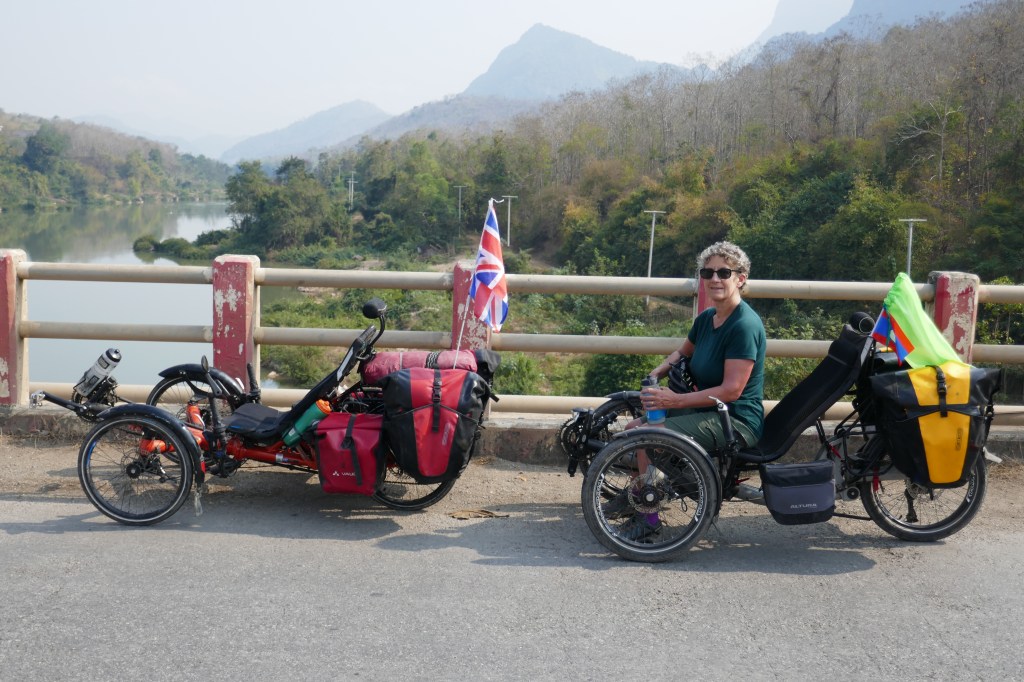
We set the alarm early as we knew this would be another big climbing day and set off into the foggy morning determined to pace ourselves. Unfortunately, in our final departure, we left David’s UK and EU flag behind. We only realised after 6km but could not afford to add another 12km to what would already be a long day so cut our losses and left it. We will try and replace it somewhere.
It was 20km to the start of the ‘big climb’ along the river valley. As with yesterday this was not flat but significantly undulating. We did 400m climbing and only gained about 50m elevation – it was hard not to resent every 30 or 40m downhill which we knew we would have to climb again.
However as we neared the end of the valley the scenery got more and more beautiful. The usual early morning fog had burnt off to another cloudless day. As the river we were following turned up one valley we turned into a new valley between the large rocky cliffs that are characteristic of the ‘karst’ mountains of the region. We had a 750m climb ahead of us and were relieved to get it started.
We have learnt much about the psychology of big mountain climbs over many years. Like so much sport, much of it is in the mindset. Particularly heavily laden for touring, we switch to a new mode where we spend much of the time in (or very near) bottom gear, often only going at 4-5km an hour. Once you have accepted that you are going at snail’s pace, there is something very calming about plodding up a mountain. The mind becomes tuned to the body and seems to clear of everything else. Hours can go by with hardly a thought, apart from thinking about the next significant point – 50m climbed or a 100m height gain.
This was a particularly enjoyable climb. The gradient by and large was not too great, the road surface (for Laos) was OK, The road was quiet with vehicles only about every 10 or 15 minutes (if that) and the landscape was beautiful with the narrow road winding up through tropical forest. This gave good shade, which combined with the steadily increasing elevation, kept us cool. So it was quite serene with just bird song and insects chirruping to accompany us.
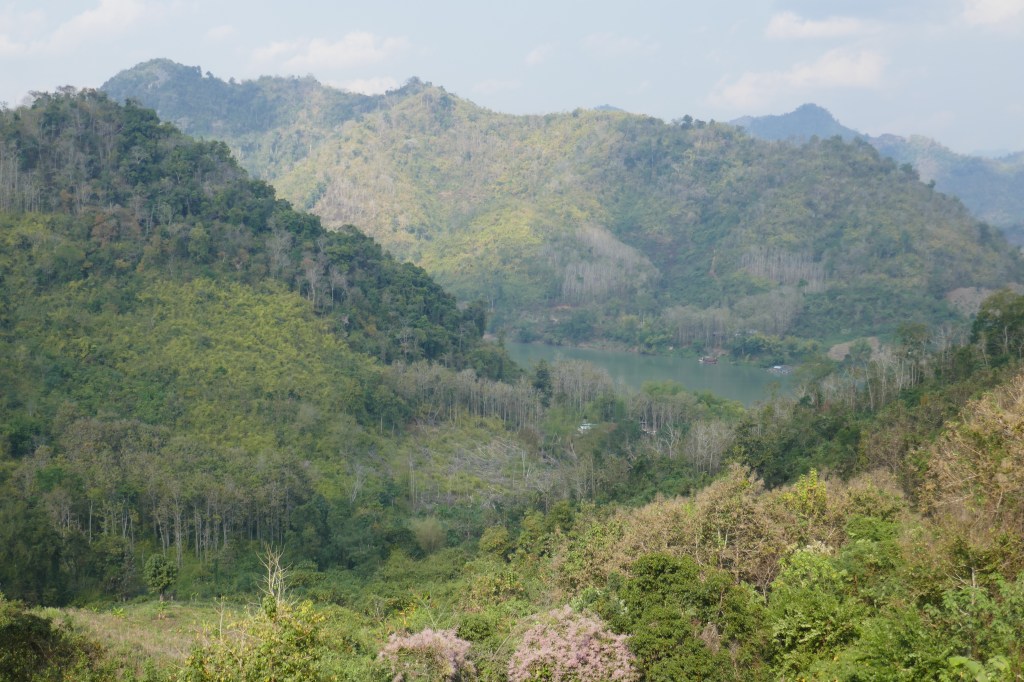
We reached the summit at about 1350m – the highest point of our trip so far. No views as such as we were in thick forest but amazing vegetation. We then descended 500m, crossed a river then into the next climb – another 250m. Legs were definitely tiring but we gritted out teeth and plodded up to a view that opened out onto layer upon layer of hills and mountains.
Then a lovely 12km descent – the best road surface we had had for days so we could swoop down to the town (but still need an eagle eye out for pot holes). We had completed 1450m climbing, the third day of 3 mammoth days. We felt pretty bloody fit but decided that this was probably enough for us so decided to get a bus tomorrow to rest our tired limbs.
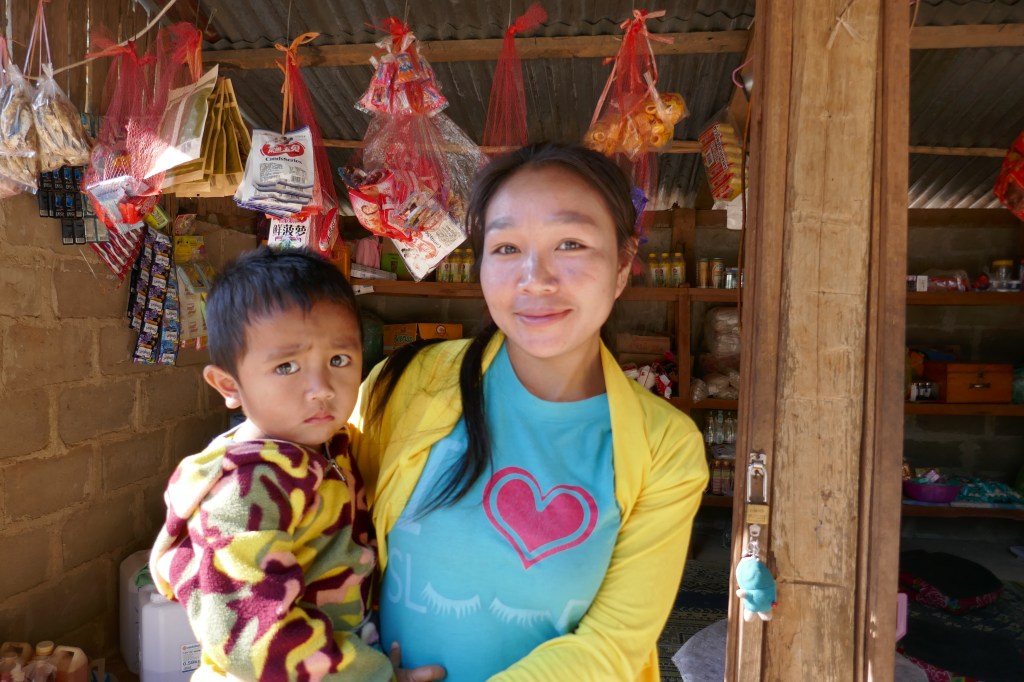
Young women with children will be one of our strongest memories of Laos.
There are days when the mileage and climbing figures for a bike tour tell a large part of the story of the day and days when they obscure the real events to the point of being nearly irrelevant. Today was one of the latter days when the stats tell only part of the story. 50km and we feel exhausted.
We woke early and were on the road by just after 7 because we knew we had a big climb to begin with and wanted to do it in the cool of the early morning. When we first started in Bangkok, a climb of 800m would have freaked us out but now it is pretty standard – it’s a mind game this cycling lark and our minds are moving towards accepting nearly anything the road throws at us.
It was misty, cool and not too steep as we climbed out of the valley. We managed 250m climbing in our first hour and felt pretty good (and would pay for our recklessness later). The sun emerged from the mist and the views were spectacular. We plodded on upwards, passing through villages of hill tribe folk – some greeted us with familiar Lao greetings or even saying “hello” or (more often) “goodbye”, and others used languages that we did not understand at all.
We reached the top of the climb about 10.30am, over 3 hours up and the time had flown by. We felt that the day was going OK, but we knew our main challenge was ahead of us – the sections of the road ahead which had no tarmac. Kamoot had advised us that there was a section of 10km without tarmac but Tino and Alice (who had cycled this in reverse) told that they were not counting but it felt more like 15km to them. They were being too kind as the section of road that substantially omitted tarmac was nearer to 20km.
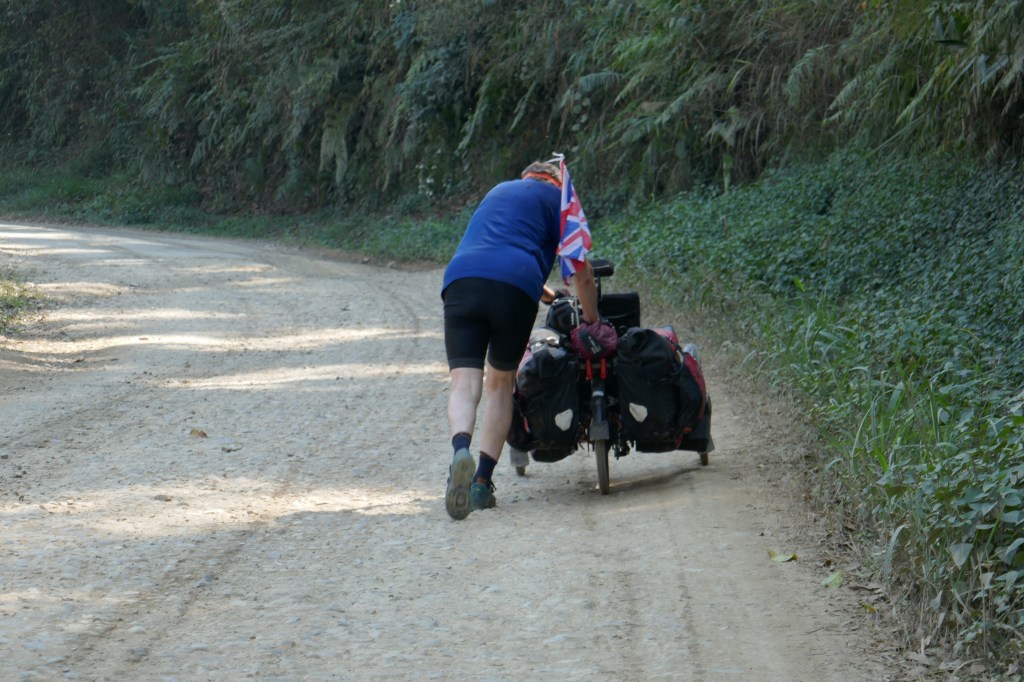
Riding trikes on a track without tarmac is difficult to describe but is an acquired skill – like enjoying hot curries or understanding compassionate conservatism (we are still working on that one). The surface ranges from hard sand (good), soft sand (bad) or soft sand and lots of rocks (bl***dy awful). I was super-mindful that my derailleur was at risk in this type of terrain and so we were ultra cautious with the trikes and we crept down the descent little faster than going up. It was slow, a bit tedious and scary. There were uphill sections where we got off and pushed as this saved the gear systems, but the sweat fell off us as we pushed loaded trikes uphill.
Fortunately, the route was more down than up which means we award mega brownie points to Tino and Alice who cycled this the other way, and so climbed on soft sand. We kept thinking that the non-paved section was coming to an end as we were seduced by a few hundred metres of tarmac, but then we went round a corner and hit long sections of sand and rocks again. The level of concentration that was required to navigate through the uneven ground, avoiding falling off or tipping the trike and yet continuing some form of momentum was considerable.
Pushing uphill to protect the derailleur
Eventually, after 20km of this hateful road, we reached a village which largely marked the end of the section where there was no proper road. I do not wish to speculate on why the local authority (assuming there are such bodies in Laos) responsible for this bit of road has so failed in its duties in preparing a road surface for everyone (including passing foreign touring cyclists but also cars and Chinese lorries)! The one advantage is that there were limited numbers of vehicles – the lorries teamed up in convoys and so we would be passed by 6 or 7 at once and then have an hour without them. It was just as well there were few vehicles as each one threw up vast amounts of dust. By the time we got to the bottom the trikes, panniers and both of us were caked in dust – but we were sort of proud of the fact we got through with few breakages (apart from the welded mudguard holder which did not quite make it through – another “Heath-Robinson” repair was needed.
The village at the end of the non-tarmac section had no functioning lunch outlet – we could have got beer and loud music, but not food (or so it seemed). So we pressed on and eventually cooked up noodles and eggs for ourselves. Bernie commented that, with all the eggs she is eating, she might look like an egg but that seems unlikely as days like this are thinning and transforming our bodies into something like 60 year old Love Island contestants – forgetting that that is a contradiction in terms (which brings us back to compassionate conservatism).
We looked at the maps online and expected a 10km stretch along the valley whilst the road followed the river to the next town which might have had a guest house or 16km to one on googlemaps. So we set off at about 3pm feeling that our tired limbs would soon be relaxing.
But – and there is always a “but” with this type of travelling – the map did not quite do the terrain justice. Instead of following the river, the road undulated up and down with a series of 50m climbs and descents that sapped our energy and challenged tired limbs (we should have set off less quickly and saved ourselves for later in the day).
There was no guest house in the village after 10km – so just an extra 6km but the final kick was that this section involved an unexpected 180m climb. So we struggled up watching the metres accumulate, thinking that we had a lot to do tomorrow and it was probably better to do this now than in the morning. Finally we arrived at the guest house and collapsed – no wifi but £4 for the night so who can complain. The room is just about wide enough to fit in a double bed but everything is very clean and the shower hot so we could finally get rid of the dust and dirt.
Overall a “memorable” day with fantastic views but maybe one we will not seek to repeat in a hurry.
Luckily David slept solidly through the night without any further stomach issues and so although he wasn’t feeling 100%, we were both keen to set off. I was feeling slightly nauseated but otherwise ok and we both managed to eat breakfast so we set off.
We were immediately into more stunning scenery, which distracted us from our ailments. It’s difficult to keep describing mountains in the early morning mist in different ways to how they look at other times, but they seemed even more beautiful at this time. The mist soon burnt off as we entered a narrow valley, following a tumbling stream and then we were into our major climb of the day. We do these climbs slowly but today we took it even slower as we knew we were only aiming for 50km and had this one 800m climb to do (although we had undulated over 200m climbing before even starting).
The road was spectacular as we climbed through wonderful scenery. We passed through villages clinging to the ridges, with the usual waves and smiles. We understand these villages are inhabited by different ethnic groups, but this was not obvious to us passing through. We navigated past piglets, cows, ducks, numerous children and a lot of pot holes.
At one point we passed a line of young men walked along the street of a village banging drums and cymbals, with one holding an animist symbol. Animism is a belief that natural objects like trees, hills or rocks are inhabited by spiritual entities with supernatural powers. Ancestor worship is also common in the highland tribes. A talaew is a bamboo star that is placed somewhere – often amongst growing crops, to ward off evil spirits. We had seen them in the rice fields on the walk yesterday and have seen them along the road, but these seemed a lot more elaborate than just a star but presumably do the same task. We didn’t know what this was about and although tempting to leap off the trike and take a photo, it was clearly a ceremony of some sort so did not seem appropriate (although they waived to us and gave us thumbs up from the procession).
The road was mostly quiet although there were occasional large Chinese lorries. We always tucked right into the side of the road when we heard them coming (and could see in our mirrors), even slightly off the road if we could. However we have no complaints as the drivers always gave us as wide a berth as possible. Bizarrely, later on near the summit, they were all parked up in a line on the road for no obvious reason (other than possibly all stopping for lunch). This was not a long stop as they all passed us again, going down the other side.
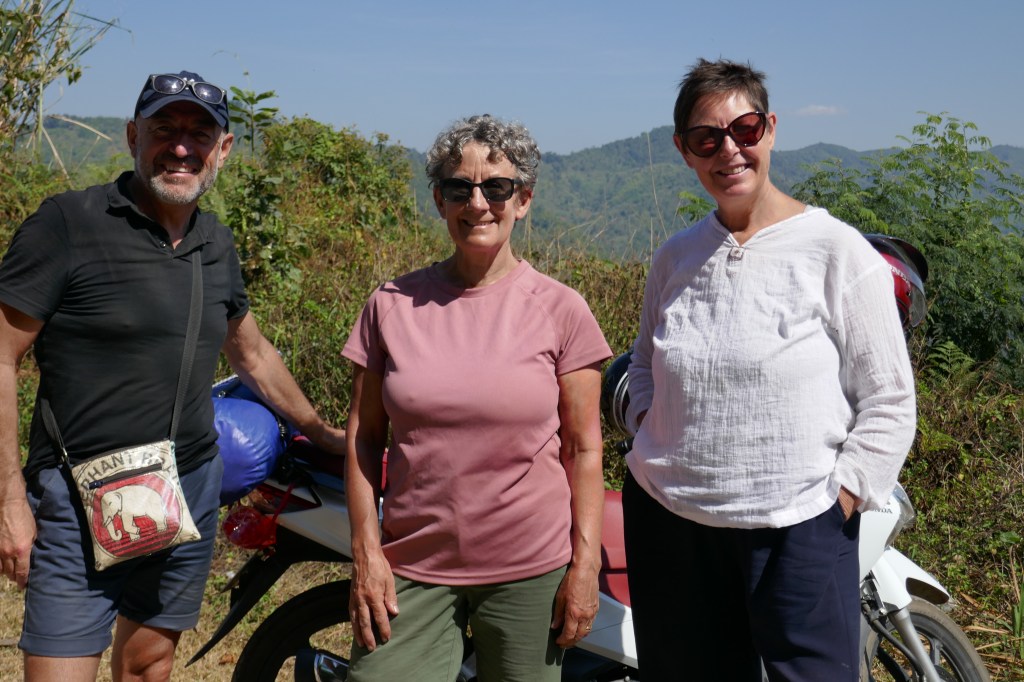
About two thirds of the way up we were assailed by a Scottish voice passing on a motorcycle and so of course we stopped. George and Julie were, we guess, about our age and were traveling around for several months on buses and rented motorbikes. They lived in Fleet, Hampshire, the place of my birth and the first 18 years of my life! We had a good chat but then left them as they went on upwards with the help of the motorbike and we were reliant on our legs. They said something very interesting – that they were travelling to provide a good example to their children about diversity in the world. I would not like to suggest our reasons for travelling are so altruistic but maybe a small point of this blog is to share some of the wonders we are fortunate enough to able to experience, and it may even tempt others to push their own boundaries. Onwards and upwards, finally reaching the summit about 4 hours after we started the climb (that did include a lot of stops, both the rest and savour the scenery).
We then had a 15km descent ahead of us but this was no whizzy descent. In Laos, the road surface is always unpredictable. This part of the route had lots of potholes and short stretches where there was no tarmac – and thus only stones and gravel. So the descent was very concentrated as we controlled the trikes carefully over the bumpy sections, still mindful of the previous broken derailleur. We were also in the hottest part of the day and soon lost the refreshing air at 1200m.
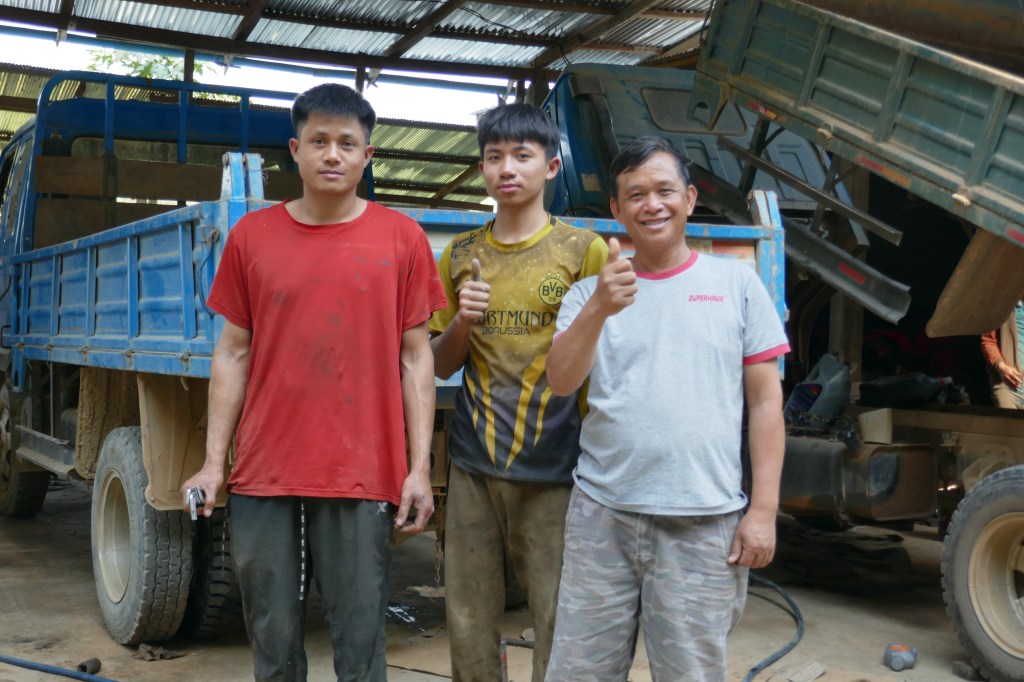
I had had problems with the spokes of my rear mudguard over the last few days. One spoke was held into its slot with red electrical tape but another one had sheared off completely at the base and was held together with reams of duck tape. The latter one pinged out again on the descent. At the bottom we passed a motor repair shop. We showed them the problem and a young mechanic very carefully welded and moulded the spoke back into position. While he was doing this the rest of the garage mechanics gathered round and studied the trikes. They seemed impressed that we had come over the hill but I also think they thought we were a bit mad – but maybe that is a feature of travellers from afar! When the repair was complete we asked how much and were told 10,000 kip – around 50 pence. We gave him 15,000, still less than £1 but he seemed very happy with the tip.
Then we followed the road for the last few kilometers into the town. There is rarely fresh fruit or vegetables in the grocery shops but the market in the town was still going so we got eggs and lovely fresh cauliflower and coriander which David transformed into a delicious egg and cauli curry later on. We both proved to be hungry and finished it all so hopefully all will be back to normal tomorrow.
Apologies for the late posting of this blog – when I would have been writing I was either in bed or vomitting and writing a blog seemed far too much like hard work. But more of that in a moment.
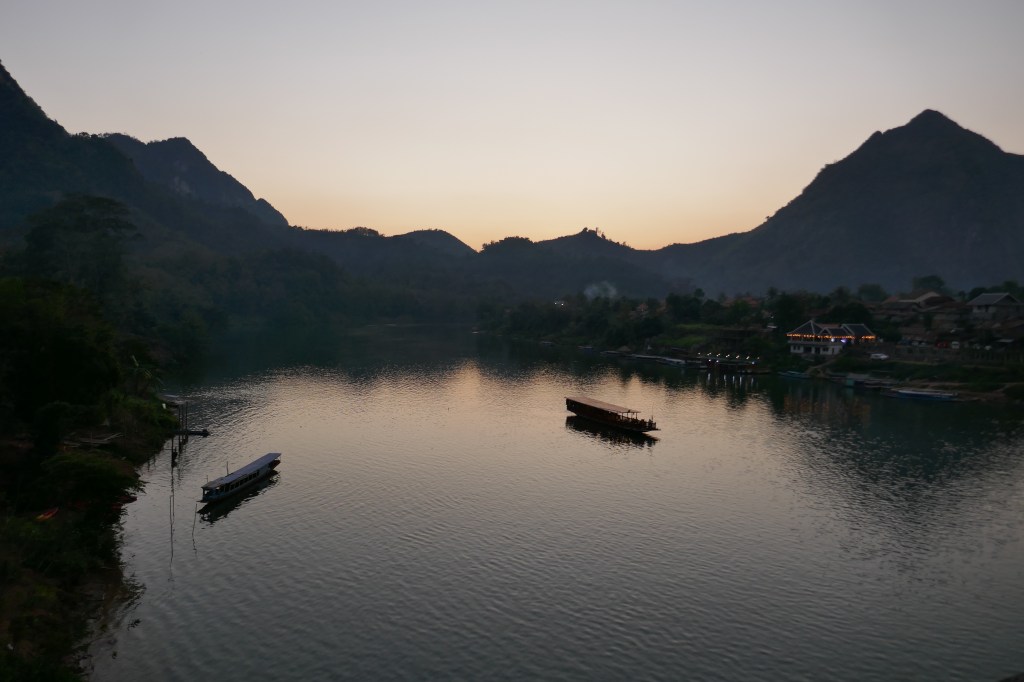
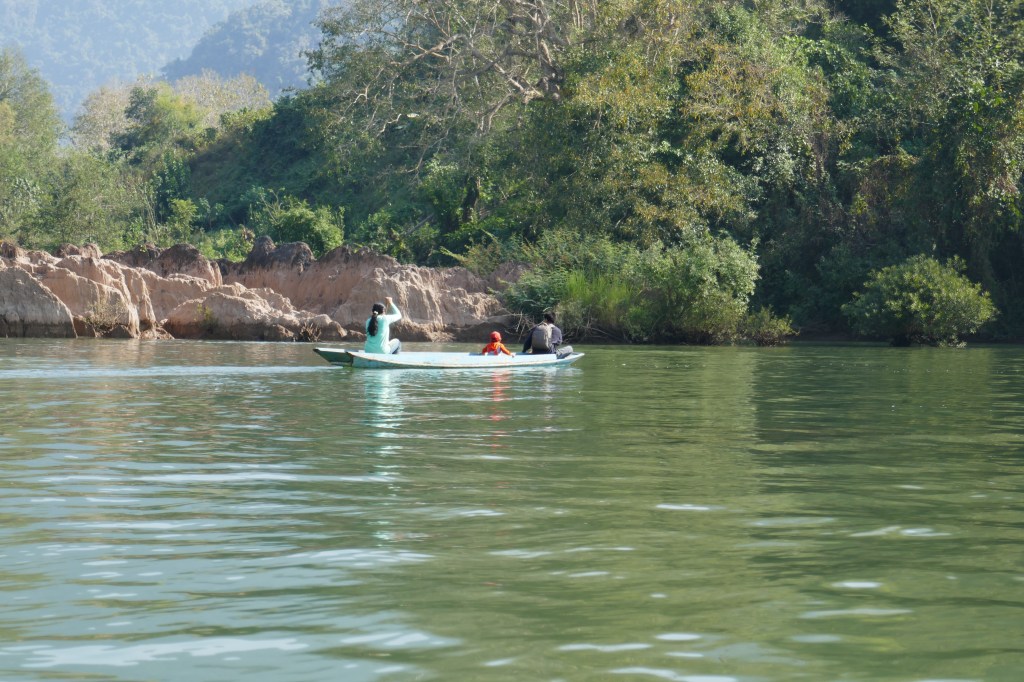
We had booked a day trip with Tiger Travel which started with a boat ride up the Nam Ou river to a small village, Muang Ngoy. Nong Khiaw is only a small place but it has hit it big with back-packing tourists because of its spectacular location and there were loads and loads of Europeans who were taking in Nong Khiaw whilst travelling through South East Asia. We felt older than the vast majority of them, note the absence of signs of an alternative lifestyle such as multiple tattoos or multiple rucksacks and were significantly shorter than most of them. That is not to give us an inferiority complex but just to say that, as a couple in our 60s, we sort of stuck out as short, “tatless” and staid (must be our floppy hats but we did eschew socks with sandles this time). We only notice this when we are in a crowd of other travellers, which is pretty rare to be honest.
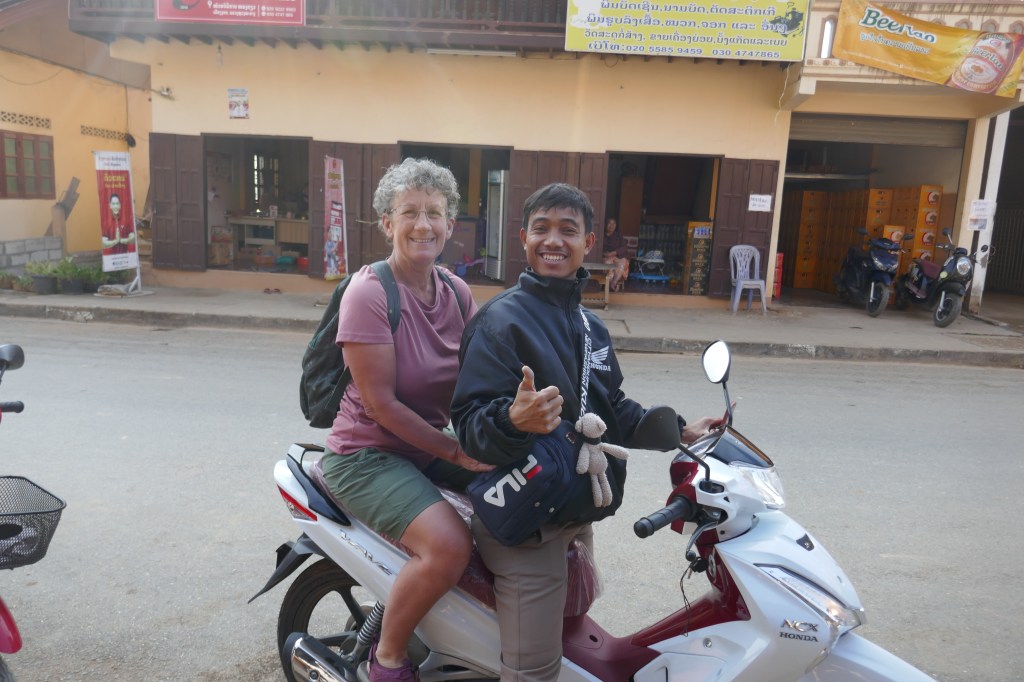
Bernie being driven off to the boat – on the back of a motorbike and no helmet – when in Rome!
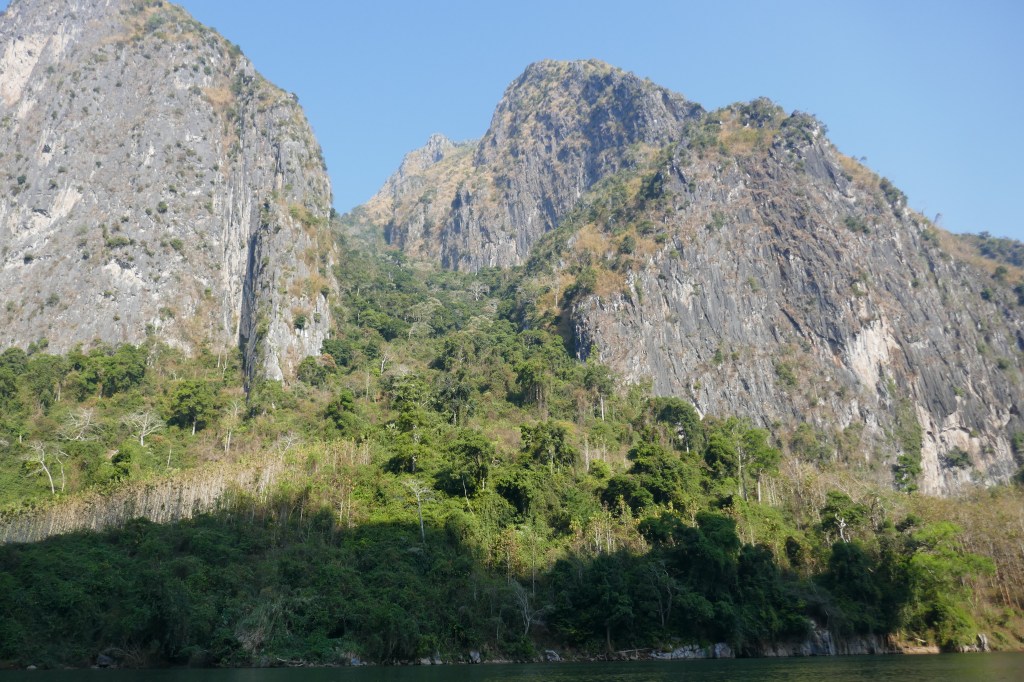
The boat was long and thin (one person wide) and the engine noise made conversation limited; but the scenery was lovely. High cliffs to begin with then some farmland next to the river including buffalos cooling off in the water.
After an hour and a half we reached the village and went a little further to a landing stage where we disembarked to start climbing up to a cave and view point. We reached the cave after about 10 minutes, took our our head torches and entered. It had a tiny entrance but then expanded out to a long, thin cave system which was about 250m in depth. This was one of the many caves that villagers used to live in during the bombing raids carried out by the US military (and not officially acknowledged at the time) during the years 1967 to 1973. I am reading Max Hastings’ book on the Vietnam War which details how the USA dropped more bombs on Laos than were used in the whole of the second world war – all in a pretty futile attempt to stop the Viet Cong supply lines from China. There is still unexploded ordnance in the jungles and so leaving the path is inadvisable (to say the least). It was an entire air war – no troops invaded – and yet it caused huge devastation in this beautiful country.
The cave was a cave – with cave features like stalactites and stalagmites. It also had a large boa constrictor snake that had taken up residence and was seen by others who had sharper eyes. But I am pleased to say we got out without being aware of the snake’s existence. Bernie, in particular, would not have been too pleased to know that she was sharing a thin cave with a large snake.
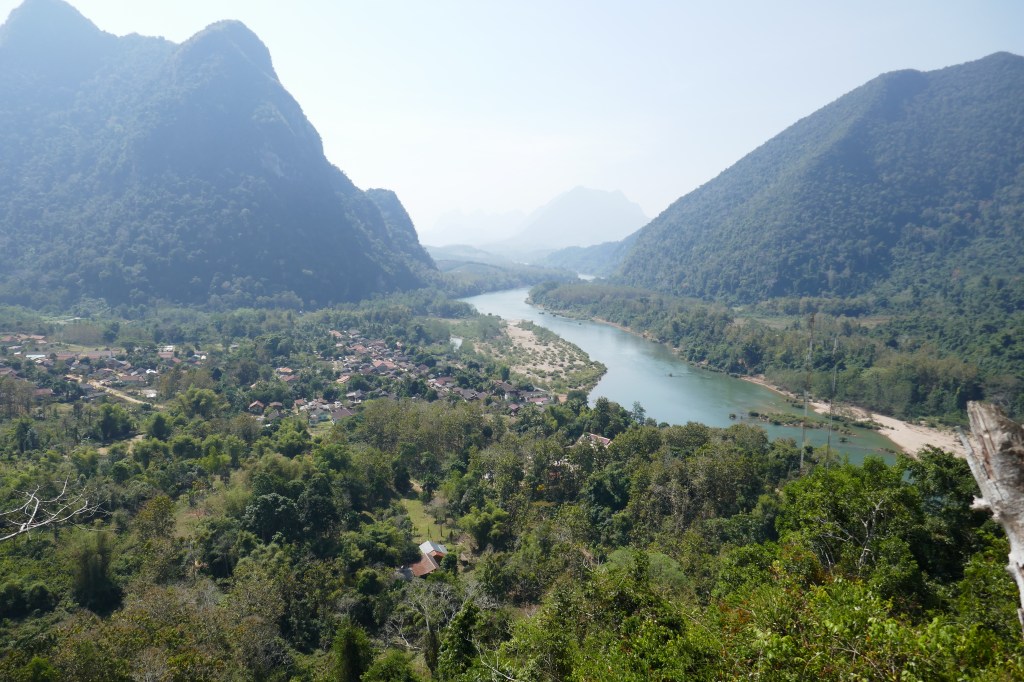
We then climbed up to the view point which overlooked the river valley. Having seen so many fantastic views from mountain roads in the past few weeks, we were not blown away by this.
On reflection – not too bad a view!
But it did give us the chance to meet a lovely couple from Canada where the woman was taking advantage of the 4 over 5 scheme, and travelling for a year with her husband (he got 6 months off) and 3 teenage/student children. Mention of this scheme brought us back to some people we met in Mexico in 1990 who were doing the same thing. Essentially, a Canadian public servant can opt for 80% of their pay (which is probably about 90% after tax) and has to work 4 years out of 5, and gets paid for the fifth year without the need to work. If the UK government wants a scheme which creates both motivation and retention, they could do no better than study the Canadian scheme.
The view point was crowded and there were giggling youngsters who were carrying on loud banter that was hugely sexual and seemed to have started at least the previous evening nd possibly had been going on for longer. Travelling and casual sex might be synonymous for some on the road, but perhaps there are others who don’t need to hear the details or the aftermath – especially on a viewpoint. Or maybe I was just being “Mr Curmudgeon” – something I am working on.
Next we descended to near the river, met up with our guide (who spoke Lao and French but not much English) and ambled into the village. This has had a lot of investment in recent years with brick houses replacing wooden shacks, mostly on the back of the tourist trade.
We were confused as to what was happening next as we thought we were going to walk to a waterfall, but we were led back into our little boat. There is an extent to which, on these trips, one just has to put oneself in the hands of the guide (on the basis they do this every day) and go with the flow – although we find that difficult at times as we are so used to organising our own time. The boat took us half way back to Nong Khiaw, but then we stopped at another small village, disembarked and understood that we could now walk to the waterfall. Just outside the village our guide produced “lunch” from his backpack – packs of rice with limited vegetables. These had been in his pack since the morning; getting hotter and hotter. We were hungry and had little choice so we consumed them – and both paid the price later.
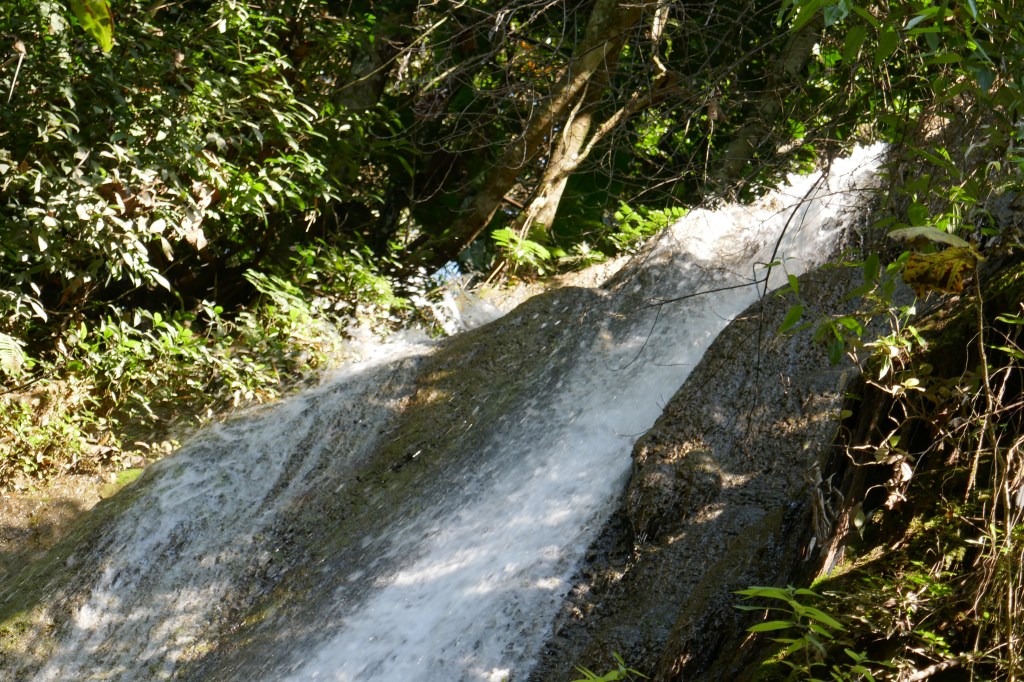
The walk to the Tad Mook waterfalls took us through some irrigated rice fields and past an organic farm. It was getting very hot and it was a relief to reach the shade of the final few hundred metres up to the waterfalls. They were also crowded but there was room to swim in the pool under the main waterfall, and we duly put our heads under the cascade and felt pummelled by the water.
The walk back down was easy and we were happy to sit in the boat to go back to Nong Khiaw. We turned down the chance to change to a kayak when offered because we both felt drained, and then found that there was no kayak on offer anyway (which was a shame for the other two in the group who wanted to paddle back to the town).
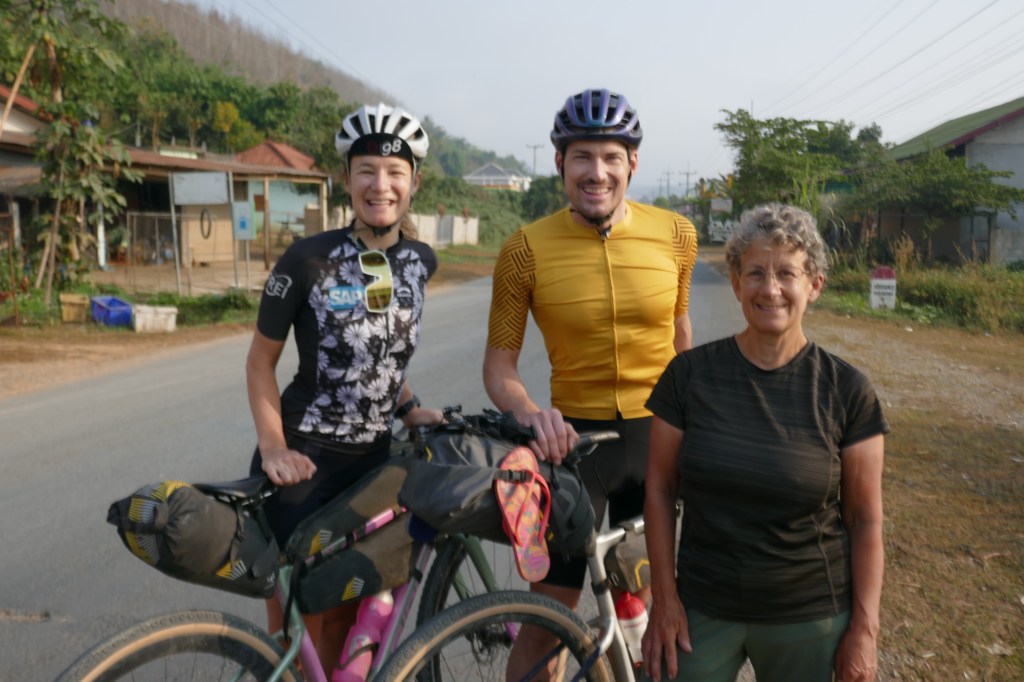
When we got back we made tea, and then crossed the bridge into town for provisions. In the distance I spied two touring cyclists who seemed to have come from the East – just where we were going tomorrow. So we busied ourselves across and introduced ourselves to Tino and Alice. They were from France and had started in Hanoi, and were heading to Bangkok. So we wanted to get information about the roads they had just travelled and they wanted the same from us. We agreed to meet a bit later after they had showered and eaten pizza – something Alice had decided she needed after a long day in the saddle and lots of climbing.
We went off to eat and, by chance, bumped into Adrien and Damian so they joined us. However, by this point, my world was starting to feel distinctly unstable and I doubted I could eat any of the food I had ordered. I excused myself and went back to the room, leaving Bernie to talk with our friends, although she was not feeling a great deal better than me. I am pretty confident that it was a bug from the lunchtime meal that had upset my stomach, and it duly all re-emerged. So I collapsed in bed and felt sorry for myself but it is an almost inevitable part of travelling in this part of the world so I had nothing to complain about.
Bernie went out to meet Tino and Alice and shared travelling tips and road conditions before coming back to collapse herself.
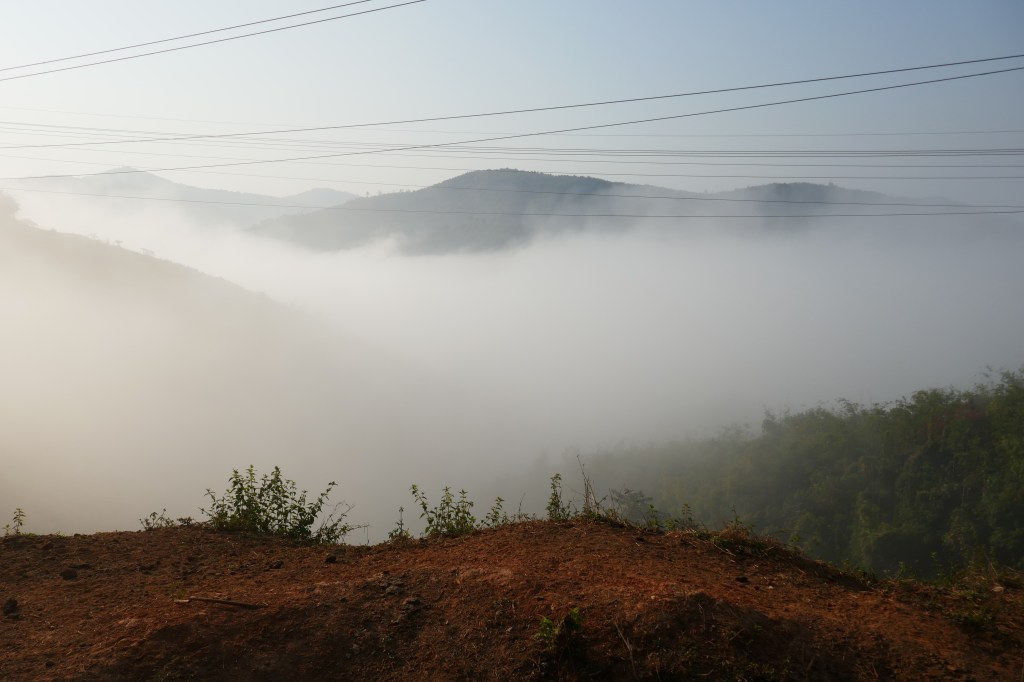
We woke and went through our usual routine of cooking porridge and filtering water as we readied ourselves for the road. And a crazy road it was to start off. The town was teeming with motorbikes, lorries, cars, school children, all wrapped in the thick fog of the morning. For 3 or 4 km we dodged and weaved through the traffic and around deep pot holes and disintigrating bits of road. We were glad of our front lights and flashing back lights in the fog – although most of the traffic could not be bothered with such things, even if they had lights they did not turn them on.
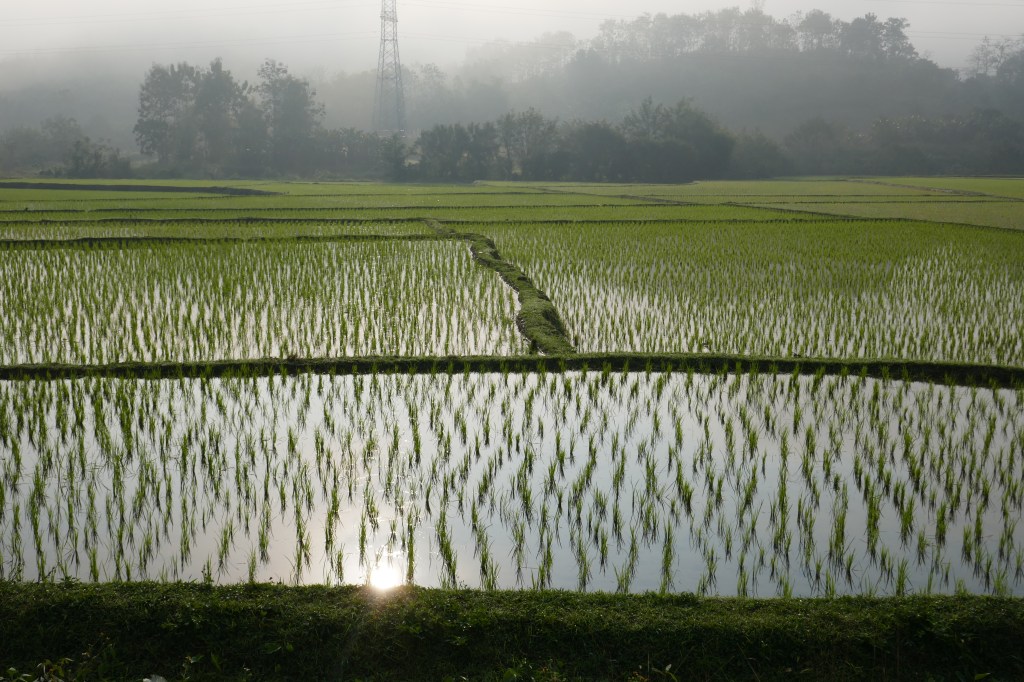
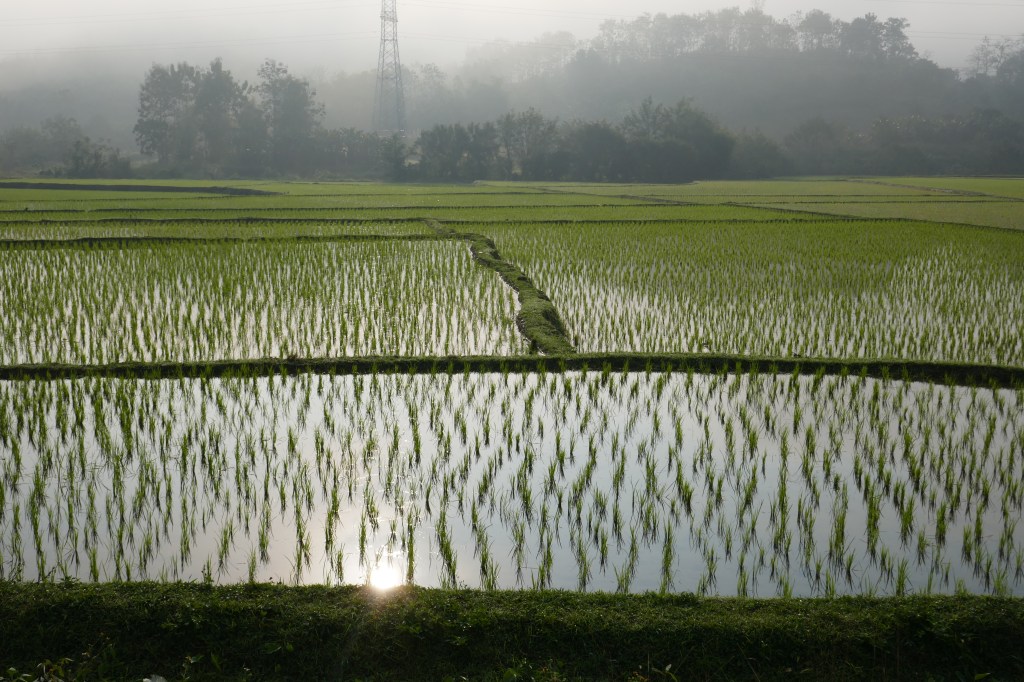
As we left the last houses of the town the traffic abruptly halted. What made this town particularly busy at 7.30 in the morning was not clear but it was all local and soon we were in beautiful country side. Emerald green paddy fields and swirling mist on the mountains as the sun burnt off the clouds.
We stopped to take photos and were passed by 2 touring cyclists, Joisen (from Holland) and Franklin (from Brazil), who previously lived in Switzerland and were on the way to a new life in New Zealand. There is something about European people we have met which has struck us – how many have chosen to live and offer their talents to a different country from their birth. We have met French people living in Germany, Italians living in France and Germans living in Holland. Maybe it is that free movement is a living thing – spreading talent across the continent or maybe people who have the courage and openness to live in another country also have a mindset to travel.
Joisen and Franklin were the first cyclists we met in Laos and only the third in our whole trip so far. They only had 2 weeks so were traveling light on gravel bikes and going off road into far more adventurous territory than us. It was good to chat and exchange tales. They were heading for the same town as us but would arrive much quicker.
After about 15km we reached the town of Pak Mong where we turned off Highway 13. Now we were leaving the territory we had covered in the bus (but had not seen) and were on Highway 1C. Given Highway 13 is the main artery from Vientiane and Luang Prabang up to the Chinese border it could hardly be called busy (this morning excepted). The new road though was blissful.
We had a fantastic 30km ride along a valley with beautiful tropical vegetation and increasingly spectacular mountains coming into the view. The road was gently undulating along the Nam Bak river. We knew we had a short day so we went at ambling speed, just absorbing the scenery and thoroughly enjoying the cycling. Passing through pretty towns and villages it was easy to return the smiles and waves we were getting. This is what it’s all about! For the thousandth time we felt so lucky that we enjoy doing this together, storing memories to share for our dotage.
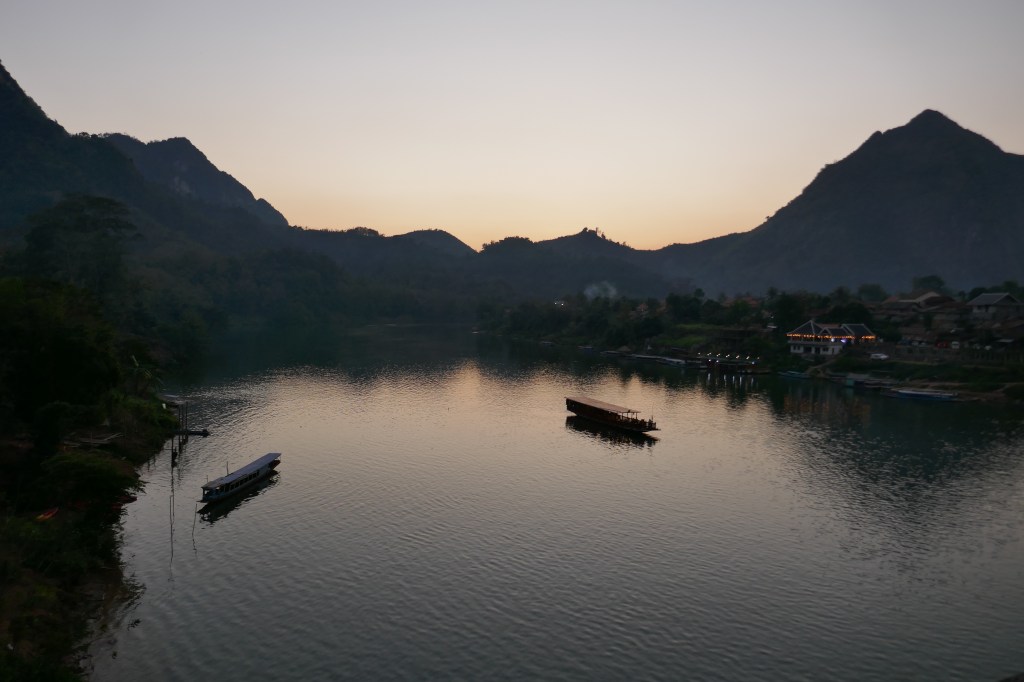
We gently rolled into Nong Khiaw as the Nam Bak joins the Nam Ou river. We had left the Nam Ou yesterday afternoon as it took a course carving through roadless gorges until we rejoined it at the most spectacular setting of mountains and cliff faces.
We booked into a simple guest house at the south end of the bridge over the Ou. Simple but with a balcony overlooking the river and mountains, complete with hammocks. The other good thing about simple guest houses is there is no issue with using our little wisperlite stove to brew up so we sorted ourselves out with coffee and sandwiches (this part of Laos at least has decent baguette type rolls). We strolled into town to sort ourselves out with a trip to do tomorrow then spent a very lazy afternoon reading, rocking in our hammocks, listening to Dire Straights on our portable speaker, drinking tea and generally feeling very laid back.
In the evening we hooked up with Joisen and Franklin again. They are real athletes and it was fascinating to hear about their endurance racing exploits. Tomorrow they have a big day of climbing so were loading up with carbs with burgers and pizza. I just had to remember that we will be swanning about on the river tomorrow and didn’t need to be eating quite so much! One of the great things about this trip is the number of different people we have met from all round the world.
I am typing this as the sun is setting above a small lake, next to the main A13 road. We are just less than 100km north of Luang Prabang, and well on our way to our next destination, Nong Khiaw, which we should reach tomorrow. It has been an easy day to navigate – we joined the A13 in Luang Prabang and stayed on the same road all day. This is the same road we took on the bus to get to Luang Prabang 3 days ago, but we travelled in the dark across all of this section and so the scenery was all new to us.
The road out of the city of Luang Prabang was typical for this part of the world – ribbon development along the road and loads of sheds occupied by car parts dealers, shops selling beds, light fittings, ornaments and and just about anything else you might want to buy. Loads of motorbikes and poor air quality.
It all improved as we left the city and the road took us north roughly following the banks of the Mekong, but frustratingly we were rarely able to see the mighty and beautiful river as it was always a few hundred metres away (or more).
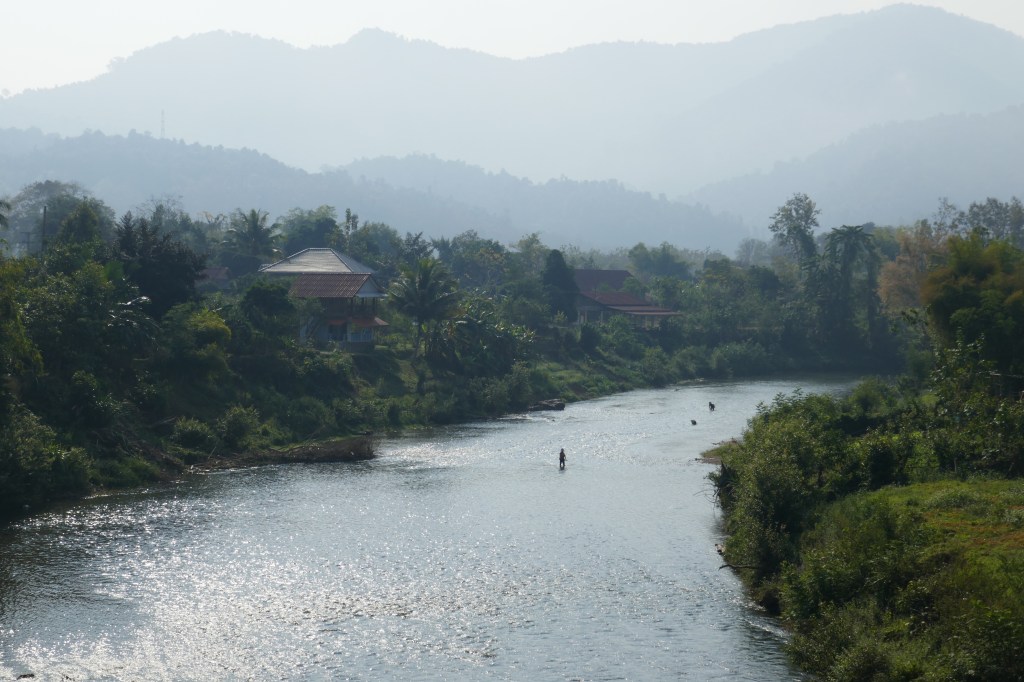
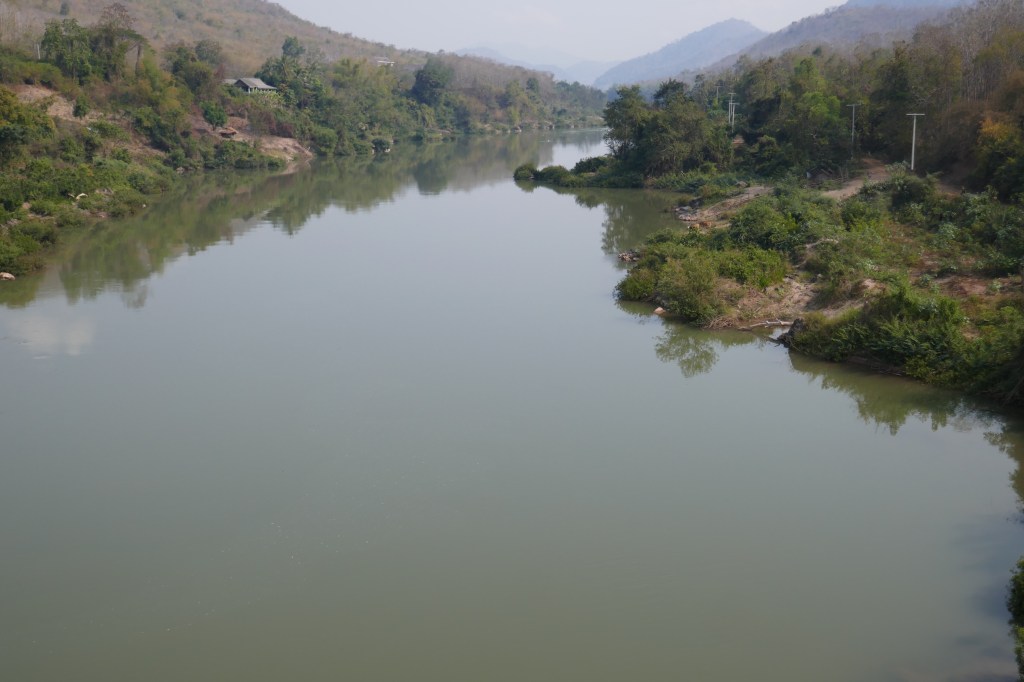
After about 20km the road diverted away from the Mekong and followed the Nam Ou River, a substantial river itself which feeds into the Mekong (as appears to be the case with all rivers in Laos).
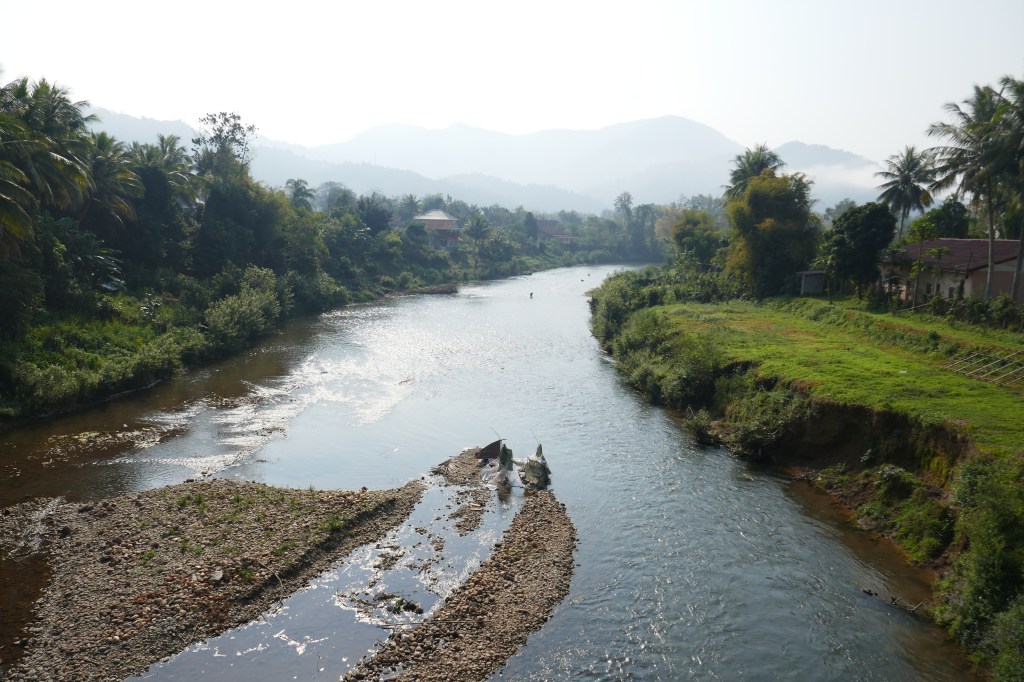
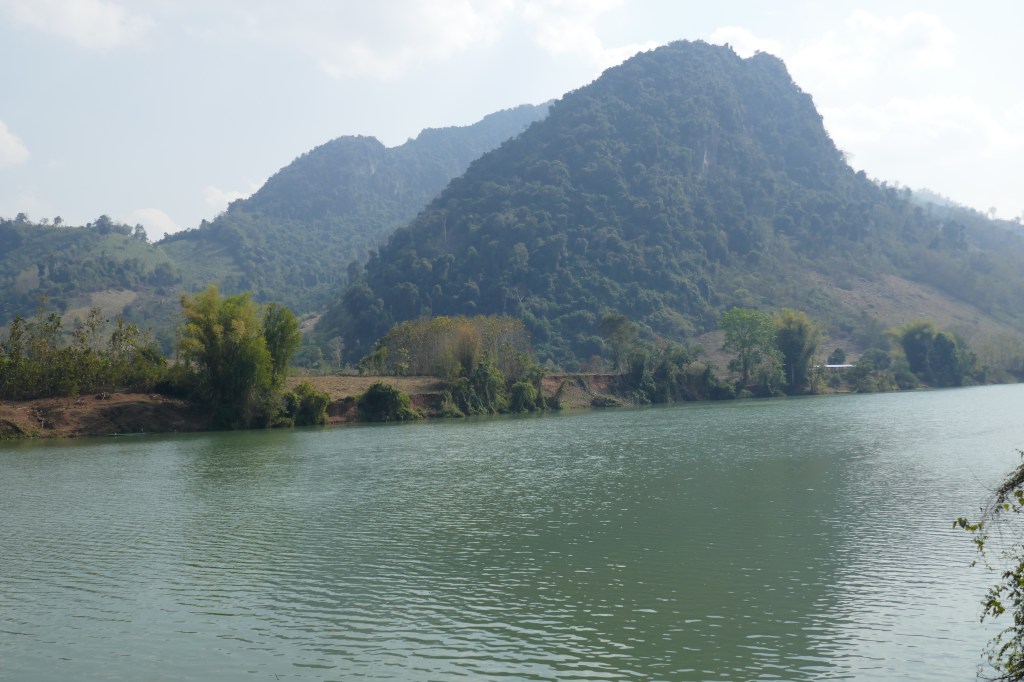
The Nam Ou river
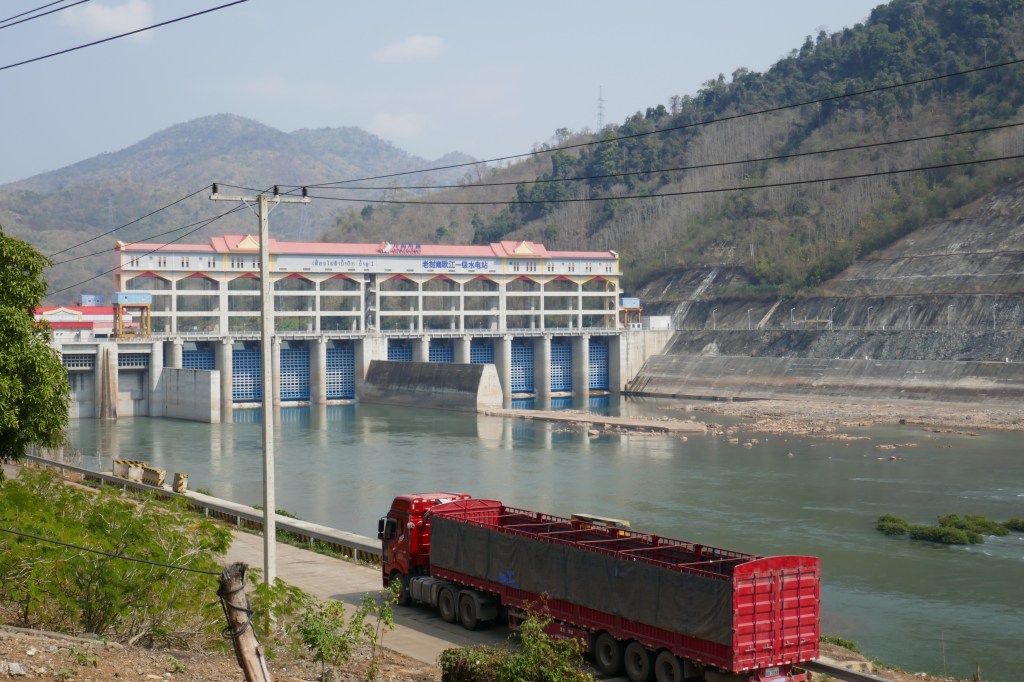
The Nam Oh was recently dammed (very impressive engineering and more Chinese investment), so the road followed a lake about half a mile wide for the next 20km. There are a series of dams up the Nam Ou, all generating substantial amounts of hydroelectric power for Laos. The dams are hugely controversial as they displace people living in land that is flooded, prevent the river being navigable and change the eco-systems so that fish cannot swim up the rivers and there is species change from a river to a lake environment. However, the “clean” energy and tourism benefits are also substantial.
Our only comment was that, given the huge cost of the railway and the dams, it seems a shame that the road is still in such a poor condition – but to be fair, there were not as many mega pot holes or sections without tarmac as the road from Luang Nampha (which killed off my derailleur of course).
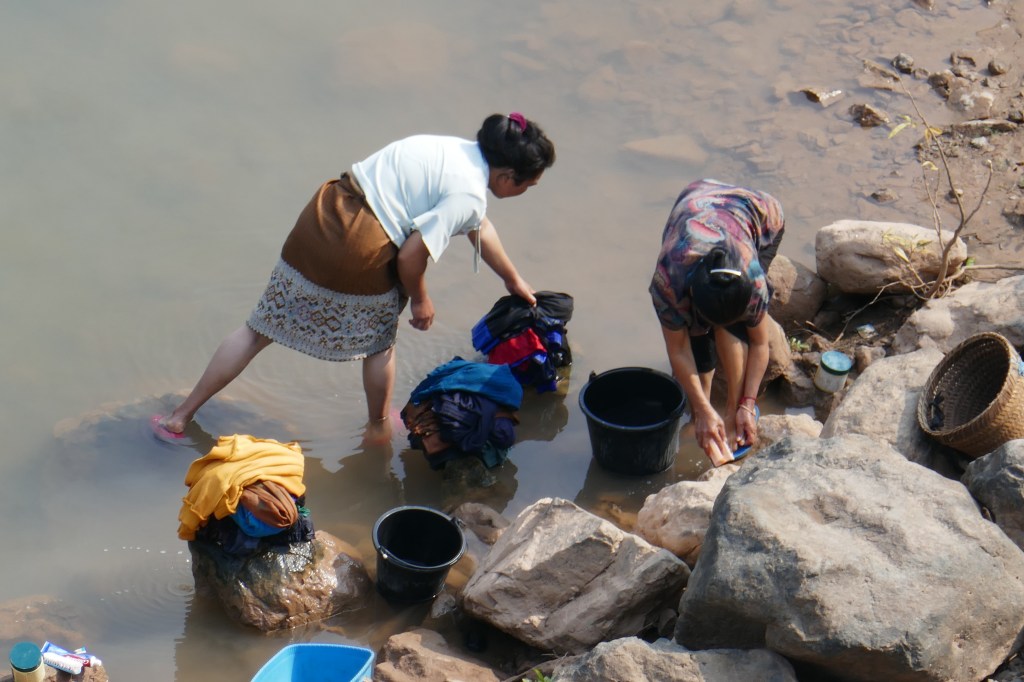
The river is still used for clothes washing
As the heat of the day developed, we noticed that it was hotter and far more humid than we had experienced to date. The road was also undulating and, whilst we did not do any mega climbs, we clocked up nearly 1000m of climbing across the day. All that in the heat and humidity was a real trial and, by midday, we were pretty desperate to find somewhere to hide from the sun. Village after village appeared to have nowhere with food on offer, but we heard some music and stopped – but it was coming from a temple. However, as we were stopped, a young chap on a motorbike, Ya, stopped and chatted to us in pretty good English. He proudly told us he learned English whilst he was a buddhist monk and, after leaving, had worked at the “international airport” at Luang Prabang for the last 4 years. It is correct that this is an “international” airport (flights to Thailand) but it is not quite Heathrow. I would wager that there are no flights to Europe from Luang Prabang.
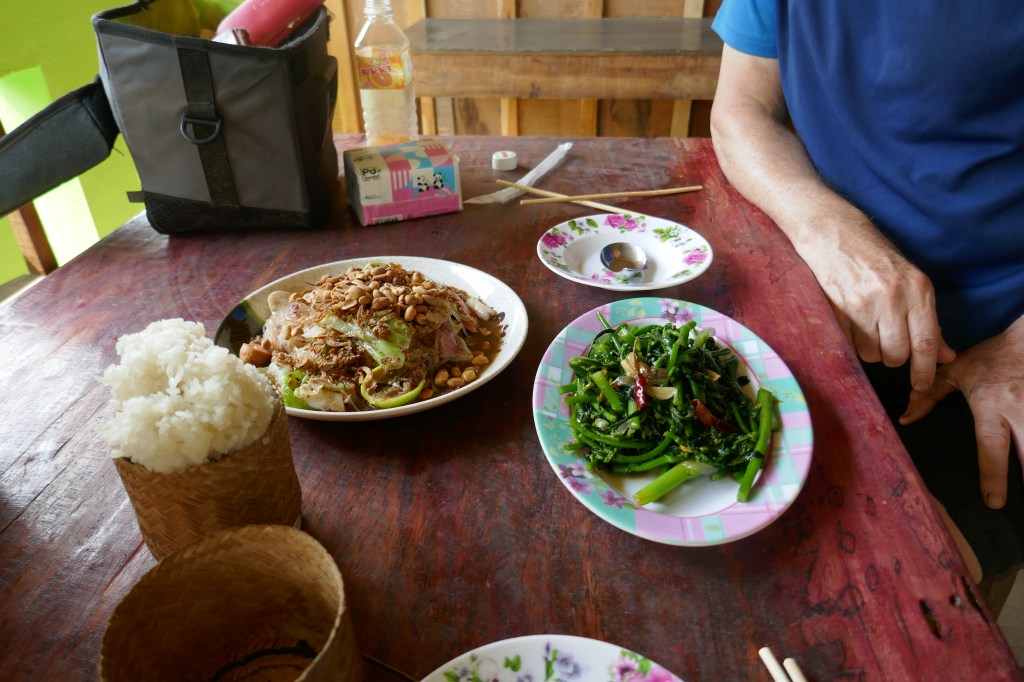
He was on the way back to his home village and told us about a restaurant 8km further on – but said it could be 10km or might be 6km. Useful if slightly frustrating information. However about 1km further on he flagged us down and said that a building with no sign was, in fact, a new restaurant. We were relieved and even better he negotiated a meal (and a price) for us! So we had lovely green vegetables, a mixed stew, glass noodles (you will have to look them up) and sticky rice, all for less than £5.
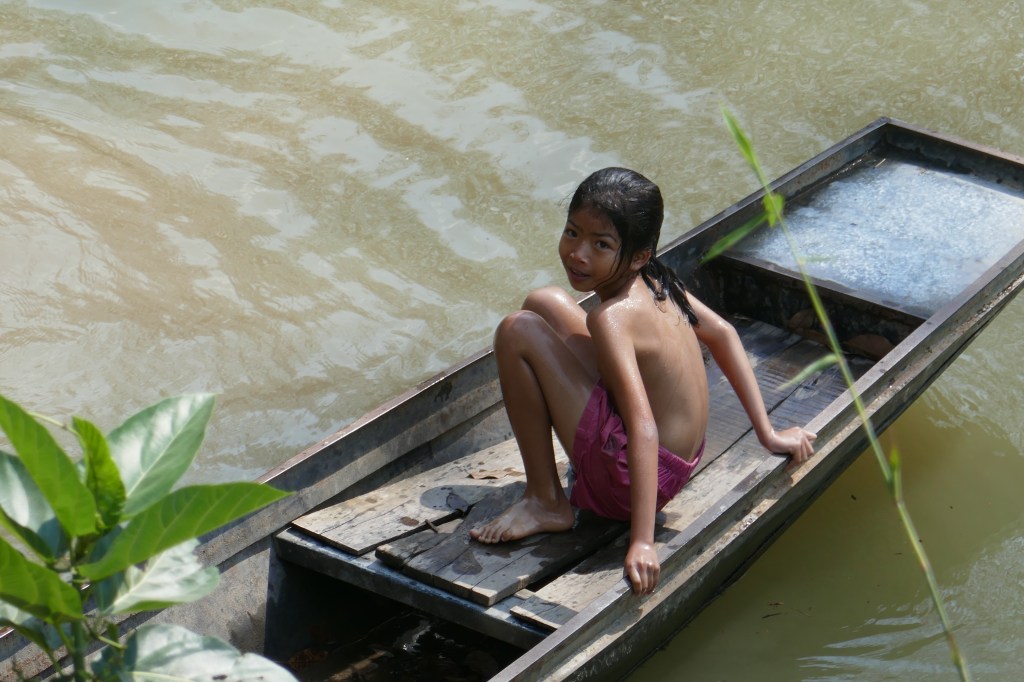
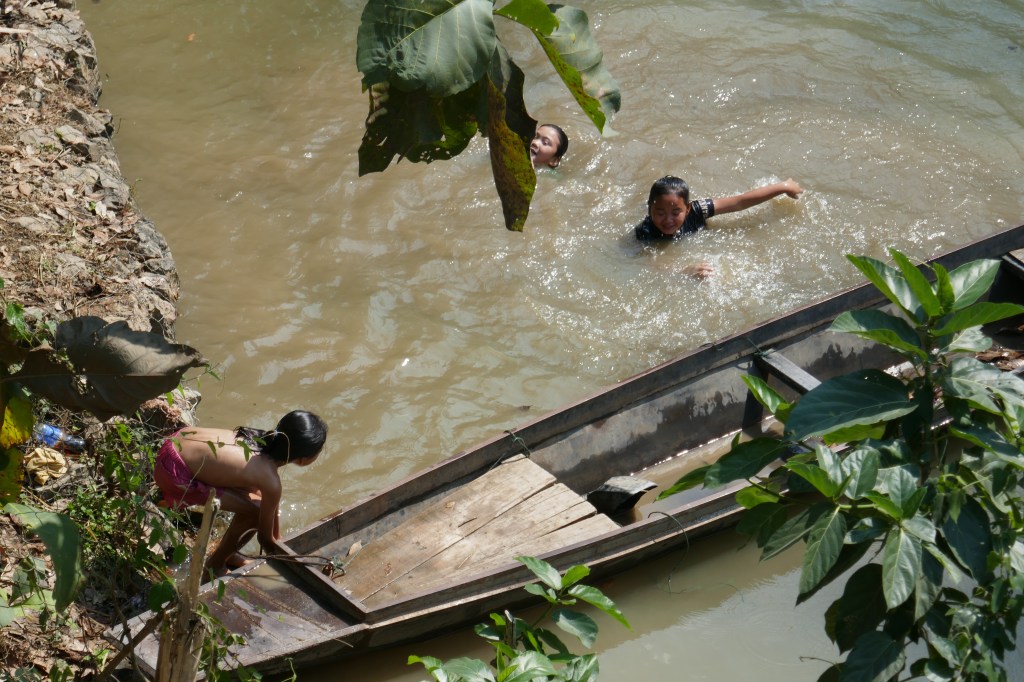
Children playing in the river near our lunch stop
Fortified by that we resumed in the heat and gradually climbed out of the river valley. The scenery was fantastic and the road mostly quiet and not too potholed. We ambled along, enjoying the scenery, the villages and the interaction with a constant line of children who wanted to wave and call out to us. I should record that, contrary to the experience of some travellers, no child has ever asked us for money – they are just excited to see foreigners (at least in our experience foreigners on trikes) and want to call out to them. The boys are more forward than the girls of course but our experience is that Lao children and adults are all so welcoming.
What could be more fun on a hot day?
We were pretty tired by the time we got to the basic guest house we had identified on googlemaps. This is a “hit and miss” affair but this one was basic but clean, and had hot water. We don’t need much more, although we did chuckle at the contrast with our lovely hotel last night. But that’s one of the aspects we like – being content with basic but also enjoying the odd bit of luxury!
After the anxiety of the last couple of days we decided we deserved a little pampering. So we checked out of our basic guesthouse and checked into Villa Ouis, one of the gorgeous wooden French colonial era houses in the old town, a spur of land at the confluence of the Nam Kham (River Kham) and Mekong River. Our villa looked over the Nam Kham, a sultry green at this time of year, with mountains in the background.
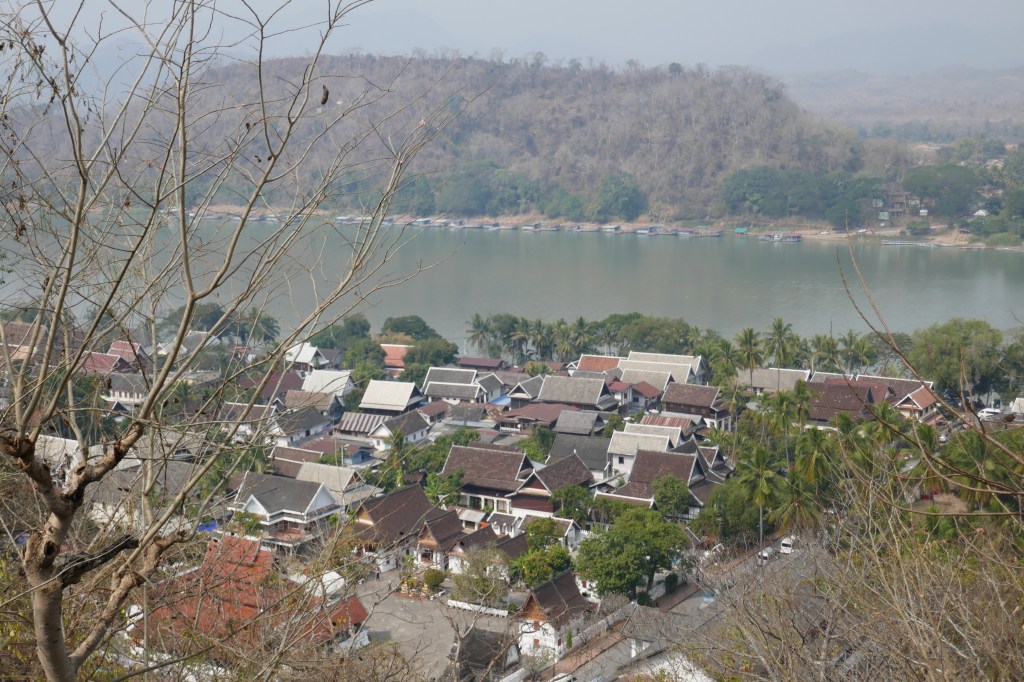
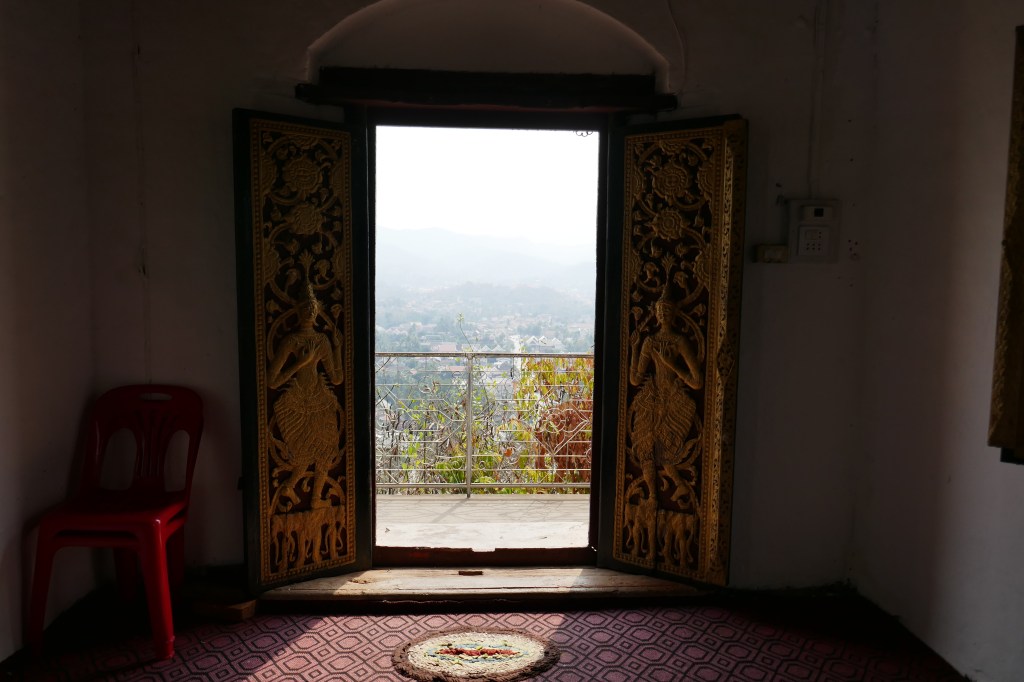
We packed up early and went back to TTT where we picked up a spare derailleur on the basis that lightning could strike twice. We then cycled across town and left all our stuff at the hotel until our room was ready. We wandered along the old town streets and had a lovely breakfast at an amazing French style bakery. We strolled further on to the palace museum, only to find it was past 11 so it was closed to visitors until after 1.30pm. We therefore climbed the numerous steps up Phousi hill, the sacred mount in the middle of the town. It was a hot and humid day but we sat in the shade and looked out at the very hazy view of the river and hills beyond.
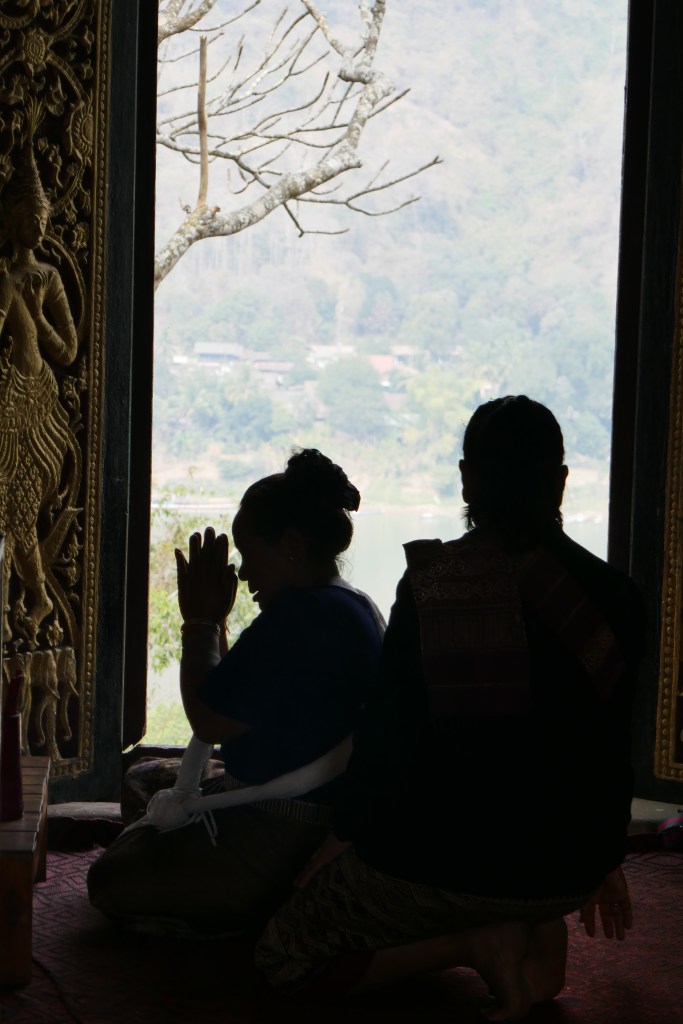
Prayers offered at the hill top shrine
There are no clear views at this time of the year. At this stage of the dry season the dust, pollution and the result of agricultural burning lies heavy in the air so everything looks shrouded in a hazy mist. Apparently this builds up so that by March/April the air is really tainted and unpleasant (the same was said in Chiang Mai) until the April rains finally clear the air.
We climbed down the other side of the hill past Buddhist temple buildings and Buddha statues. Buddhism is far less in evidence compared to Thailand but in Luang Prabang we had seen lots of boy monks in their distinctive orange garb. They look about 10 to me but I guess could be up to 15.
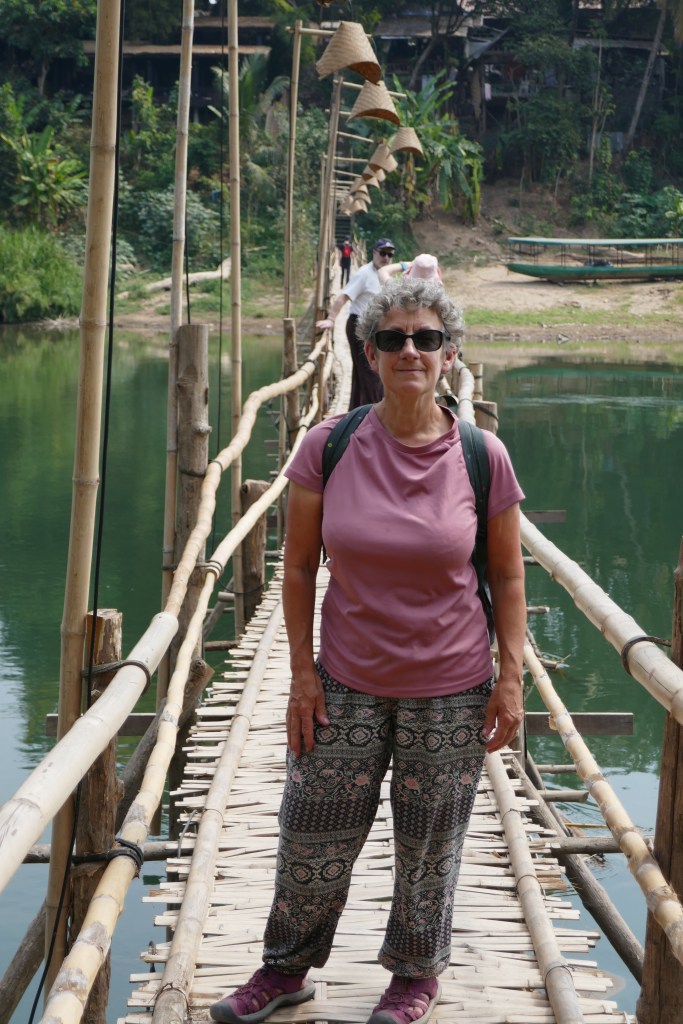
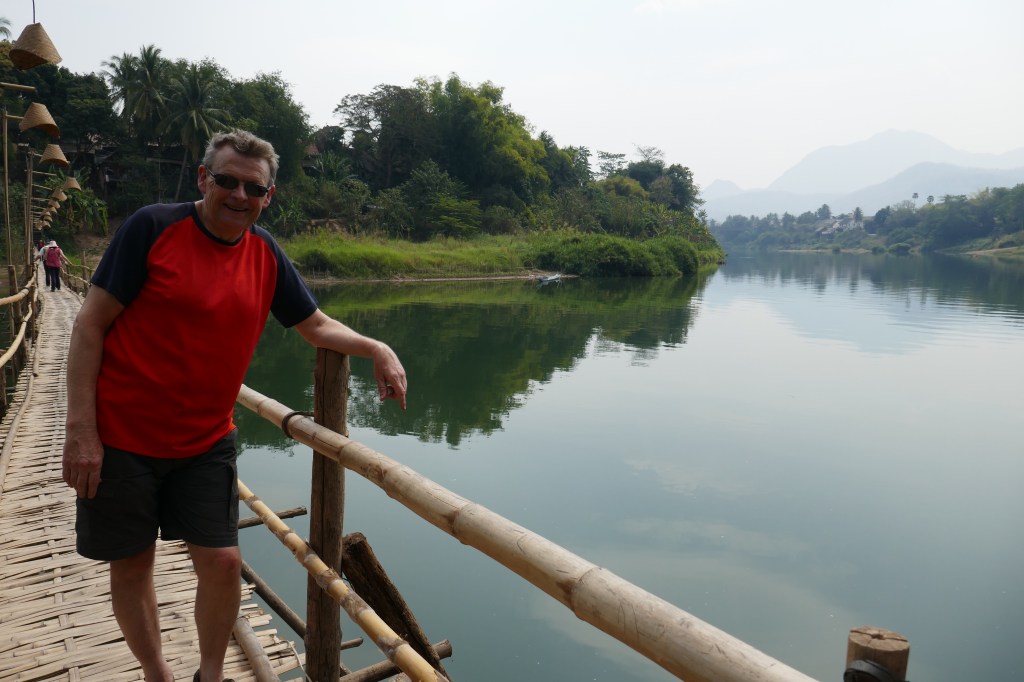
At the bottom of the hill we wobbled across a bamboo bridge over the river. There are two of these bridges, which only stand for 6 months of the year. Once the rainy season comes, the current is too strong and the bridges are dismantled. It certainly did not feel very sturdy.
By the time we ambled back to the hotel, our room was ready and we were ready to retreat from the heat and humidity. The very pleasant and helpful Vietnamese man (manager?) even said it was a hot day! We knew we needed time to apply for our Vietnamese e-visa, which required us to state which border crossing we were going to use. So we did some route planning to make our final decision then had a frustrating time filling in the e-visa form and working out how to upload photos of ourselves and passports so that the file sizes were not too big (easy when you know how!). After several attempts (across an hour and a half) David had it cracked and had paid for his;and so when he did mine it only took about 10 minutes!
We then sat on the balcony watching the world go by and the view of the river while we read. So laid back we were literally almost horizontal!
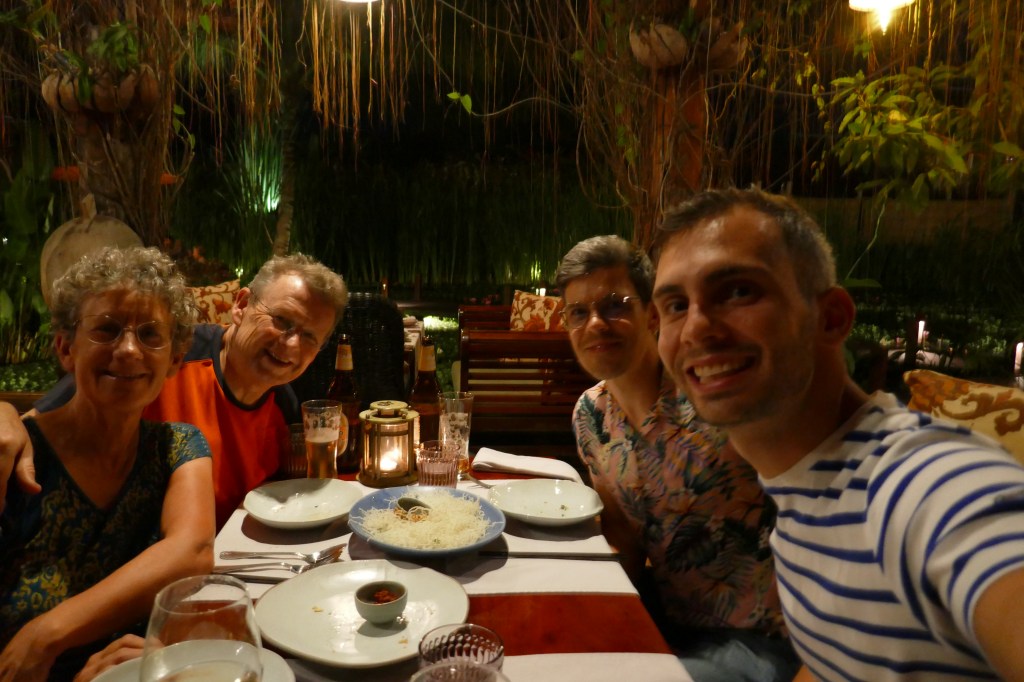
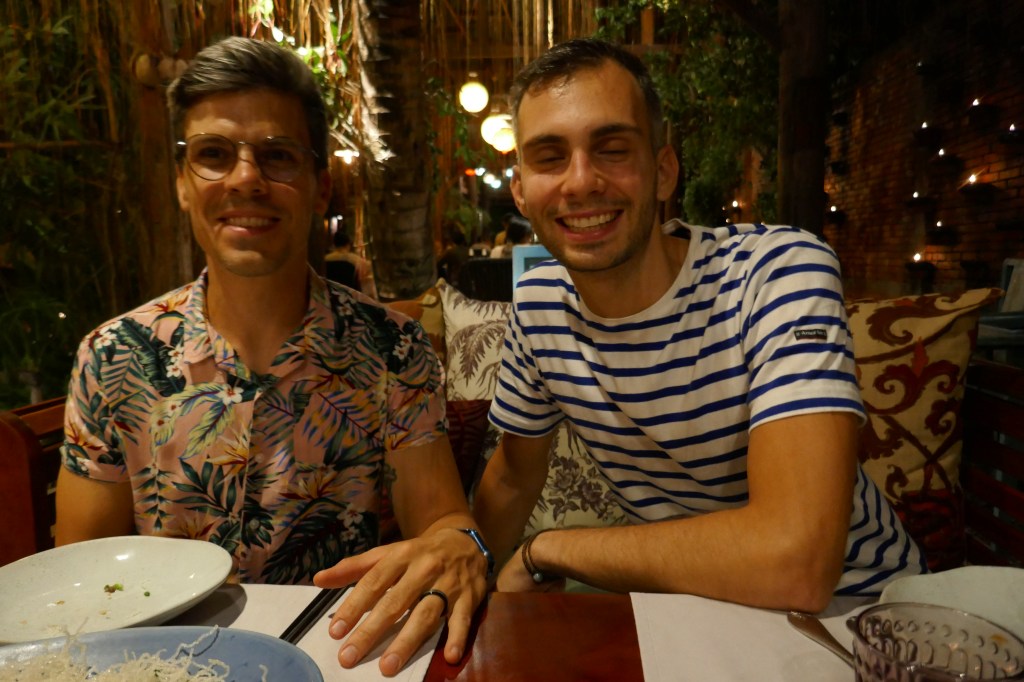
Finally we stirred ourselves to set out for dinner. One of the people in our Gibbon Experience group had highly recommended the restaurant Manda de Laos saying that it was a really special place with the best food in Laos. As this was our pampering day we booked a table. We had linked up with Damien and Adrien again, who were also in Luang Prabang. They were in the other Gibbon Experience group and had got engaged while in their tree house. We really enjoyed their company before so we invited them along to have a celebratory meal – for us getting our trike fixed but much more importantly for their engagement.
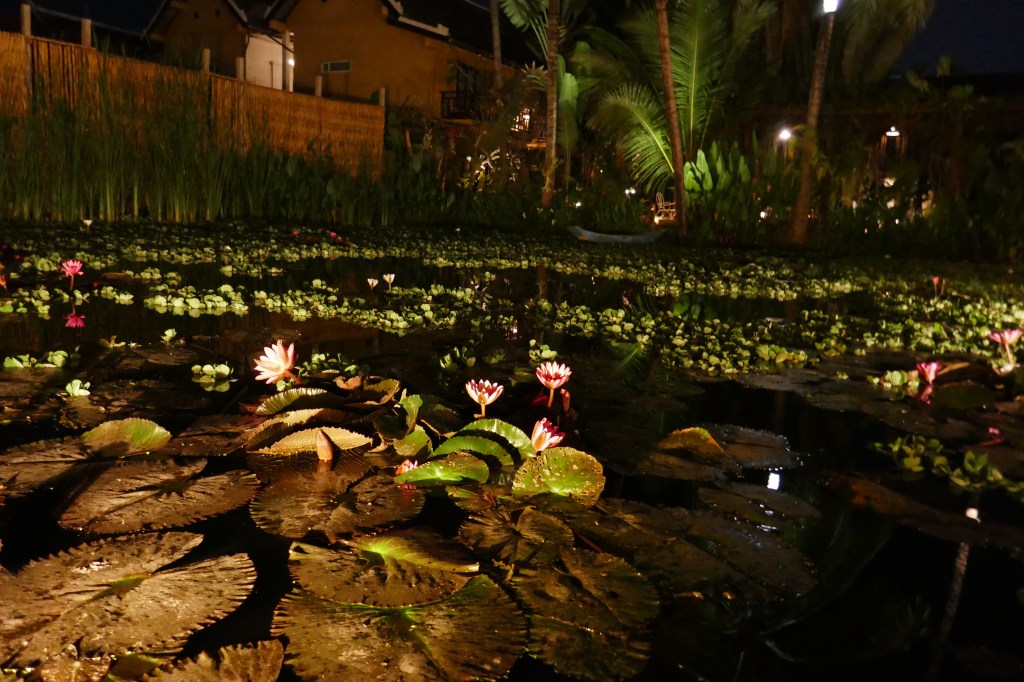
The restaurant lived up to the recommendation. The tables are set up around some beautiful lily ponds, which are now protected. The lighting and the setting was beautiful, the food fabulous and the company delightful. A special evening to finish our time in LB. Tomorrow we are back on the road, staying in basic guest houses or camping and eating one-pan meals. But for tonight we looked out over this magical city which has been sympathetically restored and, due to the presence of the new trainline, will no doubt change under greater Chinese tourist influence going forward, but now was a mixture of Loa residents, Lao visitors, all manner of europeans (but fewer gap year students than the rest of Laos due to the cost) and some Chinese (many of whom seem to be in camper vans).
This is not a murder mystery blog so news up top – we are back in business thanks to the wonderful bike guys at Tiger Trail Travel. There were no bike shops as such in Luang Prabang but TTT offered bike repair services as well as hiring out bikes for their travels. So we pushed the trikes the 1.7km to their offices and asked for their help.
We could not recommend these guys too highly – please look them up if you are in Luang Prabang.
We were introduced to “Mr Mee” who was the lovely bike mechanic and clearly a bike person. He had never seen a trike before but loved the idea of our travels in his country and was determined to get us back on the road so we could continue. A short inspection confirmed his technical assessment of the derailleur – it needed replacement. Fortunately (and purposefully) I had not damaged the derailleur hanger – the bit which is particular to the trike. Getting that replaced would involve a part from Europe – but the derailleur itself is a standard bit of kit.
He asked us to come back later and said he would do his best. We then spent an anxious day mooching around whilst we waited for the outcome. However, as we ambled into the town, we met Tabitha and her partner (sorry – senior moment and name eludes me) who we met in Huay Xai. We chatted and then joined them for breakfast at a lovely cafe, along with Matthais from Austria. Tabitha and her partner are both from Germany but are studying in Holland – with all psychology teaching in English. Matthias is from Austria. They have all taken a break from studies or work to travel across this part of the world. Like quite a few young people we have met, they are taking time out after university because (and this is my formulation) they know they will be working for decades ahead and so have worked hard, saved and then taken time out of working life to travel and experience the world rather than just remaining on the treadmill of work at home.
Just for amusement – flying triffids??
Lovely chatting to them – and of course they wanted to try to understand the idiocy of Brexit. They just could not understand how people in the UK had lost their collective minds by voting to leave the EU and hence lose all the benefits for citizens of EU membership. Like so many young people we have met here, those benefits included citizens from one EU country living and working freely in another EU country.
We struggled to try to explain what was going on in the UK but broadly shared their perspectives – after all we have an EU flag on our trikes. But also trying to explain the complex mood in the UK in the aftermath of the financial crash, the feelings of those left out by economic progress and the painting of the EU as the cause of some of their problems (wrong in our view but lodged in the minds of so many in the UK). It’s all post-Empire heart not head we tried to say, but it is the whole country that is left with the cost of the heart based decision.
Later we ambled around the old town, walked along the banks of the Mekong and waited for trike news. We had a nice lunch overlooking the Mekong and managed to relax a bit but still glanced at the phone from time to time to see if there were any messages.
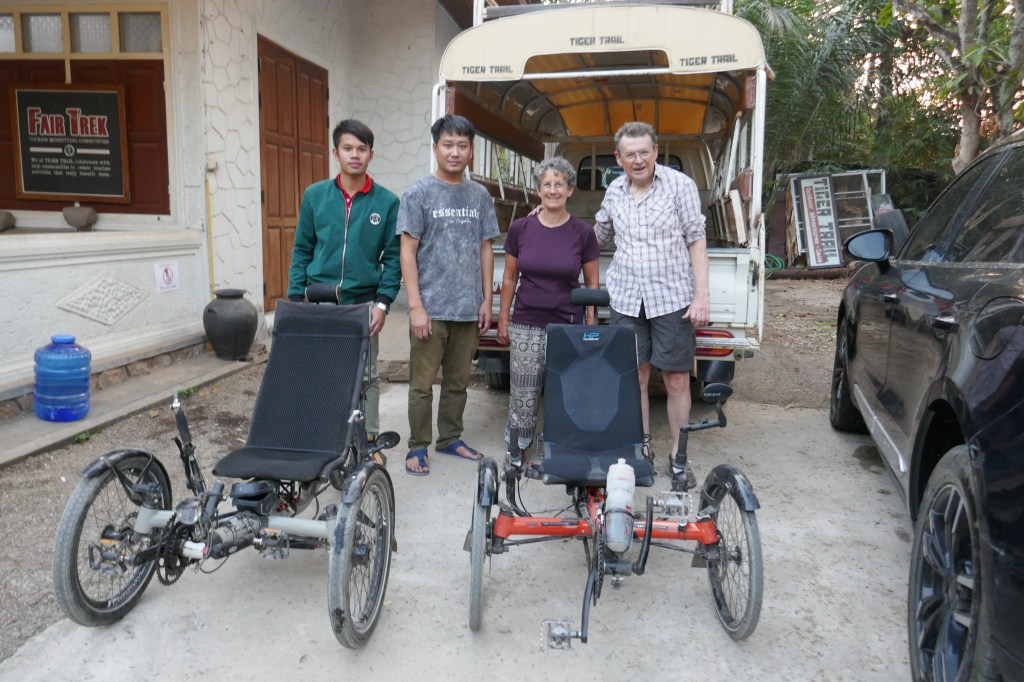
At about 3pm we went nervously back to TTT and found the derailleur fixed thanks to a new part sourced from somewhere that is not in any google directory. Not the same part as before but doing the same job. Mr Mee wanted to replace the cables and clean chains so we left it another hour or so, collecting the trikes at 5.30 when they were better than before. Such a relief. The cost of the new part was just $30 so we ordered a second one (just in case) and then chatted bike stuff and other things with Mr Mee and his colleagues (he spoke more than enough English), met his daughter and felt so much gratitude.
Mr Mee, his assistant and us with functioning trikes
We then cycled into town and had a celebratory drink in a rooftop bar where we met Chris, a just retired banker from Austria who is travelling with is wife (just retired from the UN) in slightly more comfort than us across South East Asia. Great chats, lots of exchange of local knowledge as the sun went down.
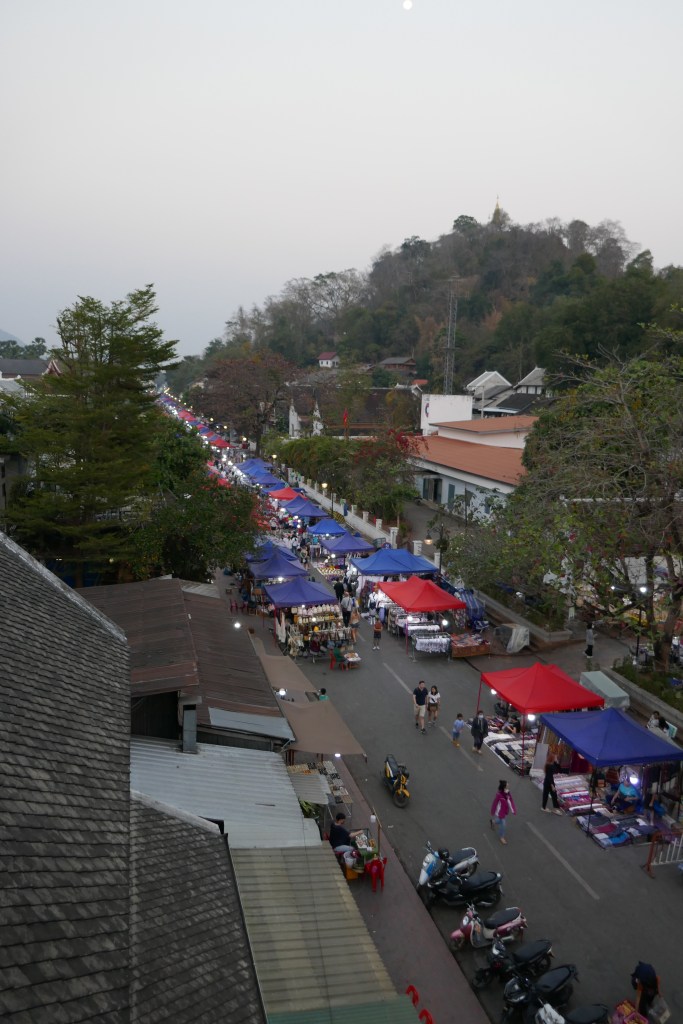
Finally, we went to the night market and had something to eat – sharing a table with a couple of Swedish students who are real “gap year” travellers, much more akin to the way our children travelled. Then back to our nice but slightly dodgy hotel near the bus station on our now fully functioning trikes. Huge relief and, after a very international day, we can now enjoy Luang Prabang before the next stage of our travels.
We had planned a shortish day with a leisurely start but we both work early after a really good sleep and were feeling good and up for a more strenuous day. So we packed up and were on the road about 7.30am. But of course, as this is cycle touring, anything can happen – and it did.
Again the morning was misty- clearly a feature of the early mornings in these mountains. As soon as we were out of the town, we were in rural countryside and after about 10km rejoined highway 3 again. The road followed a lush deepsided valley with a pretty river below. It felt magical as the mist swirled around. We passed through a series of villages and saw zip wires stretched across the river. This was the original use of wires – to transport across wood and other goods presumably. No humans seen hurtling along them!
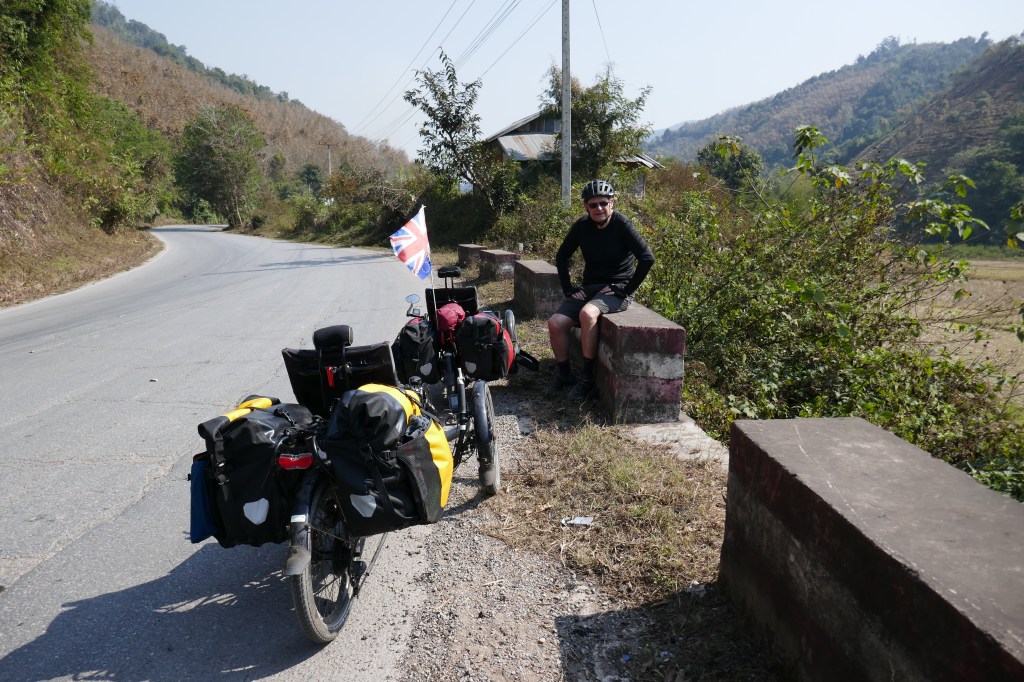
Sitting in teh morning sunshine – with no idea about what is about to happen
About 9.30 the sun burnt off the mist just as we started a 100m climb. The road was in poor condition and we bumped and bounced along. Just as we were nearing the top there was a steep section with a long and particularly bumpy stony section. I reached the top and saw that David had ground to a halt. I freewheeled back the short distance and found that he had a significant problem with his deraillier.
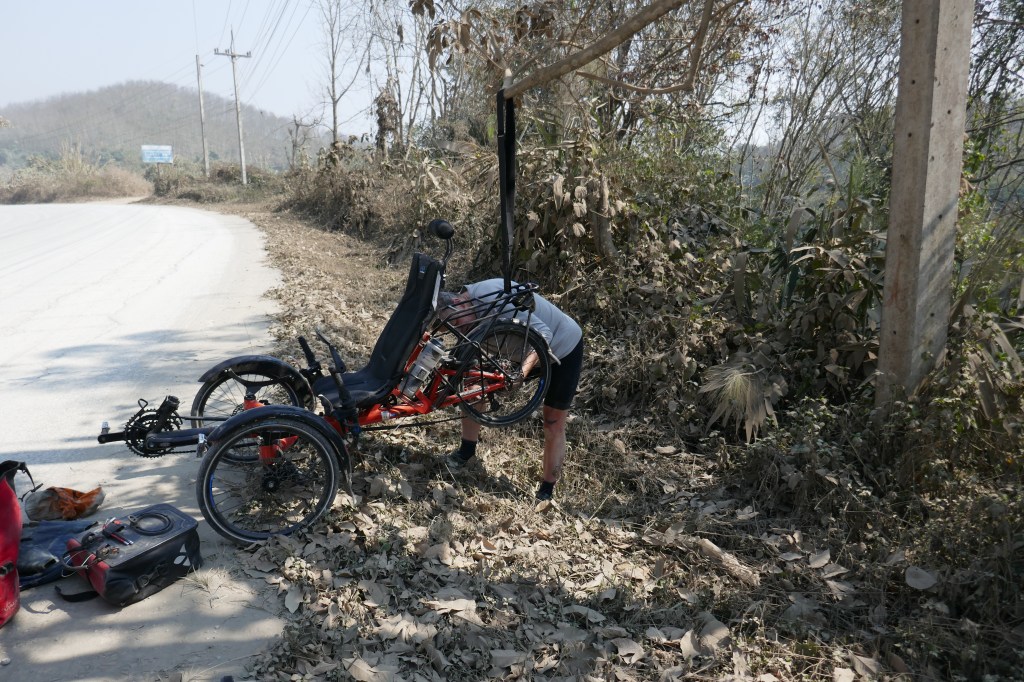
Pop up bike repair shop – before realising it was unable to be repaired
Parked up by the side of the road with vehicles and lorries chucking up dust from the gravelly section David set about repairing it. He took the whole thing apart and put it back together again. Initially it seemed to look more aligned but it still wasn’t working. He then realised a small bit of metal and a bolt had sheered off. This wasn’t something mendable and he declared the deraillier well and truly f**c**d.
We both felt devastated. Surely not another trip with bad luck. We told ourselves of the travails of travel and that everything was solvable with time (and money). But I could see from David’s face how upset he was. The good side was that we were only 3km from the town of Nateuy and we had heard from other travellers that there was a train station there heading south towards the city of Luang Prabang where there was a (small) chance of getting a new derailleur. This Chinese funded high speed railway link runs from China across the border to Laos and all the way down to the Laos capital, Vientiane, which is on the Thailand border. Since opening just over a year ago it has transported over 2 million tons of goods. The railway is planned to extend through into Thailand to Bankok, and once that leg is completed it will be a cultural highway extending China’s influence into South East Asia. Luckily, David derailleur broke only 3km away from the railway – or so we thought. We quickly decided that the only chance of getting a replacement deraillier was in a substantial city so decided to try and get the train to Luang Prabang.
Efforts to flag down a pick up truck to take us the 3km were unsuccessful. Only one person stopped but the back of the truck as already too full for all our stuff. So we trudged the 3km in the heat of the day, freewheeling down the down hills and pushing the trikes as we trudged uphill. This included a googlemaps special that took us down a steep hill to the wrong side of the railway tracks for the passenger station and into a huge lorry unloading area. This was solely for large crates being craned onto cargo trains but not passengers – but Google did not know that. Back up the hill we trudged and took the long way round to the train passenger station.
We seemed to be in luck as there was a train in 50 minutes to Luang Prabang. We showed them our trikes and there was a lot of head scratching and calling of more people – each more senior than the last – to take a look. We showed them how they fold up, tape measures were brought out, they thought it was still too wide. We could take the wheels off we explained but then the crunch point came – the trikes would have to be in a box or we could not take them on the train. This point became insurmoutable. The main guy who spoke reasonable English kept saying he wanted to help us (and I believe he did) but this was the rule – and being Chinese this was a rules based society. We could send them cargo and they would turn up in 3 days time (if at all).
We cut our losses and said we would try the bus. The same guy helped us with the taxi/bus man who confirmed there would be a bus at 4pm. He could take us in his minibus taxi to the place to buy bus tickets for what seemed an extortionate about in money but was only £2.50 and hey it was only 2 minutes but a) he knew where it was and we didn’t and b) David didn’t have to push his trike any more.
We piled up our 2 trikes and 6 panniers into his small mini van, and he took us to the “bus station” where we bought the bus tickets. No eyelids were batted at the mountain of our luggage – and no extra fee to take it with us. It was very vague abou what sort of bus it was, how long the journey would take, where we would arrive in the town or at what time but by then we just went with the flow. It was now 3pm and we hadn’t eaten since our porridge at 6.30 that morning so we brewed up our own version of noodle soup with instant noodles, packet sauce, boiled eggs and tomatoes. It was surprisingly tasty and again no eyelids were batted at 2 falang cooking their lunch in the forecourt of the bus station!
Lashing the trikes securely to the top of the bus
4pm arrived and pronto, the “bus” arrived. It was a small yellow bus which already looked pretty ful and perhaps would be used for a short trip in the UK but here it was a form of travel across the country. Our bikes and panniers were hauled onto the roof and firmly tied down as we nervously looked on, but the driver looked as if he had done this hundreds of times before and brushed aside our vain efforts to help. Finally we clambered onto the bus. That was a slight error – no proper seats were left but a row of padded stools were set out in the aisle between the seats and that’s where the rest of us were to sit. A fellow passenger confirmed that the journey time would be about 9 hours – so we would arrive at 2 or 3am. We pushed to the back of our minds what we would do when we arrived and settled ourselves between the seats. We initially consoled ourselves that we would be able to get some seats at the next town when people got off.
We set off with our jolly driver and soon we were winding up the mountain passes, down again and up the next one. He was a great driver and although the road was narrow and windy we felt very safe, even when overtaking lorries round the tight bends. There seemed to be a sort of dancing etiquette about how this was done, and unlike some other parts of the world, the roadside was not scattered with memorial crosses to those who met their end over the side on a blind bend. Maybe in Laos they just don’t mark these events! The scenery got more spectacular with a beautiful red setting sun over the mountains and we mourned that we were not cycling the route.
By the time we were over the other side of this mountain range it was dark, my back was aching but we consoled ourselves with the thought that soon we would be at the next major town, but we bypassd that town and it became clear that the bus was not stopping. Everyone was on for the duration including the irritating middle-aged (and overweight) Chinese man who was constantly on his phone or striking up conversations with all around him – the equivalent of the village bore in the pub stuck with us in a bus and irritating fellow passsengers. As it turned out most of the passengers were on the bus for longer than us, as we were the lone 2 passengers dropped off in Luang Prabang at 3am.
I did not know how I would survive 10 hours wedged between the seats with David perched in front and someone elses knees in my back? Somehow we just managed it, as one always does of course. Like on a long plane journey, we entered a sort of zombie state and the hours ticked by. I managed to dose on and off and for the last couple of hours I did have a seat, although David was perched on his stool for the whole time. At least we weren’t on an unpadded upturned box like some others.
Finally we rolled into Luang Prabang at about 3am. Everyone patiently waited while all our stuff was unloaded from the roof unscathed and we were left in the cold and dark in this unknown city by the roadside with no one around as the bus drove off.
We decided to start pushing our trikes towards the centre of town to see if we could find a guest house that would open it’s doors at that time of night. Luckily only a few minutes away we found just such a guest house – we shook the boy asleep on a camp bed on the porch and indicated we wanted a room. As we walked up a young woman in a short skirt left the guest house and drove off with a truck driver – a rather strange time to be leaving I thought and I feared we were entering a den of ill repute. However a woman appeared, showed us a pleasant room for a reasonable price and soon we were lying horizontal at last. Other commercial transactions of ill repute may well have been going on around us, but we were oblivious and although still feeling pretty gutted, were pleased and grateful that we had got so far.
It remained to be seen whether we could get the trike mended in Luang Prabang or whether we would have to get another bus to the capital (another 8 hours at least) to access the specalist skills needed to mend the trike.
Today was a shortish cycling day – not too far and not too much climbing, and thus a chance to spend the afternoon exploring a town in Northern Laos, Luang Nampha.
We were on the road by about 7.15 and the day dawned with a thick mist – covering the road and surrouding areas. It made cyling tricky as it easier to hear oncoming lorries than see them. The mist was much thicker than on previous days and stayed around until about 10.30 – far longer than previous morning mists. It meant we did not see much of the valley that we were cycling through – just the mist and occasional steep slopes with rubber trees. There are extensive rubber tree plantations in Laos and many new trees have been planted in the last 20 years, feeding the former seemingly insatiable demand from industrial China for rubber. It used to be known as “white gold” but there was a crash in the rubber price in 2011, when the price fell from $4.82 per kilo and is now as low as $1.20 per kilo in late 2022, recovering a little to $1.44 at the moment. I think that is becasue synthetic alternatives are now preferred to rubber, and they can no doubt be produced at a fraction of the price. I mention this because, once the trees are planted, the farmers in these remote communities have little practical choice apart from tapping rubber and selling it on, but they are at the mercy of a hugely fluctuating world price.
We were moving from an area where there appear to be virtually no tourists (or Western travellers) and into an area where the economy is partly funded by tourism. That did mean we saw our first proper coffee shop for several days and it was too tempting to pass by – and the coffee was very good indeed.
The enthusiasm shown to greet us as we pass did not seem to be affected by whether we were in a tourist area or not. Westerners – collectively “falang” – have a reputation here for being somewhat miserable (or so we are told). The Lao people are naturally exuberant and this comes out when they see us as we cycle by – and I think they expect us to be just as exuberant back to them. But here is the rub – they do it once when we pass their village but we experience this hundreds of times a day. The cries of “sabaydee” (a form of greeting), “hello” or even “goodbye” ring in our ears as we pass through every village – because we are pretty unusual for them. There are not too many falang on trikes along this road! We can feel a bit overwhelmed by needing to respond every time but, to some extent, we have chosen to do this and have to live up to the choices. That means calling out in return, waving and being as enthusiastic as we can in the brief seconds before we move on – partly out of respect and partly so as to scotch the miserable foreigner tag.
The AR3 road – the only road – was good in places. At times the tarmac was fine but there were fairly long stretches with no tarmac at all – just stones and dirt. We did two major climbs and were making good progress but then hit a section of about 10km with bits of tarmac and bits without. This is one of the few major roads in Northern Laos, and is a major through route for lorries going from China to Thailand, so the lorries have the same challenge but they ride over the rough stuff better than us. Sometimes we were struggling to pick our way through the dirt sections enveloped by dust from a lorry that had passed the other way. But they never lasted that long and the joy of smooth tarmac (with potholes of course) soon returned.
Despite the quality of the surface, the ride was fantastic through a valley which was beautiful with steep sided mountains coming down to a lovely river which wound its way through a cultivated valley floor.
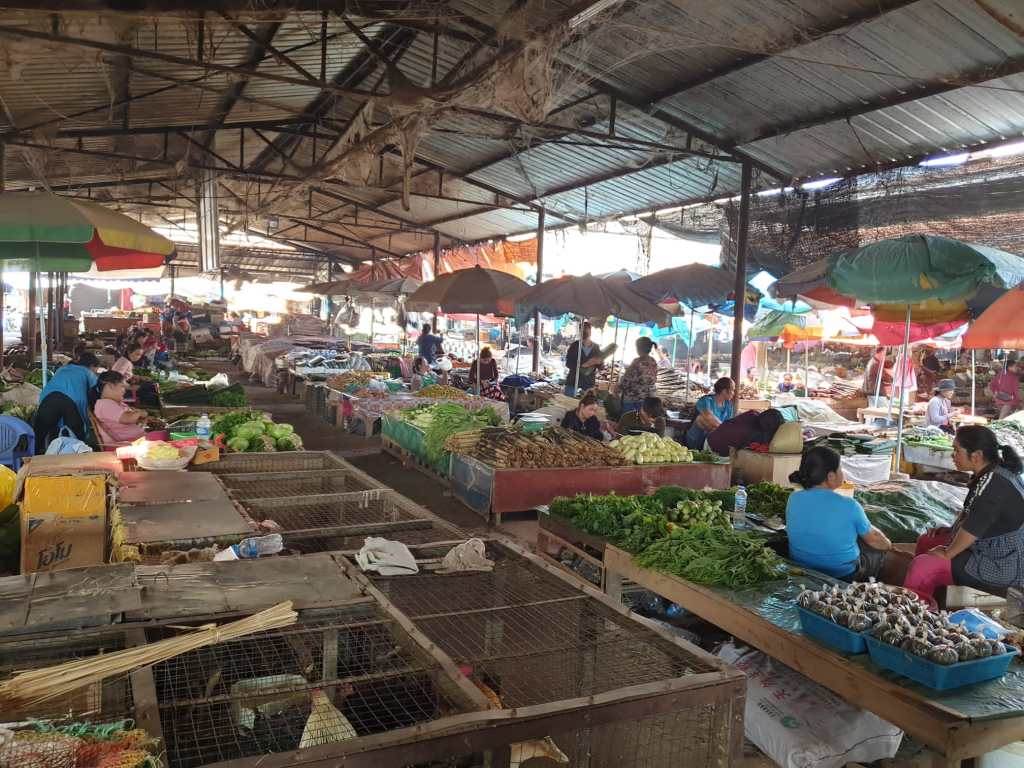
We arrived at the town of Luang Nampha for a late lunch. We checked into our guest house – spurning the “VIP room” at 250,000 kip and settling for the standard room at 150,000 kip (i.e. £7.50 for both of us). Perspectives change and the extra £5 for the higher quality room did not seem a good deal – ridiculous really in any objective sense. Then to the market for “pho” – soup with loads of fresh vegetables; and then picking up provisions for the next few days when we may have to camp.
Anyone fanch chicken for supper?
Luang Nampha is the largest town we have seen in Laos. We passed huge motorbike sales pitches with hundreds of bikes for sale (it would not be right to call them showrooms) and also places to buy agricultural machinery – tractors, JCB equivalents (all Chinese of course) and implements for doing all manner of things to soil. This seems a fairly thriving area, with a bit of eco-tourism on top – trekking, rafting and the like. It is very different from the subsistance farming villages we have been passing through for the past few days.



 The Slow Cycling Blog