Tag Archives: new-zealand

The wonders of wet walks and Milford Sound

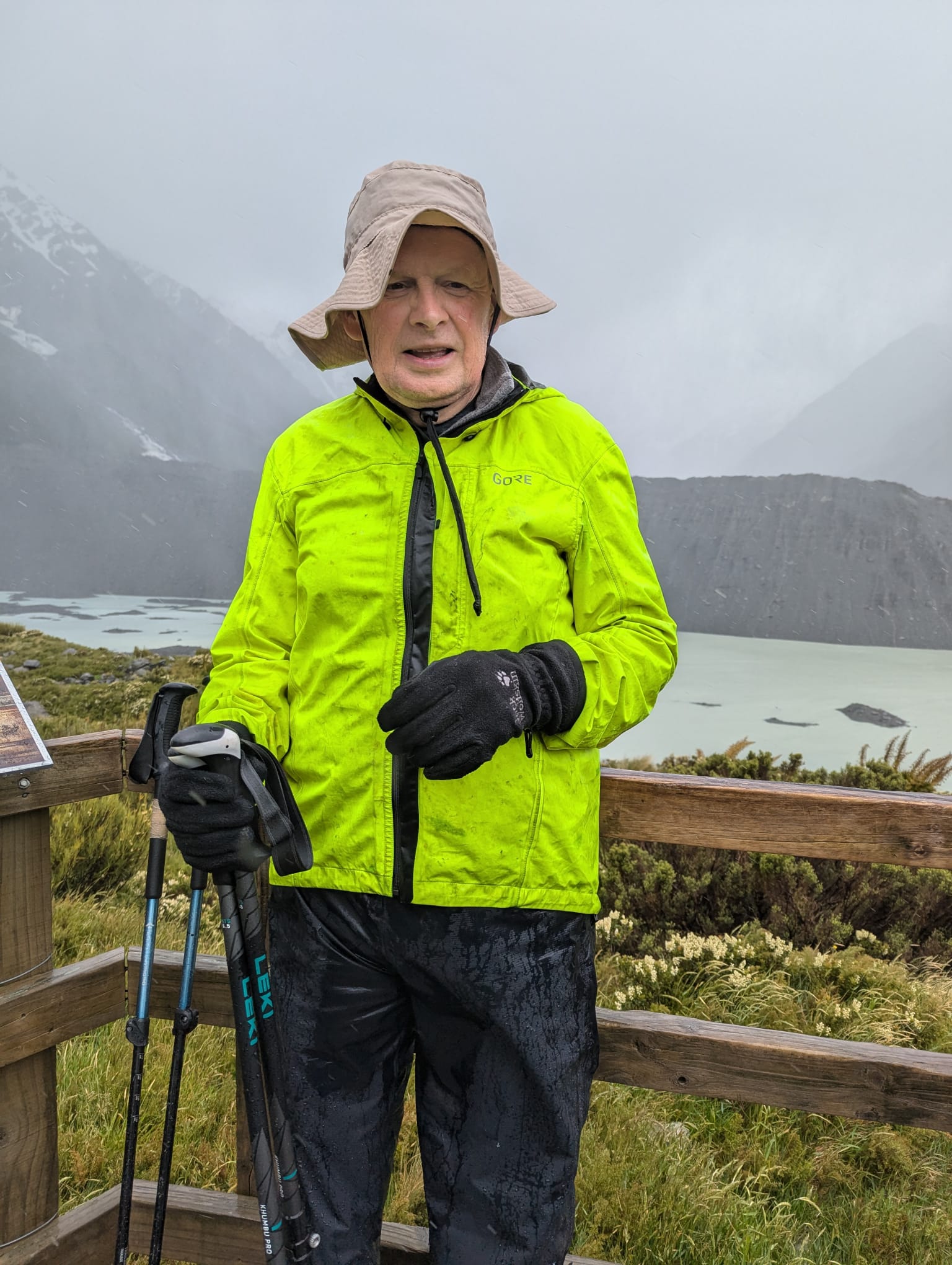
We are heading towards the end of our trip around Aotearoa, as we are now learning to call New Zealand.  Today we started from our accommodation and drove from Te Anau to walk the beginning of the Routeburn Track.  The clouds were building and it was raining fairly hard by the time we started the walk.   

The route goes over the mountains and comes out not too far from Queenstown, but we were only doing the first couple of hours of the track, but it looks a great walk to put on the list for a return.  We slowly climbed through ancient rain forest – in the rain. 
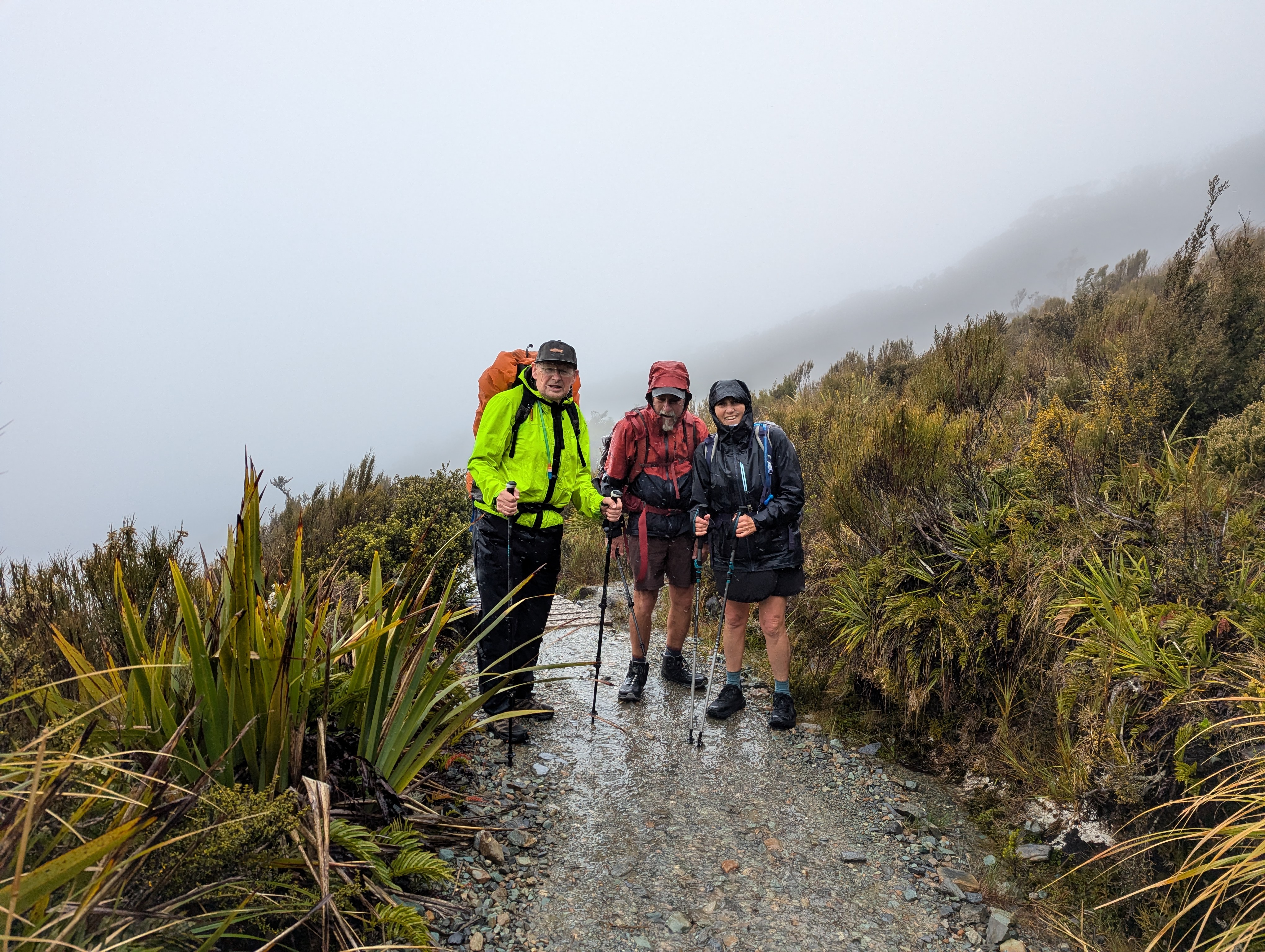
Walking up a track in a forest with no views with continuous water running underfoot does not sound too attractive, but actually it was very pleasant.  By this stage our fitness had improved, the forest protected us from the wind and so walking uphill was not a real effort as we were constantly conversation with people who were now friends, distracted by birds and plants.  When we emerged out of the forest, the wind and rain hit us, and the rain turned to something near hail. 

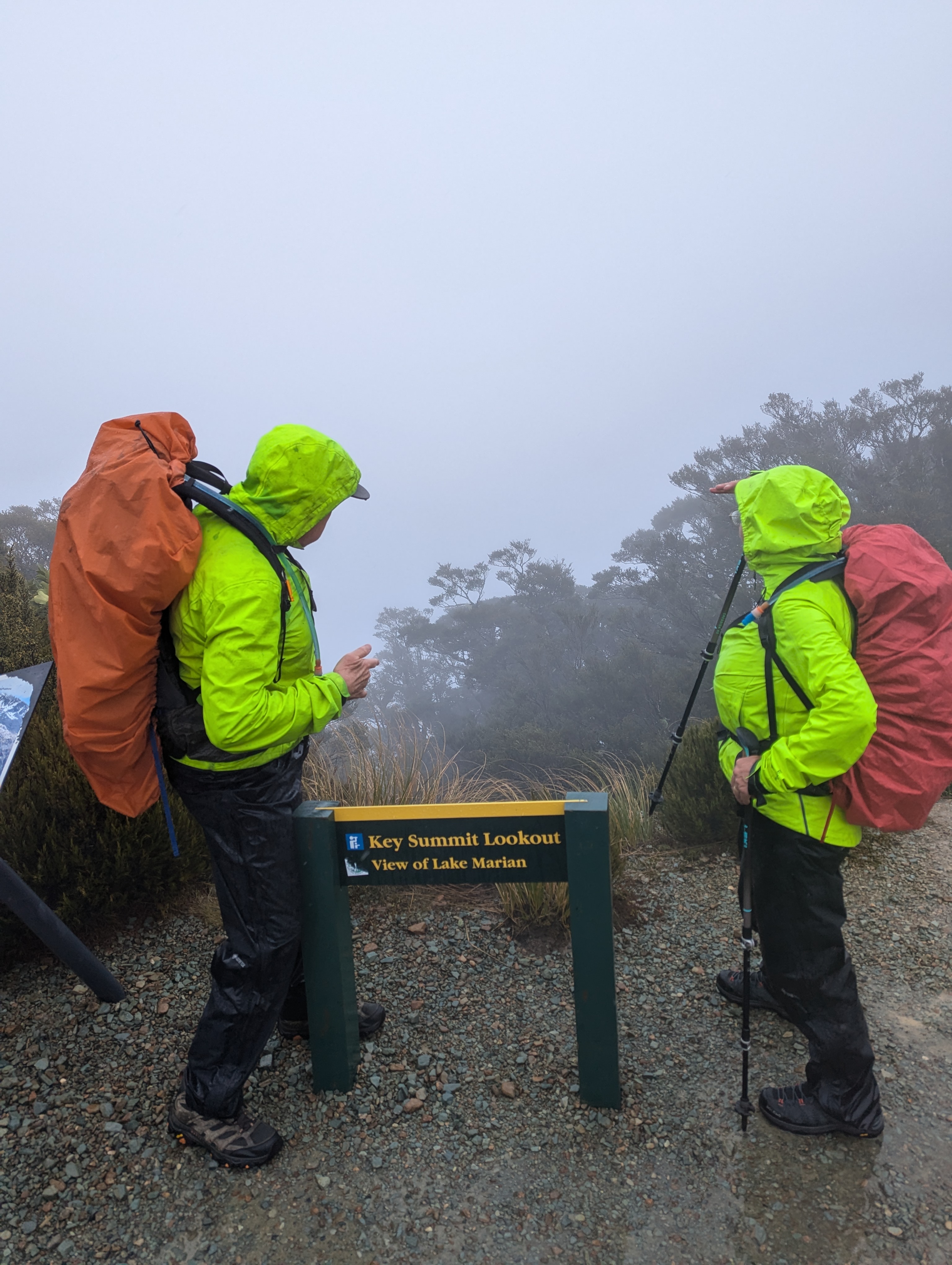
We carried on walking up and got to a “viewpoint” but, of course, there was no view – just clouds and rain.  We still felt a small measure of elation at reaching the top of our final walk of this trip with all our group. 
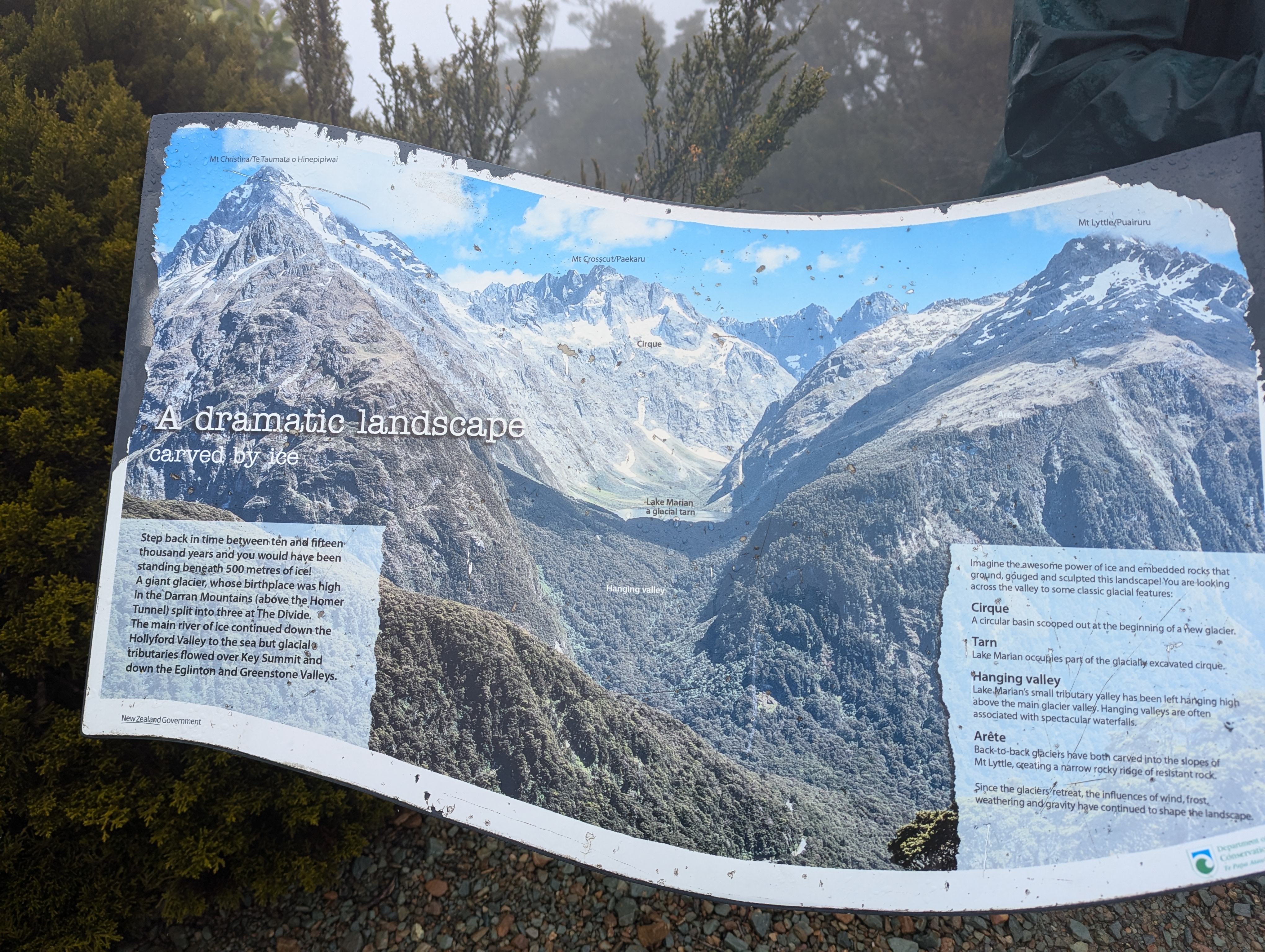
What we might have seen on a clear day

The amble down the hill was, of course, easier but felt longer.  The rain continued and we got out of our wet weather gear at the bottom.  Then we were driven over the mountain, through a tunnel and into the valley leading the town, Milford Sound, which is at the start of the glacial valley called the “Milford Sound”.
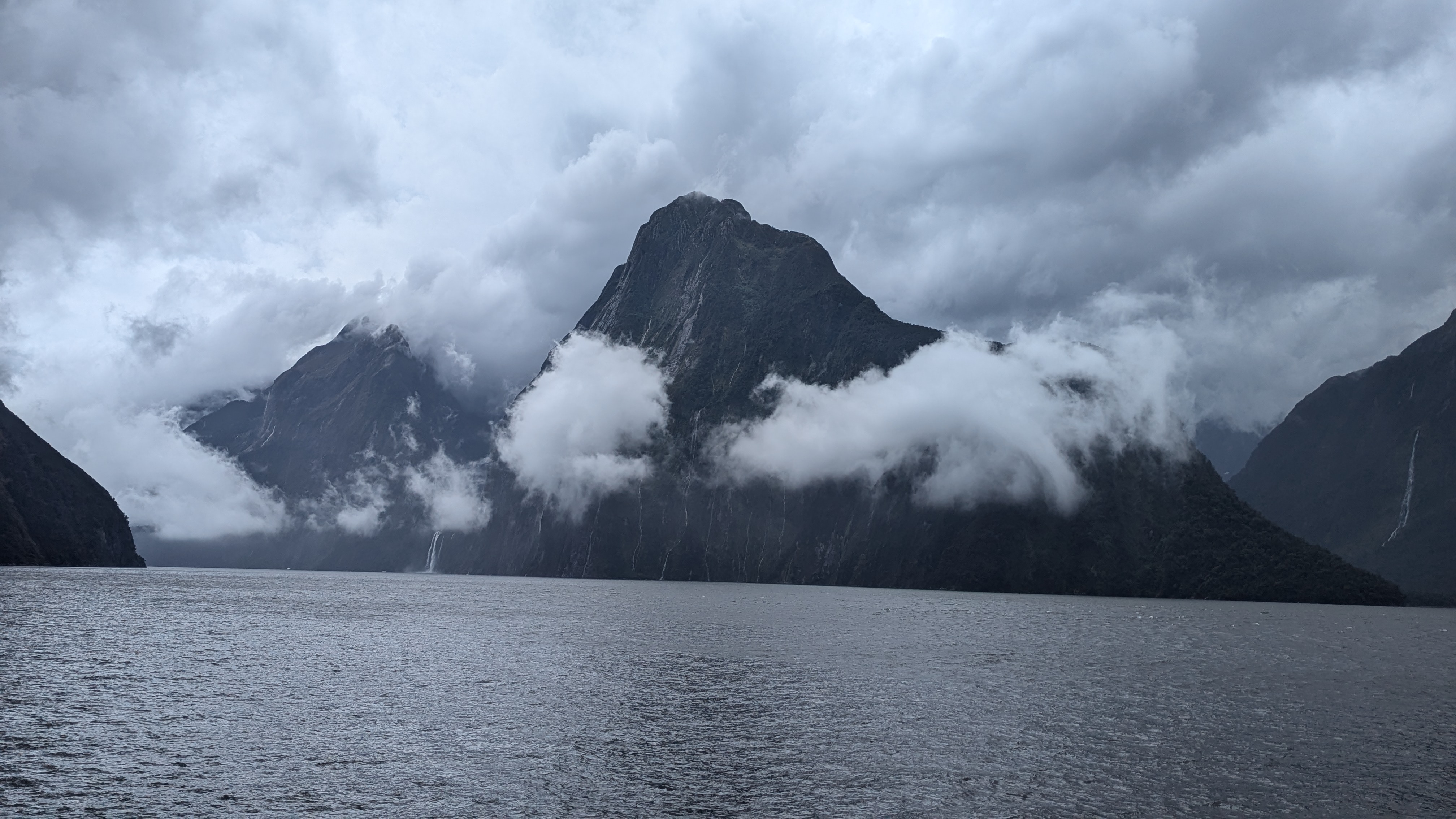
What we could see!!

We tried to find out if there was a difference between a “sound” and a “fjord” (or its less common spelling of “fiord”).  A fiord is a narrow inlet of the sea between cliffs or steep slopes, which results from marine inundation of a glaciated valley.  In contrast a “sound” is formed by the flooding of a river valley, not a glacial valley.  Milford Sound is an amazing glacial valley, where the force of the ice has carved out spectacular walls hundreds of metres high, creating a valley leading to the sea.  So, of course, it is a fjord and not a sound.  So why is the most famous fjord in the Southern Hemisphere misdescribed as a “sound”.  Only a pedant would ask that question, he says in a self-revealing comment.
The area was well known to the mauri who fished the area.  Early European settlers did not explore Milford Sound by boat, not realising that inside its narrow entrance there was such a beautiful region to explore. In fact, it is so well hidden that the famous explorer Captain Cook managed to miss the entrance to the fiord twice! In 1823 a sealer called John Grono was the first European settler to visit. He named it Milford Sound after Milford Haven.  Milford Haven is an inlet on the Welsh coast, but there is frankly little comparison between the magnificence of Milford Sound and Milford Haven!
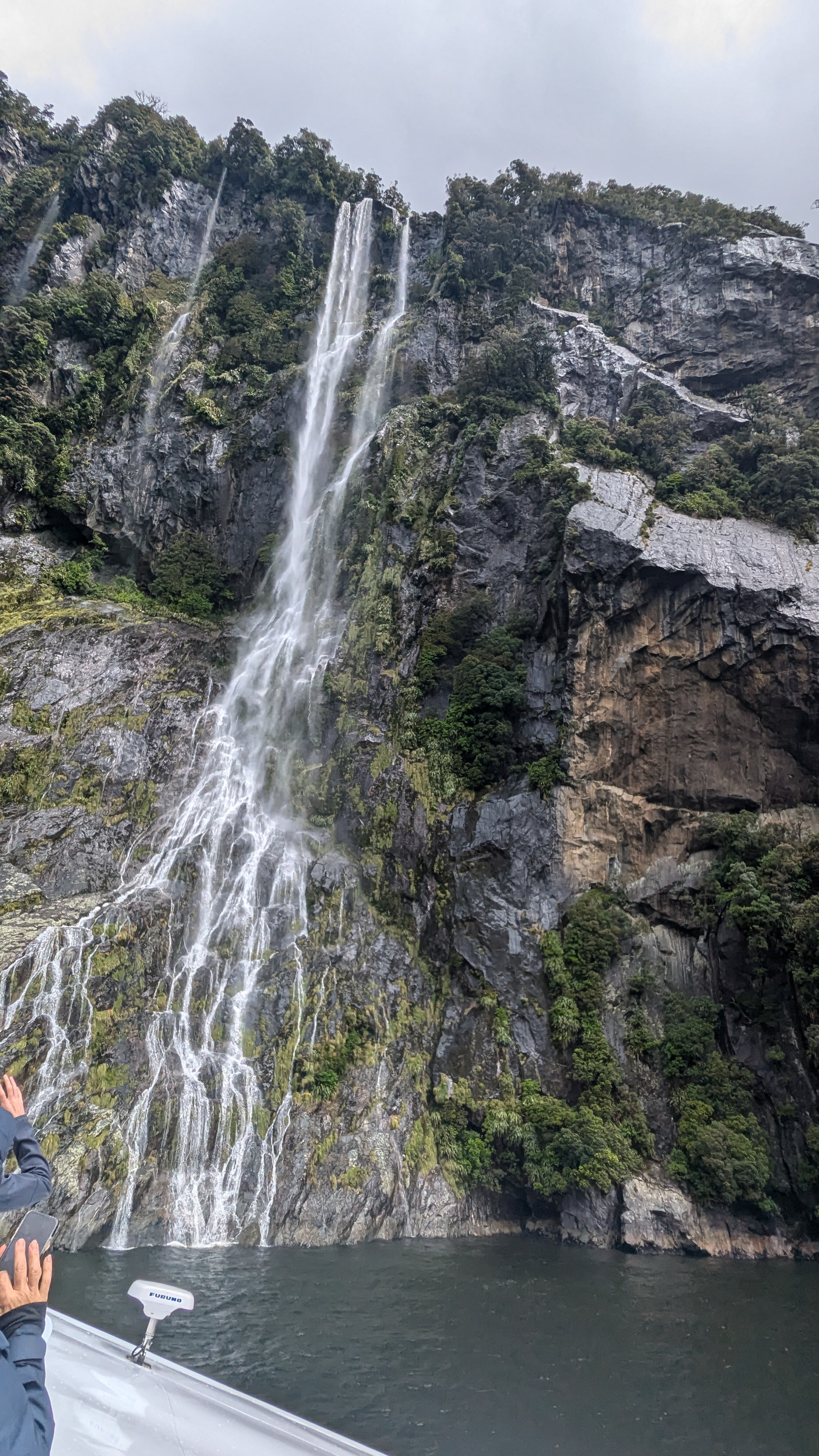
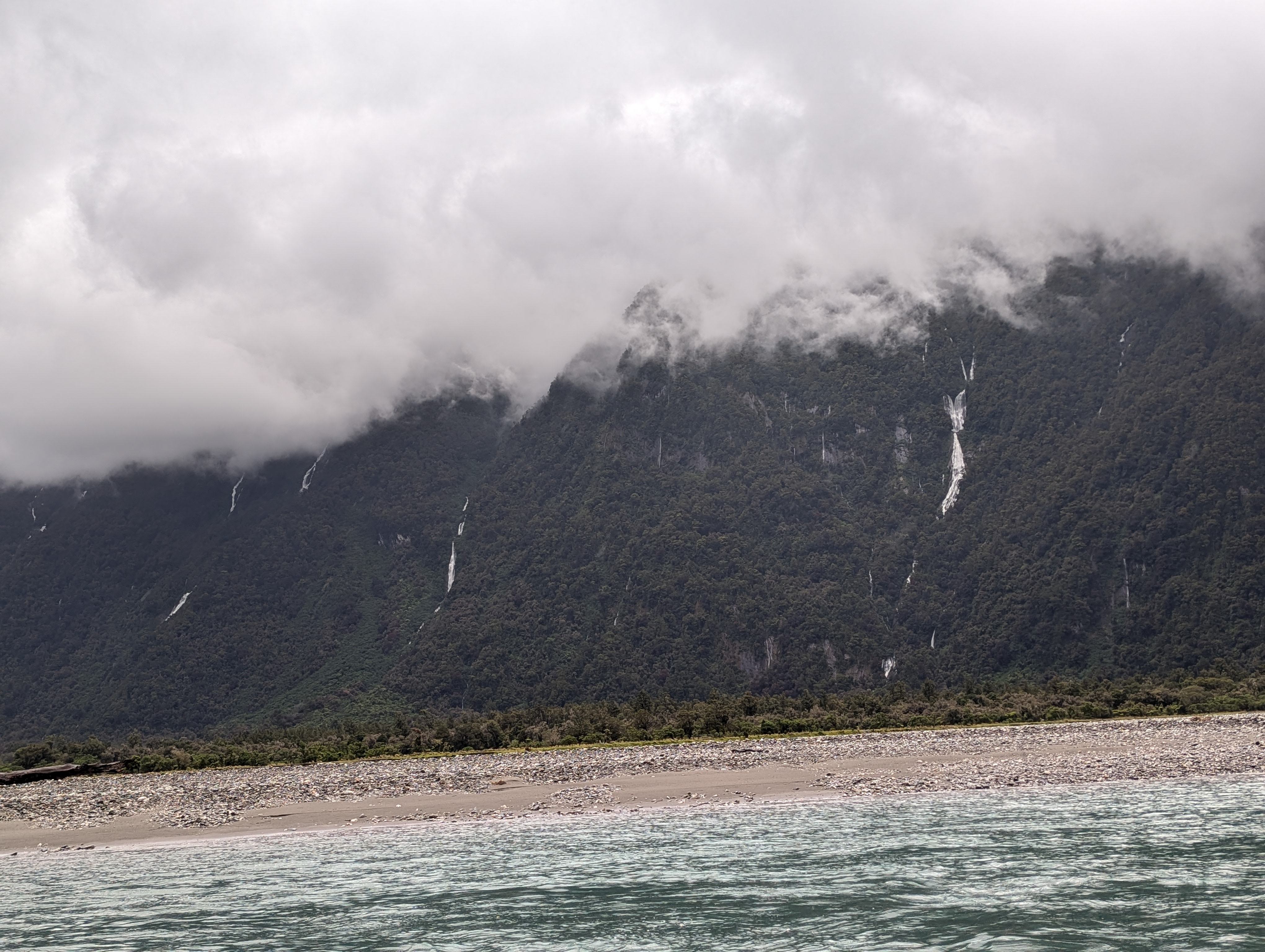
We felt a bit “processed” as we lined up to take a boat up the sound, but that feeling soon disappeared as we gazed at the awesome rocks.  The fjord is 10 miles long so it was a pleasant couple of hours cruising up and down, looking up at the rock formations.  There were numerous waterfalls – but they come and go depending on the rain (and it rains a lot here- about 7m of rain a year).  These waterfalls start within a couple of hours of rain, and then stop within a day of the rain ceasing.  It had been really wet in the hours before we visited so they were all in full flow, even though it was largely dry when we were on the boat. 
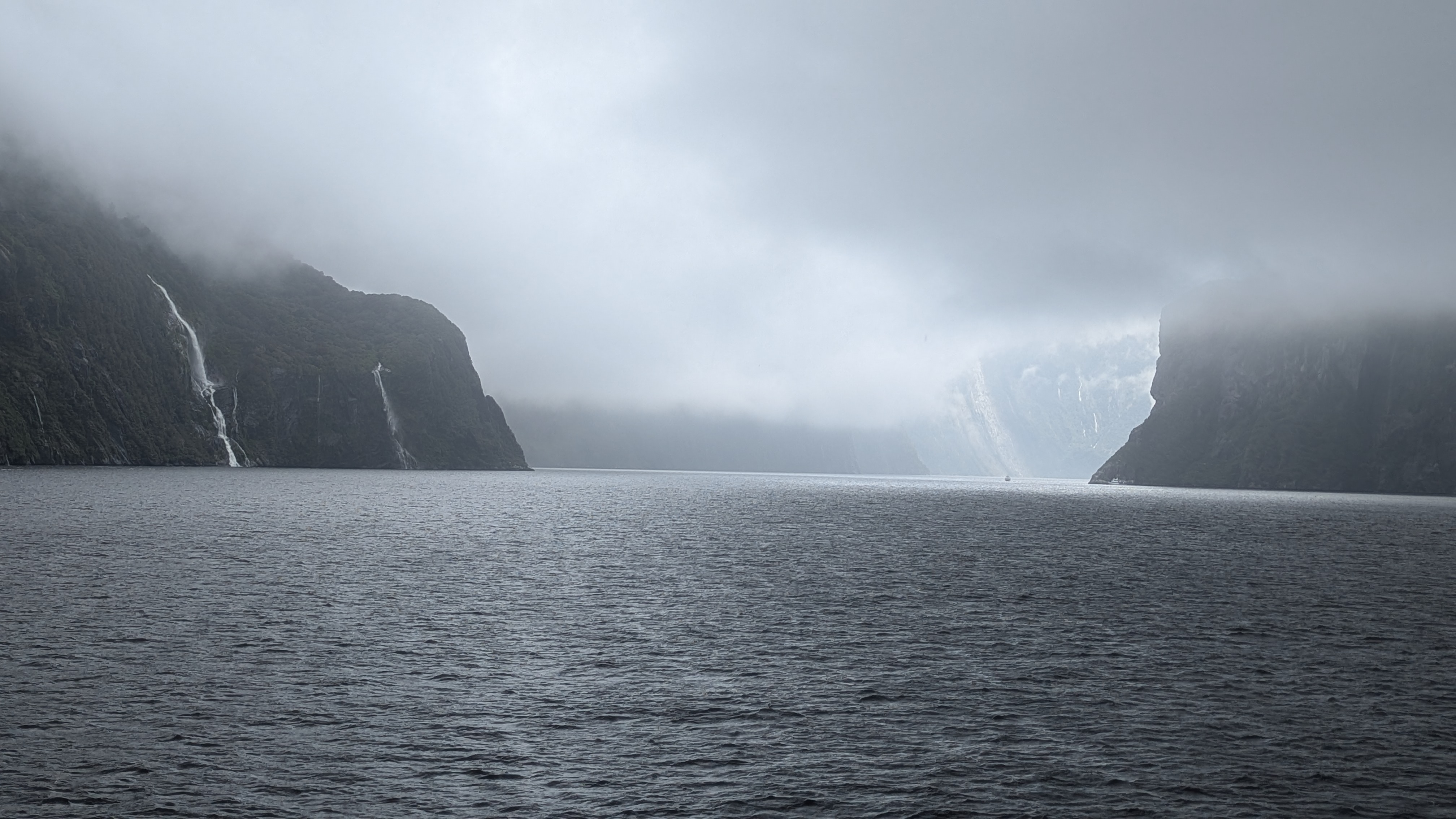
The only way to describe the place is with pictures and so I’ll let the pictures do the describing.
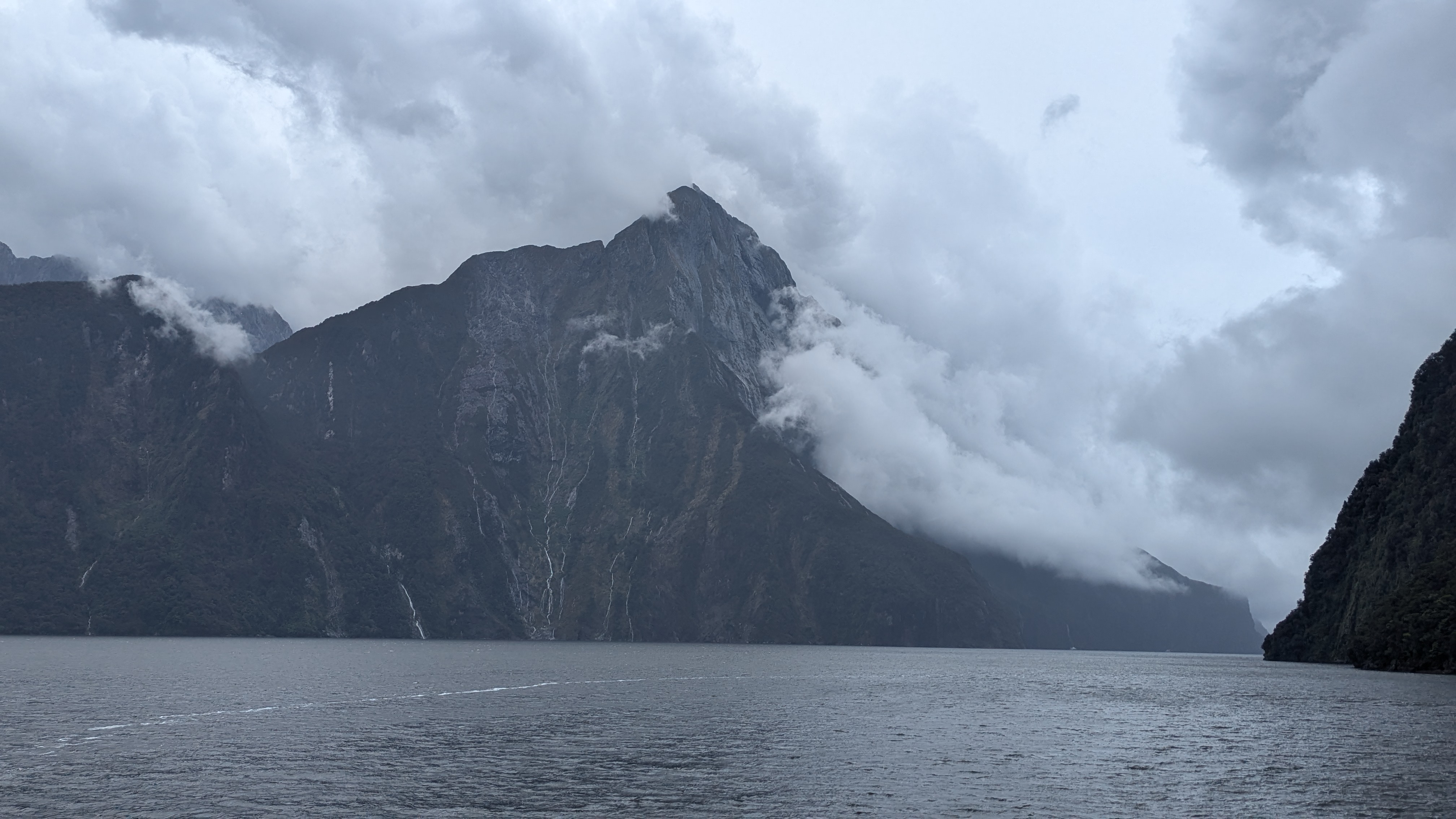
Then it was back in the bus and a return to Te Anau.  That trip brought an effective end to our New Zealand odyssey.  Thanks for taking the time to read – please respond or subscribe if you want to read about future travels.

Great memories of an amazing trip

A Jetboat trip up the Haast river and on to Makarora

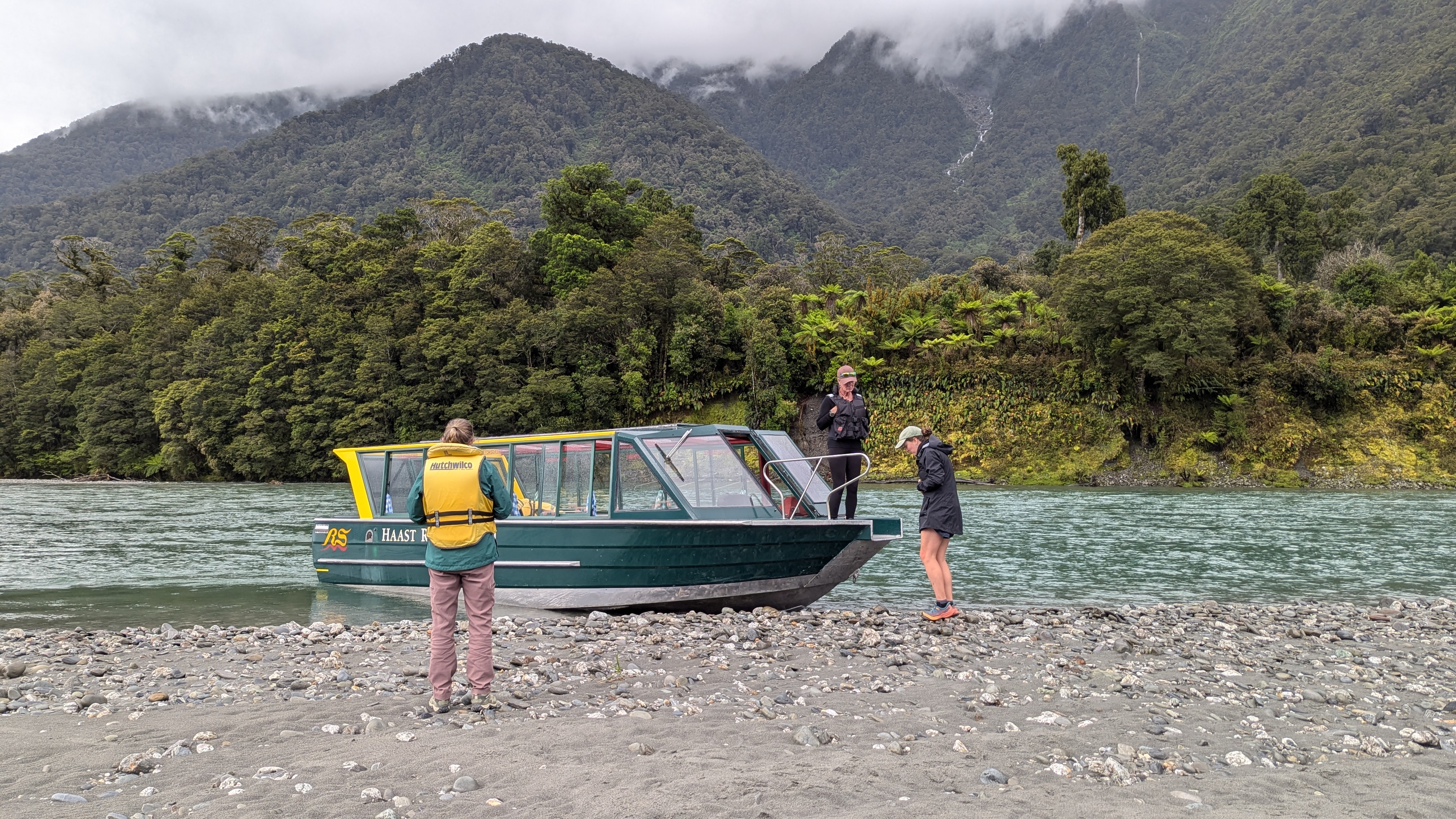
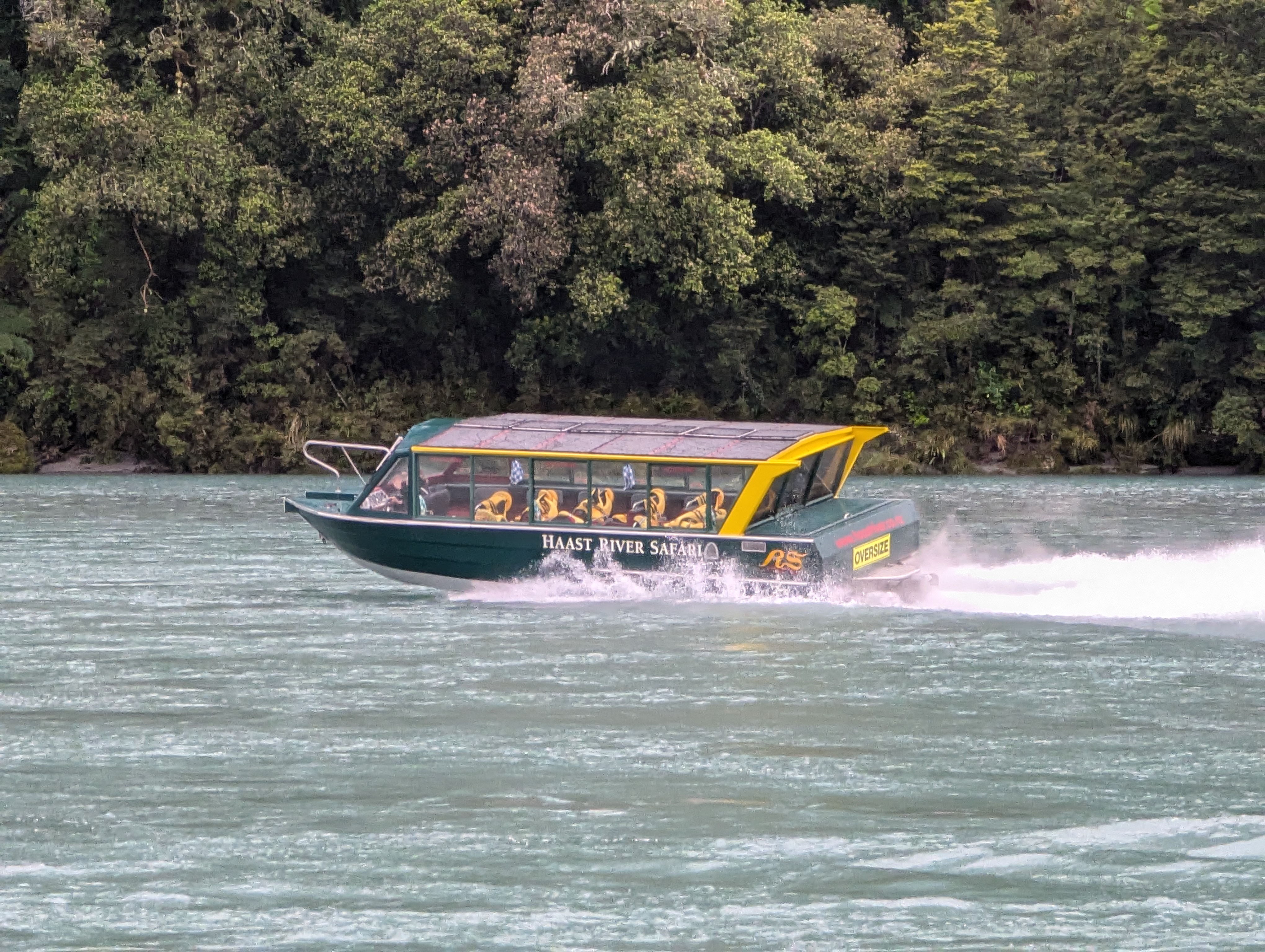
We started the day on the bus to get through before the road closed.  There had been a landslip and the road was closing at midday – so we went early to pick up our boat at the mouth of the Haast river. We were directed onto the jet boat by our driver and guide – a formidable huntin’ shootin’ and fishin’ woman – for the 36km ride upstream. She described how she lived in the tiny township of Haast, proudly told us the entire population numbered 259 and that the nearest supermarket was 2 hour drive away in Wanaka.  She said the locals were hugely self-supporting and largely made do with what they could hunt or forage from the sea – mainly fish and crayfish.  She said she could take her boat home and in half an hour put on her dive stuff and come back up with 6 crayfish and 10 abalone (a type of sea snail) – the allowed daily quotas. These were not crayfish as we knew them but in her photos looked like enormous lobsters.  She told us that she could also shoot dear from her from gate. We decided she was not to be messed with – but she was also informative and great fun.

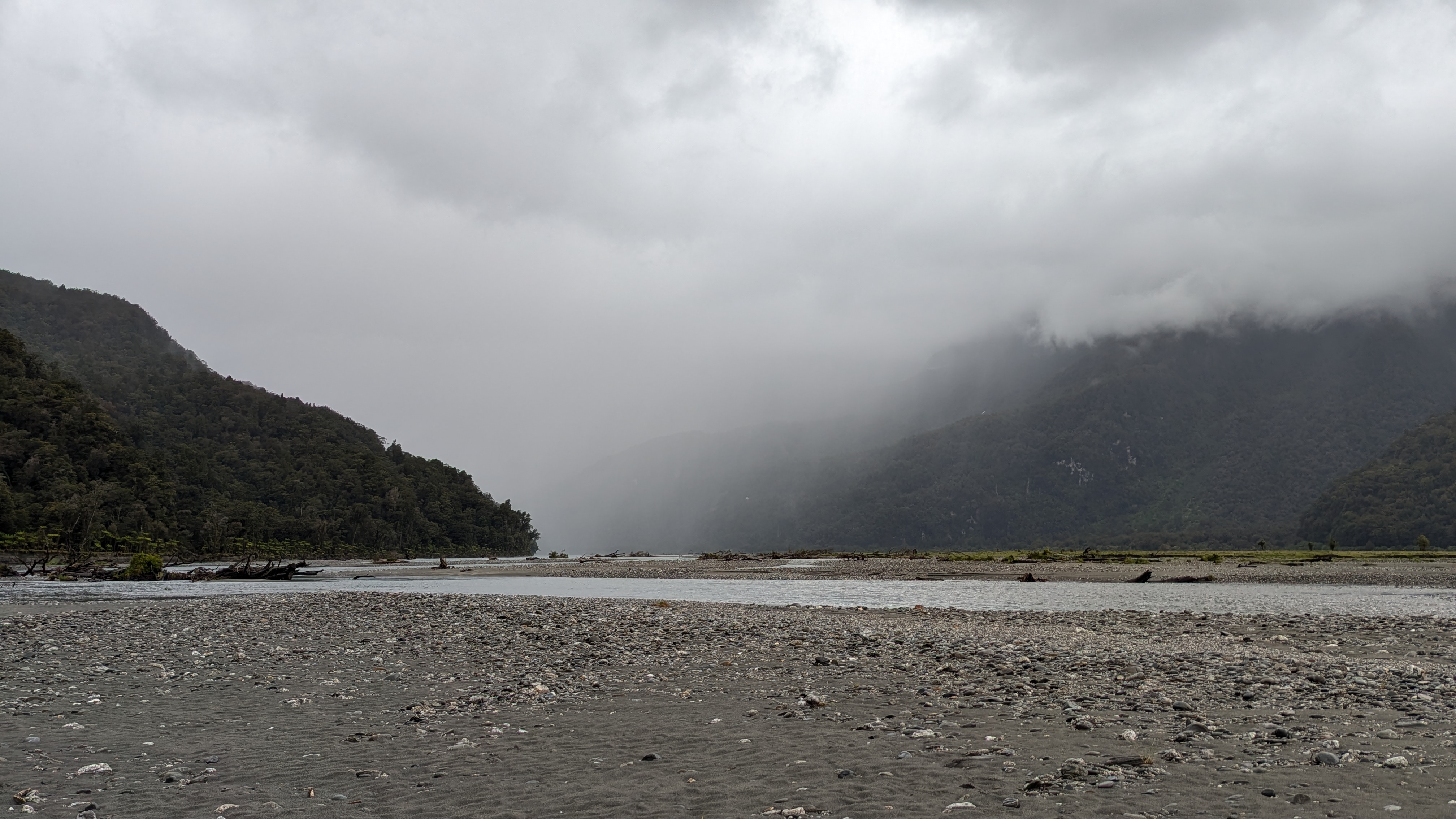
The Haast is a braided river – a glacial river formed of many channels. The jet boat was invented in New Zealand she claimed to allow navigation through the sometimes very shallow channels.  When the boat is at full speed and rising above the water, she only needed 4 inches clearance (she also said the Japanese had stolen the idea to develop jet skis).  The river channels can change after every rainfall and we marvelled at her skill as she wove through the river threads at considerable speed.
The Haast river is located along the Alpine Fault, where the Pacific and Australian tectonic plates clash against each other.  These plates are responsible for forming the Southern Alps. We were shown the valley where the Pacific plate is on one side and the Australian plate on the other – a rare event on land apparently.  They appeared quiet as we passed over.
She stopped the boat after half an hour or so to land on a large stony sandbar, and invited us to disembark to look for Douglas Jade – a rare form of the green stone that is famous in NZ.  Needless to say none of us made out fortune by finding any real jade, but we did find a lot of pretty stones!

We got back on the jet boat and zipped up the river, passing numerous waterfalls which formed whenever there was recent rain. ‘Do you want to spin’ she said?  As “no” didn’t appear to be an acceptable answer, we were told to hold on tight with both hands and after picking up speed she did the equivalent of a handbrake turn, which had us all squealing like kids on a rollercoaster (with much the same feeling). After four of these, the final turn brought us up opposite the largest waterfall – and with some relief the journey was over!

 We continued up the narrowing river valley in the minibus and over the Haast pass. We stopped for a short, wet walk through the forest to a lookout point – but it was rainy and foggy and not much was seen.

We ended the day at the Wonderland Lodge on Lake Makarora – a complex of toy-town like A framed houses. The clouds were clearing so we could see the mountain tops from our bed.  Our guides cooked us a delicious barbeque to end the day.

Return walk from Bushline Hut and Coastal Walk to Seal Colony

(David) The night was quite cold and the wind blew under our tent. I felt it blowing right onto an exposed patch of my body; one where the sleeping bag appeared to have no effective covering.  Adjustments to clothing mostly sorted this and eventually we both slept well – or fairly well at least.  We woke, ambled into the hut and were greeted by tea, coffee and breakfast!  We could get used to being catered for.

After breakfast we packed up and ambled down the mountain.  I have been resistant to out and back walks in the past but we have done quite a few this holiday and my resistance is crumbling.  The views are different going the other way, the weather is different and we see the mountains at a different time of the day.  It was a delightful hour plod down the hill, with great views of the lake and then back to the minibus.

We put this in because it made us laugh!

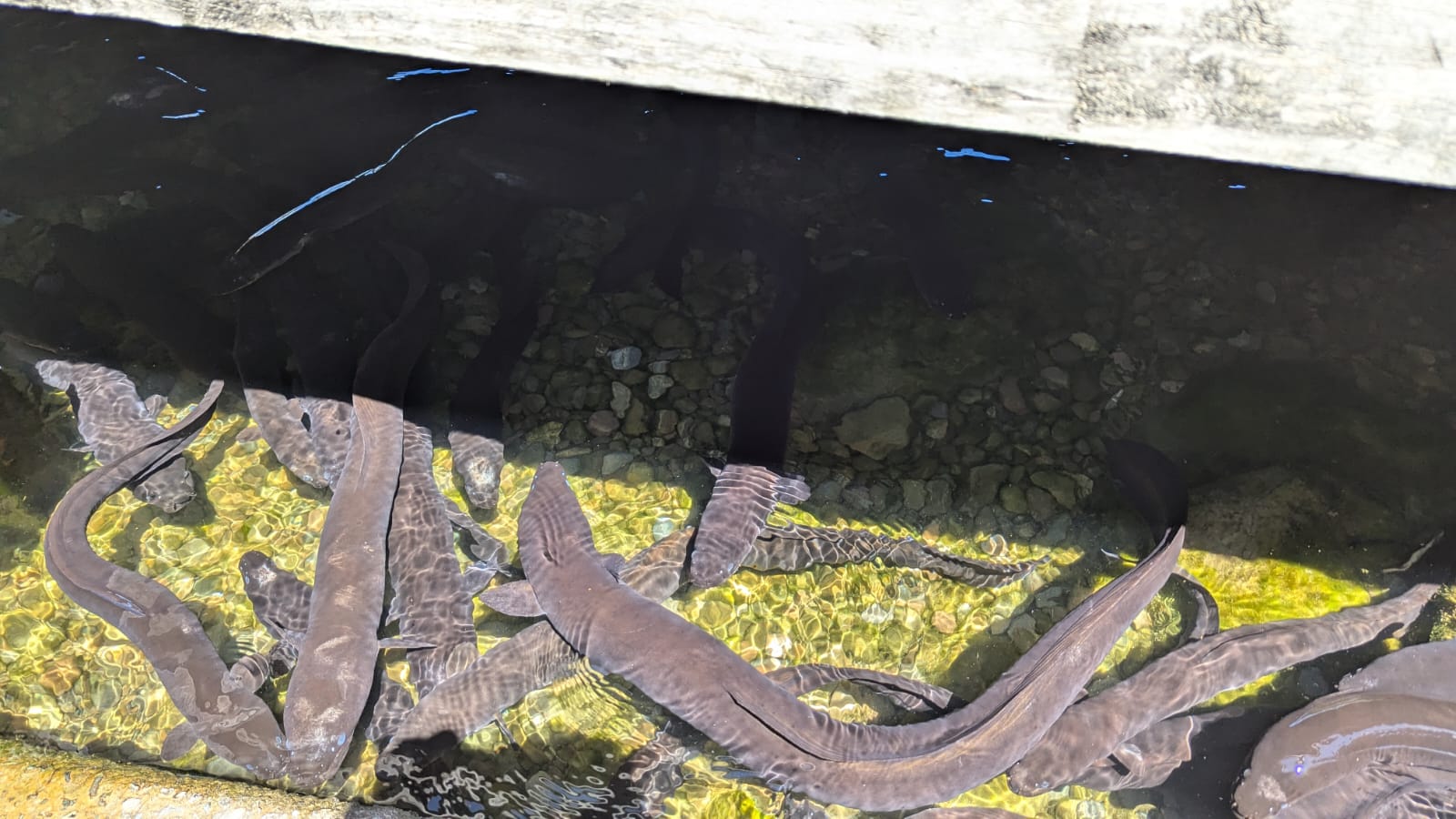
We had a bit of free time at Lake Rotoiti again. We and saw again the long finned eels around the jetty and read about their incredible lifecycle.  The eels can live up to 100 years of age and only spawn once in their lifetime. Before spawning they leave the lake and head to the Pacific and swim 1000s of miles to near to Tonga where they mate, spawn and die.  The baby eels spend 7-10 months drifting back to New Zealand on the ocean currents and as they develop, swim upstream to the lake.

Leaving the lake we had  another (tedious) drive of a few hours, heading to the west coast, where we reached the wonderfully named “Cape Foulwind”.  We were booked into mini-cabins at this seaside resort.  The area was a former quarrying centre where granite was discovered as part of the cliffs, and so these were blasted away to make roads and the like during the C19 and early C20. 

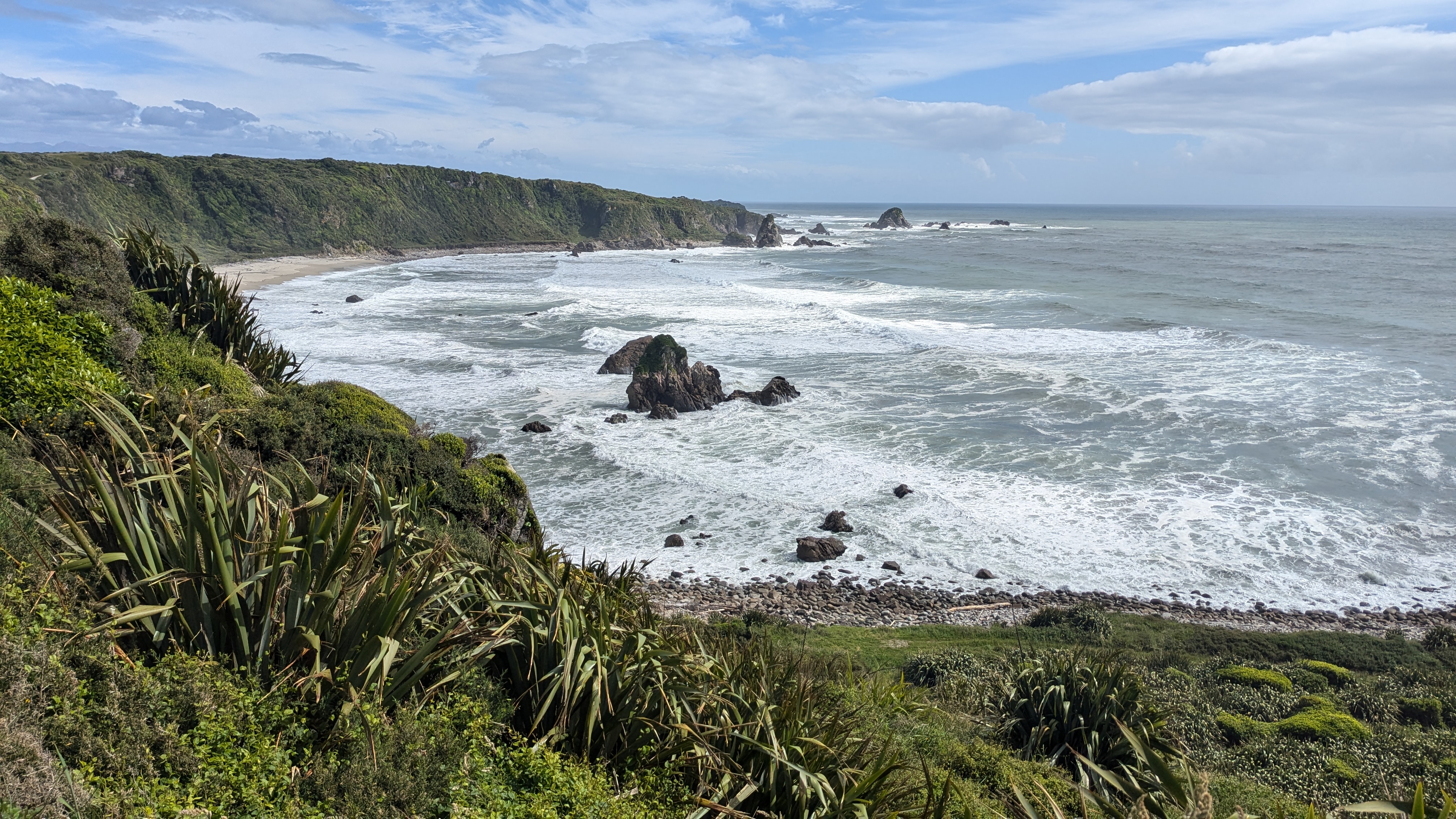
The stone was used in a concrete plant which operated here as late as 2016, but there is no evidence of the plant now.  Instead, there is a coastal area with some modern (expensive looking) houses probably being second homes for Christchurch’s elite.  We walked along the road and then joined a cliff walk at a lighthouse.  It was a great walk for a couple of hours to see a seal colony.  In typical DOC style, the path was well marked with barriers and signs preventing anyone being tempted to go too close to the cliffs. 

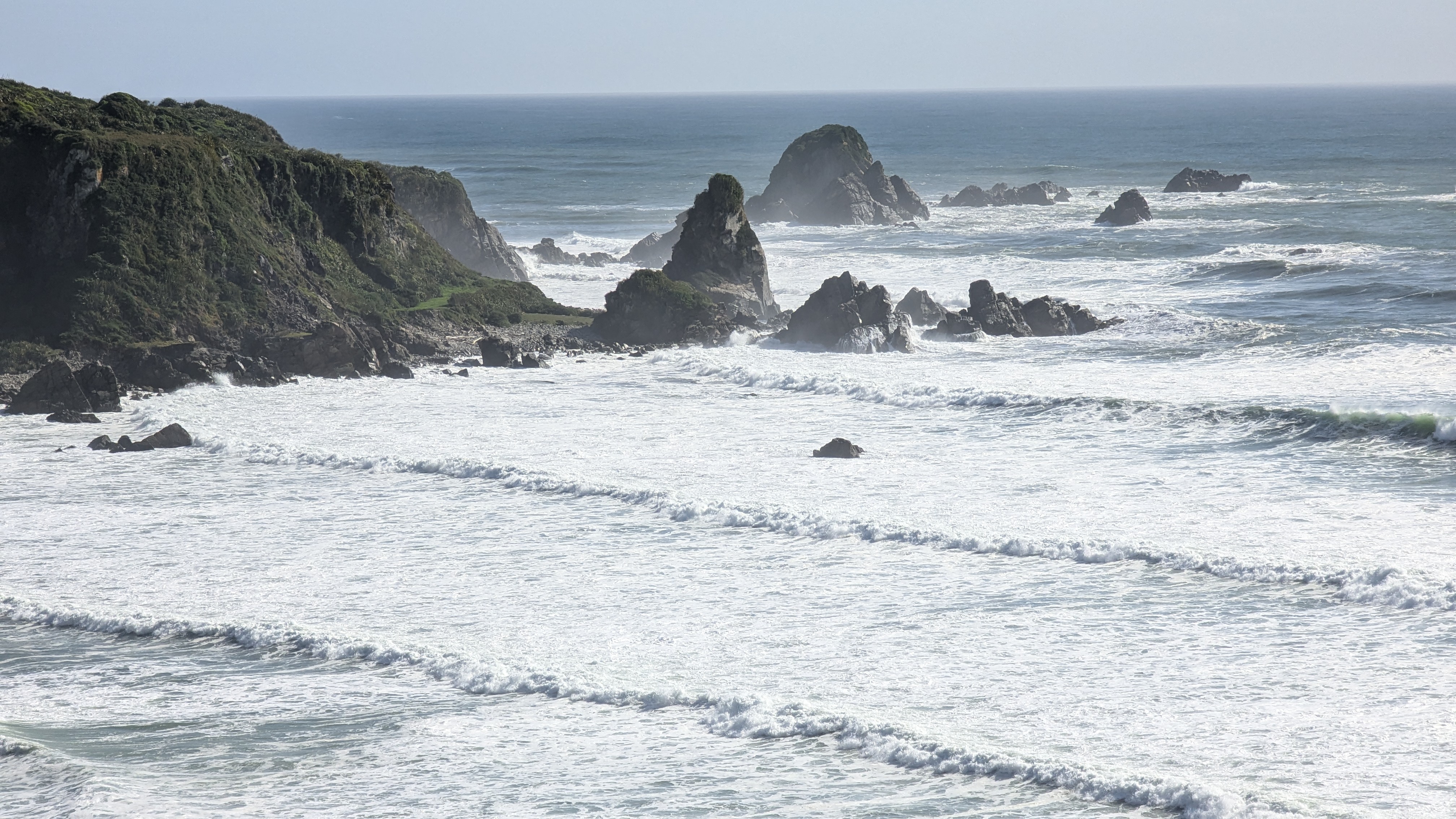
This was the Tasman Sea, with waves rolling in every few seconds.  It was a peaceful, sunny afternoon but the storms here must be impressive. 

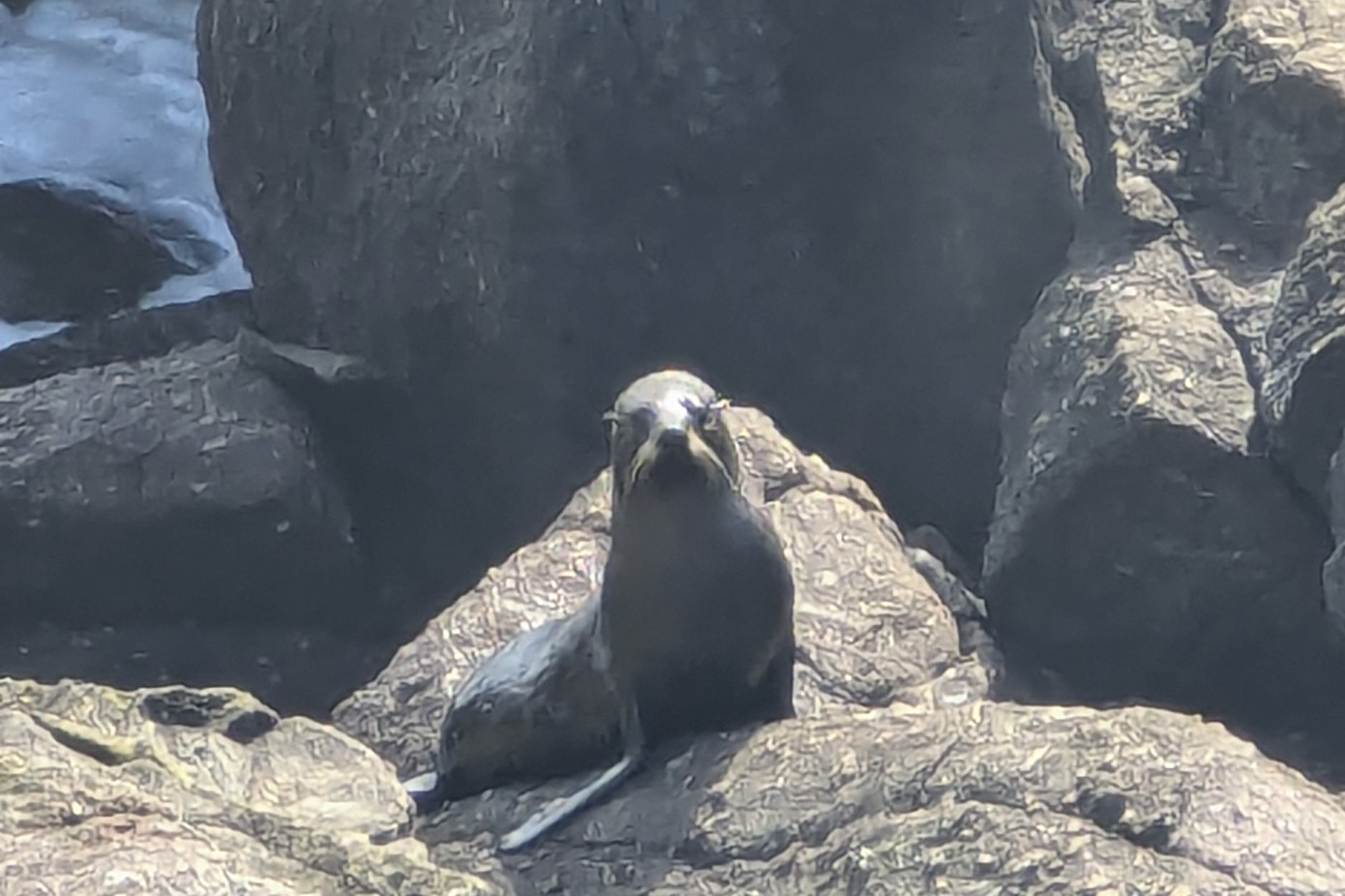
The seals were New Zealand fur seals (known as kekeno in maori).  They were lolloping about on the rocks, having an occasional spat and then gliding into the sea. 

We ambled back to the accommodation feeling we had had a good day.

Nelson Lakes National Park. Overnight hike to Bushline Hut.

Our day off in Nelson was cloudy and rainy – so much for being the sunniest place on the South Island. It gave us the excuse to do very little for the day; so we were raring to go the next morning, which did dawn bright and sunny.

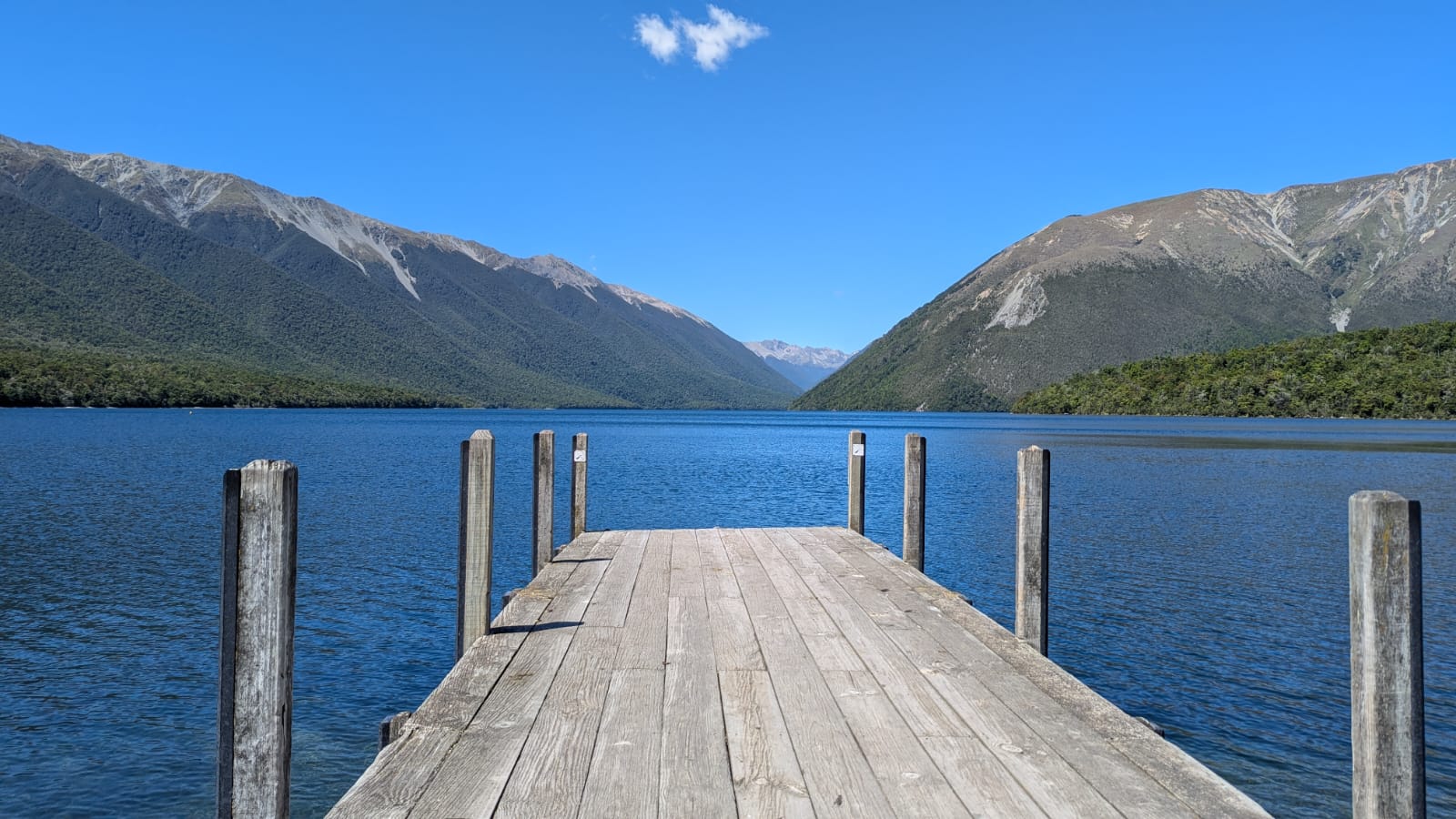
After a tasty breakfast (best coffee so far), a shortish drive took us to the beautiful setting of Lake Rotoiti in Nelson Lakes National Park. We did a short walk through the forest, learning about the key part played in the local ecology of the honeydew from the scale insect that lives in the bark of the beech trees. Unfortunately, invasive wasps were gobbling up the honeydew, so as in most parts of NZ, there was a programme to get rid of the invasive species to restore endemic species.

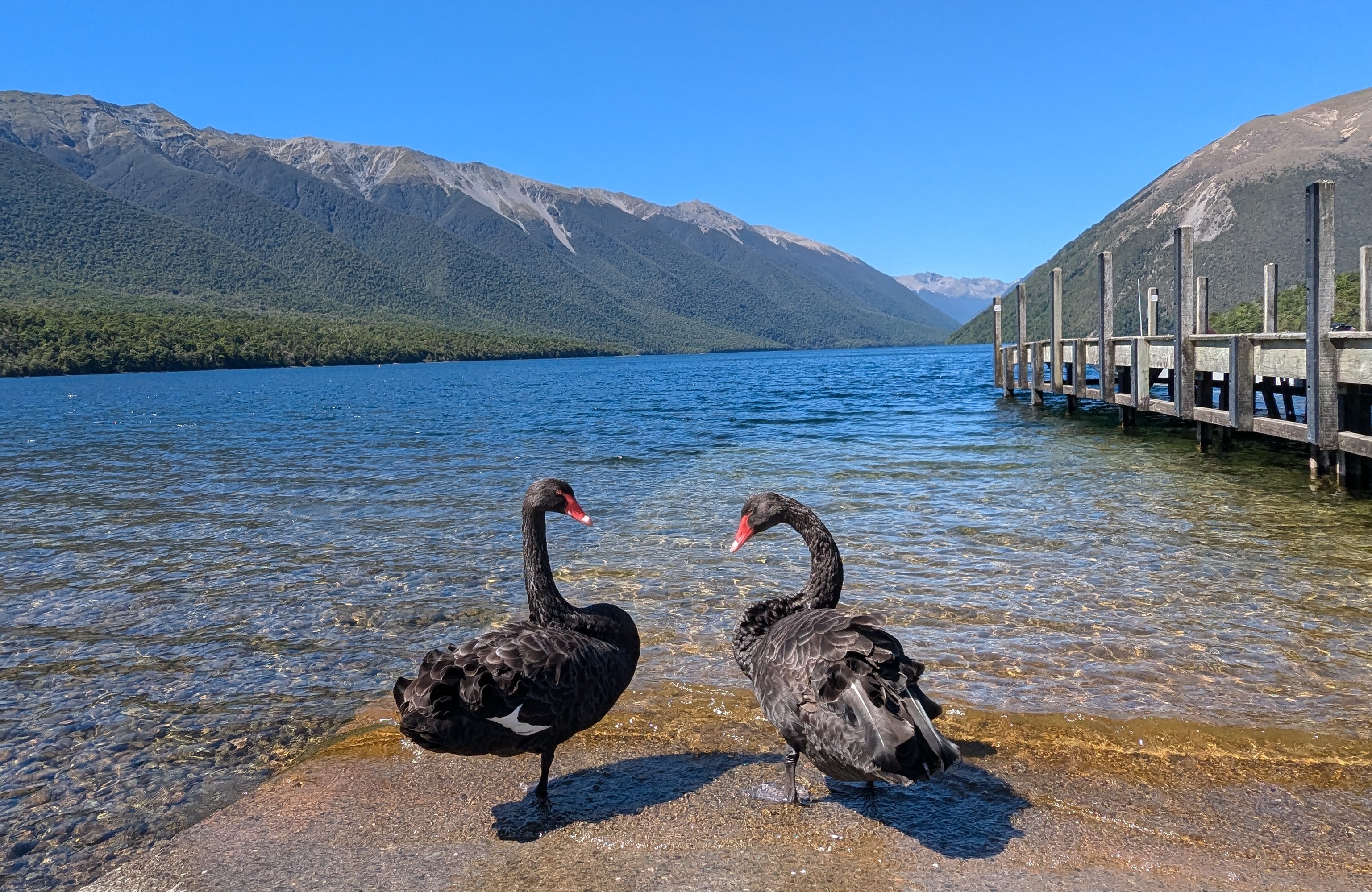
Lake Rotoiti
Eels below the jetty – they live for up to 100 years!

After an early lunch by the lake we set off on the hike proper for the day – a two hour tramp with packs up to Bushline Hut on Mount Robert, where we were staying overnight. We had elected to camp, rather than squash into the rows of mattresses in the hut, so were back to carrying full packs.  This paled into insignificance when we saw what out guides carried up –  their kit and all the food for 11 people for the evening meal and breakfast.  Their loads included 2 bottles of wine – I fear we set a precedent.

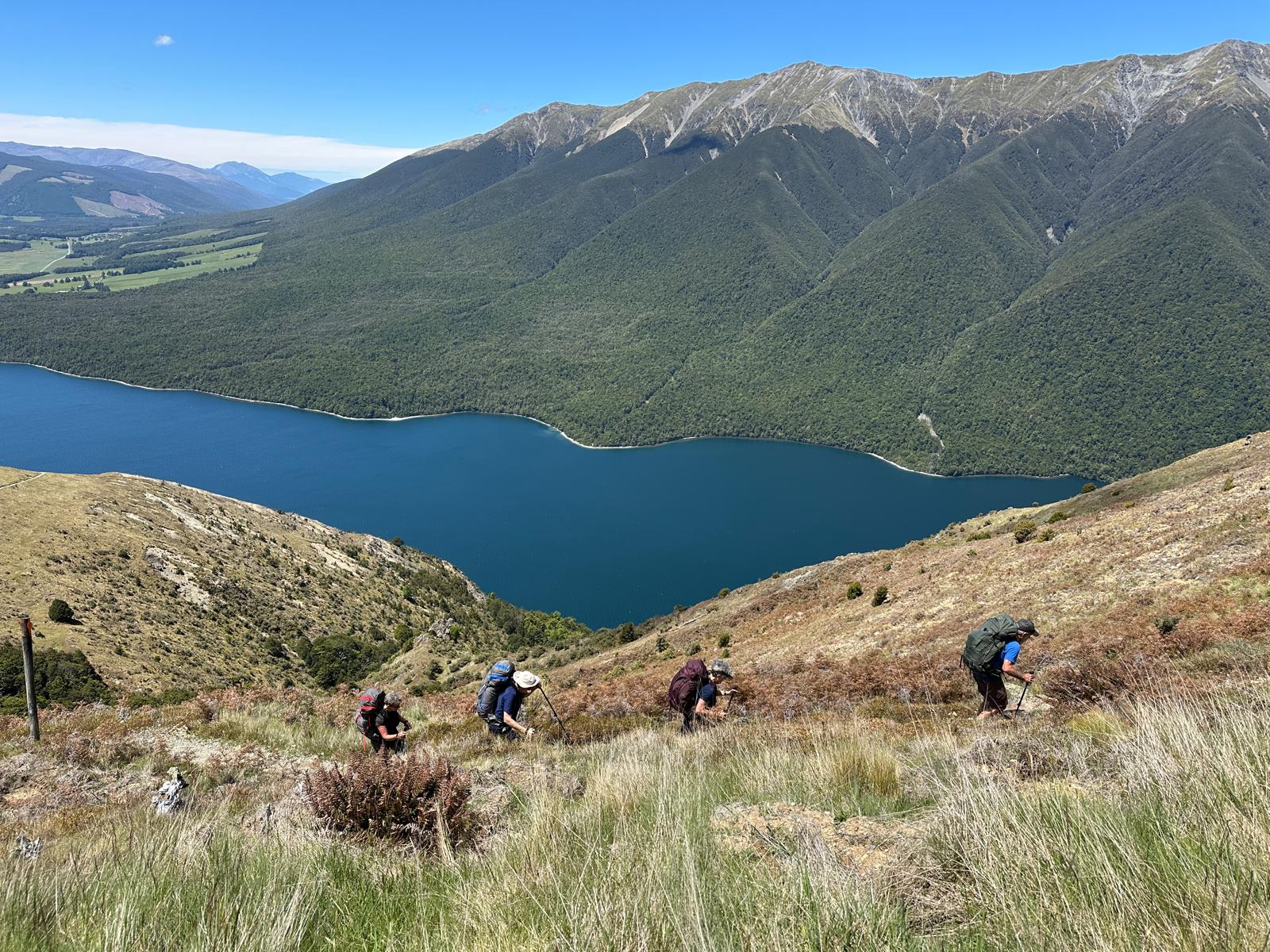
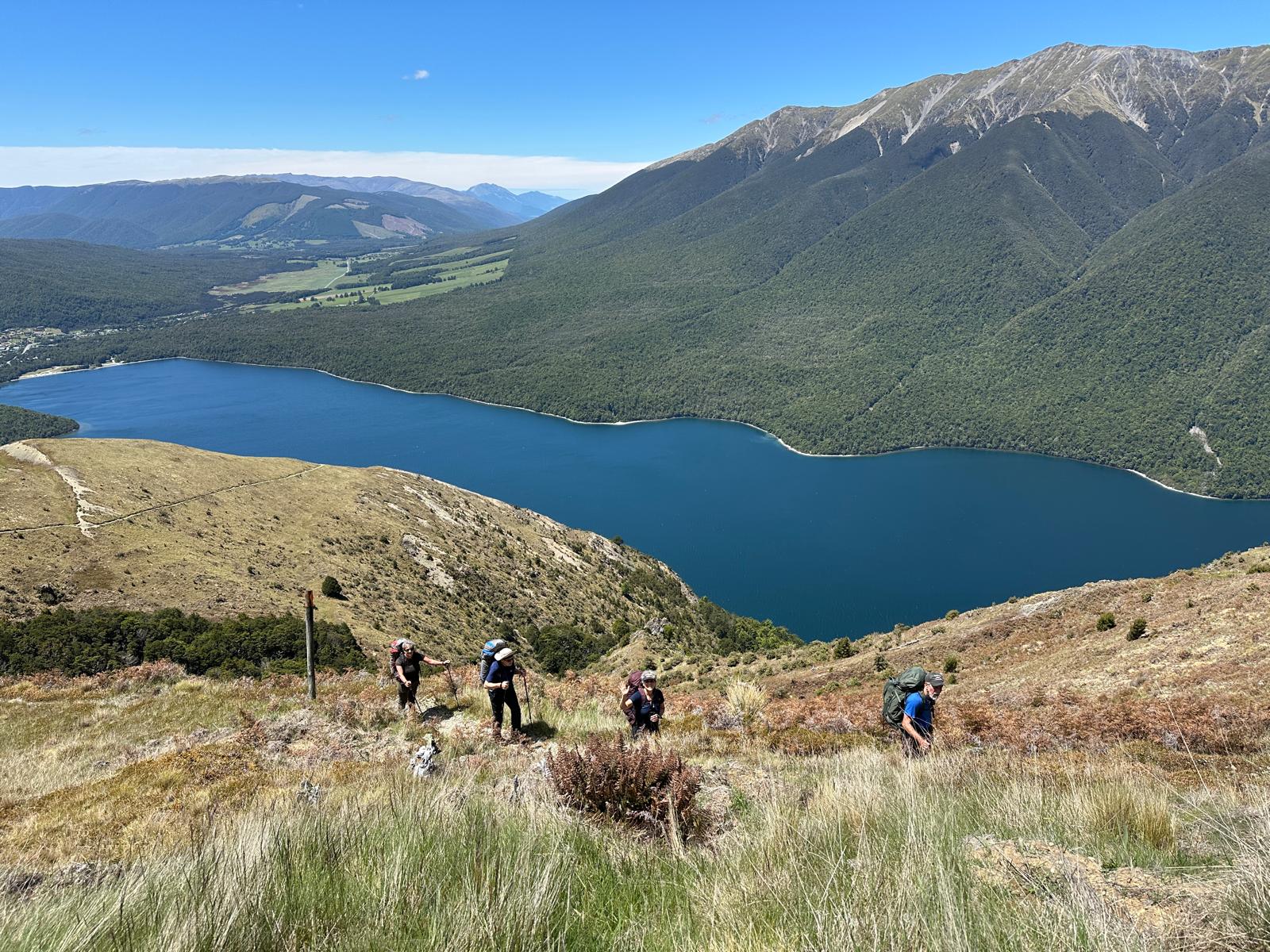
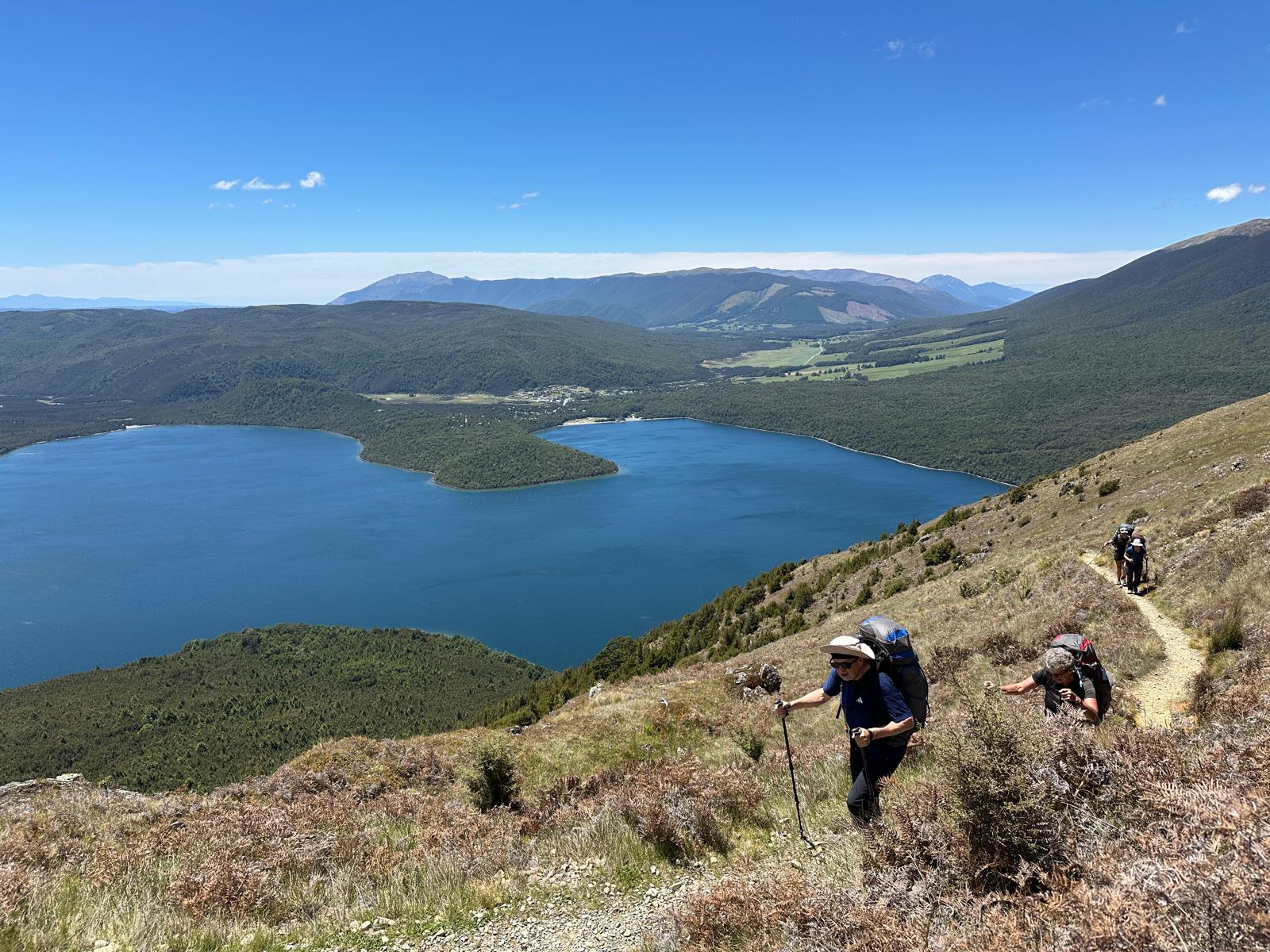
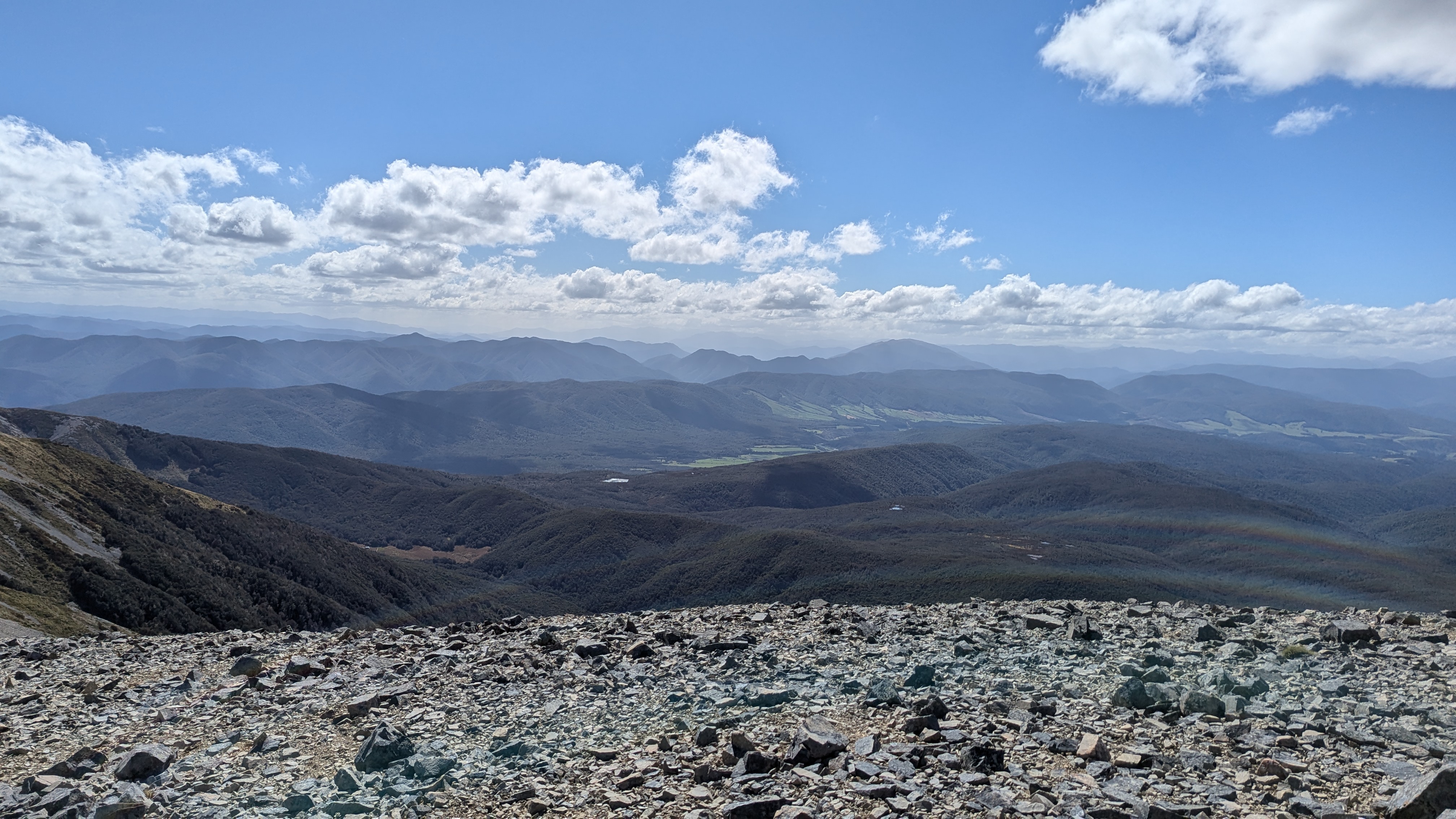
Back to the hike – this was a perfect climb. Nothing was too steep. The views over the blue lake were stunning.  As we climbed, the lake got smaller but the views over the mountains got greater, then we were rewarded with views over to distant mountain ranges. 

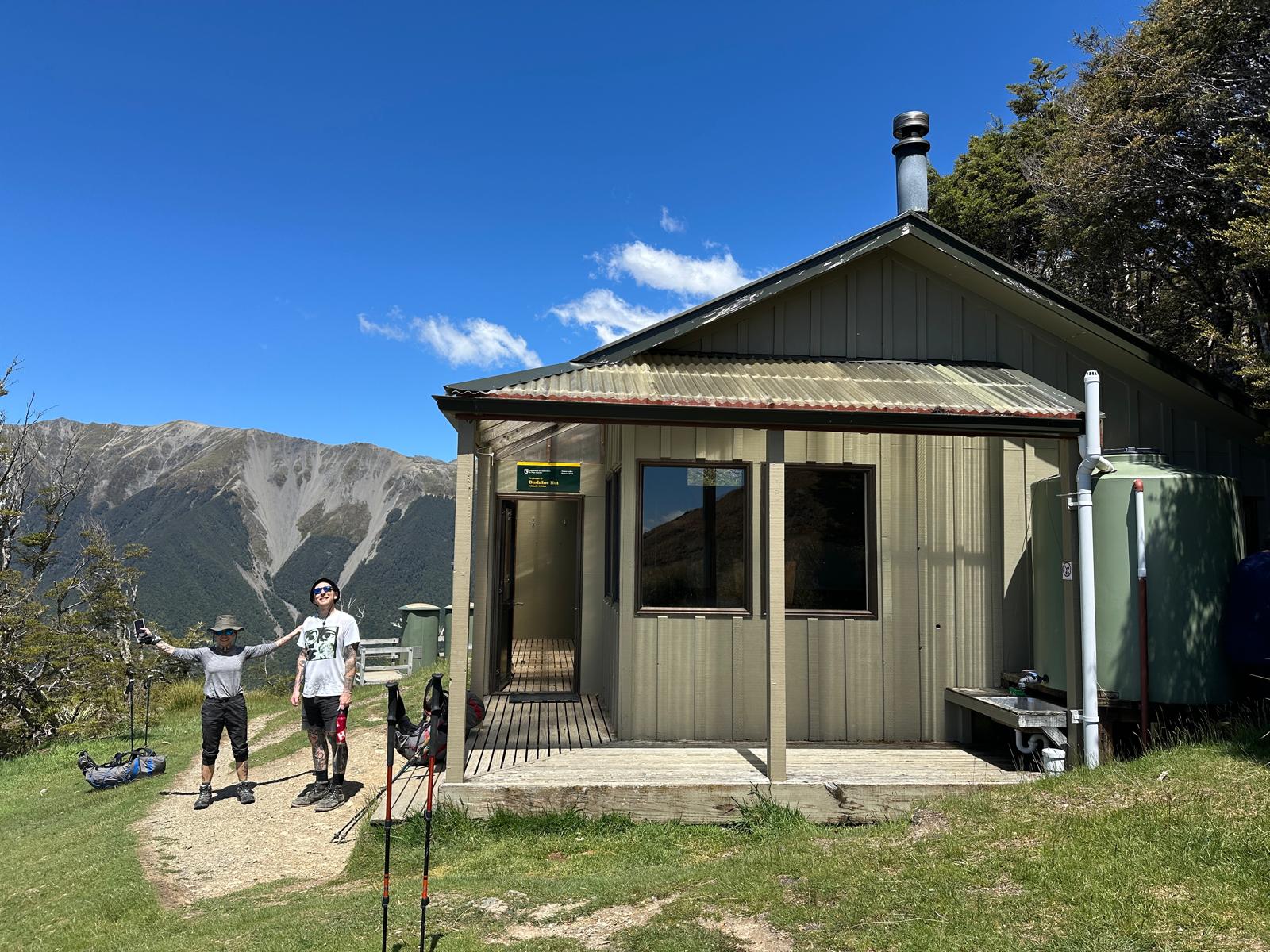
The setting of the hut was stunning – as the name suggests it was right on the bushline (or tree line as we would call it).

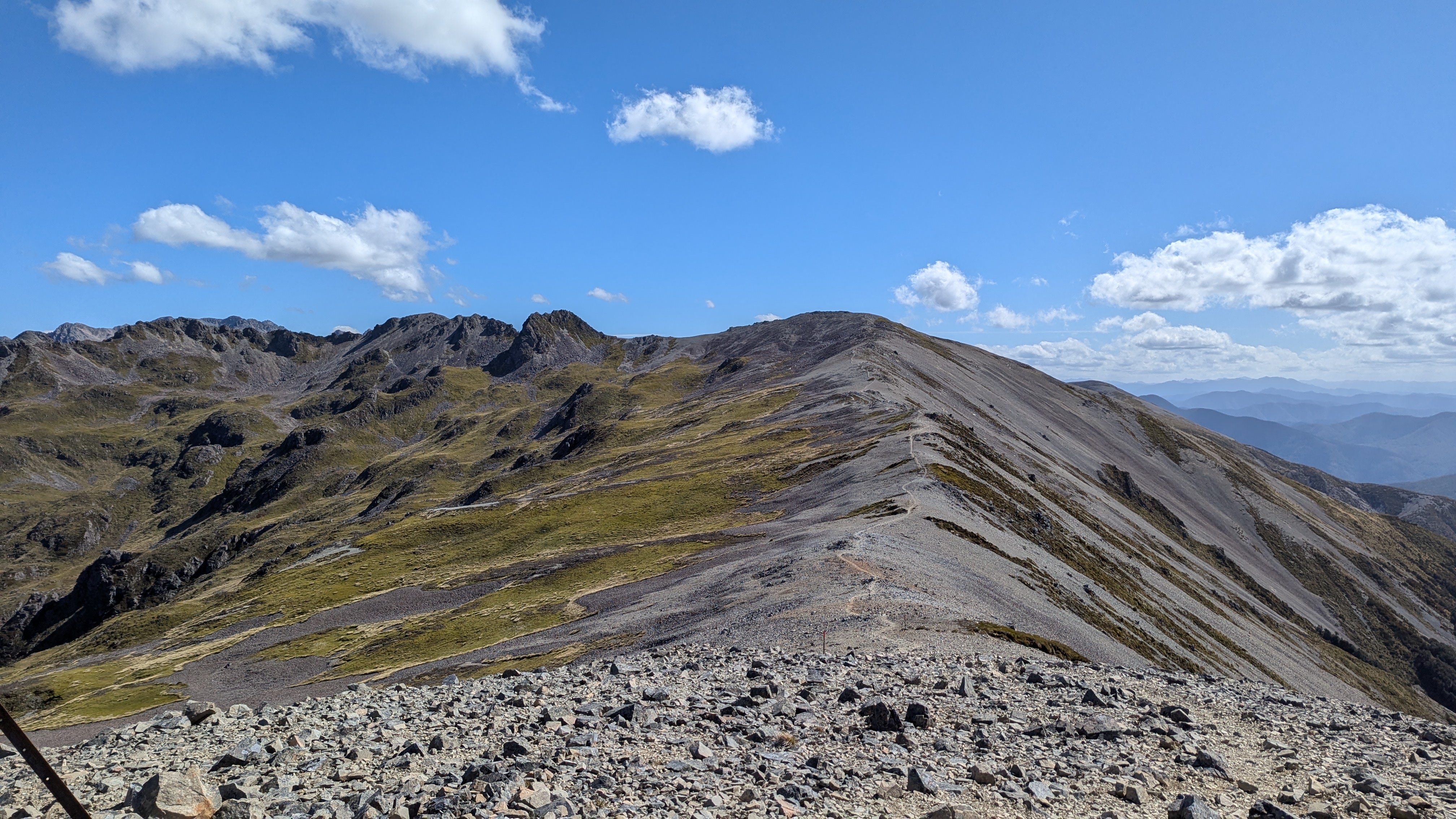
We set up our tent in the trees behind the hut where we would be relatively sheltered as the mountain was famed for its strong winds.  We then emptied the rest of our packs apart from a few layers and some water to prepare for the next part of the day.  The more energetic in the group (including us) decided to hike up to the main ridge and then along the ridge for a while.  This route would eventually lead to the Angelus hut though that was not for us today; it was four and a half hours further on from our hit. Six of us set off, reaching the edge of the ridge about half an hour later.  We then walked along the ridge, gradually climbing as the vista opened up even more views.  It was windy but fortunately the forecast winds of 55-70km an hour did not materialise.

After about an hour we got to a lookout spot and the rest of the group decided to turn back.  David and I were keen to carry on a bit longer so we agreed we would do another half an hour max, and then turn around so as to ensure we were back in time for dinner. The sun was getting lower and we were walking in the lovely golden light of late afternoon. We could see a high point ahead and now there were only the two of we could move faster.  We set ourselves a brisk pace and managed to get to ‘Flagpost’ summit, one of the highest points on the ridge, about half an hour later. Our stay at the top was necessarily brief as we were hit by the famed strong winds. So we about-turned and walked equally briskly down. Our legs were beginning to tire following our exertions but, having checked the time, we got to the last turn off down to the hut as predicted.  We then allowed ourselves to slow down a bit and got to the hut bang on time – to find cheese and wine ready and waiting for us, followed by a delicious meals cooked by our guides. Tired but elated we were tucked into out sleeping bags by 8.30pm and soon asleep.

The Nydia Trail – A delightful forest tramp

(David) This day started with a fantastic breakfast.  Now I know we go on and on about breakfasts in this blog – usually the best meal of the day which is “second breakfast” – but this was great.  We left our anonymous hotel to go a few hundred yards along the beach road to The Beach House Café, Kaikoura – squashed between the Little Laundromat and the Lazy Shag (which claimed to be “serviced” accommodation – although what services were provided was a little unclear).  Anyway, the eggs benedict and bacon, with excellent coffee, at the Beach House Café are worth travelling hundreds of miles for! 

Then it was back into the minibus to go north to the Marlborough Bay area.  This area of New Zealand is wine country, with mile after mile of vines across the hills, and even on flat fields.  The wines are well known in England and taste just as good here (more of that later).  We stopped for ice creams at the town of Havelock, which had a “frontier” feel to it.  The town sits beside Pelorus Sound, one of many sea water inlets that lead out into the Cook Strait.  Whilst there and spurred on by all the wineries we had passed, Bernie had the genius idea of buying some local wine which we smuggled into our backpacks for later.

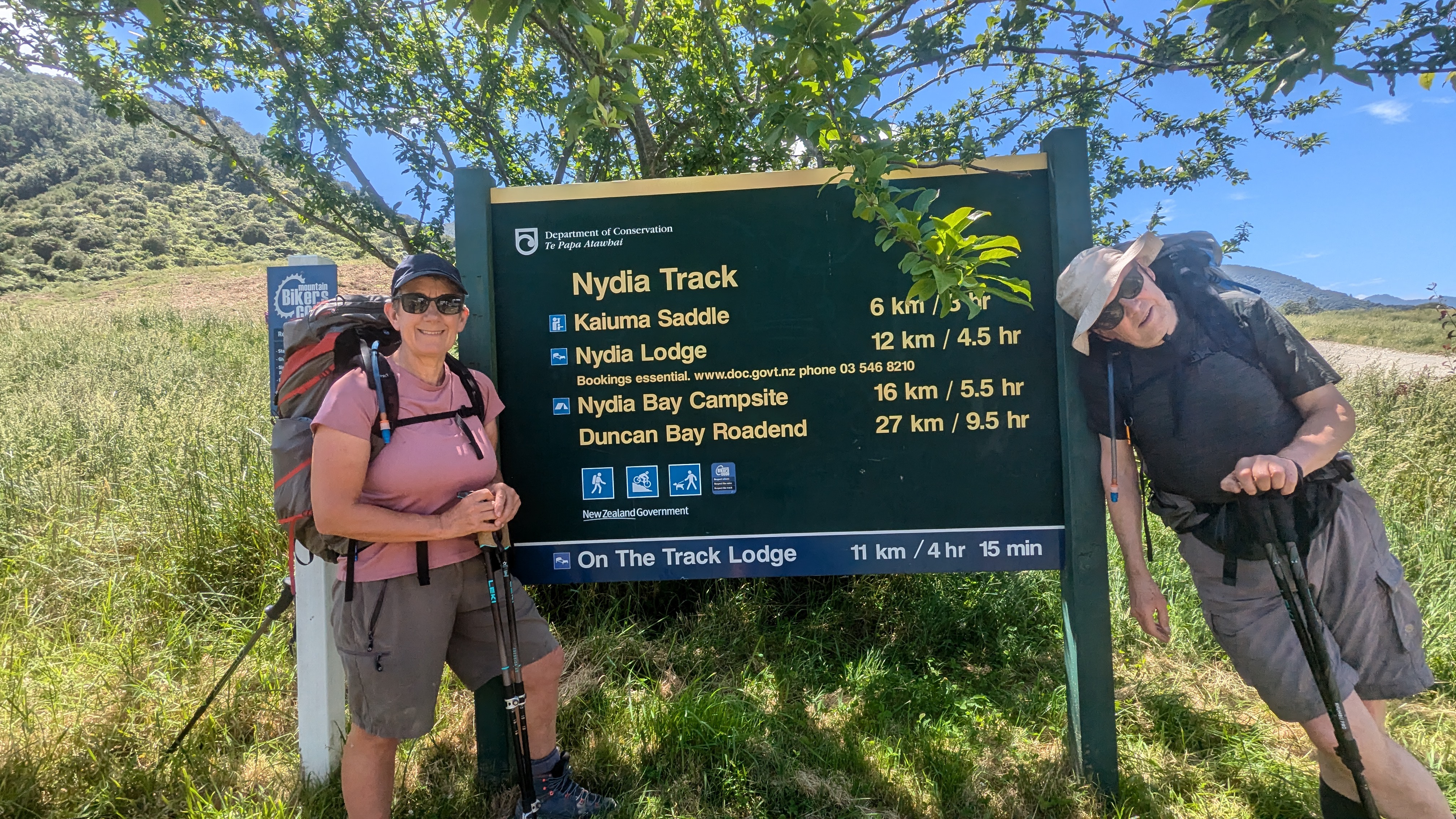
Then it was a 45 minute drive along a gravel road on the northern side of the sound to get to Kaiuma Bay, where the trail began.  The trail was about 12 km, including two fairly substantial climbs and descents, to reach Nydia Bay where there is a “hut” complete with running water, electricity, a fridge (when the generator works) and hot showers – but still a hut.

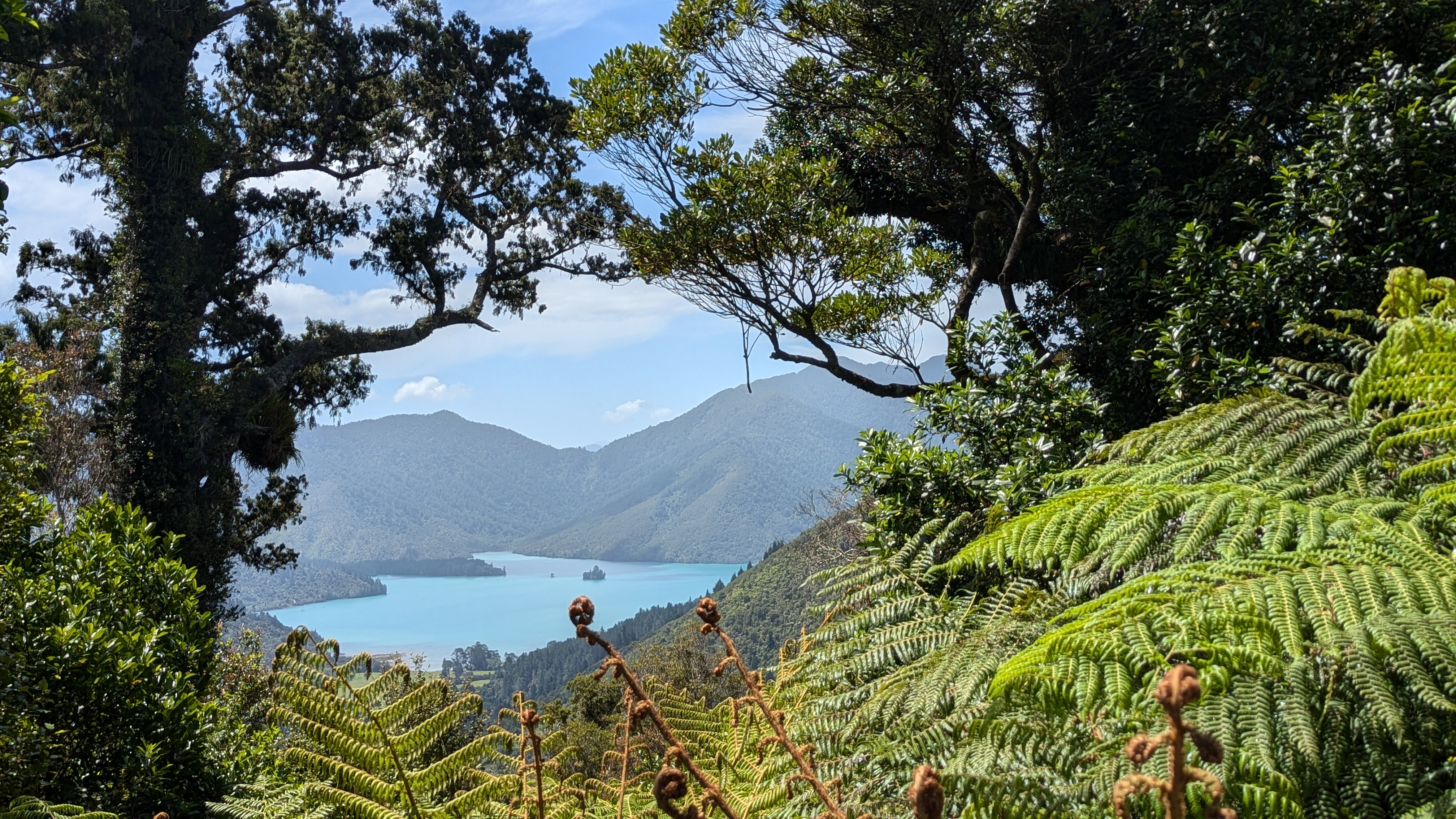
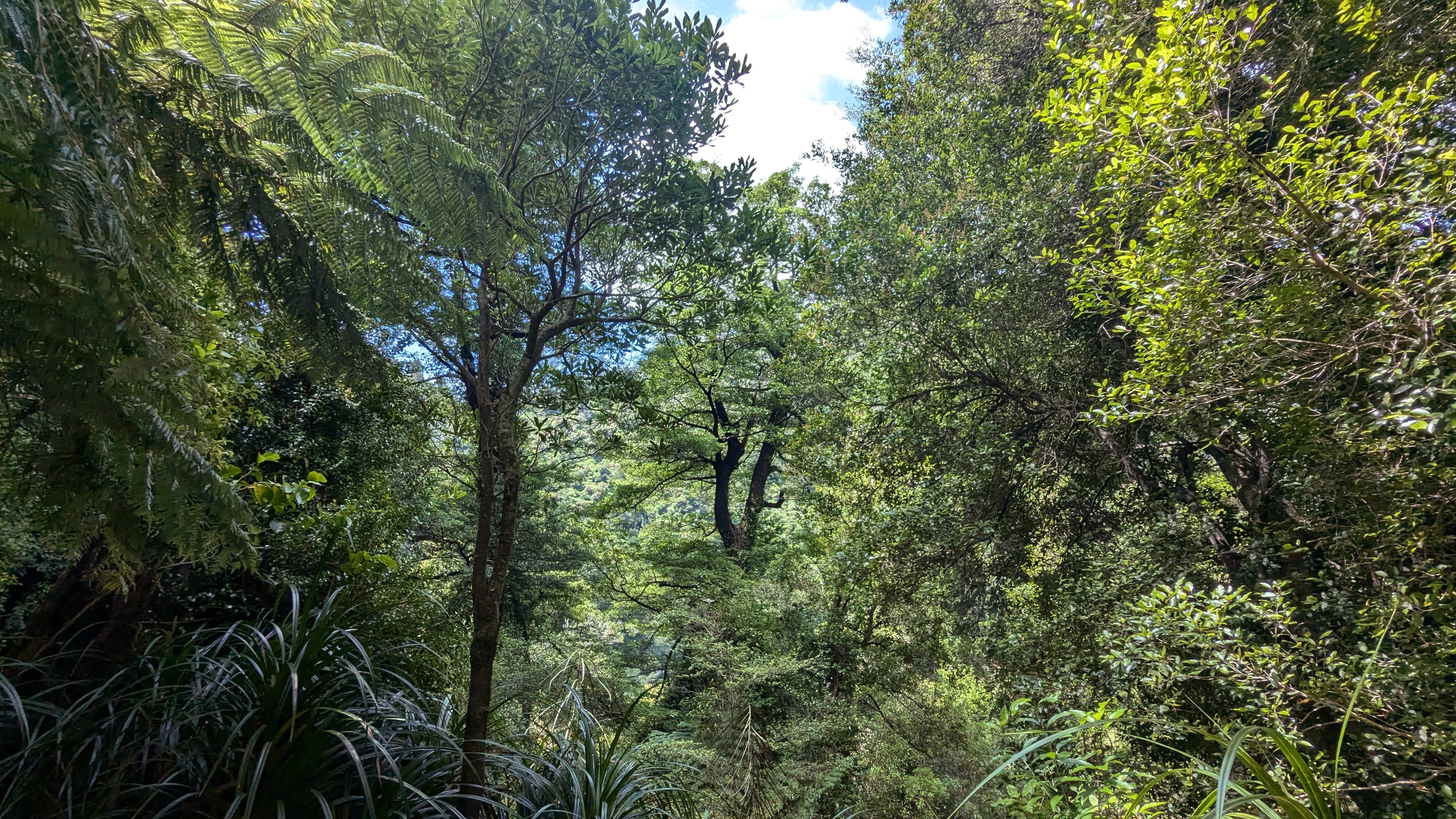
The walk was almost entirely through native forest for the first 10km and then a final 2 km along the sound.  It is hard to describe how lovely it was to tramp through this hugely variable vegetation. 

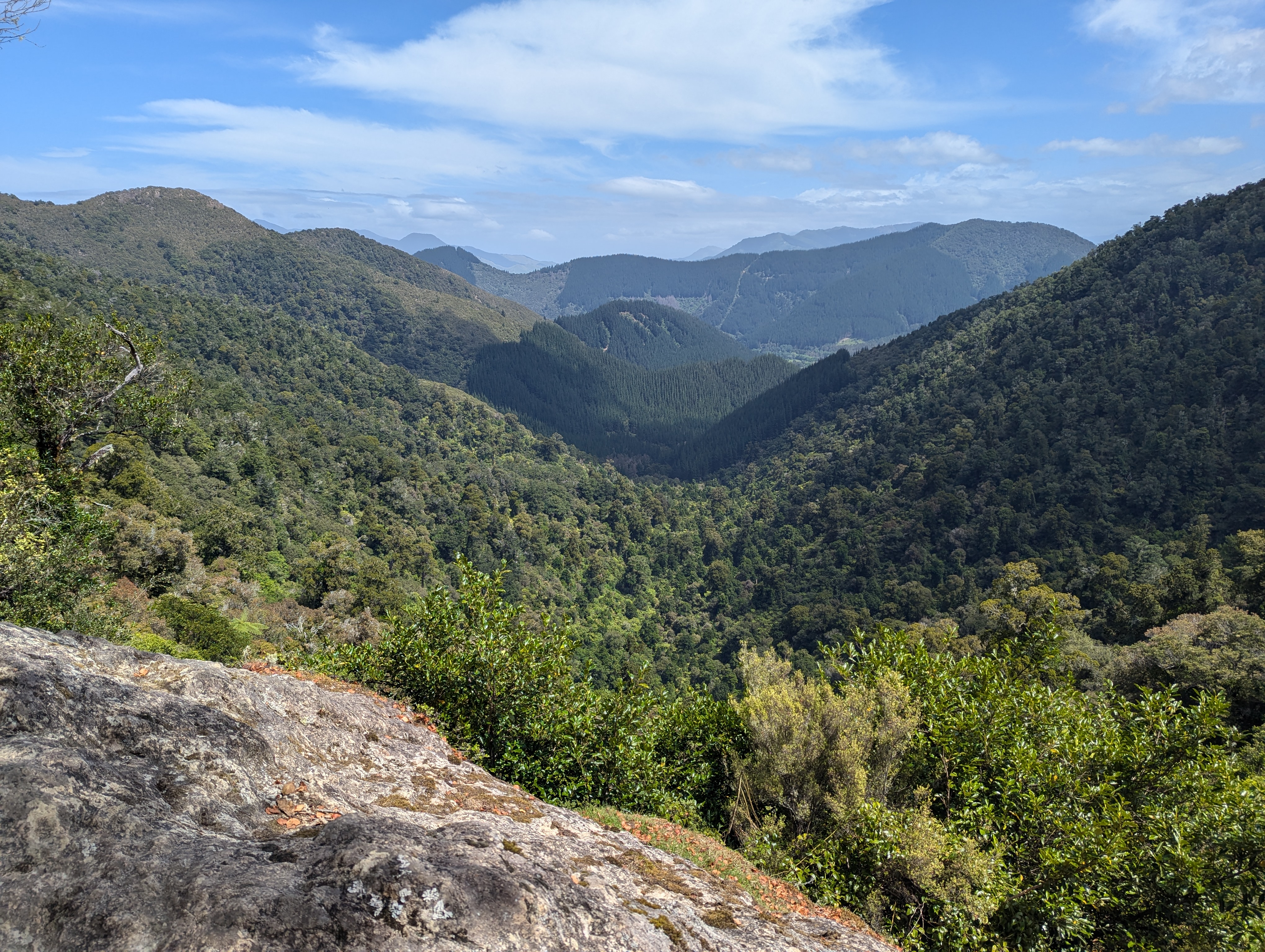
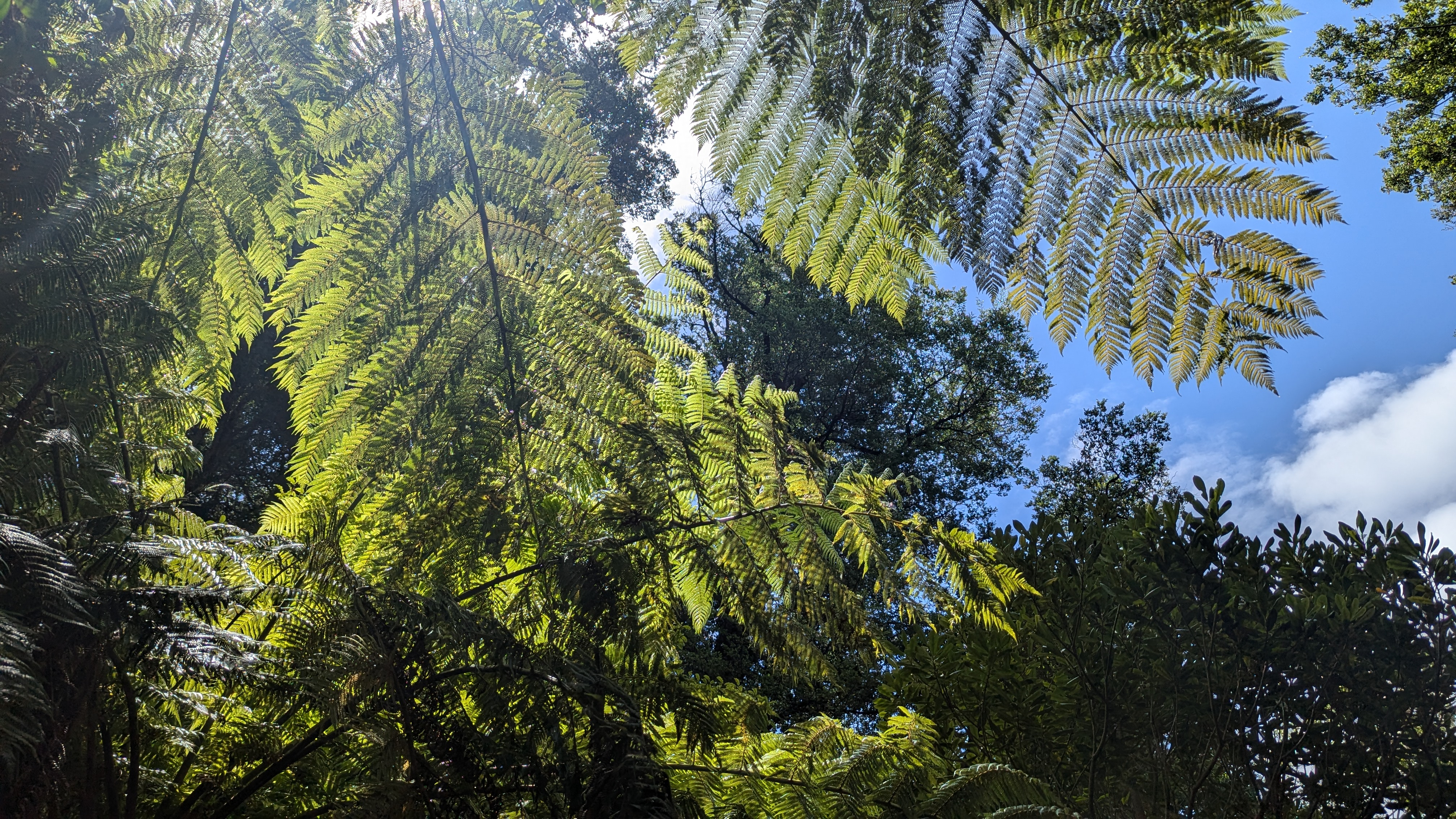
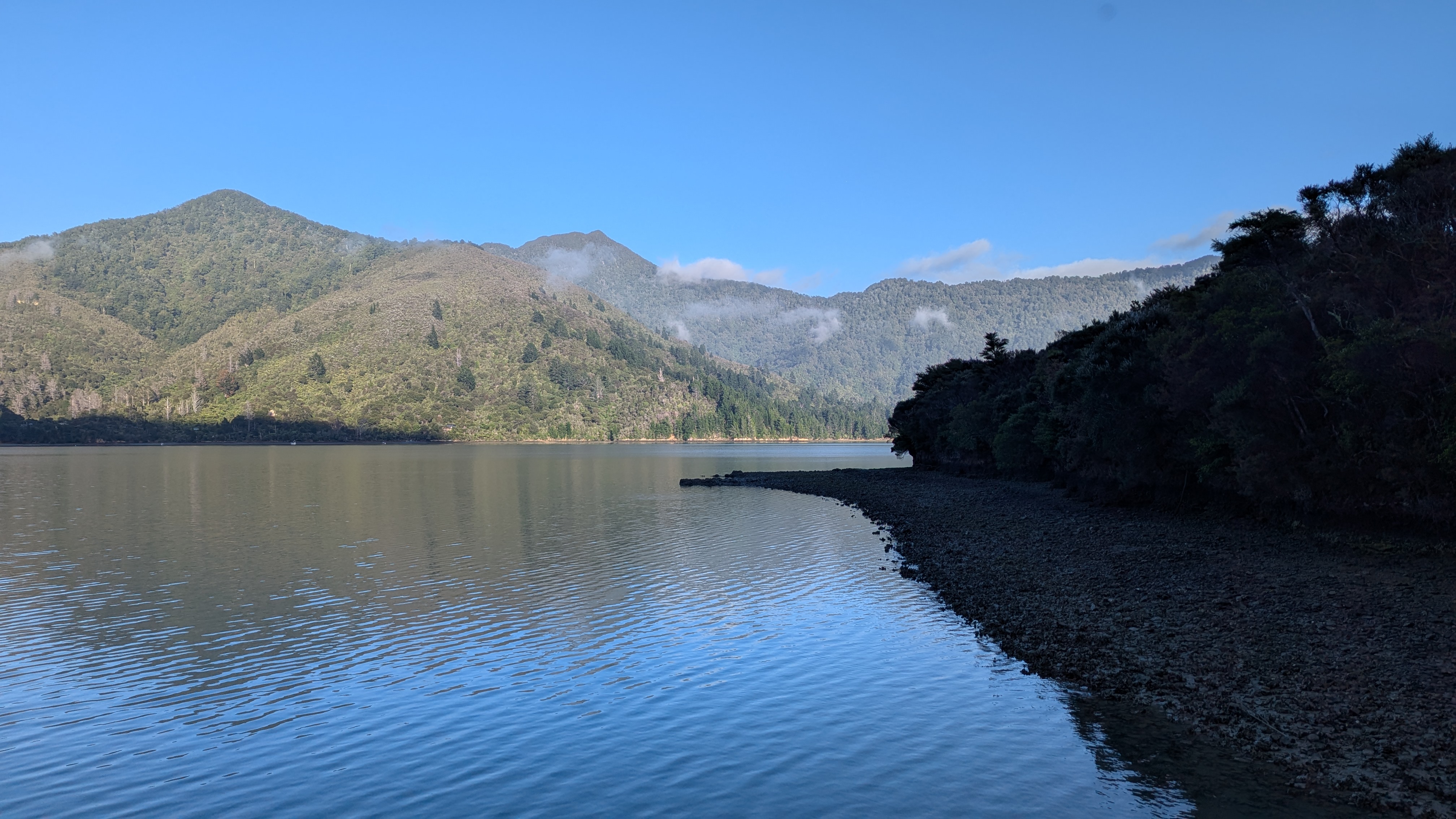
We saw palms of all descriptions, rotting trees with fascinating bark shapes, beach trees which were nothing like the beach trees we have in England and enjoyed the steady hum of cicadas, which has been the signature sound of summer abroad for so long.  I hope the pictures do credit to the beauty of the forest. At the narrow shoulder we looked down to the idyllic Nydia Bay, surrounded by the forested hills, where the only access is to walk in (or rarely get to by water taxi, although the hut ranger said he had only ever seen people walk or mountain bike in).

Once we arrived, we all went swimming in the sea to cool down after a fairly arduous tramp.  It was so, so refreshing.  There was a jetty – so for the younger elements, the inevitable jumping off, diving and trying to do “loop the loop” in mid-air, trying to turn full circle to avoid a sensitive anatomical part hitting the water at speed.  Some were more successful than others. We went for the more genteel glide in off the jetty steps!

After a swim we repaired to the lodge to have freeze dried meals, to find our guides had carried up a whole cheese board including dips and crackers.  We brought out the wine for everyone that we had smuggled into our rucksacks as a surprise.  This was another unexpected treat which let to Bernie being awarded the “toy kiwi” prize for the day.  This was luxury tramping in a five star setting.

Aoraki/Mount Cook – a wet and windy reception to these amazing mountains

We are now on journey around the South Island of Aotearoa New Zealand – as the country is now known (the addition of Aotearoa reflecting its Maori heritage).  We joined a New Zealand trails group on a fixed itinerary, which started in Queenstown and today took us to from Wanaka to Aoraki/Mount Cook, a village at the foot of the extensive Aoraki/Mount Cook range of mountains, the highest part of the Southern Alps.  Aoraki is the Maori name for Mount Cook, the highest mountain in Aotearoa New Zealand.  As we were driven up Lake Pukaki (which is the lake of the Tasmin River), the weather started got progressively worse.  High winds and driving rain greeted us as we came into the mountain village that serves as a base for walkers, climbers and sightseers in these amazing mountains. 

We dashed out of the rain to visit the DOC (Department of Conservation) visitors centre.  It contained a vast amount of fascinating material about the formation of the mountains, the flora and fauna and a history of first and subsequent ascents.  These are seriously challenging alpine mountains and Mount Cook was only conquered in 1894.  The first attempt to climb Aoraki/Mount Cook was made in 1882 by an Irishman, Rev W.S. Green, and two Swiss guides. Although his party climbed to within 20 metres of the top, it was not until Christmas Day in 1894 that the summit was reached, by three New Zealanders: Tom Fyfe, Jack Clarke and George Graham.   They had been spurred into action by news that the American climber Edward Fitzgerald and the famous Swiss/Italian guide Matthias Zurbriggen were on their way to New Zealand. The foreigners arrived in the country in late December and were less than pleased to discover that they had come all that way only to be thwarted in their aim of climbing Mount Cook for the first time. 

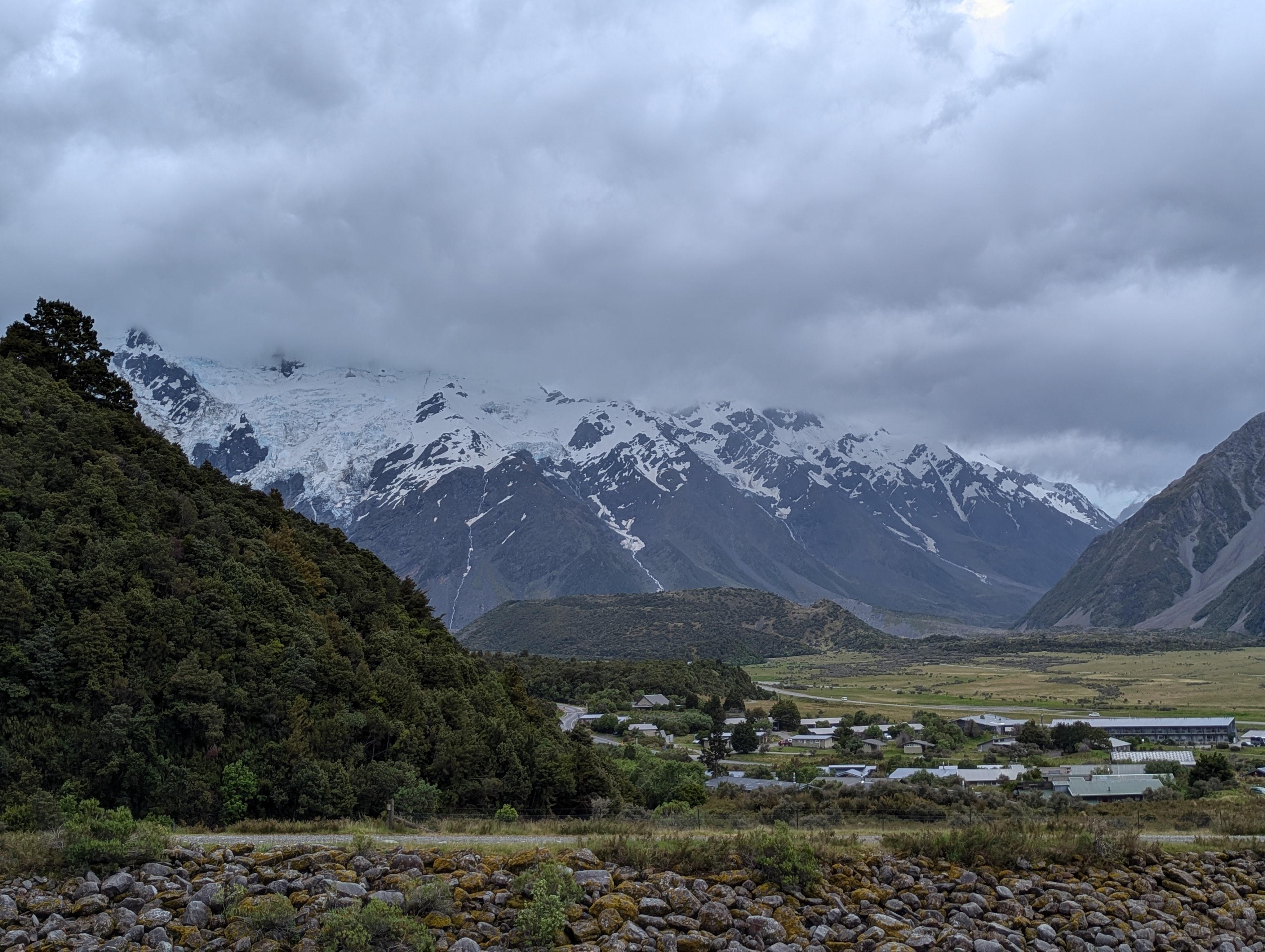
We were not intending to do anything that stretching and were only due to climb up to the Muller Ridge via Sealy Tarns but no one in their right mind would attempt the walk voluntarily in such weather.  So we settled for a half hour walk up to Kea Point, where we were blown away by the view which was supposed to be expansive views of the Footstool, the Hooker Valley, the Mueller Glacier Lake and Moraine, Mount Sefton, and Aoraki/Mount Cook.  In fact we saw the lake and a bit of the glacier but the rest was in cloud.  But we were blown away by the wind and horizontal rain.

Then back to the hotel for an hour to play cards whilst we waited for our room to be ready, and watched the rain on the windows.  It cleared up later in the afternoon and we went out for a walk for about an hour and a half – up the side of a valley overlooking the Murchuison valley.  By this point it had cleared and the forecast for the following day was not too bad, so we agreed with our tour leaders to strike out early and walk up to Sealy Tarns – so at least doing some of the day we had missed although we would not get all the way to Muller Ridge.

Day 2. Tongariro Northern Circuit.

(Bernie) Most of yesterday the mountain tops had been wreathed in cloud but during the evening the clouds cleared revealing our first view of the conical mountain Ngaruhoe and the snowy peak of Ruapehu. Clear skies meant a chilly night but we were snug in our sleeping bags and slept well.  We woke at 6am to beautiful clear skies, made coffee, cooked up our porridge and were set to go by 7.15.

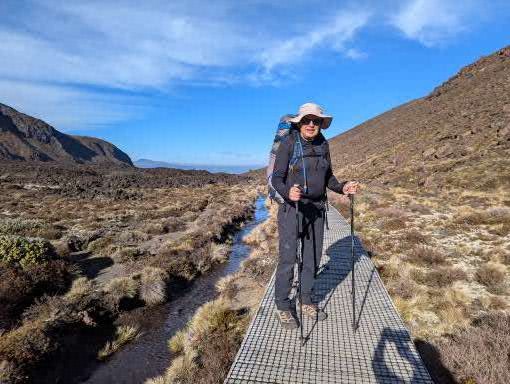
The first part of the day overlaps with the famous Tongariro Alpine Crossing – a day walk rightly billed as one of the best day walks in the world. It is an end to end walk so shuttle buses collect walkers from the end and deliver them to a car park just below the Mangetepopo hut.  We were told the first shuttle buses drop walkers off at the start carpark, which is half an or so down from the campsite; so if you want to avoid the crowds you needed to leave at either 6am or 10am.  We didn’t want to do either of those so decided just to go with the flow. Although there were plenty of people on the track it did not feel oppressive and the landscape was so awesome (taking the literal meaning of the word) nothing could detract from the day. It was one of the best day’s walking I have ever done.

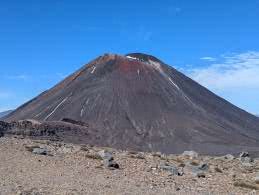
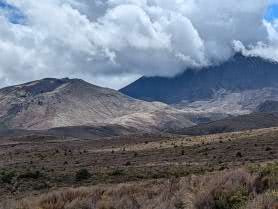
The first part of the day took us up a gentle valley with the steep climb out of the valley ahead of us.  We had our first good views of the amazing Ngaruhoe volcano as we crossed the old, and not so old, lava fields.  Signs warned us that we were entering an active volcanic area.  The volcanos in Tongariro erupt with reasonable regularity – luckily mostly small eruptions are limited to steam or ash, although these can still do a good deal of damage.  The last eruption experienced on the track was in the 1970’s and described as a very near miss for a walking group – so not so very long ago. Huge boulders told of the massive eruptions of times past.

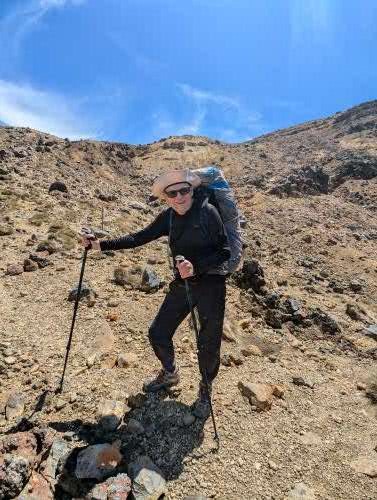
At the base of the climb further signs gave warnings that people should turn back if the weather looked bad or they were feeling unfit.  We learned that about two people a week are airlifted off the track during the summer season. However, today the skies were clear blue, the air was still and we were feeling invigorated; so we started the combination of steps and steeper path up to the first crater. We got into a steady pace and although not as fast as the youngsters overtaking us, we were not as slow as others and felt rather smug that we were making our way up with our heavy packs while others had day packs (small pleasures, ridiculous of course!).  The ever expanding, stunning views begged for frequent stops to gape in any case and to capture in photos.

Suddenly we were stepping into the South Crater with a pancake flat base.  We stopped for a break overlooking a smaller side crater with views up the red and black side of the volcano.  A climb out of the far side of the crater to the Mangatepopo saddle opened up the views on the other side to the Oturere valley.

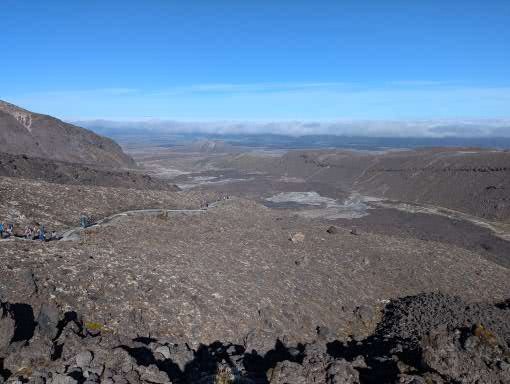
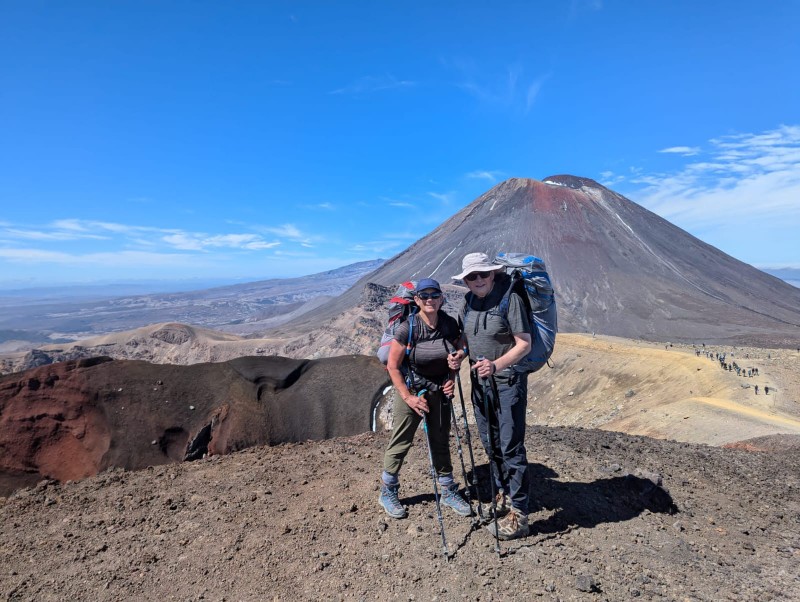
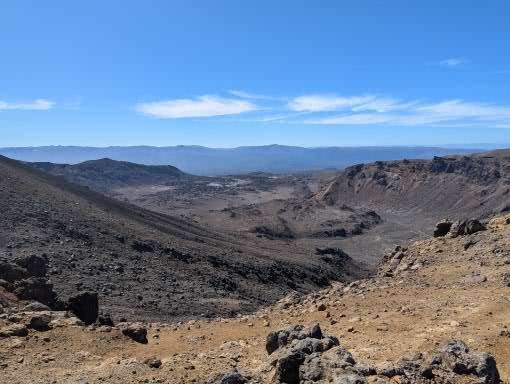
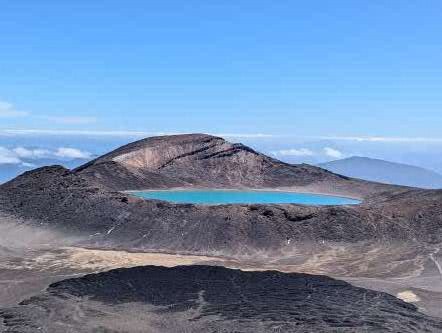
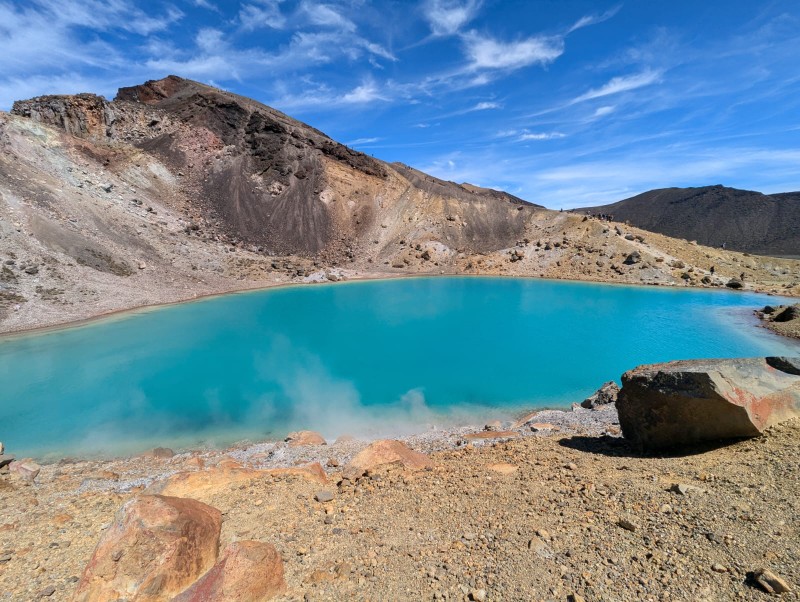
  A last fairly steep climb took us to the highest point of the walk (1867m) with breathtaking views over the Red Crater, Tongariro mountain, the Blue Lake and Emerald lakes with their steaming fumeroles.  I hope the photos do it justice.

 We realised how lucky we were when we met the guide we were chatting to at the campsite the previous evening.  He guides teenagers on their  Duke of Edinburgh hikes (yes, DofE is in NZ) and had done the trail numerous times.  He said he had never seen it so good – usually the top is on cloud. A ranger later described the weather as “one in a hundred day weather”. The summits of the mountains are sacred to the Maori (you are therefore not allowed to climb to the summits); for some reason the Maori gods were smiling on us today.

(David) I get the easier bit to write about – going down!  But the first stretch was quite tricky, as we descended a steep shoulder with drops on either side.  Underfoot it was moving sand and small rocks, and a bit like descending a scree with very small stones.  Bernie took it easy and at one point stopped to allow a woman behind her to pass – but was told “No – I am following you – you are doing this descent so elegantly!”.   Wholly unsurprisingly, no one complimented me on my descending technique as I staggered down trying not too lose my footing – when many did.  No one tumbled off the sides – at least as far as we could see. 

We stopped at the bottom by the fumeroles (wispy volcanic smoke coming from ground indicating activity just below the surface) in a small gap which was not overwhelmed by the stench of rotting eggs for our lunch – Ryvita, peanut butter and cheese!  Whilst I accept this combination is not offered in the best restaurants, it was high calorie and delicious after 4 hours walking.  Mary (one half of the Tasmanian couple joined us) whilst her partner, Polly, mooched around the volcanoes.  They have a daughter who teaches geography in a tough school in Tassie, and were under strict instructions to take photos to bring life to her classes.

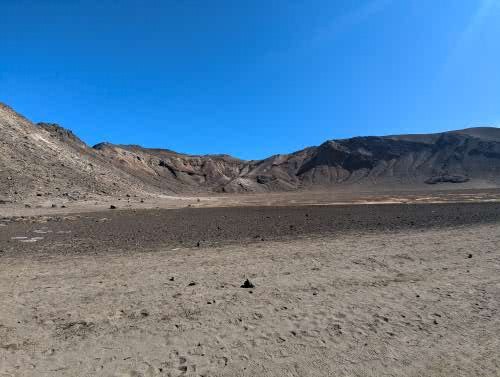
The paths split at this point – with the day packers on the TAC heading north to the end of their walk at Ketetahi car park and the TNC multi-day walkers heading towards Oturere hut.  Suddenly the valley was deserted as we climbed down a section called the dragon’s tail.  The Oturere Valley is high altitude desert with stunning rock formations.  For those who have seen the Lords of the Rings films, this is the set for Mordor.  By this point we were a tad tired, but met a jolly face coming the other way with a spade, clearing the track.  This was Sally the Oturere hut ranger who told us we only had an hour to go, and all would be well!  She was roughly right – it was about an hour but it stretched out as tiredness set in.  But soon we went over a small ridge and there was the hut, nestling just below a ridge.

Sally had advised us to camp up on the ridge as she said the dawn was lovely from there.  90% of the time this is good advice; we were in the 10% when wiser heads would have pitched below the ridge line.  But, in the calm of the afternoon, there seemed no reason not to take her advice.

Once the tent was pitched and a brew revived us, we ambled over to a stream for a wash and paddle.  Mary had said she had “wallowed” in the water but she is clearly made of sterner stuff than me as I managed it up to my knees before screaming from the cold.  But it did leave us cleaner than we had been for 48 hours.

A windy night!

Supper, reading, chat, brew, reading, more chat, funny stories, and early bed.  That is the way of life on a trek and it is super enjoyable.  I was stuck into a crappy book, loved the scenery and wished it could go on for ever. However, as the evening drew on, the wind got up and the lack of wisdom of our chosen campsite became clear.  It was dry but blew a gale all night, with the sound of the wind trying to keep us awake – mainly unsuccessfully I can report.  However the only reason the tent did not blow away down the valley was that it was weighed down our bodies!  At one stage I got up to see if the guy ropes were holding – they were – and then went back to sleep.  The woman in the next tent was on her own and claimed not to have slept a wink all night!

Day 1:  Tongariro Northern Circuit

(David) Now I know that this is a cycling blog – but this next few entries have no wheels and only describe a walk – or a “tramp” to give our activity its local name here in NZ.  For those who are only interested in cycling, I suggest you “look away now”.  For the rest, this is a description of one of the NZ “Great Walks”, the Tongariro Northern Circuit, also known as the “TNC”. 

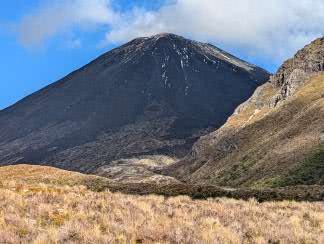
The TNC is a walk in the Tongariro National Park.  It takes up to 4 days and goes around the conical Mount Nguruhoe (2287m), a classic volcano which looks like a mountain that a child would draw – straight sides and a snow covered top.  The smaller mountain, Mount Tongariro (1967m) is north of Mount Nguruhoe, and the walk crosses the saddle between the two mountains. On the other side of the valley is the much higher Mount Ruapehu (2797m) which is longer and has an extensive snow covering at this time of year.

We drove from our accommodation in Turangi (having failed to find time to go fishing in a world fly fishing mecca) to the strangely named “Whakapapa” village to start the walk.  We later learned that it was pronounced “Fu-whack-a-pappa”. The road took us gradually up to the village which is at about 1150m.  The landscape was high altitude moorland, dominated by the two volcanos to the north, Nguruhoe and Tongariro and the Mount Ruapehue (2797m) range to the south, where there is extensive skiing in the winter.

There are huts along this walk but they were all fully booked before we got our act together and so camping was the only option.  Overall, this was better for us as it meant we got a good night’s sleep most nights, as opposed to the hit and miss of a night in a shared hut.  Having sorted out renting a locator beacon (being either intent on being as safe as possible or as pessimistic as it goes) we put on our packs and started walking.  A word about our packs – and thanks to our great friends Gill and Peter who provided advice and encouragement from their many years of trekking.  We got lightweight rucksacks before the trip, good poles and a few other items such as a gas burner, but most of the kit was the same as we have used for cycle touring.  The difference was we also packed freeze dried meals and other food for 5 days – 4 days plus a spare.  The packs were heavy but not ridiculously so; probably about 14g for David and a bit less for Bernie.  

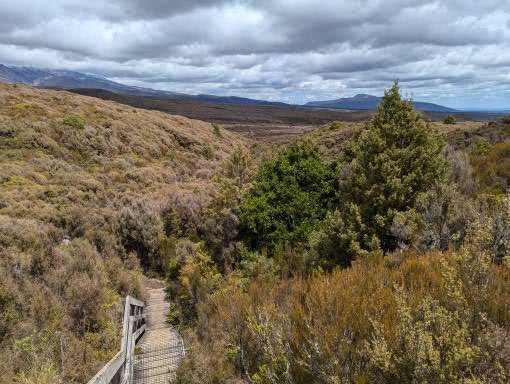
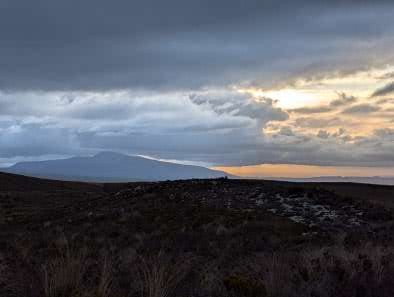
We started our trek in the dry, but with cloud over the top of Mount Nguruhoe.  The terrain was marsh/mud which went up and down across numerous streams that flowed down from the mountains to our right.  Heather was introduced to this area to provide cover for grouse in the early C20th, but was a disaster as it wiped out the native species.  Grouse never survived and so the original plan of turning the slopes into Scottish style grouse shooting never occurred.  But heather spread at pace, with local fauna declining.  The invasive heather is now a pest which the NZ Department of Conservation is attempting to remove – but it is a massive job as it has spread over vast areas. 

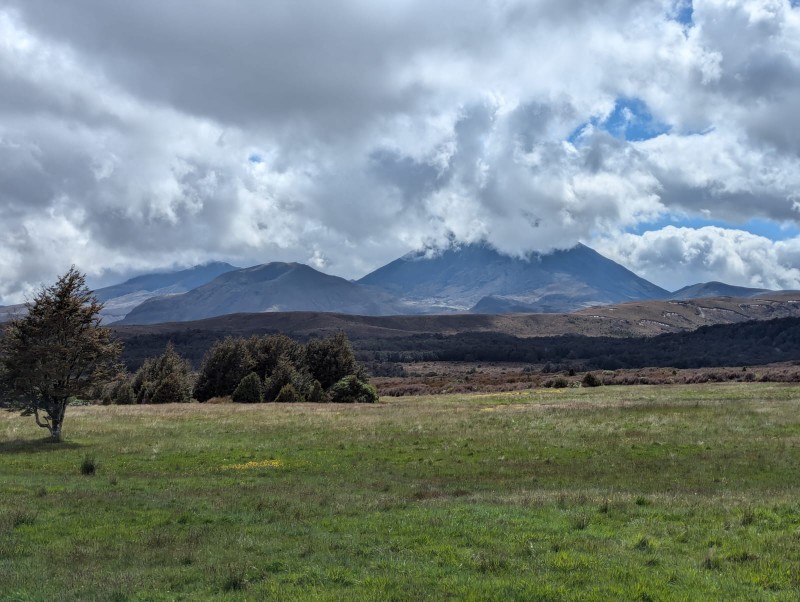
The walk was steady rather than dramatic.  There were a few others on the track – some overtook us and others came the other way.  We could tell instantly if someone was a day walker – small pack – or a multi-day walker – big pack.  The day walkers were faster (of course) and most of the multi-day walkers were faster than us (again of course).  Lots of jolly greetings along the way.  As we walked, the shape of the mountains changed – but far more slowly than on a bike.  Gradually the top of Mount Nguruhoe cleared of cloud, revealing its classic shape, and we got to see the saddle we would have to climb tomorrow.

After 3 hours of sliding along muddy tracks we reached the Mangetepopo Hut at about 3pm, and found a place to set up our tent.  The huts are hugely sociable places and we chatted to other walkers, all of whom had come to the hut under their own steam.  There was no warden, no electricity and no hassle – everyone just getting on with things.  We chatted to a couple from Tasmania who were about our age, a young couple from Boston, USA who were on a delayed honeymoon having negotiated 4 weeks holiday (amazing in a US context) and lots of New Zealanders.

Our first experiment with freeze dried meals was about 75% successful – we will get better with them – but it was tasty.  By 8pm we were in our sleeping bags as the temperature began to fall and the light faded.  This was both remote and not remote.  It was remote in the sense that there were no roads, we were in a tent and felt tired from a decent walk; but it was also not remote in the sense that another tent was pitched very close to ours and we were on a fixed and very popular walking route. That seemed about the right balance to start getting used to the experience of tramping.  If it goes well, we could explore more remote settings at a later date.  For now, this was as good as it gets.