Category Archives: Uncategorized

Return walk from Bushline Hut and Coastal Walk to Seal Colony

(David) The night was quite cold and the wind blew under our tent. I felt it blowing right onto an exposed patch of my body; one where the sleeping bag appeared to have no effective covering.  Adjustments to clothing mostly sorted this and eventually we both slept well – or fairly well at least.  We woke, ambled into the hut and were greeted by tea, coffee and breakfast!  We could get used to being catered for.

After breakfast we packed up and ambled down the mountain.  I have been resistant to out and back walks in the past but we have done quite a few this holiday and my resistance is crumbling.  The views are different going the other way, the weather is different and we see the mountains at a different time of the day.  It was a delightful hour plod down the hill, with great views of the lake and then back to the minibus.

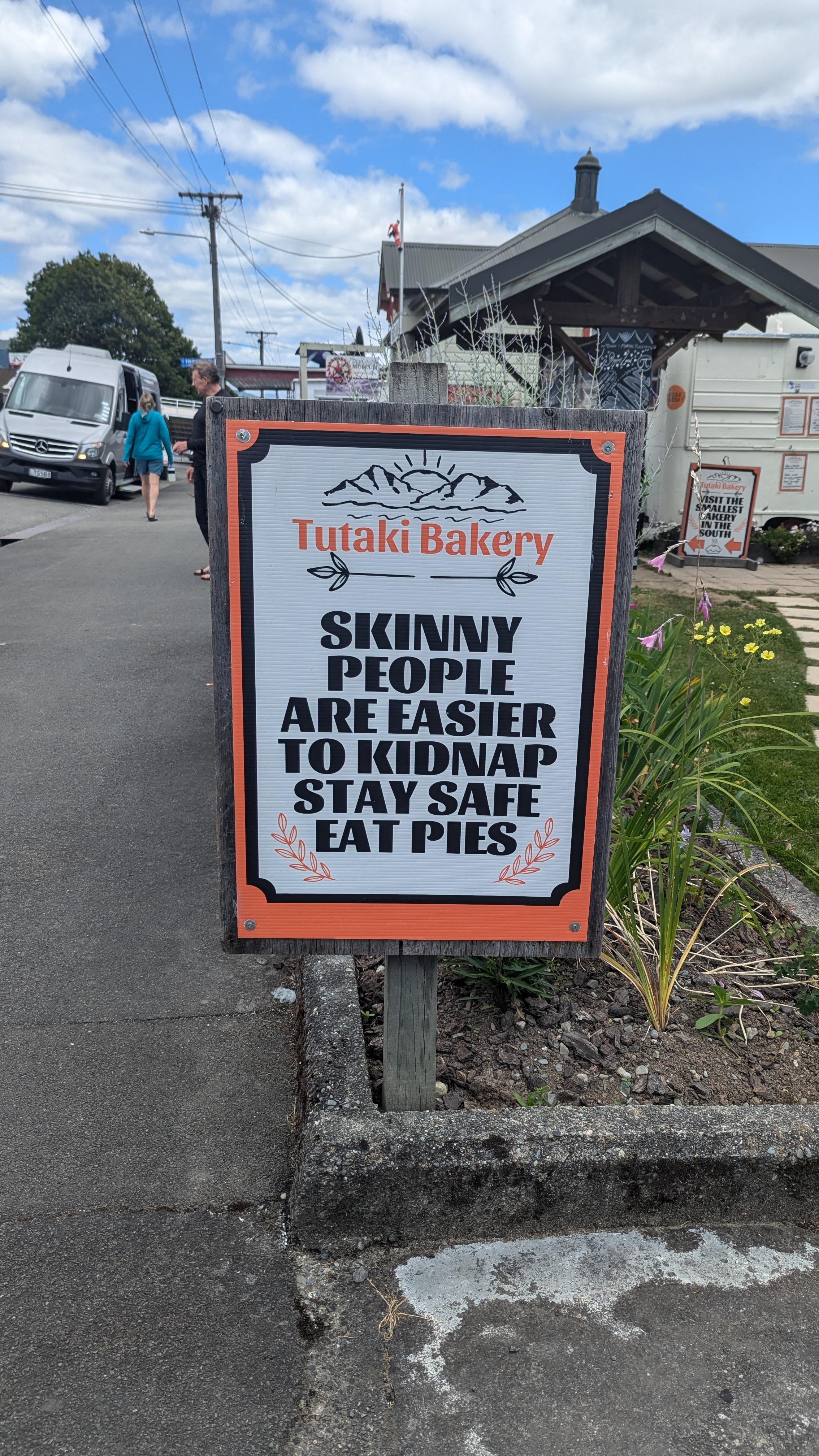
We put this in because it made us laugh!

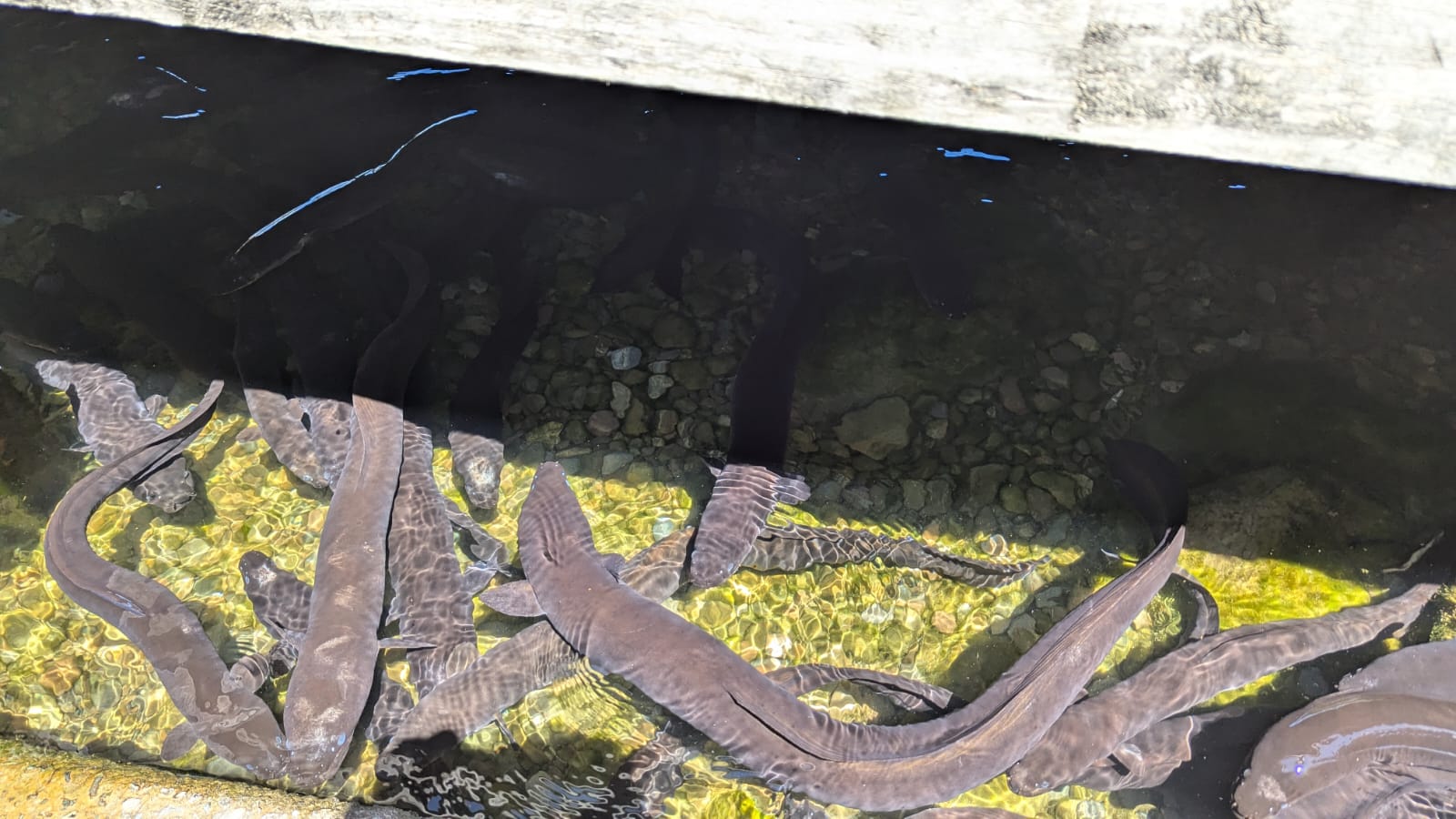
We had a bit of free time at Lake Rotoiti again. We and saw again the long finned eels around the jetty and read about their incredible lifecycle.  The eels can live up to 100 years of age and only spawn once in their lifetime. Before spawning they leave the lake and head to the Pacific and swim 1000s of miles to near to Tonga where they mate, spawn and die.  The baby eels spend 7-10 months drifting back to New Zealand on the ocean currents and as they develop, swim upstream to the lake.

Leaving the lake we had  another (tedious) drive of a few hours, heading to the west coast, where we reached the wonderfully named “Cape Foulwind”.  We were booked into mini-cabins at this seaside resort.  The area was a former quarrying centre where granite was discovered as part of the cliffs, and so these were blasted away to make roads and the like during the C19 and early C20. 

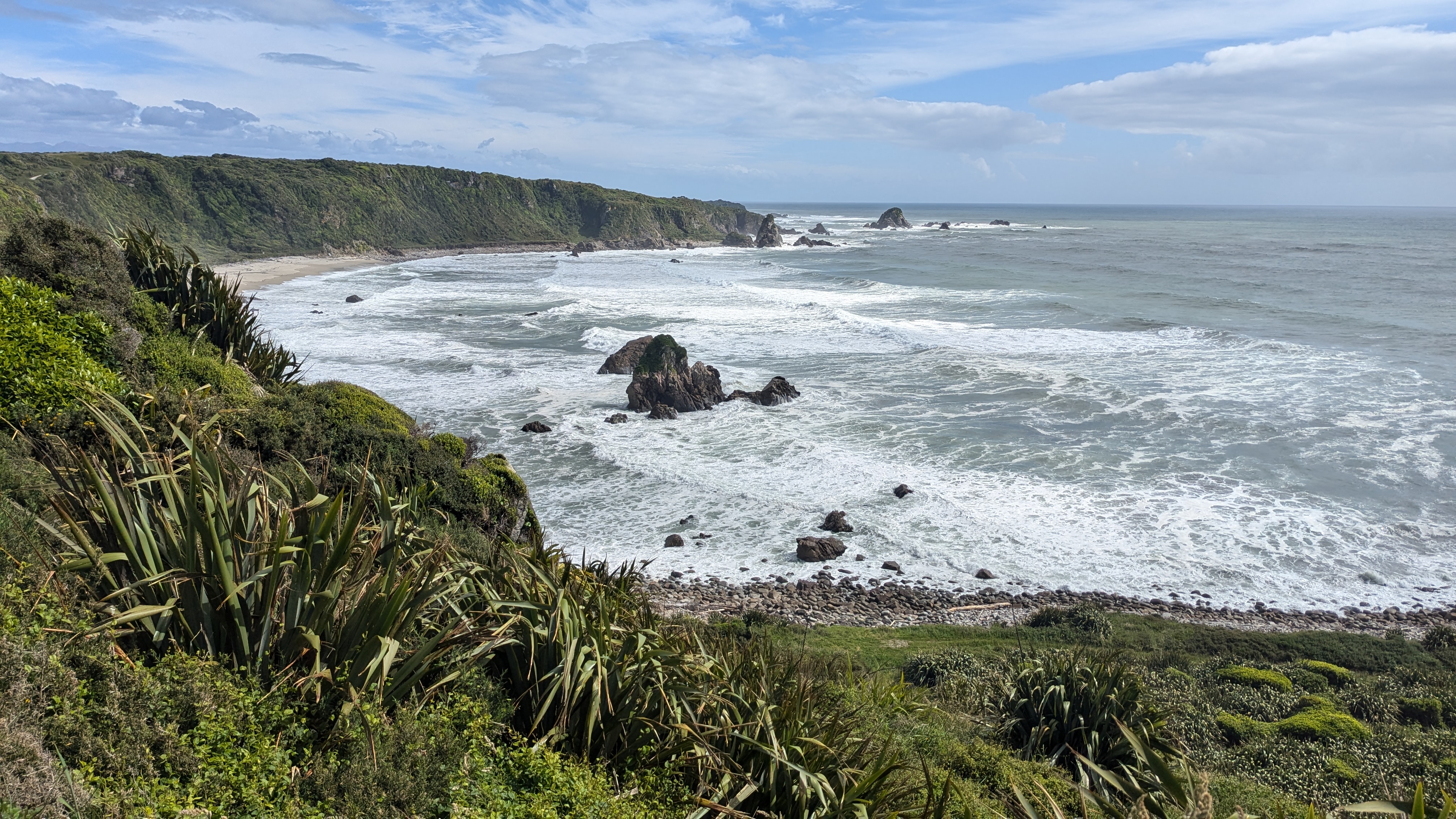
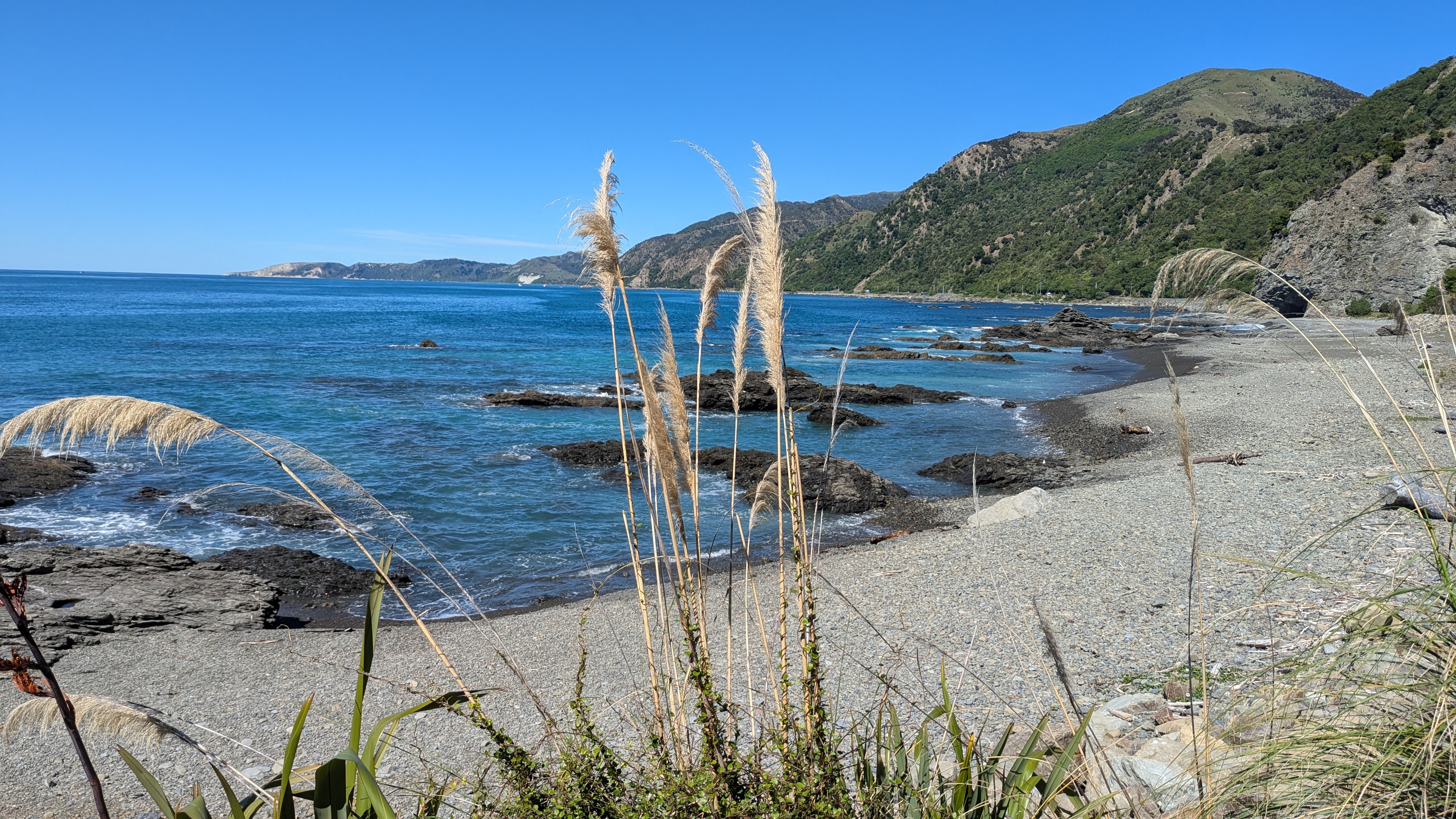
The stone was used in a concrete plant which operated here as late as 2016, but there is no evidence of the plant now.  Instead, there is a coastal area with some modern (expensive looking) houses probably being second homes for Christchurch’s elite.  We walked along the road and then joined a cliff walk at a lighthouse.  It was a great walk for a couple of hours to see a seal colony.  In typical DOC style, the path was well marked with barriers and signs preventing anyone being tempted to go too close to the cliffs. 

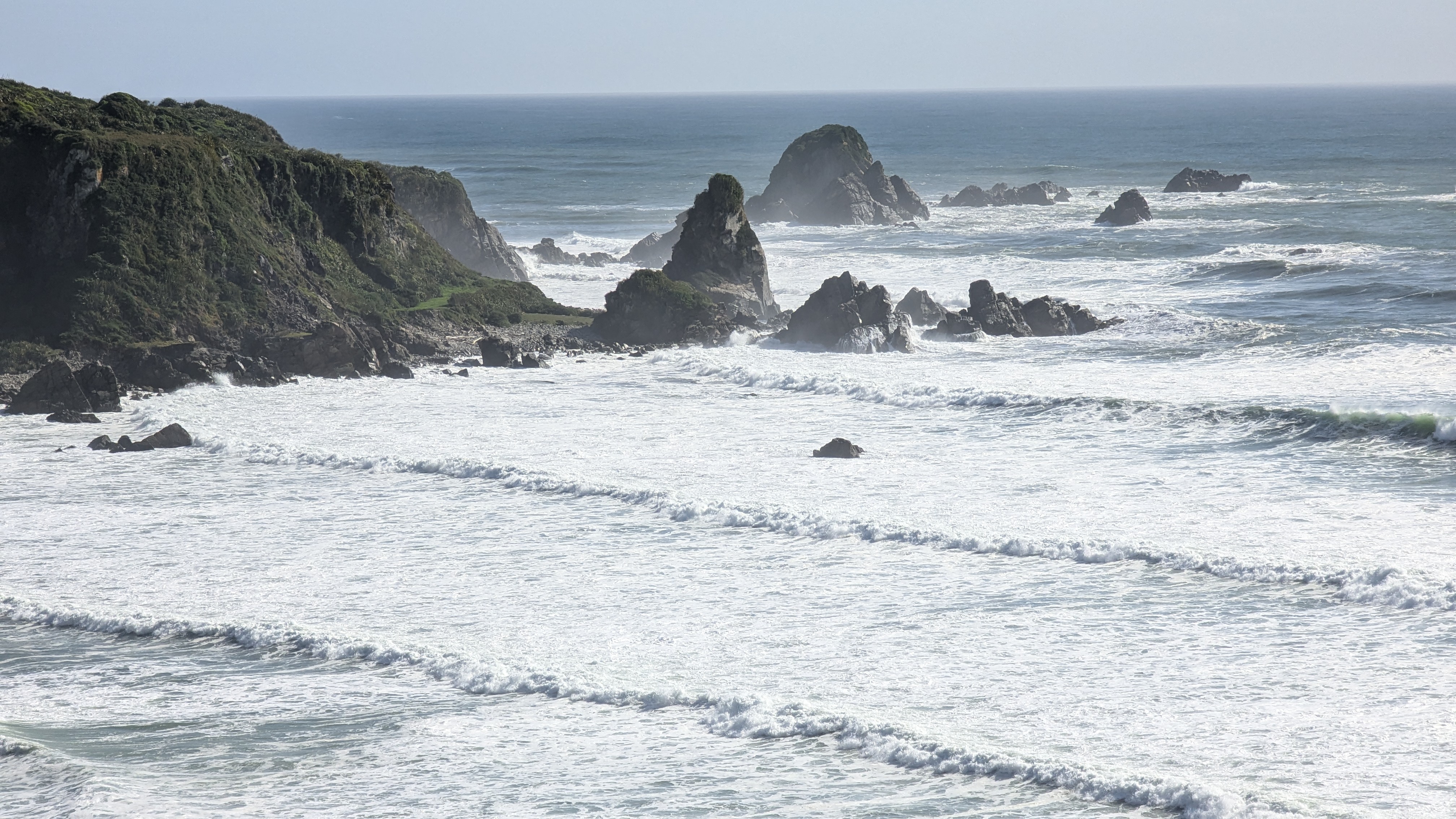
This was the Tasman Sea, with waves rolling in every few seconds.  It was a peaceful, sunny afternoon but the storms here must be impressive. 

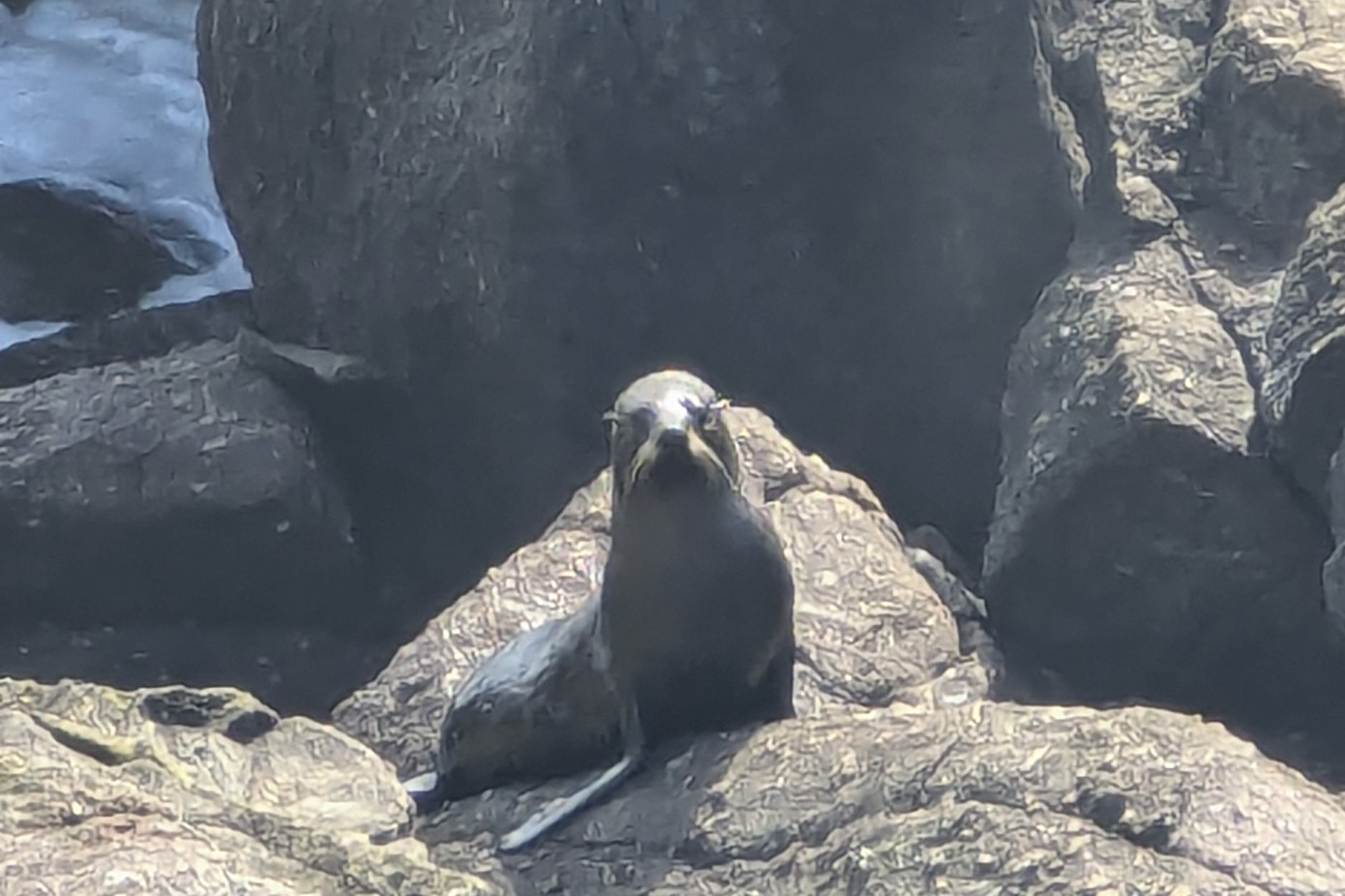
The seals were New Zealand fur seals (known as kekeno in maori).  They were lolloping about on the rocks, having an occasional spat and then gliding into the sea. 

We ambled back to the accommodation feeling we had had a good day.

Nelson Lakes National Park. Overnight hike to Bushline Hut.

Our day off in Nelson was cloudy and rainy – so much for being the sunniest place on the South Island. It gave us the excuse to do very little for the day; so we were raring to go the next morning, which did dawn bright and sunny.

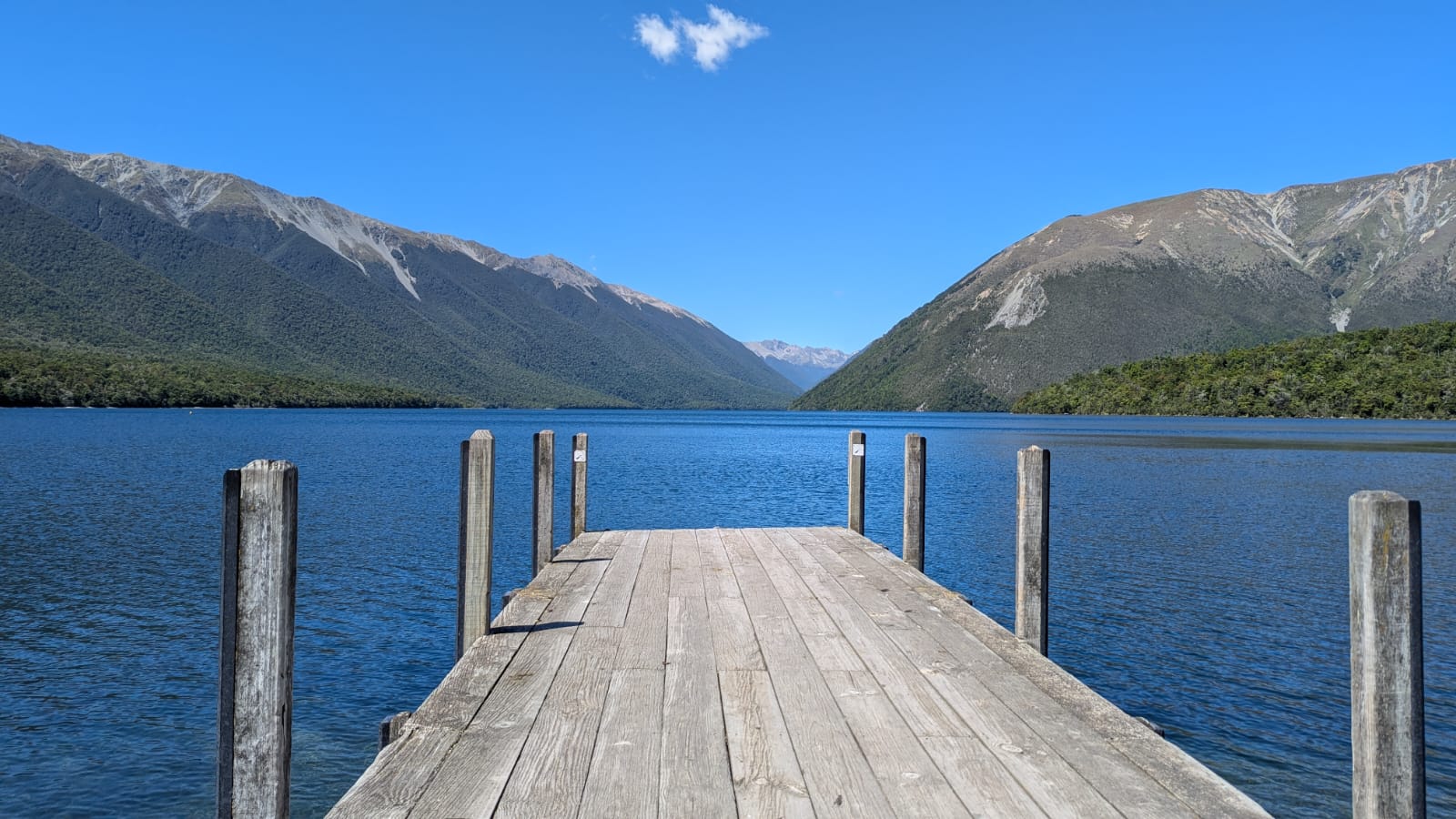
After a tasty breakfast (best coffee so far), a shortish drive took us to the beautiful setting of Lake Rotoiti in Nelson Lakes National Park. We did a short walk through the forest, learning about the key part played in the local ecology of the honeydew from the scale insect that lives in the bark of the beech trees. Unfortunately, invasive wasps were gobbling up the honeydew, so as in most parts of NZ, there was a programme to get rid of the invasive species to restore endemic species.

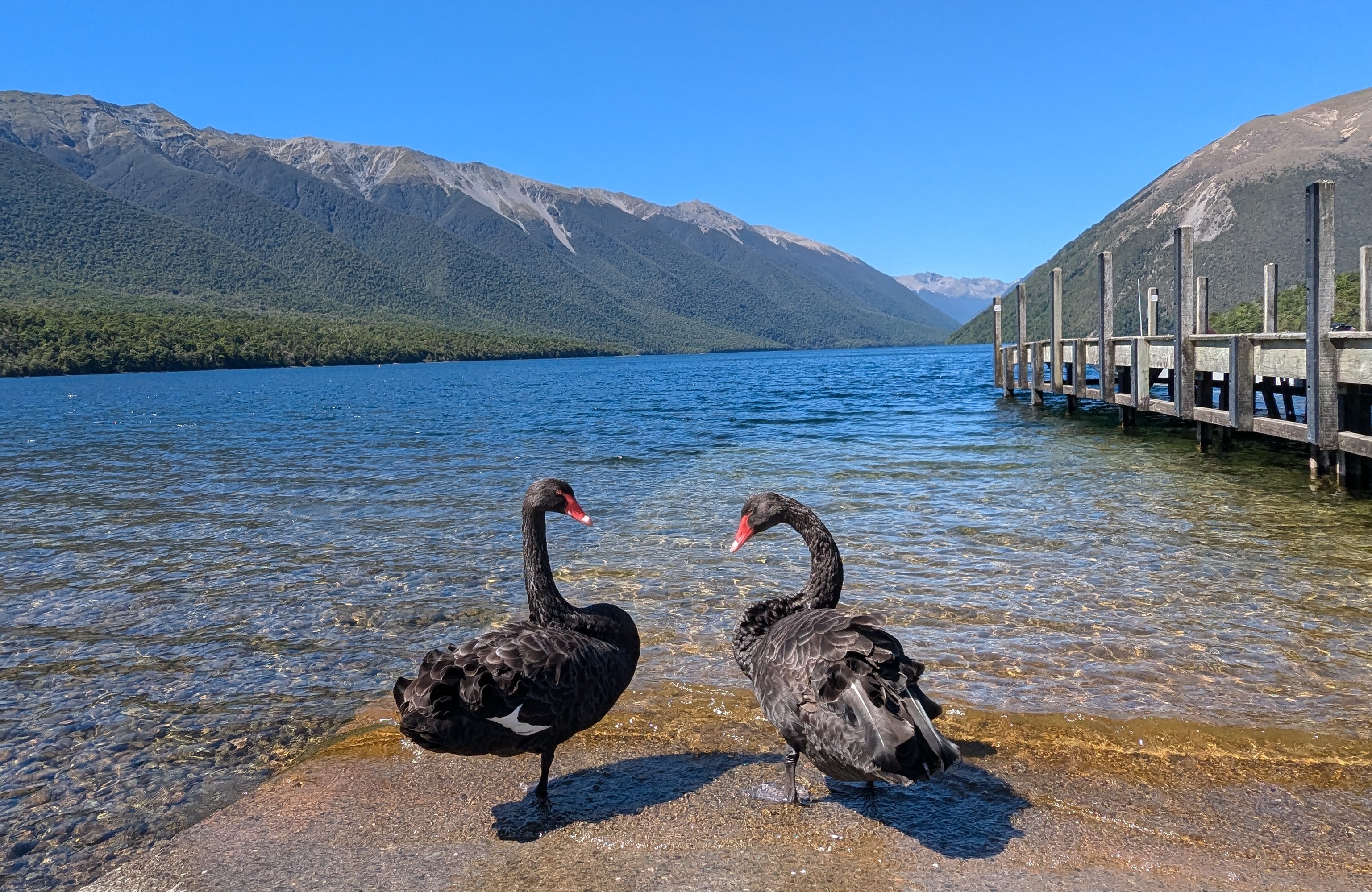
Lake Rotoiti
Eels below the jetty – they live for up to 100 years!

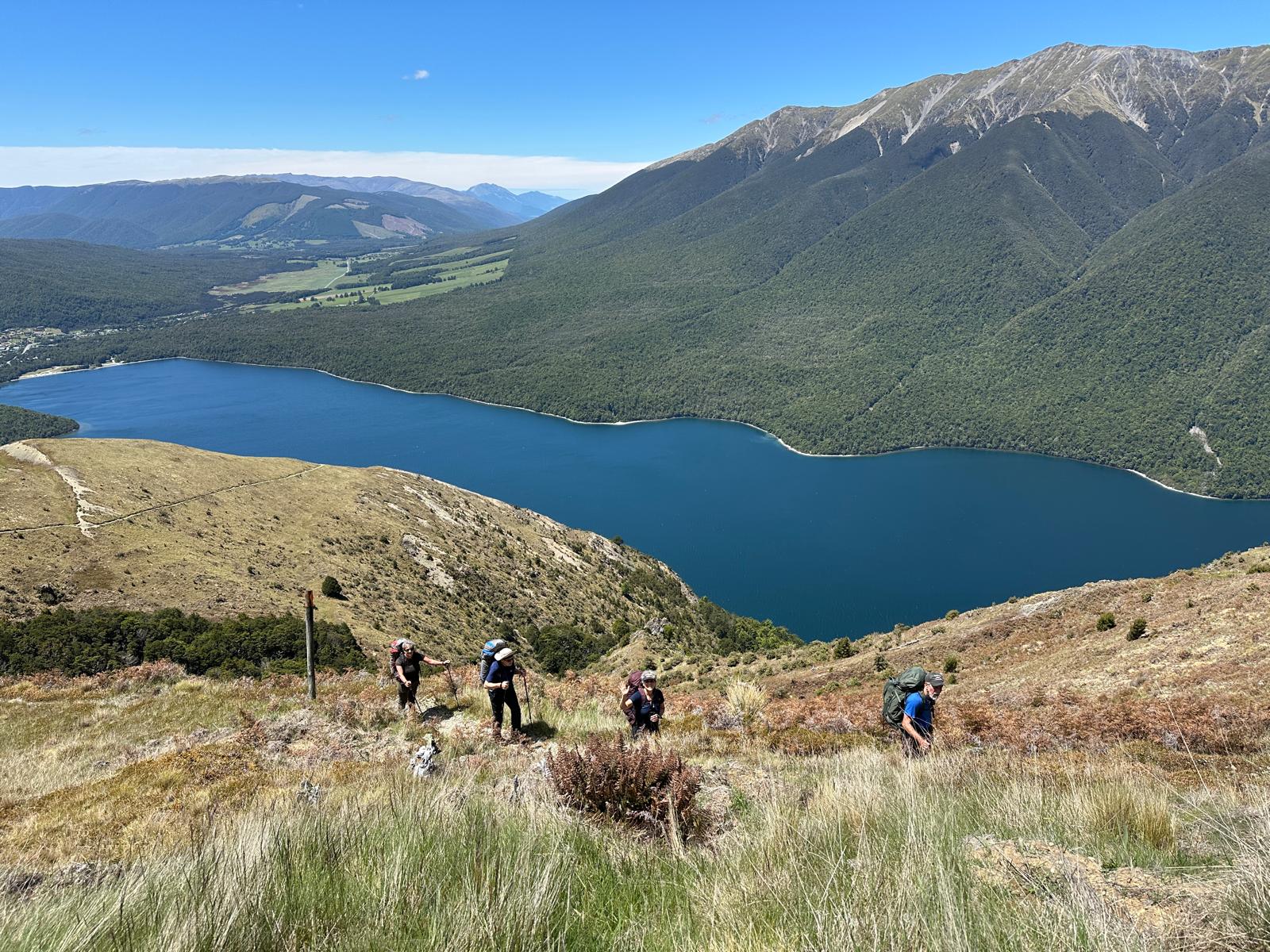
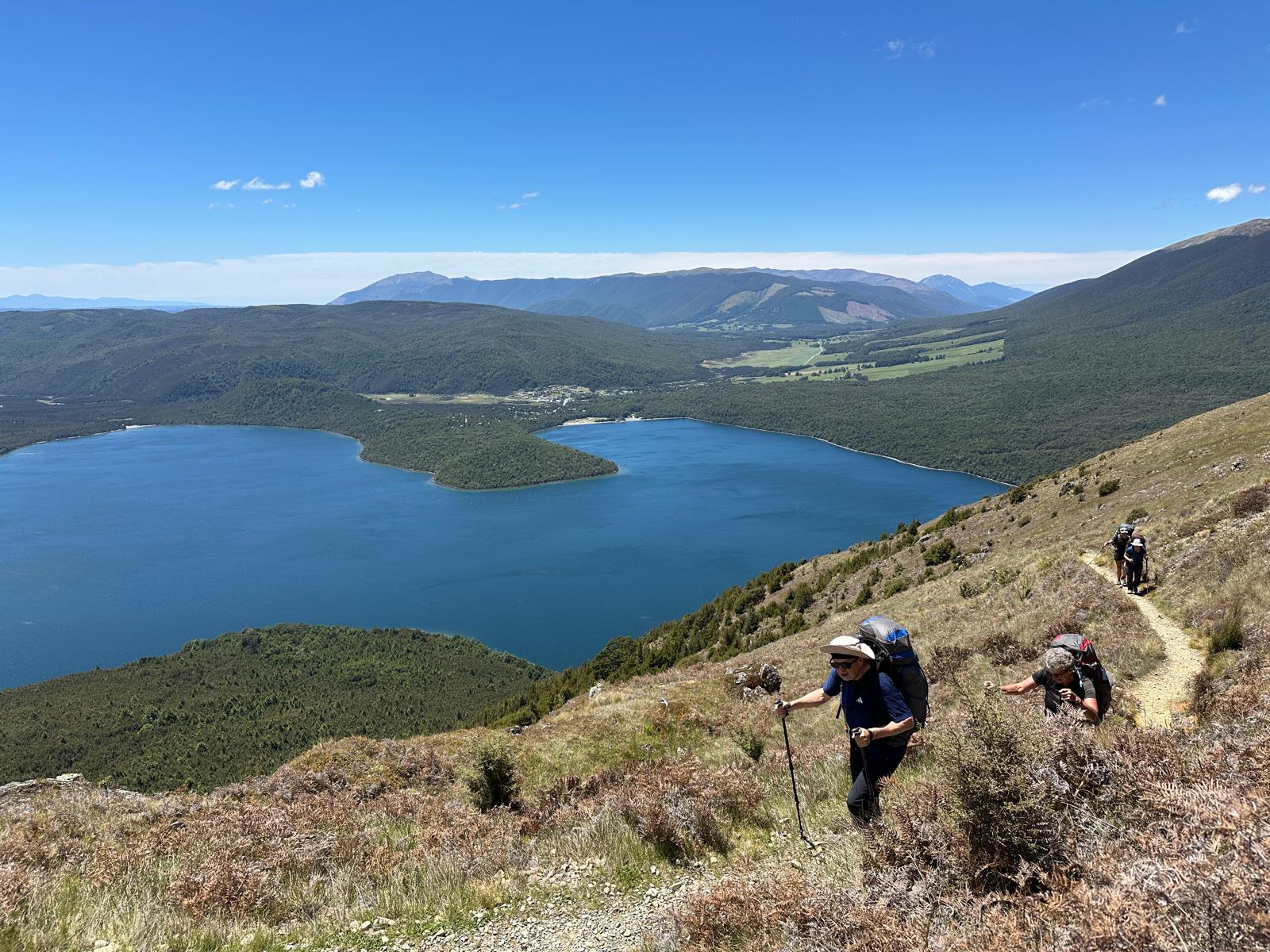
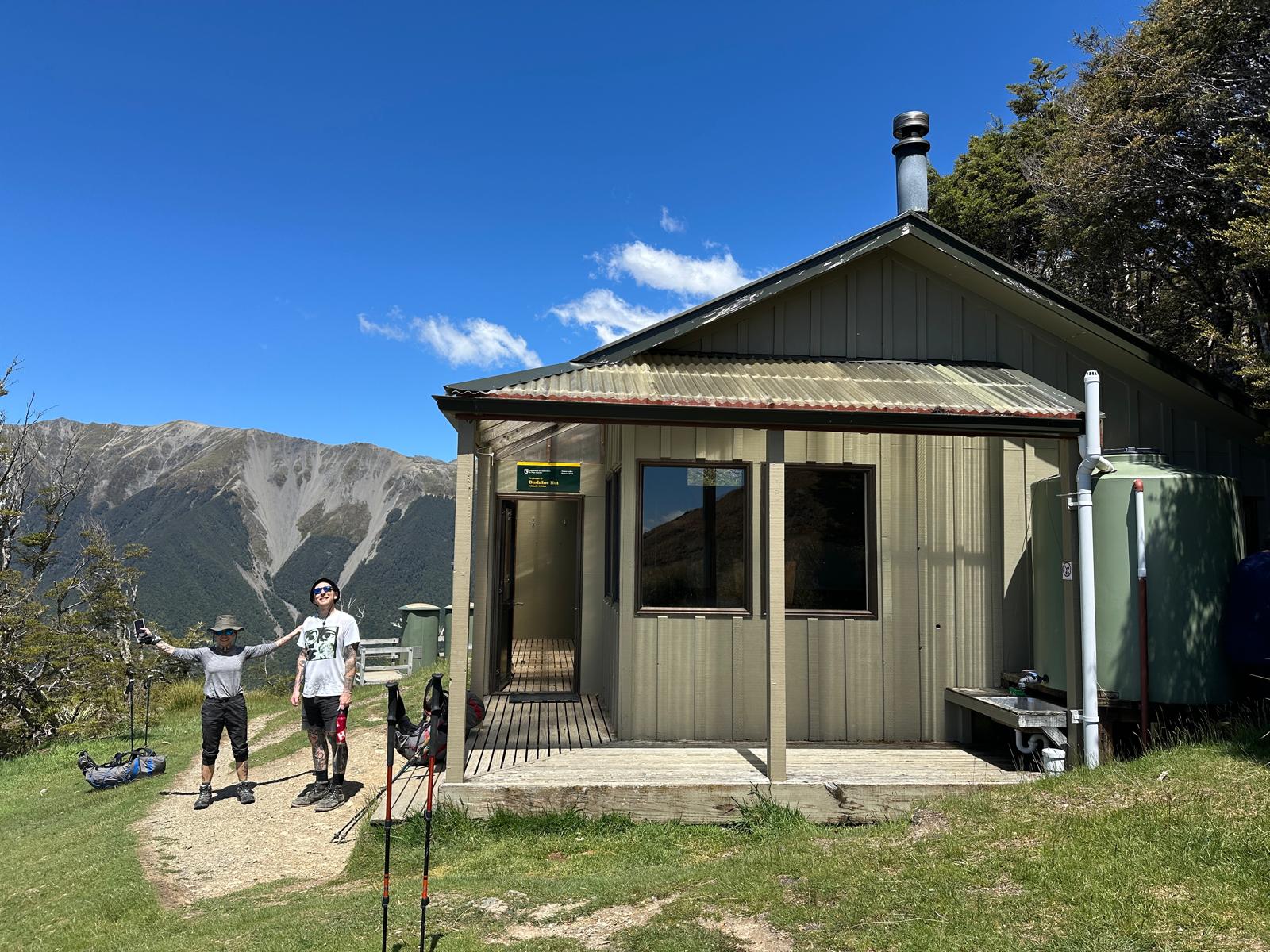
After an early lunch by the lake we set off on the hike proper for the day – a two hour tramp with packs up to Bushline Hut on Mount Robert, where we were staying overnight. We had elected to camp, rather than squash into the rows of mattresses in the hut, so were back to carrying full packs.  This paled into insignificance when we saw what out guides carried up –  their kit and all the food for 11 people for the evening meal and breakfast.  Their loads included 2 bottles of wine – I fear we set a precedent.

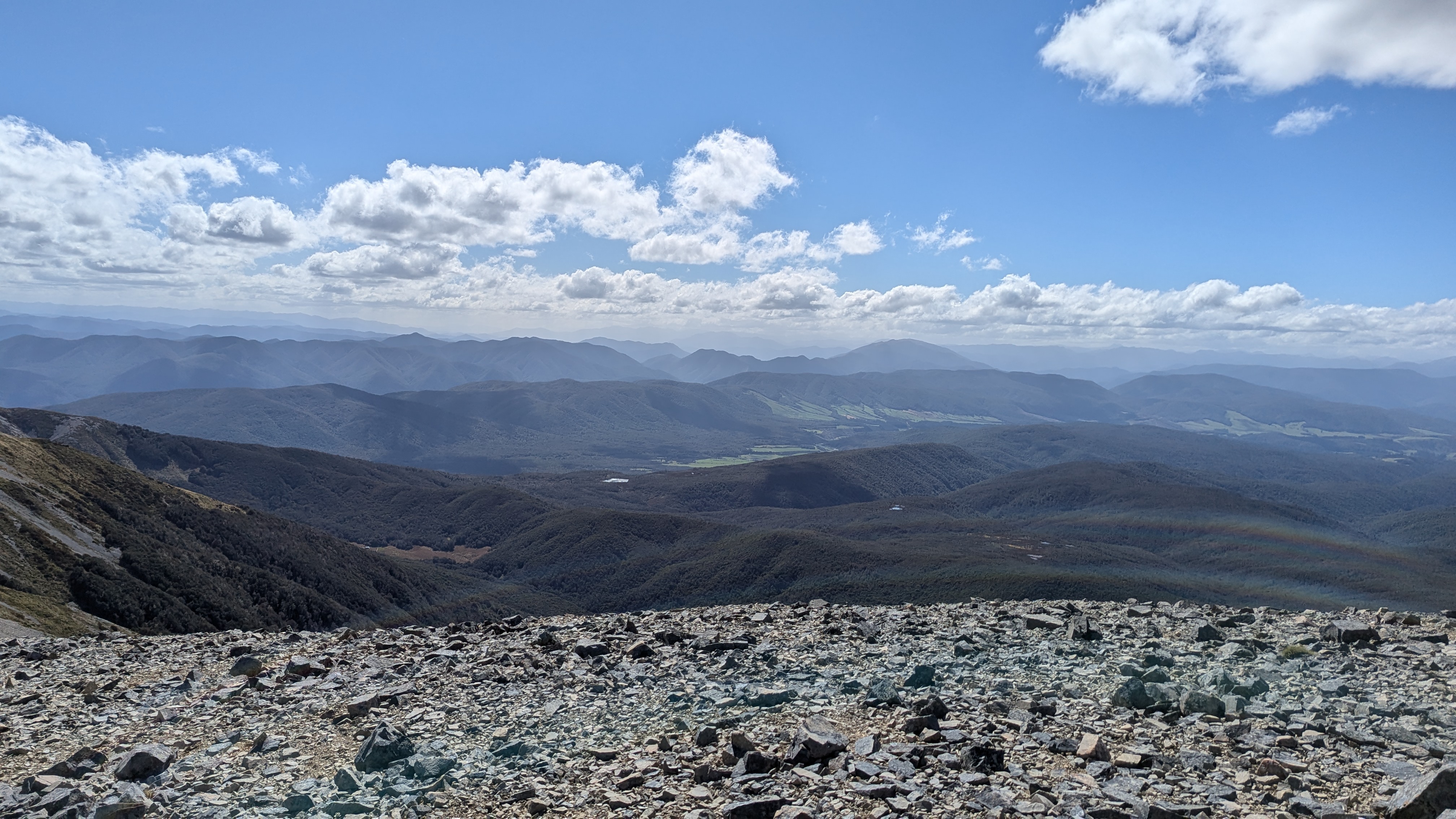
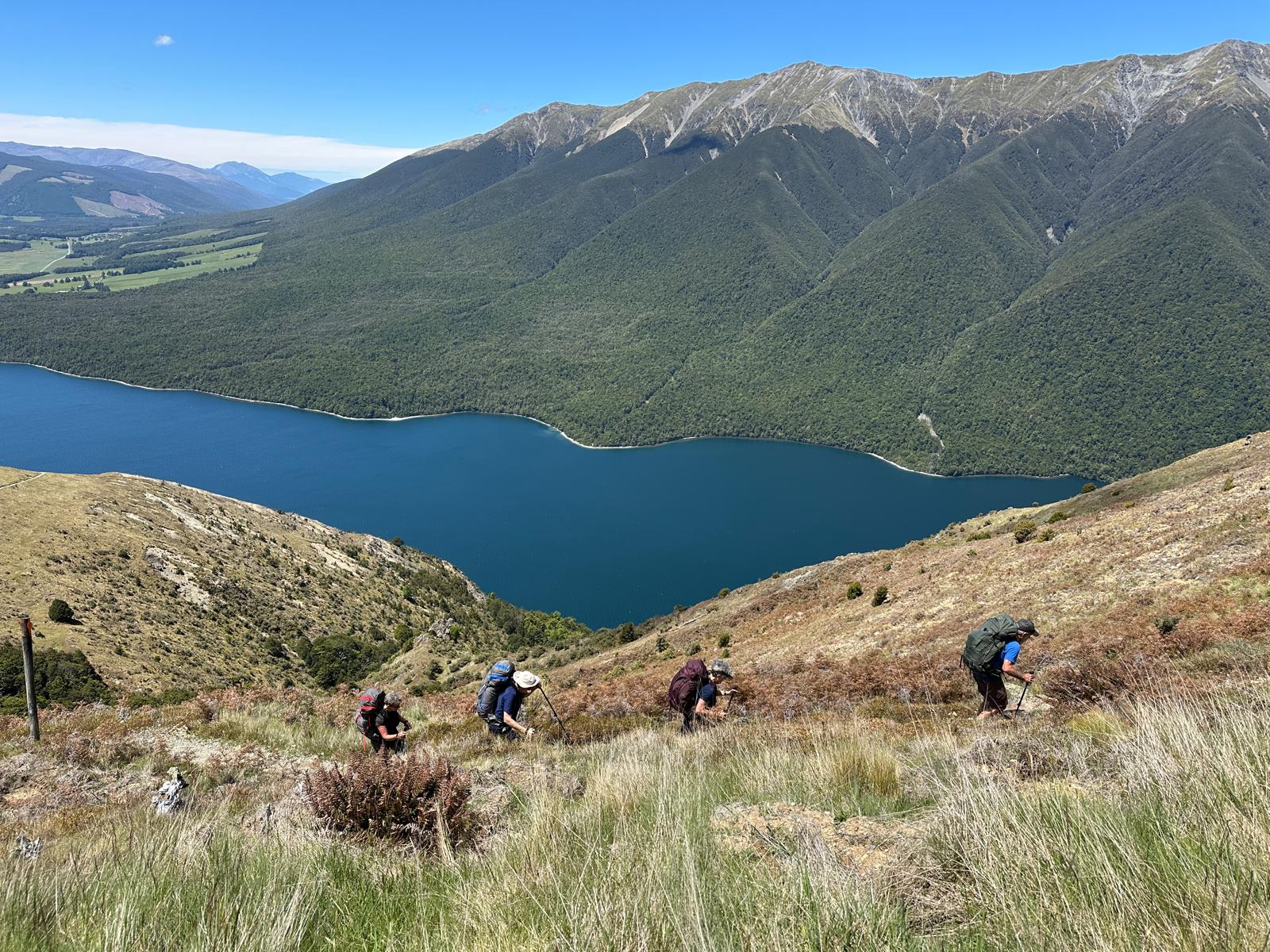
Back to the hike – this was a perfect climb. Nothing was too steep. The views over the blue lake were stunning.  As we climbed, the lake got smaller but the views over the mountains got greater, then we were rewarded with views over to distant mountain ranges. 

The setting of the hut was stunning – as the name suggests it was right on the bushline (or tree line as we would call it).

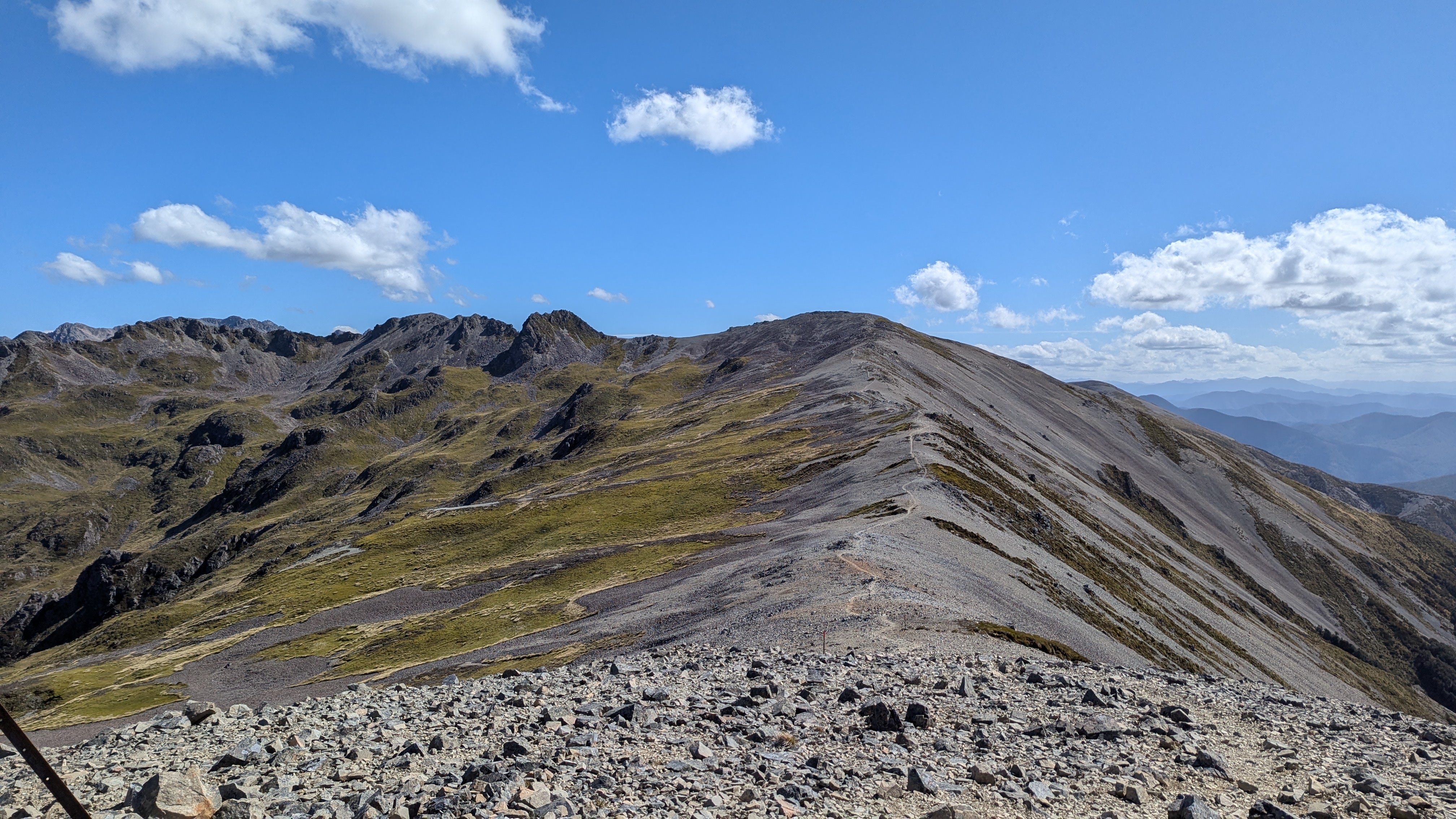
We set up our tent in the trees behind the hut where we would be relatively sheltered as the mountain was famed for its strong winds.  We then emptied the rest of our packs apart from a few layers and some water to prepare for the next part of the day.  The more energetic in the group (including us) decided to hike up to the main ridge and then along the ridge for a while.  This route would eventually lead to the Angelus hut though that was not for us today; it was four and a half hours further on from our hit. Six of us set off, reaching the edge of the ridge about half an hour later.  We then walked along the ridge, gradually climbing as the vista opened up even more views.  It was windy but fortunately the forecast winds of 55-70km an hour did not materialise.

After about an hour we got to a lookout spot and the rest of the group decided to turn back.  David and I were keen to carry on a bit longer so we agreed we would do another half an hour max, and then turn around so as to ensure we were back in time for dinner. The sun was getting lower and we were walking in the lovely golden light of late afternoon. We could see a high point ahead and now there were only the two of we could move faster.  We set ourselves a brisk pace and managed to get to ‘Flagpost’ summit, one of the highest points on the ridge, about half an hour later. Our stay at the top was necessarily brief as we were hit by the famed strong winds. So we about-turned and walked equally briskly down. Our legs were beginning to tire following our exertions but, having checked the time, we got to the last turn off down to the hut as predicted.  We then allowed ourselves to slow down a bit and got to the hut bang on time – to find cheese and wine ready and waiting for us, followed by a delicious meals cooked by our guides. Tired but elated we were tucked into out sleeping bags by 8.30pm and soon asleep.

Nydia track back to Kaiuma Bay, then by minibus to Nelson.

The day dawned bright again and after breakfast and a final look at the bay, we retraced our steps back to Kaiuma Bay.  We had felt a bit dubious about repeating the track rather than continuing north on the trail, but the logistics of getting the minibus to the other end were too great and we were told the track was not that good.  In fact, it didn’t feel repetitive and the trail through the forest, with different perspectives, was still beautiful. Everyone was going well and it seemed no time before we were back at the van (although it was 5 hours).

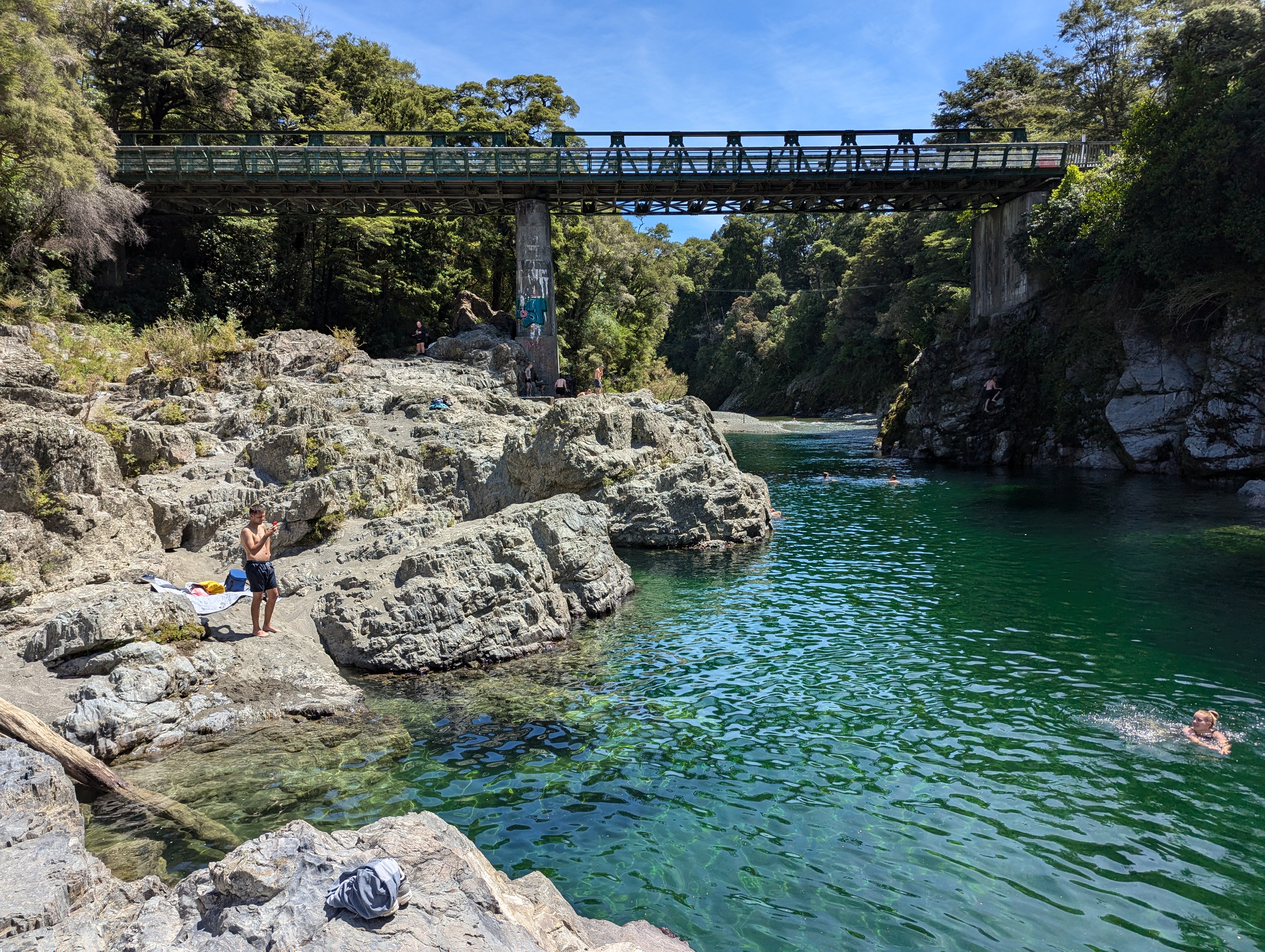
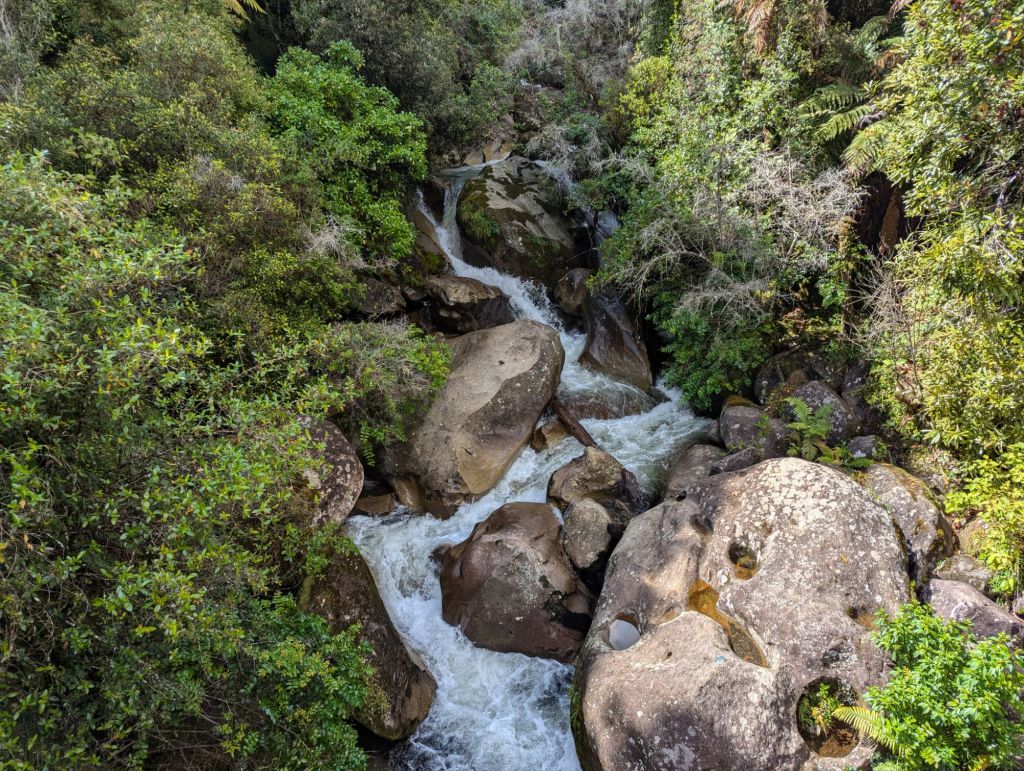
On the way on to Nelson we stopped at an unscheduled swimming spot at a bridge over the Pelorus river, which was known to one of our guides. Fantastically clear water flowed through a bit of a rocky gorge with deep pools. It felt so refreshing in the cool water after our hike. 

Then the jumping began again….First from the higher rocks, then from the bridge –  a terrifying 20m above the river.

In a bit of a testosterone fuelled competition, both the guides did the jump and then one of our fellow travellers.  I could hardly bare to watch and I jokingly threatened David with divorce if he dared it – which he did not; but they all came out alive! After everyone had cooled off literally and metaphorically, it was back on the minibus for the last hour to Nelson. 

This town is supposed to be the sunniest place on the South Island.  Here the guides left us to have a day off tomorrow to do our own thing. It felt a welcome break not be part of a group with the day pre-ordered for us.  On the other hand, it had been great not to have to think about or decide anything for ourselves for a week!

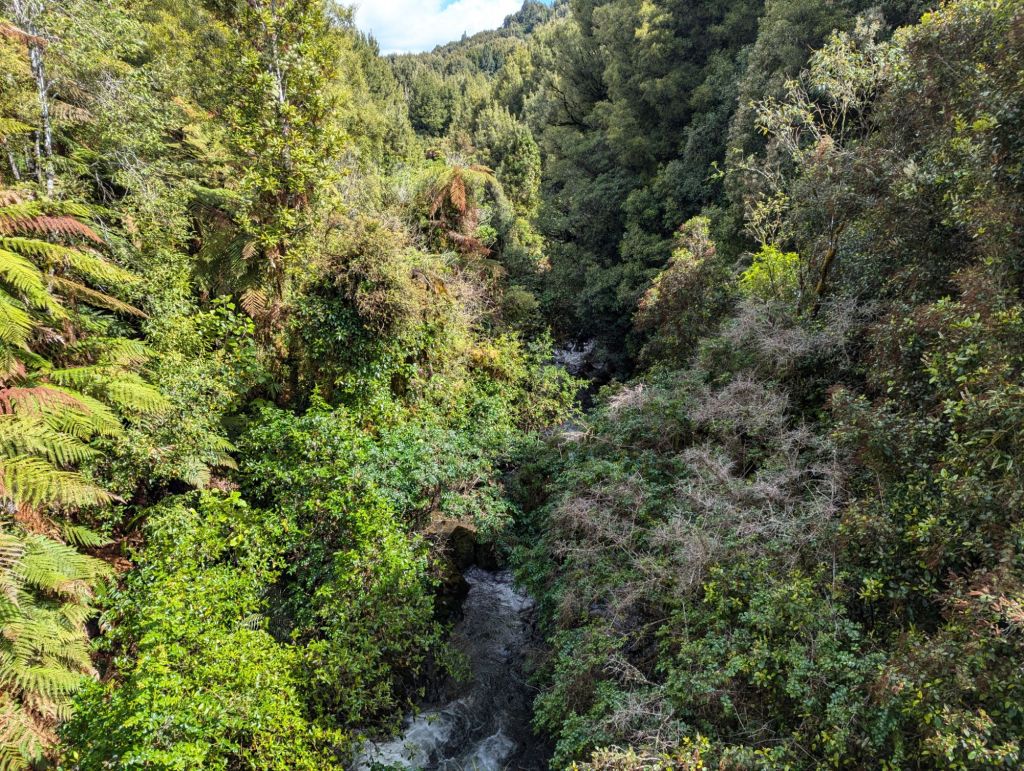
Long way down…

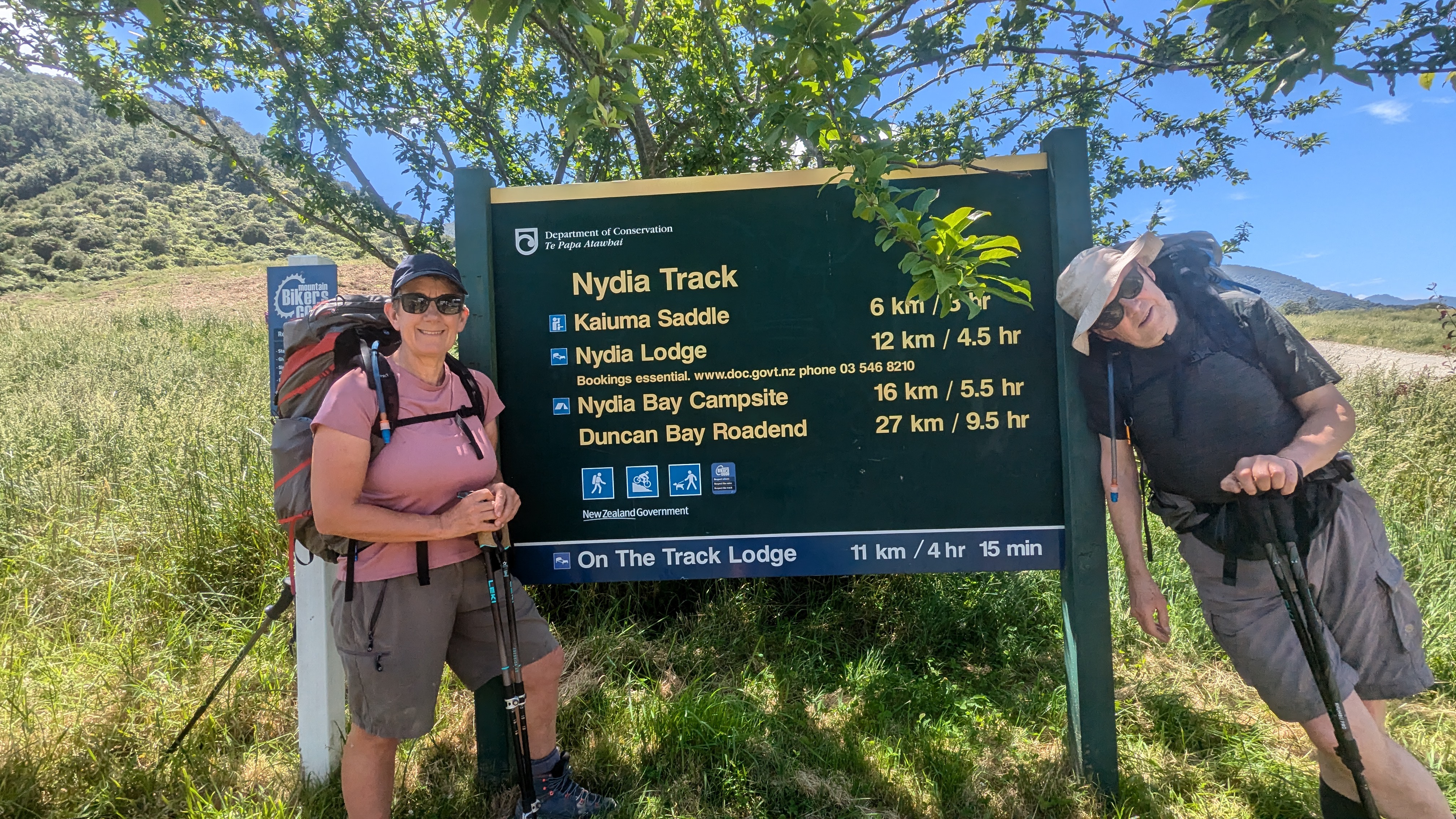
The Nydia Trail – A delightful forest tramp

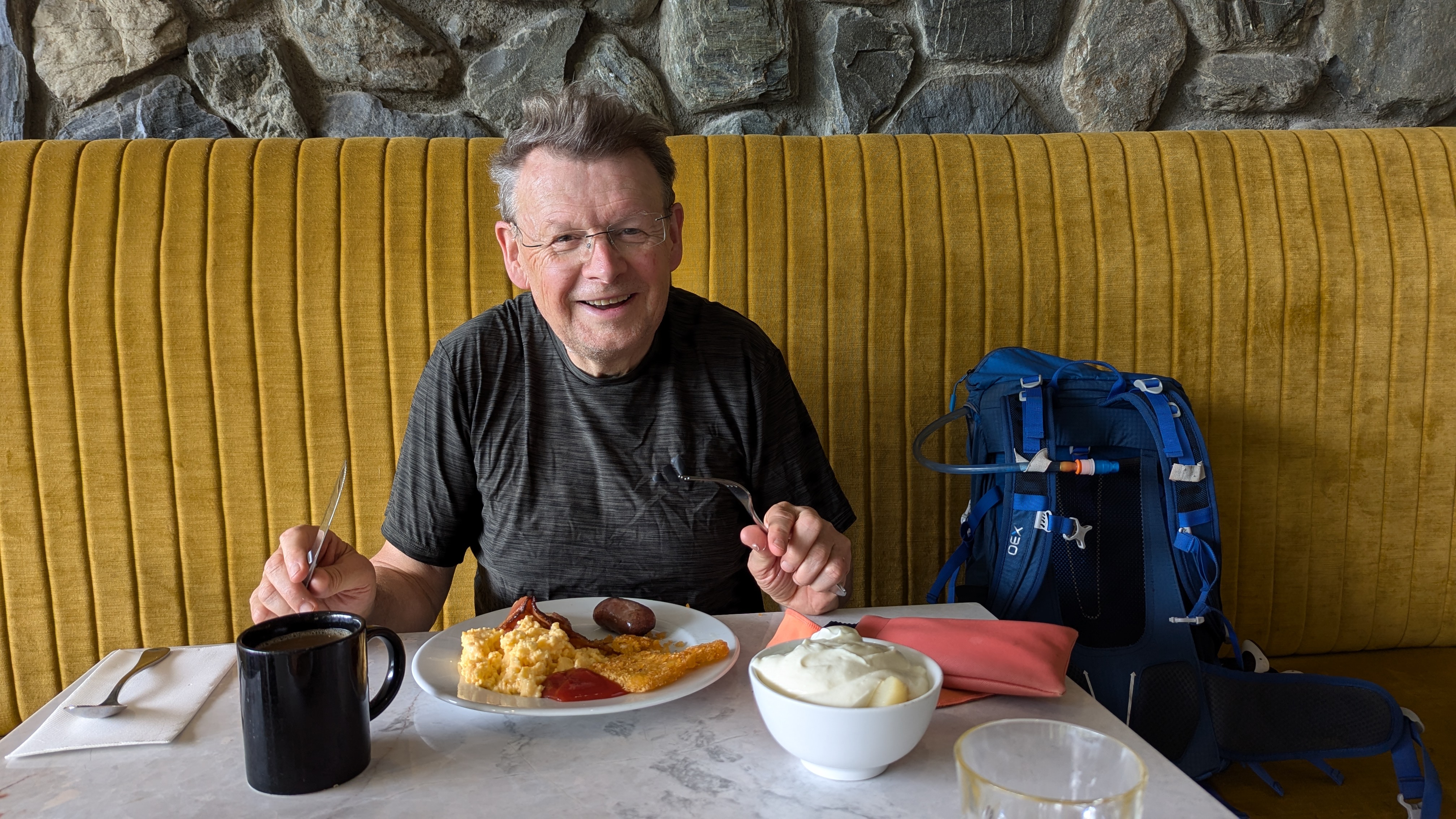
(David) This day started with a fantastic breakfast.  Now I know we go on and on about breakfasts in this blog – usually the best meal of the day which is “second breakfast” – but this was great.  We left our anonymous hotel to go a few hundred yards along the beach road to The Beach House Café, Kaikoura – squashed between the Little Laundromat and the Lazy Shag (which claimed to be “serviced” accommodation – although what services were provided was a little unclear).  Anyway, the eggs benedict and bacon, with excellent coffee, at the Beach House Café are worth travelling hundreds of miles for! 

Then it was back into the minibus to go north to the Marlborough Bay area.  This area of New Zealand is wine country, with mile after mile of vines across the hills, and even on flat fields.  The wines are well known in England and taste just as good here (more of that later).  We stopped for ice creams at the town of Havelock, which had a “frontier” feel to it.  The town sits beside Pelorus Sound, one of many sea water inlets that lead out into the Cook Strait.  Whilst there and spurred on by all the wineries we had passed, Bernie had the genius idea of buying some local wine which we smuggled into our backpacks for later.

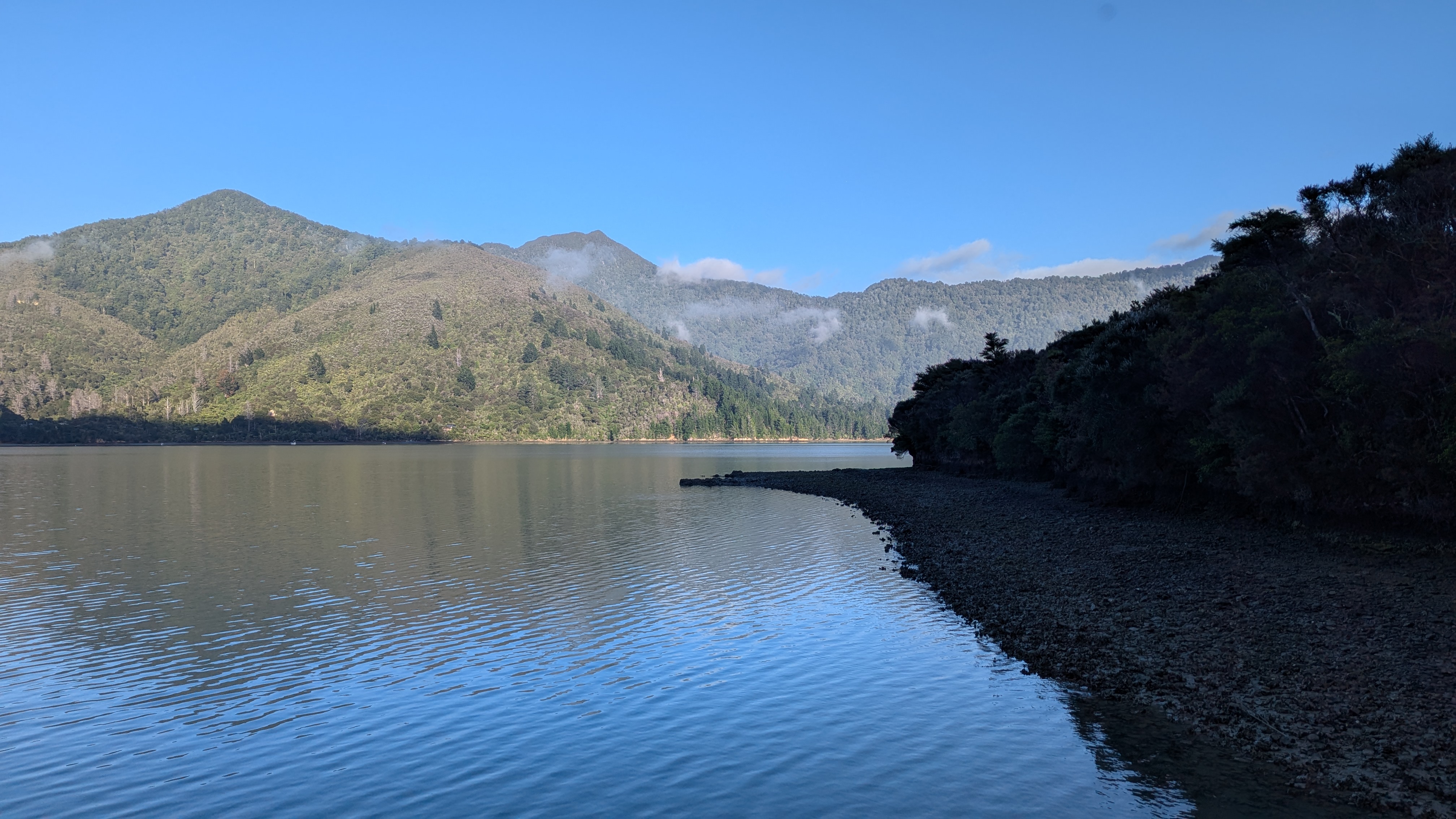
Then it was a 45 minute drive along a gravel road on the northern side of the sound to get to Kaiuma Bay, where the trail began.  The trail was about 12 km, including two fairly substantial climbs and descents, to reach Nydia Bay where there is a “hut” complete with running water, electricity, a fridge (when the generator works) and hot showers – but still a hut.

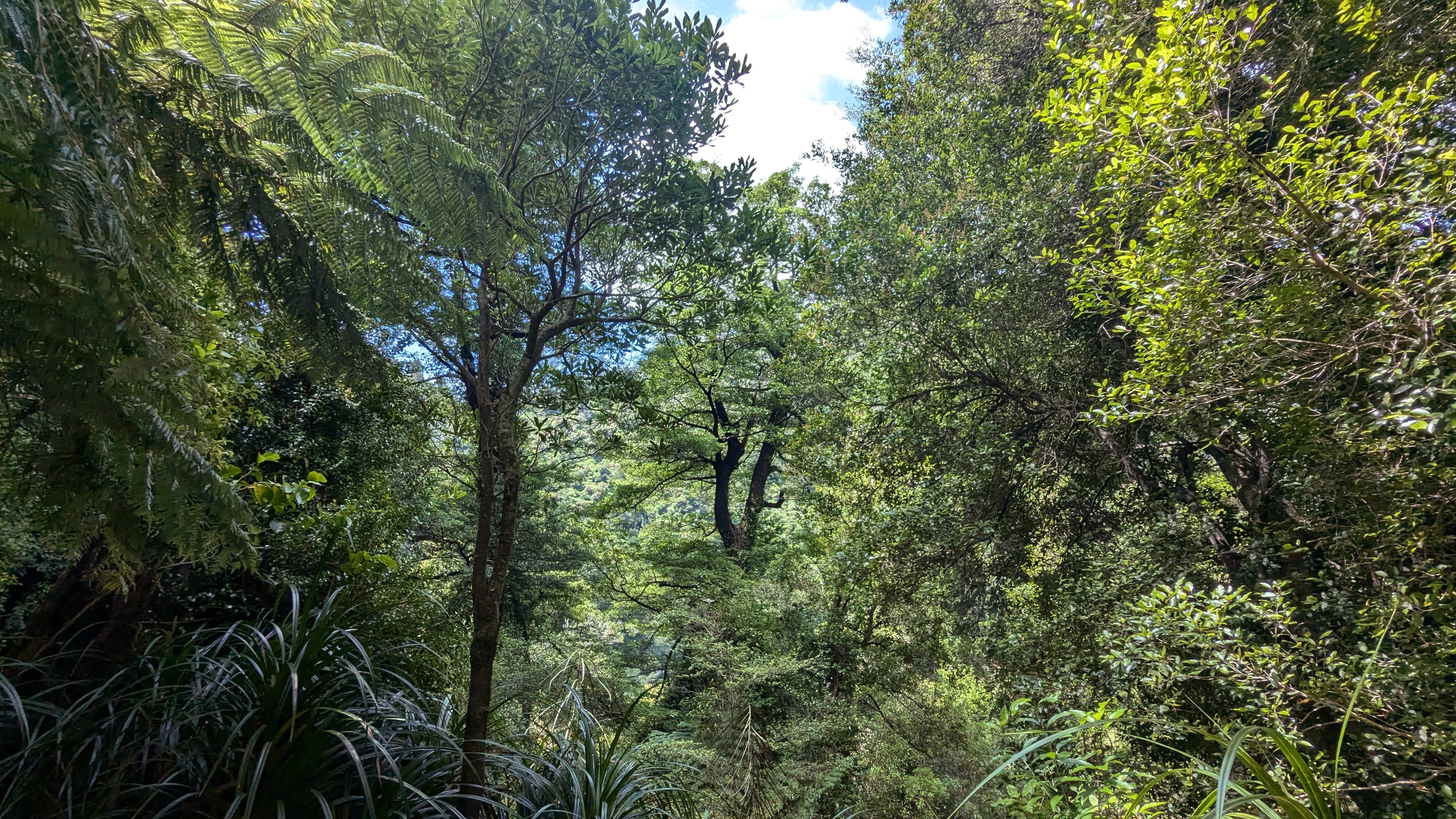
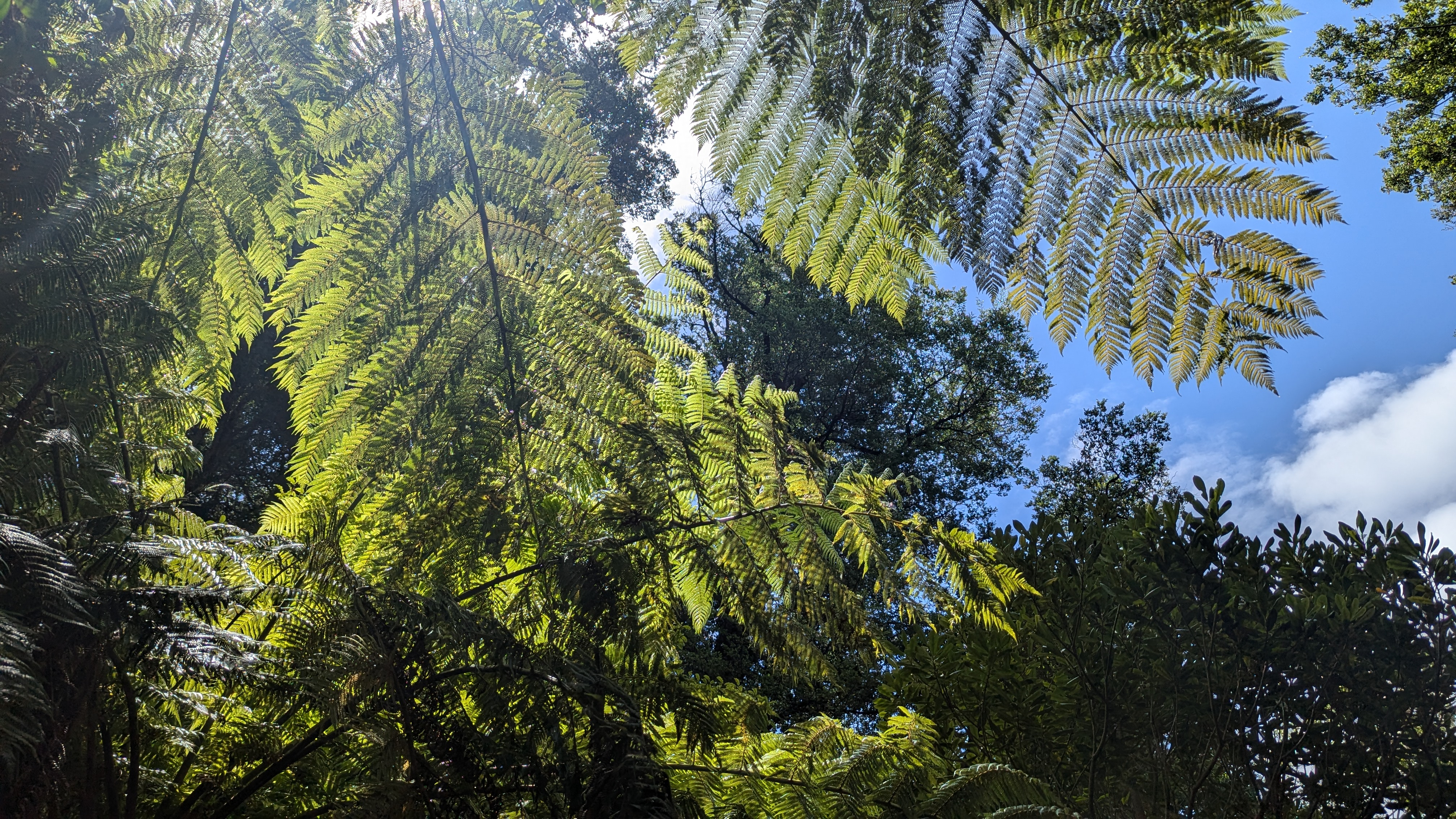
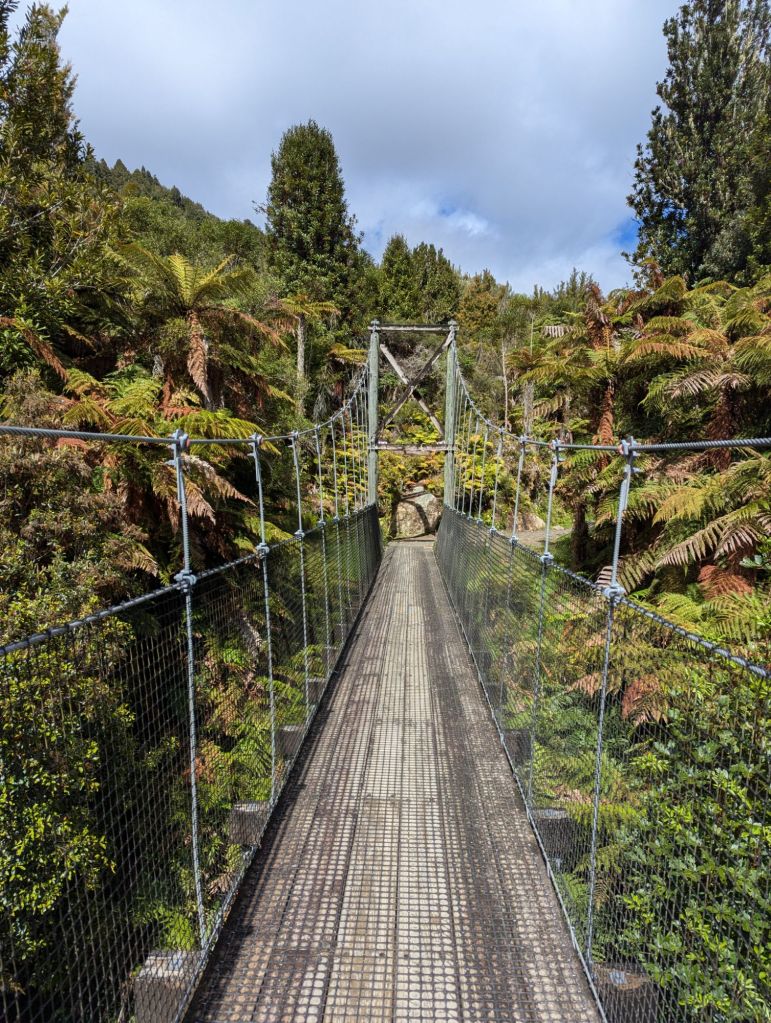
The walk was almost entirely through native forest for the first 10km and then a final 2 km along the sound.  It is hard to describe how lovely it was to tramp through this hugely variable vegetation. 

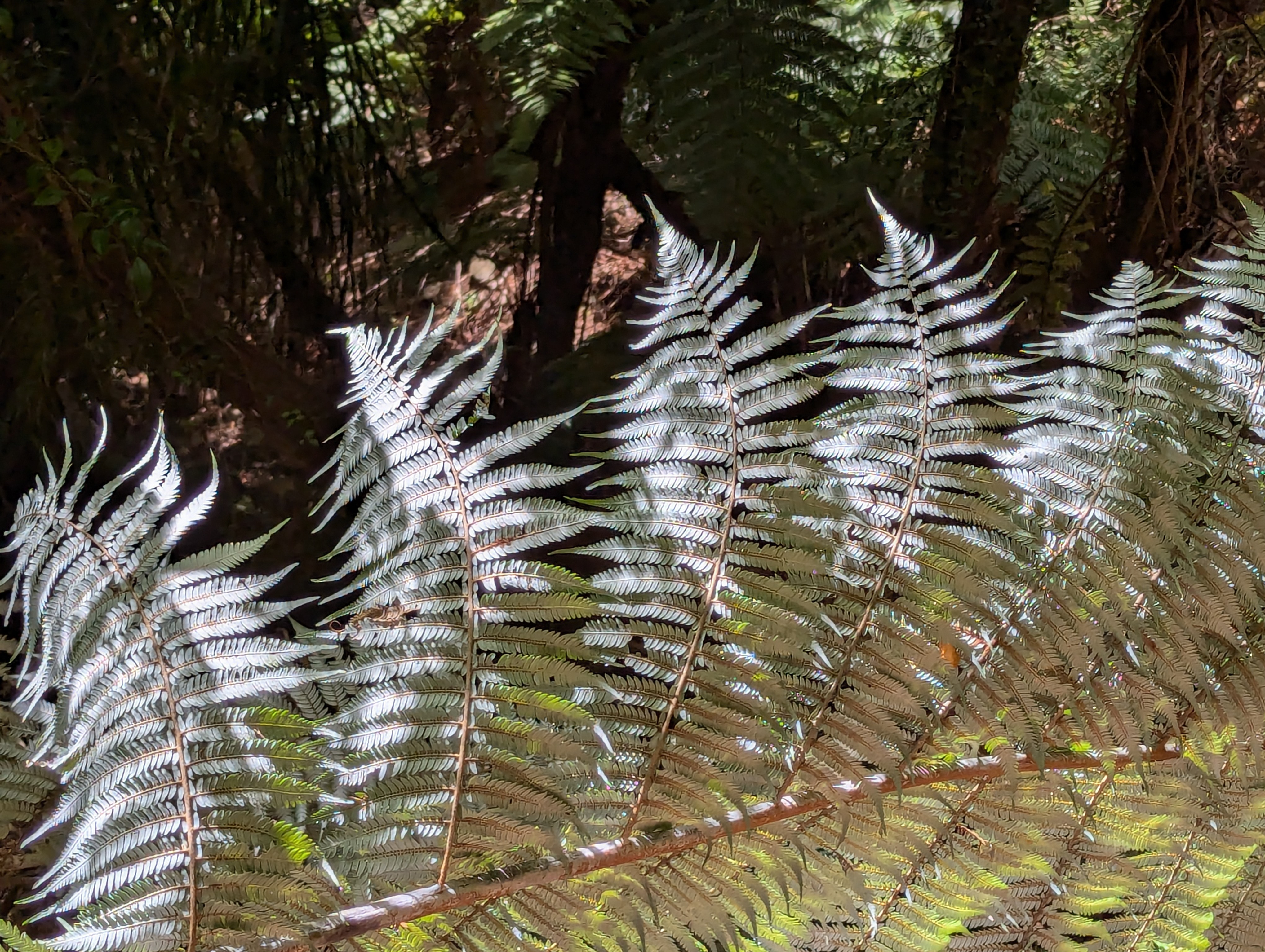
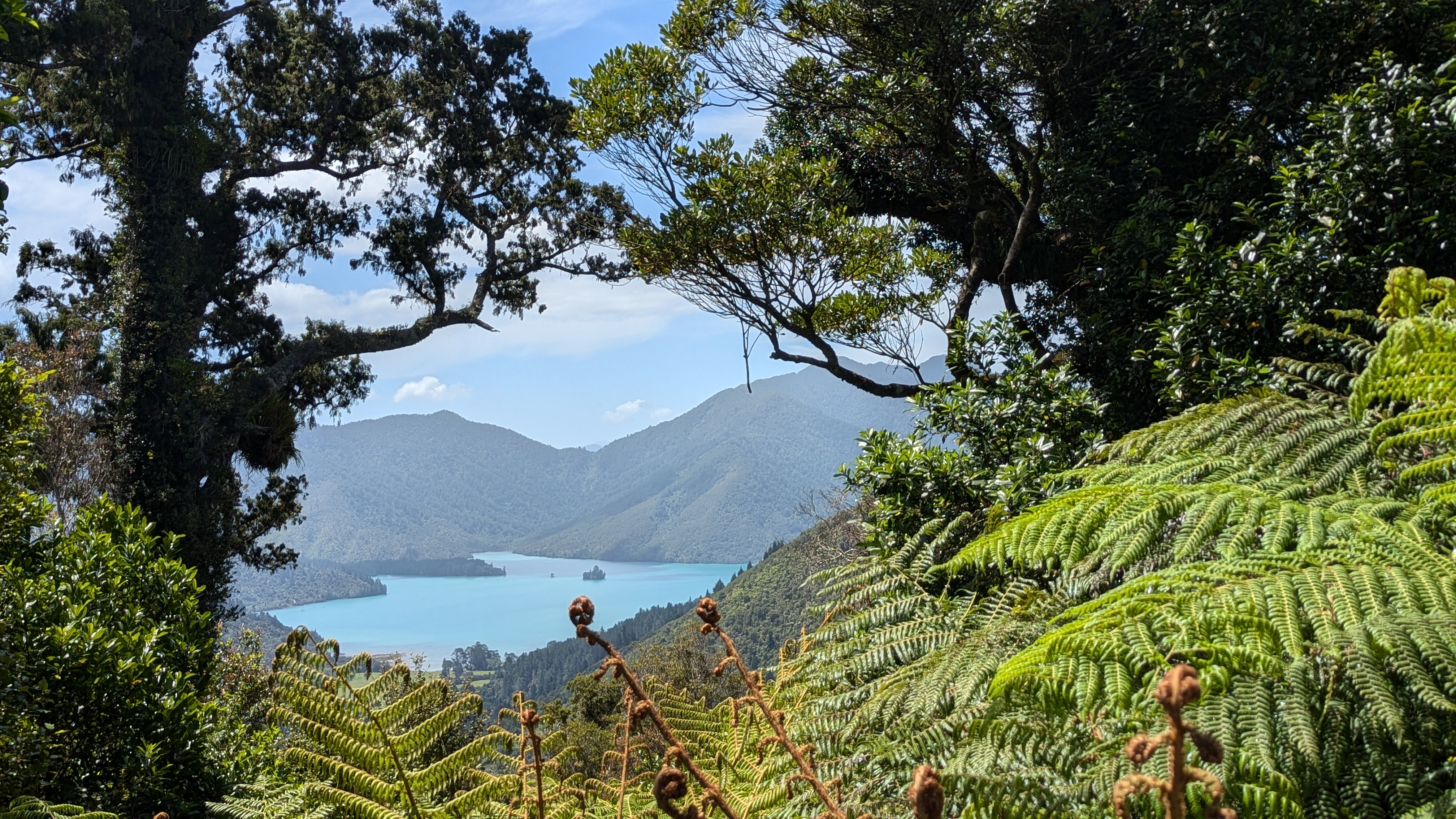
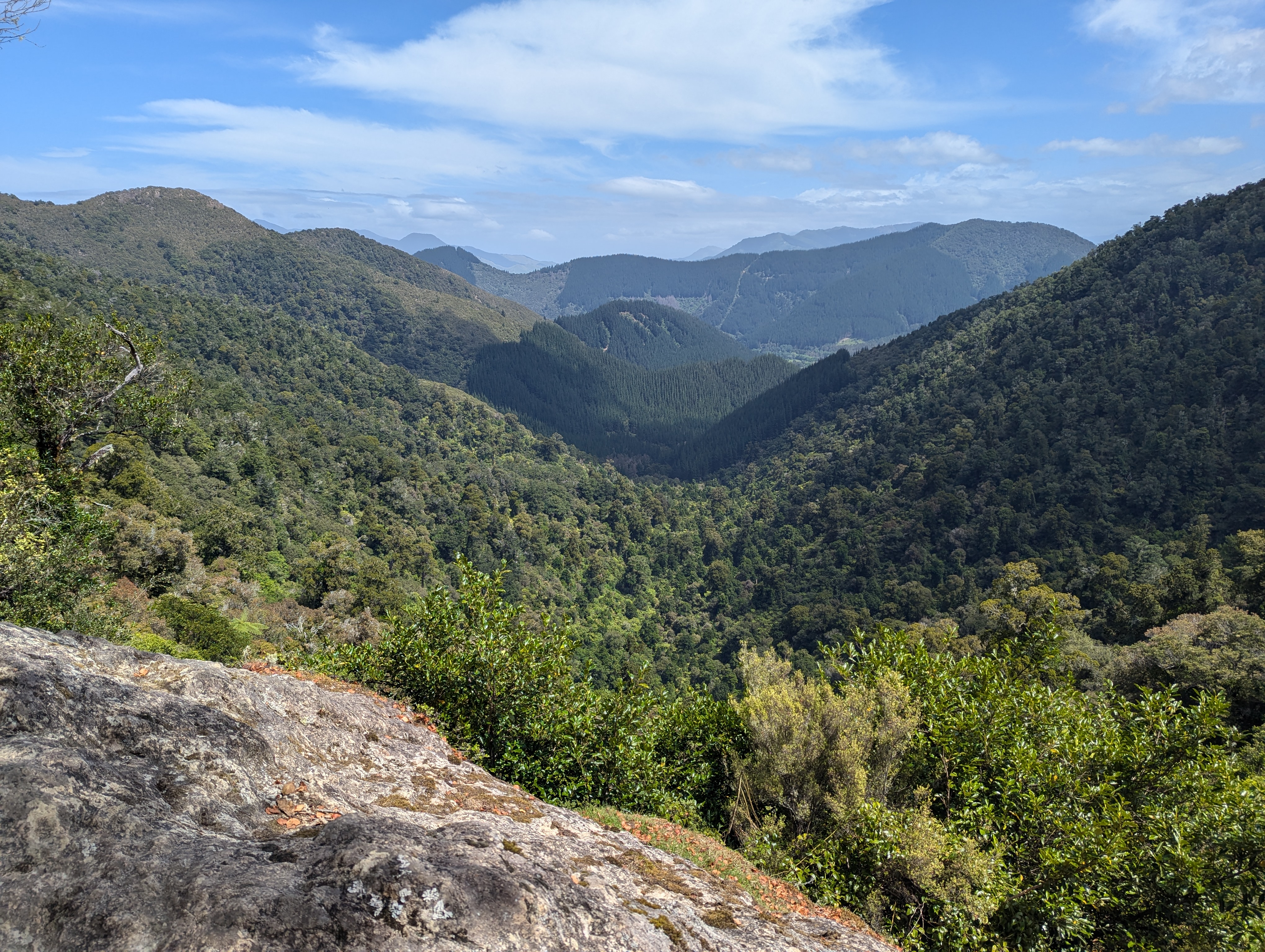
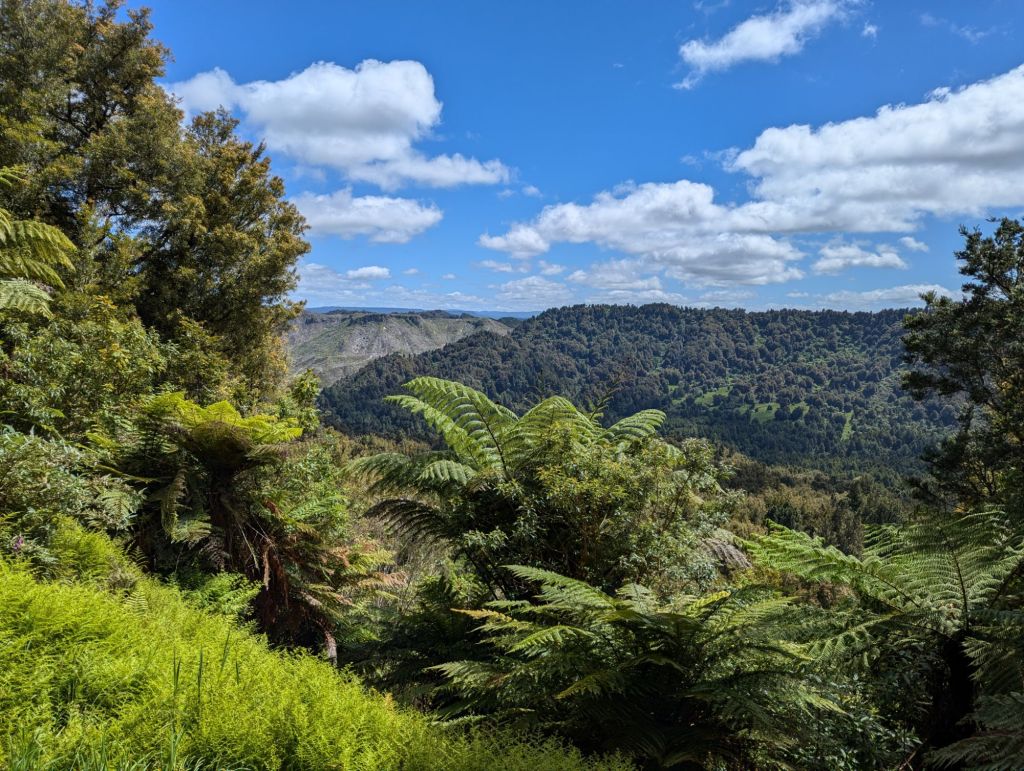
We saw palms of all descriptions, rotting trees with fascinating bark shapes, beach trees which were nothing like the beach trees we have in England and enjoyed the steady hum of cicadas, which has been the signature sound of summer abroad for so long.  I hope the pictures do credit to the beauty of the forest. At the narrow shoulder we looked down to the idyllic Nydia Bay, surrounded by the forested hills, where the only access is to walk in (or rarely get to by water taxi, although the hut ranger said he had only ever seen people walk or mountain bike in).

Once we arrived, we all went swimming in the sea to cool down after a fairly arduous tramp.  It was so, so refreshing.  There was a jetty – so for the younger elements, the inevitable jumping off, diving and trying to do “loop the loop” in mid-air, trying to turn full circle to avoid a sensitive anatomical part hitting the water at speed.  Some were more successful than others. We went for the more genteel glide in off the jetty steps!

After a swim we repaired to the lodge to have freeze dried meals, to find our guides had carried up a whole cheese board including dips and crackers.  We brought out the wine for everyone that we had smuggled into our rucksacks as a surprise.  This was another unexpected treat which let to Bernie being awarded the “toy kiwi” prize for the day.  This was luxury tramping in a five star setting.

Kaikoura. Swimming with dolphins.

Today is not about cycling or walking but swimming. But a magical swimming experience in a beautiful setting. We trundled through the suburbs of Christchurch heading north. The road looped inland through green hills with a short stop in the pretty town of Cheviot. As we wound down the last hill the first views of the Pacific emerged, blue and sparkling in the sun.  The road hugged the beautiful rocky coastline – a road that had been closed for an extended period following the earthquake in 2009. Seals were basking in the sun, and we glimpsed a few dolphins close to the shore.

The town of Kaikoura straddles two large bays bisected by a small spit.  The area is home to several pods of dusky dolphins – so called because of their bluish/black backs. The dolphins are attracted to the bay because just a kilometre off shore is a deep sea trench that contains lots of good things to eat when they rise up near the surface during the night. This also means the dolphins feed at night and spend the day nearer to shore gambling about in the water.

The Dolphin Experience takes trips out where as a ‘swimmer’ (rather than a spectator) you can get into the water with the dolphins.  This came as part of our trip package and I felt a bit uncomfortable about the prospect; but we were assured that the dolphins remain completely wild.  They are not fed but dolphins are curious creatures and like to investigate what is going on when the boats arrive.  We were also warned that sometimes they don’t play ball and we may not see them at all. The boats go out with a licence from the Department of Conservation with strict limits on the number of boats, the number of people allowed in the water at any one time and the guides monitor the human activity to make sure it does not impact on the behaviour of the pods.

It was a beautiful sunny day. The waters can be very choppy and we were told sea sickness is very common but from a distance the blue waters looked calm.  Although closer up we found it was choppy enough.  I wouldn’t like to see what a windy day looked like. We were togged out with thick, very buoyant wetsuits, flippers and snorkels.  A short bus ride and then we joined a small boat heading out into the bay.  We were in luck and after a 30 minute glide along the coast, we were called up to prepare for our first swim. The boat is adapted with seats at the back almost in the water where you push off to swim.  When the boat stops and a horn blows – in you go. When the horn blows again you come back to the boat.

In all we had 5 swims, each lasting about 5 or 10 minutes and it was a truly magical experience. The pod of dolphins do exactly what they choose – they are in control.  They swim under us, and around us, sometimes got really close to us.  We were encouraged to make squeaky noises to attract the dolphins and soon we were all cheeping away into out face masks! When the pod wants to move on it does.  A couple of the swims I only saw a few dolphins but on a couple they were swarming round, including several mothers with calves.

After the final swim we clambered out of our wet suits and the boat gently chugged after the pod.  An estimated 200 dolphins then gave us an incredible display of swimming and acrobatics. They stayed around the boat for ages, happy to swim around and under the boat, rising and falling out of the water with some doing high jumps and twists and backflips. Dolphins come out of the water to breathe and we saw them spurt water out of their air holes, take a breath in mid air and then descend again. 

There are lot of theories about why the dolphins behave in this way but there seems to be evidence that they do it just for the joy of it, and it certainly looks that way to us landlubbers on the boat. At one point a seal appeared in the middle, flapping his flippers and the smaller dusky dolphins were joined by a larger bottle nose dolphin.  The guide explained that this was highly unusual but it first appeared with the pod a couple of years ago and reappeared a few weeks previously.  He said no one know why he has joined the wrong pod, but his behaviour is starting to mimic the behaviour of his new friends.  In the end it was the boat that had to turn and head for home as we were out of time, with the pod still splashing and churning the water.

As the boat was speeding back to the bay an albatross flew alongside the boat, probably for about 10 minutes. This beautiful bird with its large wingspan was almost as big a highlight as the dolphins.  We were told this was a young, small albatross but it flew at incredible speed with only the occasional flap of the wings, dipping and swooping along the water. A fantastic end to a memorable trip.

Aoraki/Mount Cook – Seely Tarns and Mount John, Lake Tekapo.

We set the alarm for 5.15am so that we could leave at first light. The rest of the group had elected to do a shorter walk up to the Red Tarns but we felt we wanted to give ourselves something a bit more stretching.  We knew it was a tough walk and we also knew we needed to be back down the mountain to coincide with the end of their walk, so as not to hold everyone up!

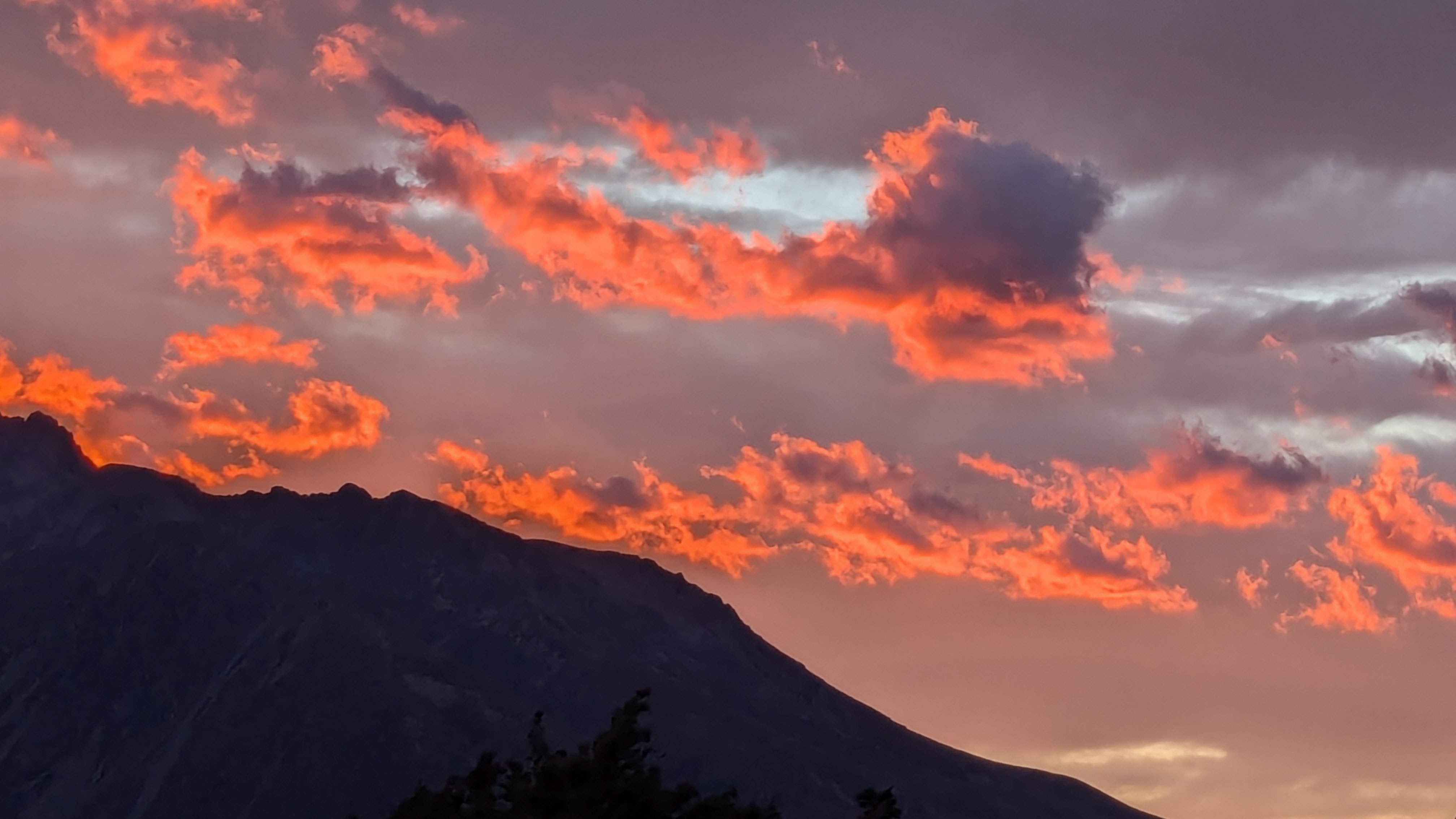
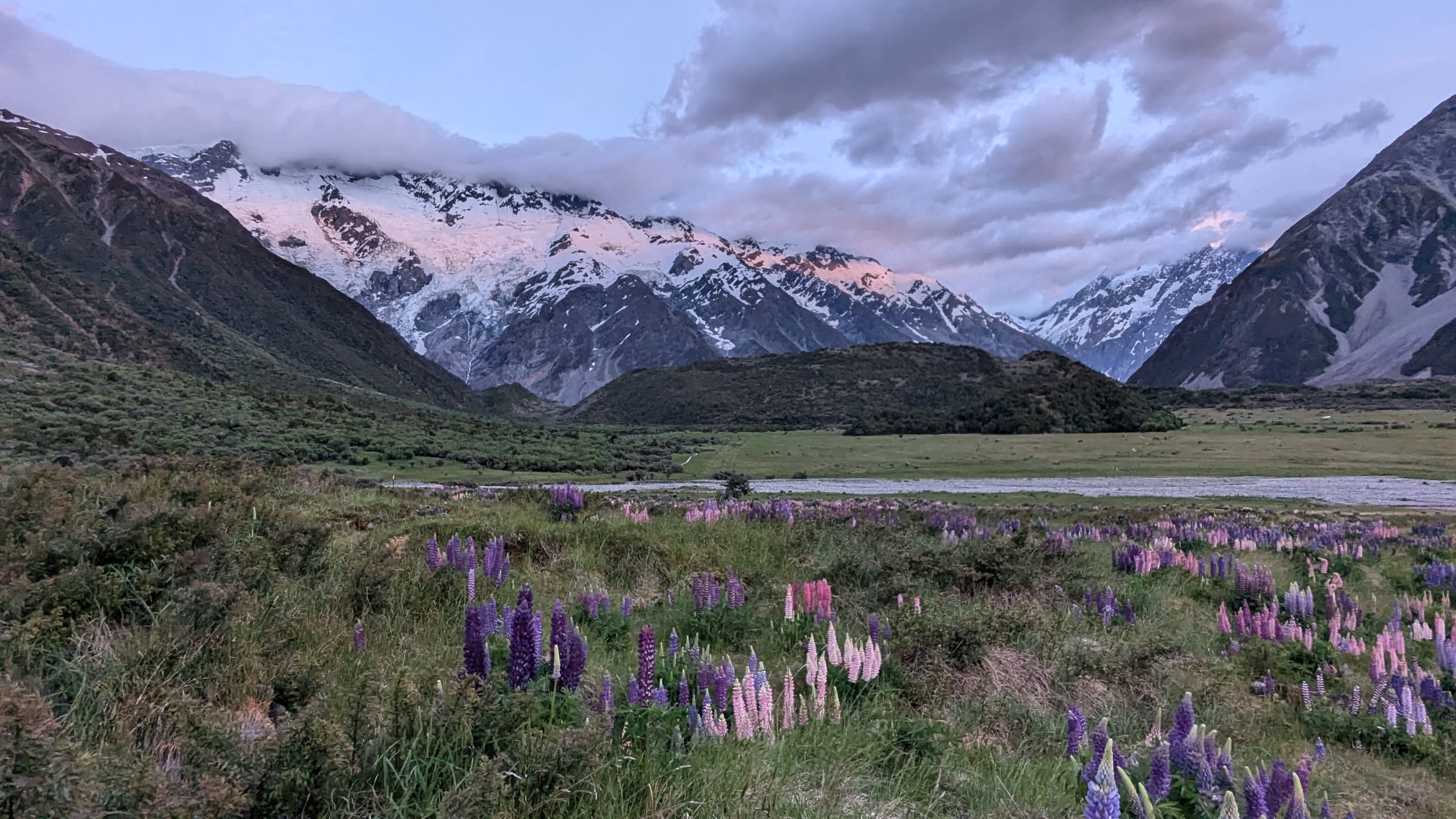
The forced early start gave us one of those truly magical moments. The sky was turning pink as we left, turning the glacier ahead of us a pale rose colour. As we started to walk the sky to the east was infused with a brilliant orange, the clouds shining and shimmering. It only lasted a few minutes but it was glorious and set us on our path in good spirits.

It was about a half hour walk up the valley to the base of the path up to Seeley Tarns. We were the only people about apart from one lone runner. As the path turned off it began to rise, seemingly almost up a cliff, and then it was steps, steps, steps and more steps. 

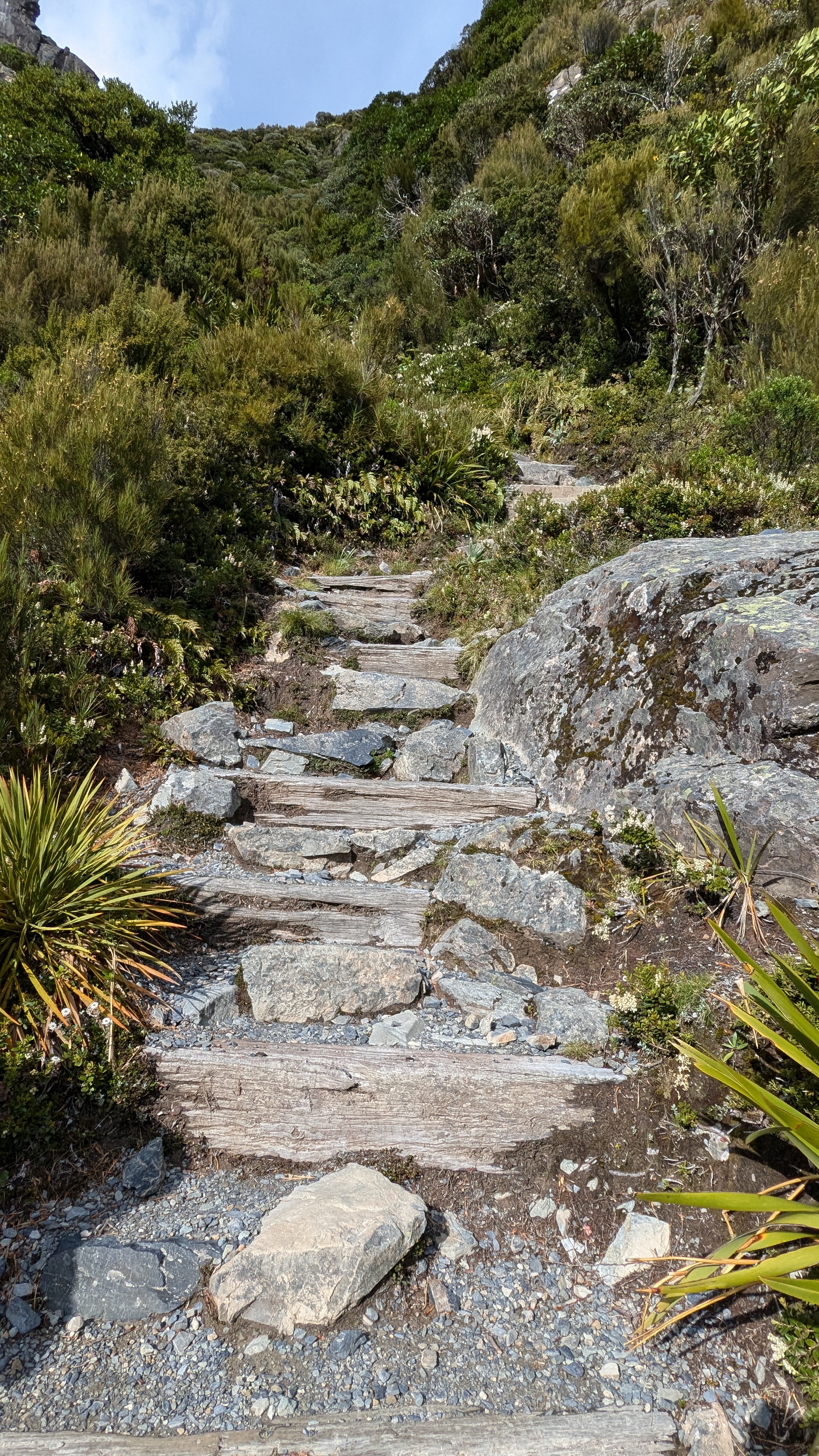
The path is reputably called a “the stairway to heaven” and involves climbing about 2,200 steps – and going up the 600m of height gain it felt like it!  However, as with so many mountain walks, the ever-evolving view kept us climbing and climbing.

We were going well – in fact so well that we almost missed the tarns. We thought it would be about 2 hours to get to the tarns (half way to the ridge) up but in fact we got there in just over an hour.  The sign was tiny and we nearly missed it by continuing on up the path to Mueller ridge. After a couple of minutes, we realised we could see the tarns and went back to the side path. There were only 2 tiny tarns but there was a lookout point with amazing views.

About 10 minutes after us, while we were eating out breakfast of bananas, the next person arrived and by the time we were going down there were a steady stream of people coming up, so it was special to have the place to ourselves for a short time.

We climbed a little higher up the path so we could look down on the tarns and take some pictures, and then it was down, down, down the stairs – killing on the knees. Half an hour back along the valley to the hotel where we even managed to scrape into the breakfast we had missed, arriving at 8 minutes to 10 with the restaurant closing at 10.  It rounded off the perfect walk.

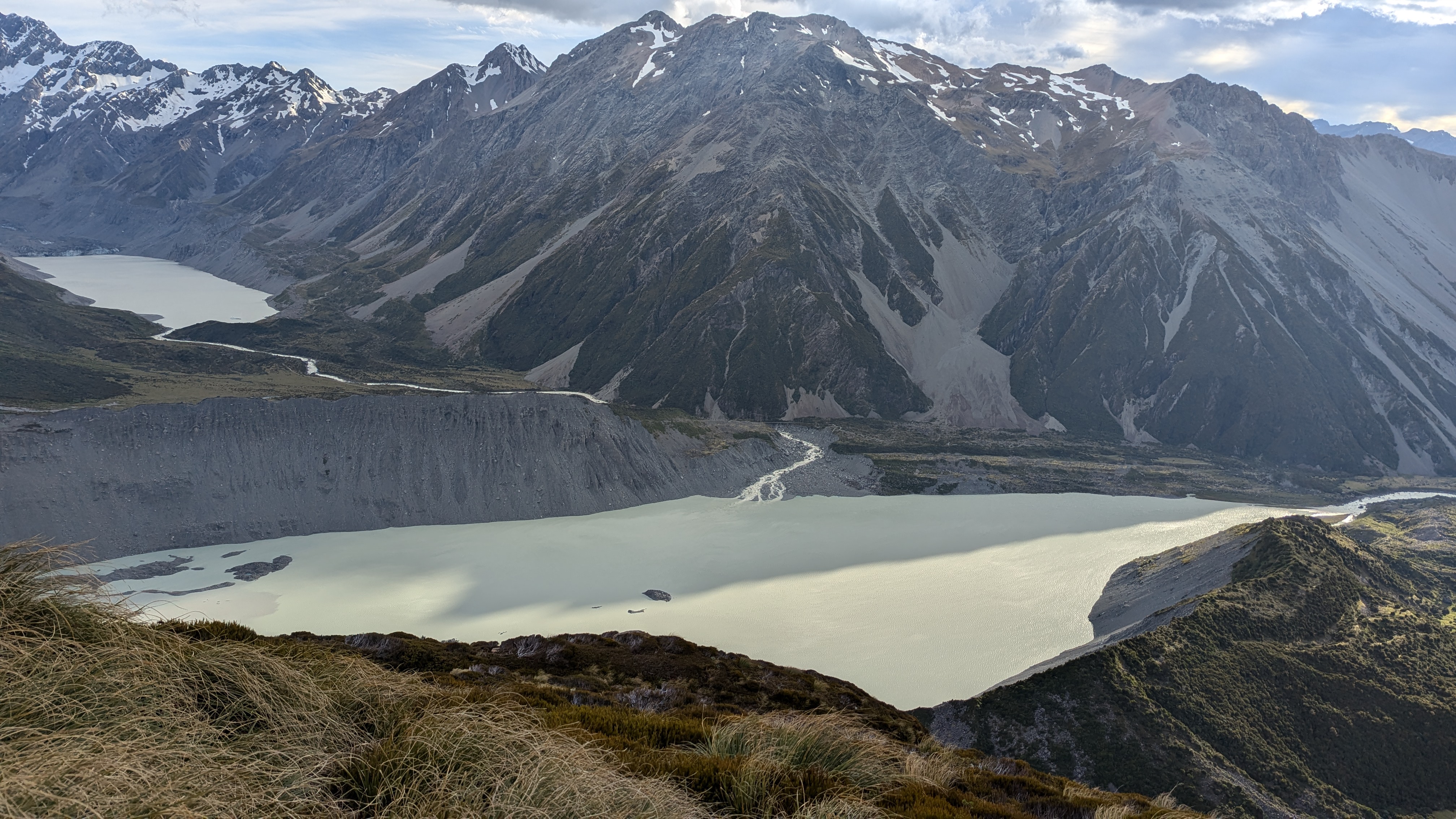
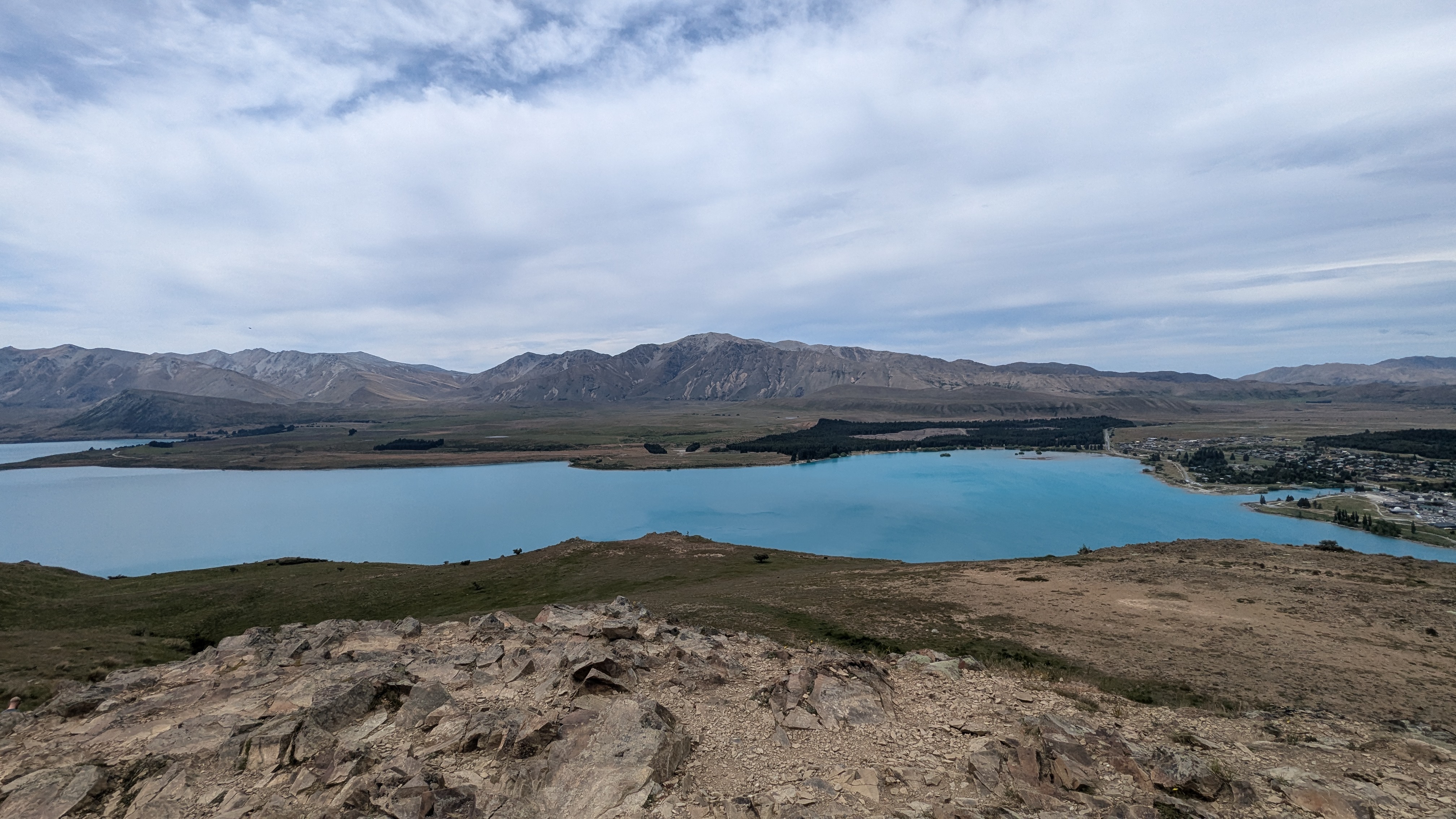
We then rejoined the group and were taken in the minibus to the base of Mount John, at the edge of Lake Tekapo.  This vast lake starts here and goes north, with Mount John at its side.  The lake is an incredible blue colour, similar to lake Pukaki running up to  to Mount Cook. The colour is caused by glacial flour – tiny particles of rock that are rubbed away by the glacier and remain suspended in the water. This fine silt absorbs the darker blue and purples of the light spectrum while to water absorbs the longer red, orange and yellow wavelengths, leaving an amazing turquoise colour.

 The climb up the mountain was only about an hour long but we were feeling our earlier walk and took it slowly.  We went through some woods and came out onto an open area and then the wind hit us – and boy did it hit us.  The top of Mount John gives a 360 degrees view around the surrounding hills, all the way to the Mount Cook range.  It is the site of the world’s largest International Dark Sky Reserve; but all we really experienced was the very strong winds.   It was a shame that we did not return 12 hours later to see the southern skies as they are supposed to be truly astonishing.

Then back in the min-bus and the long journey to Christchurch which is still recovering after the 2009 earthquake. 

Aoraki/Mount Cook – a wet and windy reception to these amazing mountains

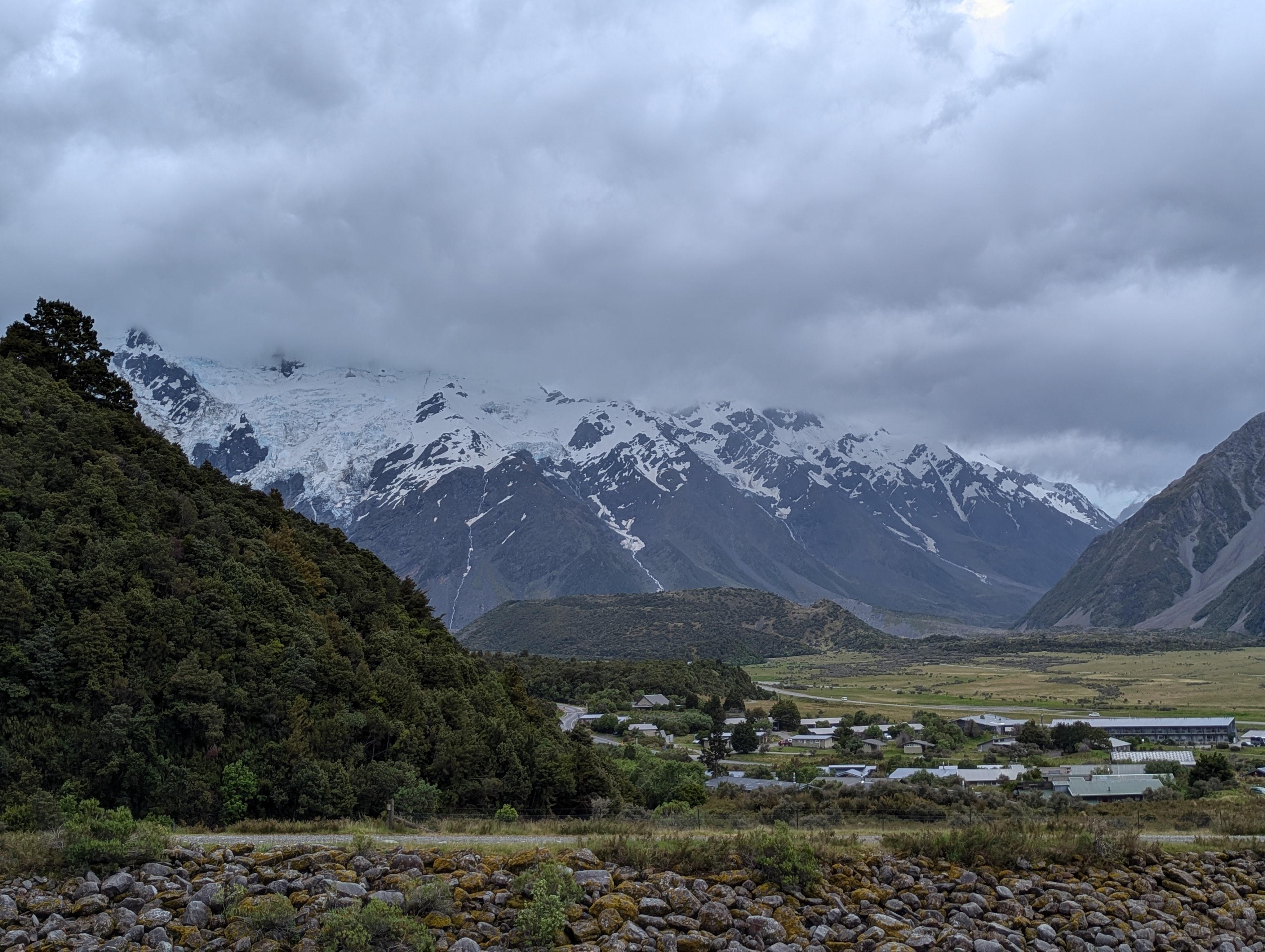
We are now on journey around the South Island of Aotearoa New Zealand – as the country is now known (the addition of Aotearoa reflecting its Maori heritage).  We joined a New Zealand trails group on a fixed itinerary, which started in Queenstown and today took us to from Wanaka to Aoraki/Mount Cook, a village at the foot of the extensive Aoraki/Mount Cook range of mountains, the highest part of the Southern Alps.  Aoraki is the Maori name for Mount Cook, the highest mountain in Aotearoa New Zealand.  As we were driven up Lake Pukaki (which is the lake of the Tasmin River), the weather started got progressively worse.  High winds and driving rain greeted us as we came into the mountain village that serves as a base for walkers, climbers and sightseers in these amazing mountains. 

We dashed out of the rain to visit the DOC (Department of Conservation) visitors centre.  It contained a vast amount of fascinating material about the formation of the mountains, the flora and fauna and a history of first and subsequent ascents.  These are seriously challenging alpine mountains and Mount Cook was only conquered in 1894.  The first attempt to climb Aoraki/Mount Cook was made in 1882 by an Irishman, Rev W.S. Green, and two Swiss guides. Although his party climbed to within 20 metres of the top, it was not until Christmas Day in 1894 that the summit was reached, by three New Zealanders: Tom Fyfe, Jack Clarke and George Graham.   They had been spurred into action by news that the American climber Edward Fitzgerald and the famous Swiss/Italian guide Matthias Zurbriggen were on their way to New Zealand. The foreigners arrived in the country in late December and were less than pleased to discover that they had come all that way only to be thwarted in their aim of climbing Mount Cook for the first time. 

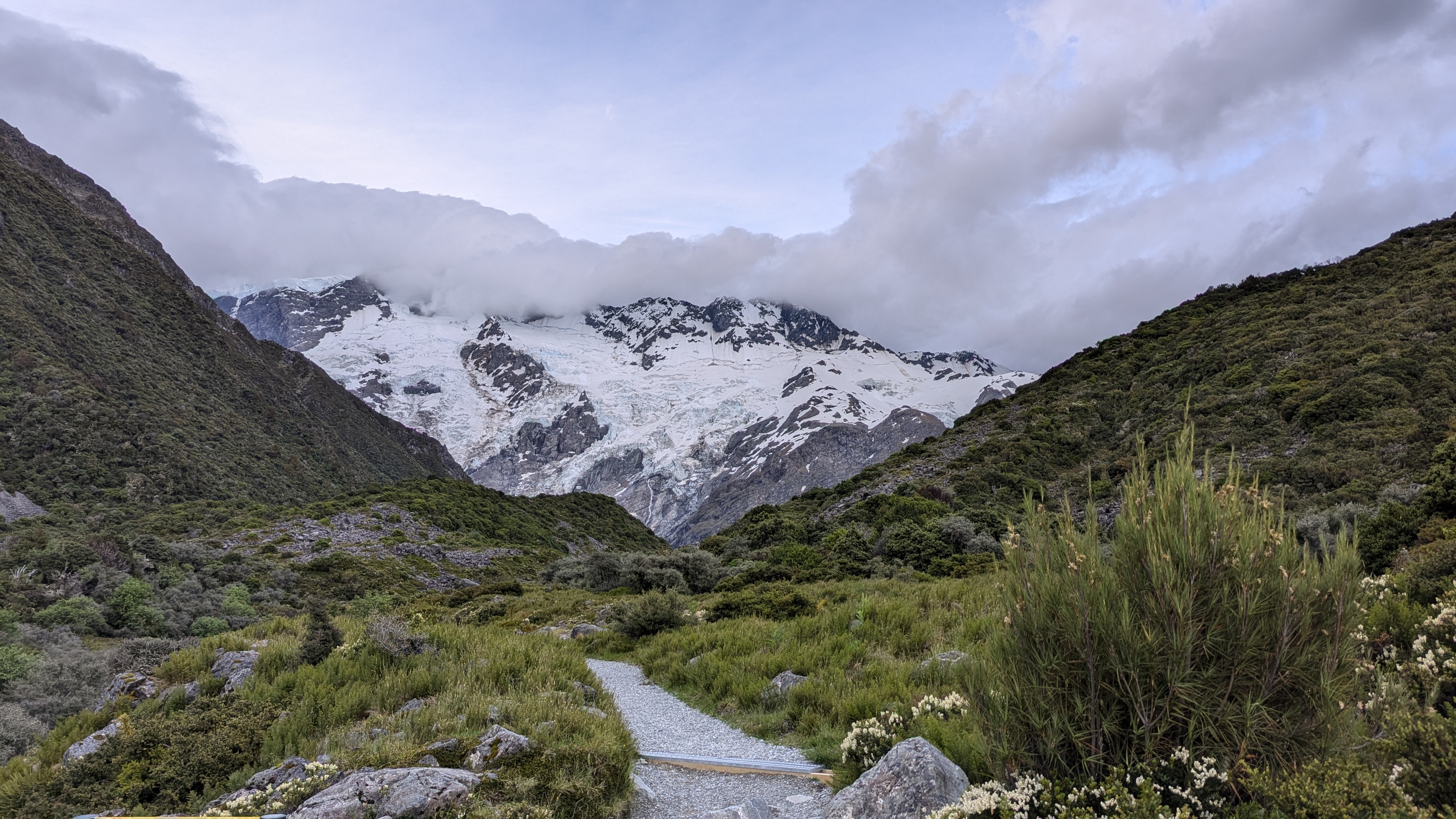
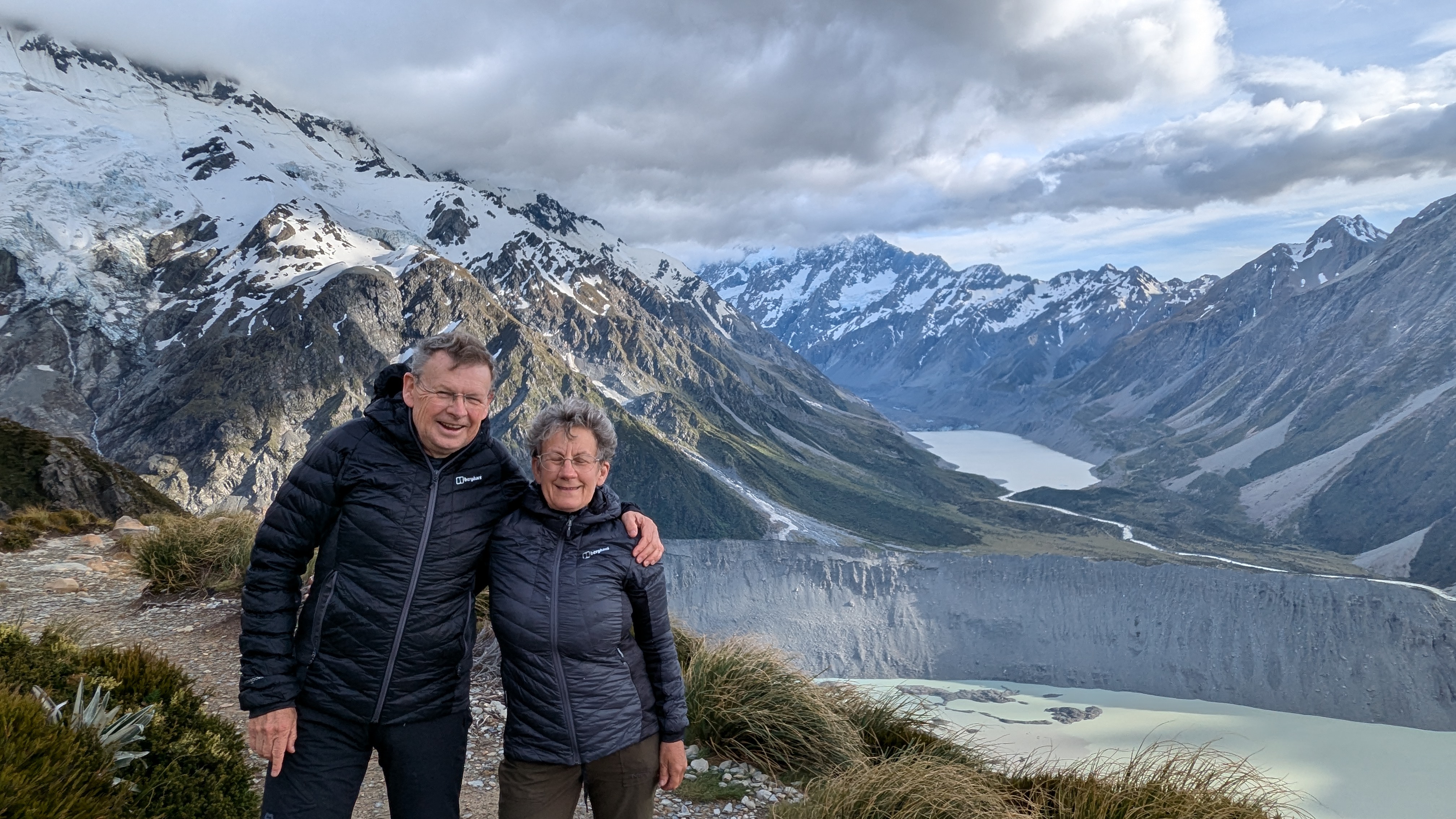
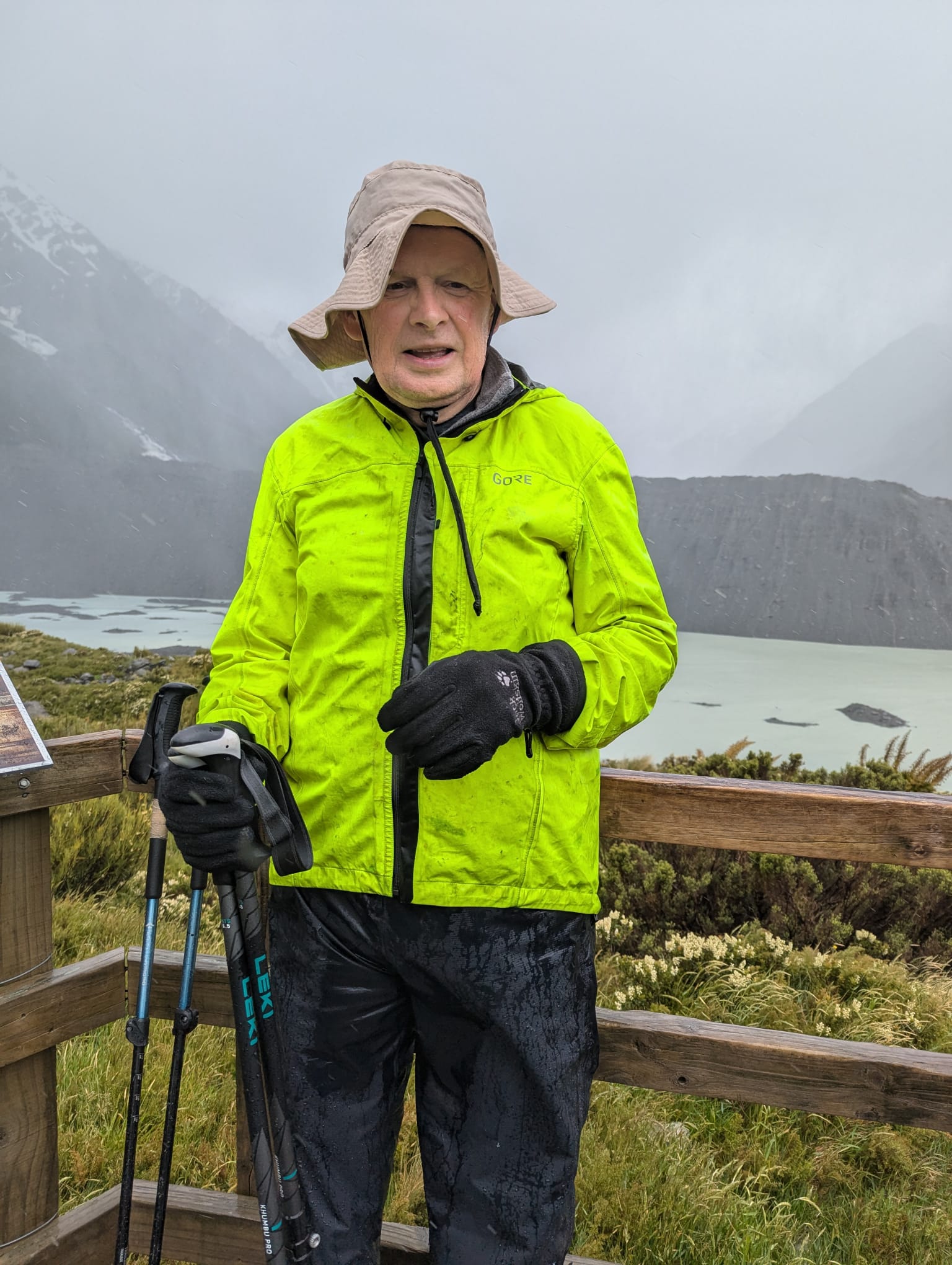
We were not intending to do anything that stretching and were only due to climb up to the Muller Ridge via Sealy Tarns but no one in their right mind would attempt the walk voluntarily in such weather.  So we settled for a half hour walk up to Kea Point, where we were blown away by the view which was supposed to be expansive views of the Footstool, the Hooker Valley, the Mueller Glacier Lake and Moraine, Mount Sefton, and Aoraki/Mount Cook.  In fact we saw the lake and a bit of the glacier but the rest was in cloud.  But we were blown away by the wind and horizontal rain.

Then back to the hotel for an hour to play cards whilst we waited for our room to be ready, and watched the rain on the windows.  It cleared up later in the afternoon and we went out for a walk for about an hour and a half – up the side of a valley overlooking the Murchuison valley.  By this point it had cleared and the forecast for the following day was not too bad, so we agreed with our tour leaders to strike out early and walk up to Sealy Tarns – so at least doing some of the day we had missed although we would not get all the way to Muller Ridge.

Day 4.  Tongariro Northern Circuit.

We had a much quieter night in our lovely campsite under the trees and woke to another sun filled day.  We packed up camp, had our usual porridge and coffee, and were on our way by 7.15.

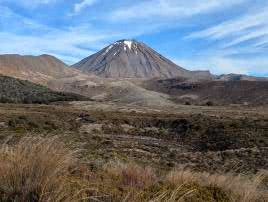
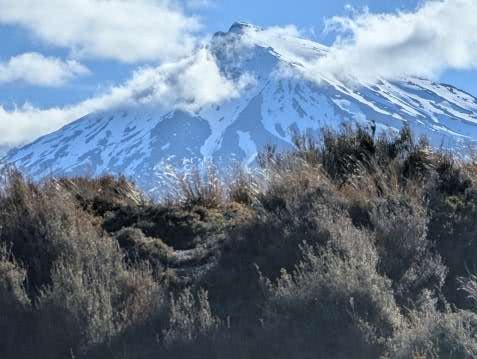
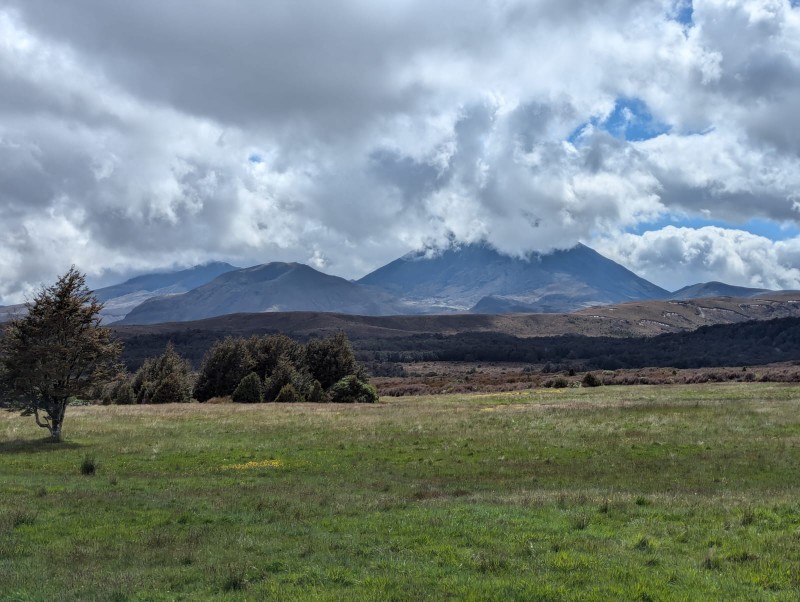
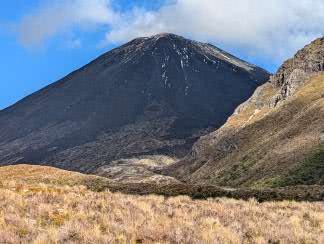
The morning walk was a gradual climb up to Tama saddle through low brush. On our right the mighty Mount Ngarahoe, walking around the southern aspect this time, still black and brooding even in the sunshine.  On our left the snowy Mount Ruapehu, gleaming white.  Awesome, beautiful, stunning – we have used all these adjectives many times already and need some new ones. As we set off we saw a lone walker ahead of us (going faster than us and so not for long) but then we saw no one else for the entire morning.  It felt wild and tame at the same time in this weather; much of the time I guess it feels wild and wilder as walkers are immersed in cloud.

We were walking really well and we seemed to reach the saddle in no time.  We almost wanted to walk slower to make the walk last longer.  There was a small side route which took just 10 minutes to the overlook Lower Tama lake;  a glistening blue backed by jagged rocking cliffs.

We decided not to add on extra hour there and back to the Upper Lake as we knew we had a way to go to reach Whakapapa village (Wh is pronounced Ph/Fh we later found out). We thought, after reaching the summit, it would be a gradual down hill all the way, similar to the way up.  But it undulated up and down with short but steep gradients.  Suddenly we began to feel the tiredness in our legs; largely psychological when you have to go uphill when you were expecting to go down. However over the last brow we could see the village ahead and a steady path down. We also suddenly started to see lots of people. 

The walk up the Tama lakes is a relatively easy day walk from the village, and more so at the Taranaki falls which is a 2 hour circular walk. We felt somewhat dishevelled, and probably a bit smelly, as we lumbered down the hill tortoise like with our worldly belongings on our back, as other skipped up fresh with gleaming white trainers.  Everyone had a cheery smile and some even an admiring (or possibly pitying) look.  No one quite said that we should not have left the old folks home but it was perhaps well hidden on their faces!

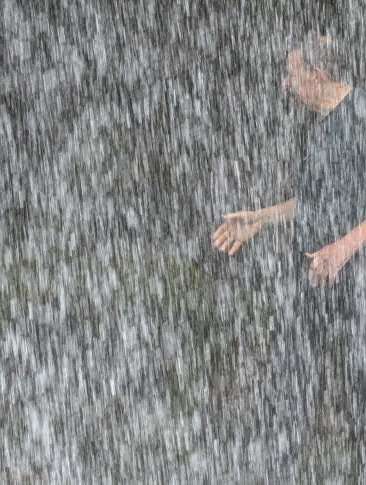
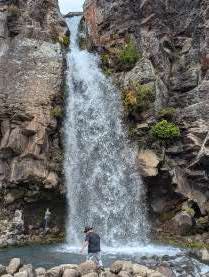
The Taranaki Falls was our last ‘feature’ stop. An impressive gush of water over a cliff, dropping about 30m to a pool before running off down the hill. David of course could not resist walking round the back of the falls and dipping his head into the water.  He came out looking rather damp but gained the admiration of a group of lads who proceeded to follow him – and got a lot wetter than he did!

The last hour of any walk, whether 4 hours or 4 days, always seems a drag, and so did this one as we reluctantly reached the village and could not extend the walk any further as we handed in our emergency beacon (unused!) at the Visitor Centre.  Then we had an excellent coffee and pie at the coffee-cart as we looked back up at the mountain and the route we had walked. Let’s be honest – we felt a tiny bit proud of our achievement.  It was not just walking around the TNC with full packs, carrying our own food, camping and tramping all the way.  It was that we had enjoyed ourselves so much.  We were left to wonder what the experience would have been like in fog, wind and rain, with endless climbing and nothing to see at the top apart from more cloud.  We were stunningly lucky and will have days ahead when the weather gods are not blessing us, but for now we were basking in the sunlight as we took a final look back at these wonderful mountains.

Day 3.  Tongariro Northern Circuit.

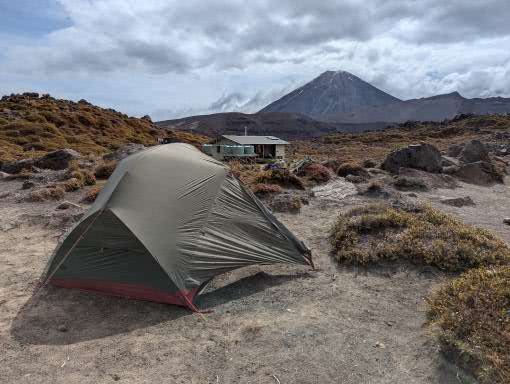
(Bernie) Unlike our neighbour (a professional travel writer) we managed a good sleep in spite of the howling gale rattling the tent all night (not smug at all of course). However we did not see the dawn as I had no intention of opening the tent flap in the gale! By 6am though the call of nature dragged me out of the sleeping bag and into the morning. In the hut everyone was up and about and you could not hear or feel the wind! Luckily the Department of Conservation instruction that campers should NOT be permitted to use the hut facilities  was no applied in practice (at least not here, at this time of the season. Others tell that it is strictly enforced elsewhere).  We could therefore brew our coffee and our porridge, and eat our breakfast in relative comfort.

Taking down the tent involved a complicated dance with the 2 of us unpegging and clutching and folding down the tent before it was ripped from our hands.  We managed to avoid any part of the tent blowing over the ridge and down the valley (chasing a tent sheet in the strong wind would have been a real challenge) and hurriedly brought everything down from the ridge to the hut where our belongings were strewn out ready for repacking.  The only thing missing was the bag to our platypus water filter.  David went back up the ridge and unbeleivably the very small and lightweight bag was caught in a bush and he brought it back triumphant.  We were complete!

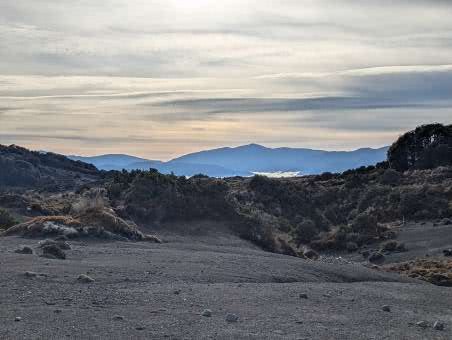
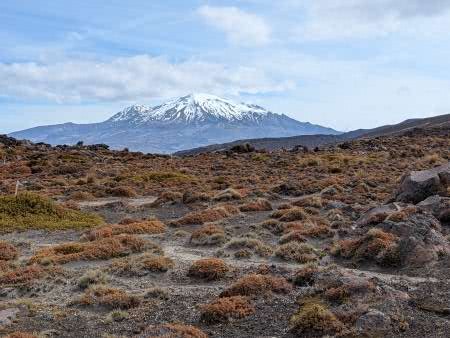
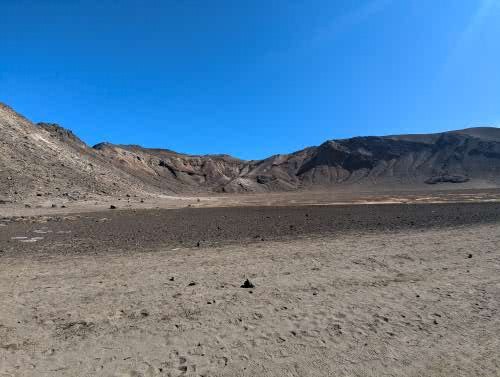
We only had a short day today so we took out time and we ambled off relatively late at around 9am.  By this point the wind had decided to die down somewhat. We were on the dry side of the mountain, walking across arid desert-like conditions, with multi-coloured rocks that showed their volcanic past.  Now we were walking round the opposite (i.e. southeast) side of the volcano – a looming presence above us still and almost totally free of cloud in the blue sky. Although the forecast was for rain by lunchtime the skies remained bright and sunny.  Our legs were tired from the previous long day and all the climbing but we were moving well and made good progress.

For reasons unbeknown to us, but presumably because it had missed previous lava flows, the scrubland which was devoid of vegetation ended and we reached a pretty wooded area.  Crossing a fairly large river (on a bridge, not wading!) there was a sharp but extended climb through the trees.  When we emerged out of the trees onto the ridge, we were greeted with dramatic new views of a snowy Mount Ruapehu.  It was then a gentle amble down to the hut, our destination for the day, just a 3 hour walk.

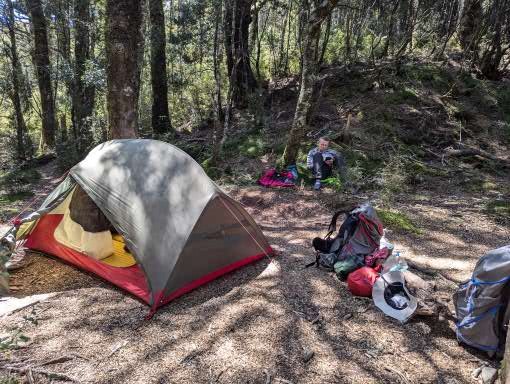
Arriving at lunchtime and setting up tent was peaceful and slow.  We camped in a clearing in the bush, just beside a river.  It was quite cool in the shade but hot in the sun – a huge difference. 

We then walked out to a set of mountain springs that emerge from the hillside, with water that has taken hundreds of years to percolate through the rock and then make its way back up to be extruded.  It was a special place – and supposedly a place that two blue ducks had made their home.  That may well have been true but the ducks were off somewhere else for the day when we visited.  However it was peaceful and beautiful. 

Back to the hut for more chat, food and chat.  One of the features of these walks is that one picks up a group of people who all follow the same trail at the same place – so we caught up with Mary and Polly and Cat and Brandon, as we had the previous evening.  Another talk from a warden – not totally inspiring and mostly about her life as a warden which was sort of interesting, but honestly not that interesting.  A guide to the volcanic history or the local wildlife would have been gripping – but we got what we were given.

Then back to our books and sleeping bags.  After just 3 days on the trail the enjoyable rhythm was settling in – just as when we are cycling.  It was strange to think that tomorrow we would be back in civilisation (of sorts that is).

Day 2. Tongariro Northern Circuit.

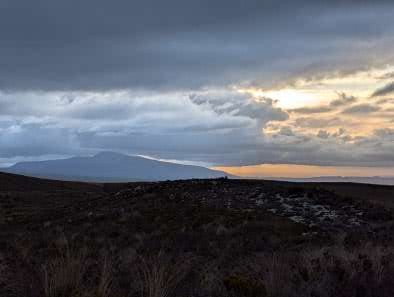
(Bernie) Most of yesterday the mountain tops had been wreathed in cloud but during the evening the clouds cleared revealing our first view of the conical mountain Ngaruhoe and the snowy peak of Ruapehu. Clear skies meant a chilly night but we were snug in our sleeping bags and slept well.  We woke at 6am to beautiful clear skies, made coffee, cooked up our porridge and were set to go by 7.15.

The first part of the day overlaps with the famous Tongariro Alpine Crossing – a day walk rightly billed as one of the best day walks in the world. It is an end to end walk so shuttle buses collect walkers from the end and deliver them to a car park just below the Mangetepopo hut.  We were told the first shuttle buses drop walkers off at the start carpark, which is half an or so down from the campsite; so if you want to avoid the crowds you needed to leave at either 6am or 10am.  We didn’t want to do either of those so decided just to go with the flow. Although there were plenty of people on the track it did not feel oppressive and the landscape was so awesome (taking the literal meaning of the word) nothing could detract from the day. It was one of the best day’s walking I have ever done.

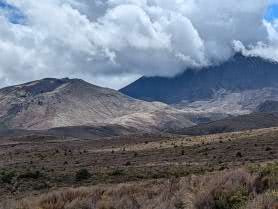
The first part of the day took us up a gentle valley with the steep climb out of the valley ahead of us.  We had our first good views of the amazing Ngaruhoe volcano as we crossed the old, and not so old, lava fields.  Signs warned us that we were entering an active volcanic area.  The volcanos in Tongariro erupt with reasonable regularity – luckily mostly small eruptions are limited to steam or ash, although these can still do a good deal of damage.  The last eruption experienced on the track was in the 1970’s and described as a very near miss for a walking group – so not so very long ago. Huge boulders told of the massive eruptions of times past.

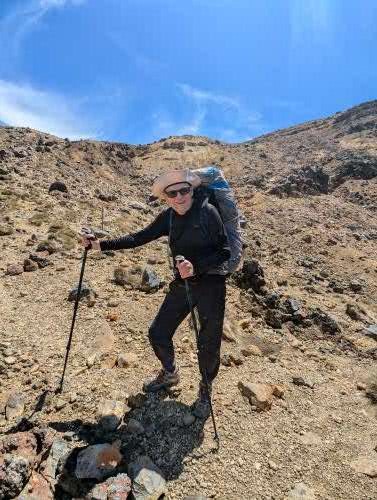
At the base of the climb further signs gave warnings that people should turn back if the weather looked bad or they were feeling unfit.  We learned that about two people a week are airlifted off the track during the summer season. However, today the skies were clear blue, the air was still and we were feeling invigorated; so we started the combination of steps and steeper path up to the first crater. We got into a steady pace and although not as fast as the youngsters overtaking us, we were not as slow as others and felt rather smug that we were making our way up with our heavy packs while others had day packs (small pleasures, ridiculous of course!).  The ever expanding, stunning views begged for frequent stops to gape in any case and to capture in photos.

Suddenly we were stepping into the South Crater with a pancake flat base.  We stopped for a break overlooking a smaller side crater with views up the red and black side of the volcano.  A climb out of the far side of the crater to the Mangatepopo saddle opened up the views on the other side to the Oturere valley.

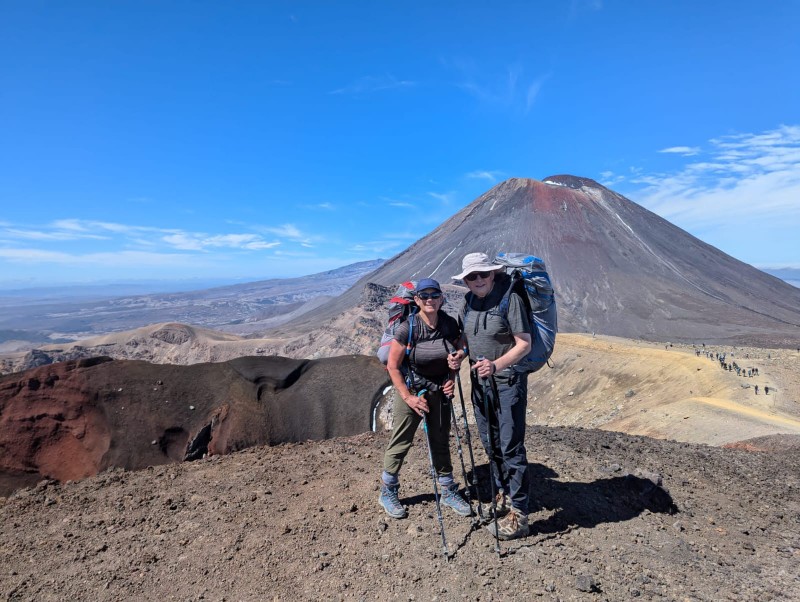
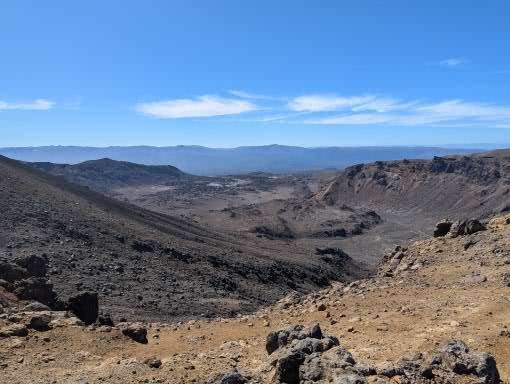
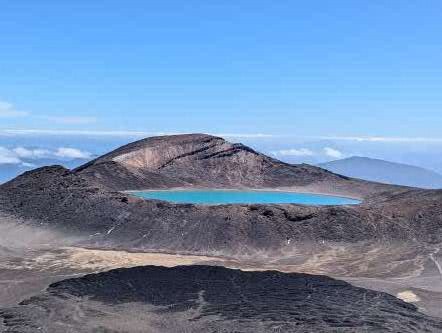
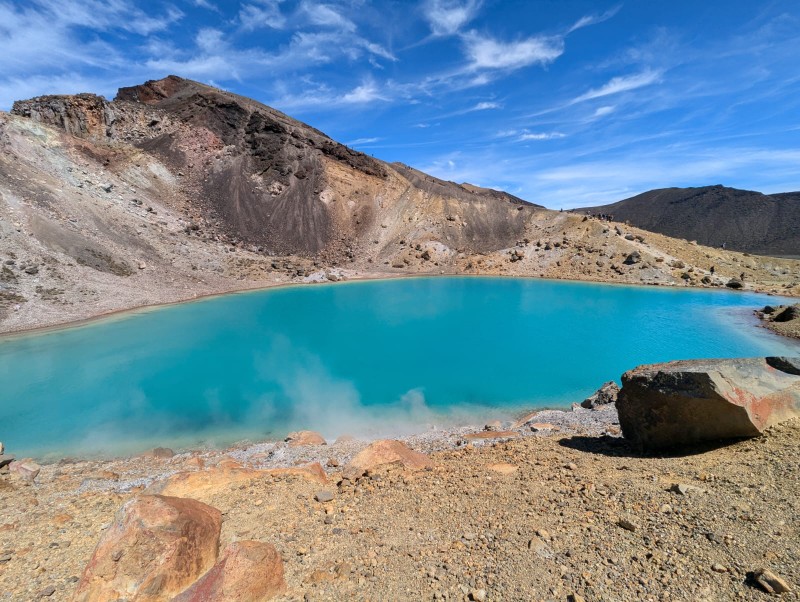
  A last fairly steep climb took us to the highest point of the walk (1867m) with breathtaking views over the Red Crater, Tongariro mountain, the Blue Lake and Emerald lakes with their steaming fumeroles.  I hope the photos do it justice.

 We realised how lucky we were when we met the guide we were chatting to at the campsite the previous evening.  He guides teenagers on their  Duke of Edinburgh hikes (yes, DofE is in NZ) and had done the trail numerous times.  He said he had never seen it so good – usually the top is on cloud. A ranger later described the weather as “one in a hundred day weather”. The summits of the mountains are sacred to the Maori (you are therefore not allowed to climb to the summits); for some reason the Maori gods were smiling on us today.

(David) I get the easier bit to write about – going down!  But the first stretch was quite tricky, as we descended a steep shoulder with drops on either side.  Underfoot it was moving sand and small rocks, and a bit like descending a scree with very small stones.  Bernie took it easy and at one point stopped to allow a woman behind her to pass – but was told “No – I am following you – you are doing this descent so elegantly!”.   Wholly unsurprisingly, no one complimented me on my descending technique as I staggered down trying not too lose my footing – when many did.  No one tumbled off the sides – at least as far as we could see. 

We stopped at the bottom by the fumeroles (wispy volcanic smoke coming from ground indicating activity just below the surface) in a small gap which was not overwhelmed by the stench of rotting eggs for our lunch – Ryvita, peanut butter and cheese!  Whilst I accept this combination is not offered in the best restaurants, it was high calorie and delicious after 4 hours walking.  Mary (one half of the Tasmanian couple joined us) whilst her partner, Polly, mooched around the volcanoes.  They have a daughter who teaches geography in a tough school in Tassie, and were under strict instructions to take photos to bring life to her classes.

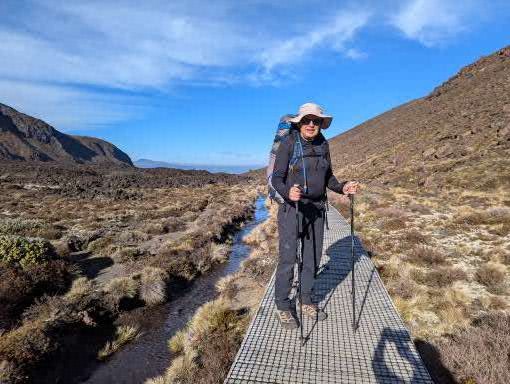
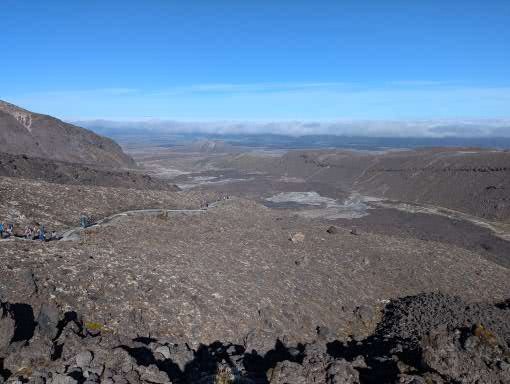
The paths split at this point – with the day packers on the TAC heading north to the end of their walk at Ketetahi car park and the TNC multi-day walkers heading towards Oturere hut.  Suddenly the valley was deserted as we climbed down a section called the dragon’s tail.  The Oturere Valley is high altitude desert with stunning rock formations.  For those who have seen the Lords of the Rings films, this is the set for Mordor.  By this point we were a tad tired, but met a jolly face coming the other way with a spade, clearing the track.  This was Sally the Oturere hut ranger who told us we only had an hour to go, and all would be well!  She was roughly right – it was about an hour but it stretched out as tiredness set in.  But soon we went over a small ridge and there was the hut, nestling just below a ridge.

Sally had advised us to camp up on the ridge as she said the dawn was lovely from there.  90% of the time this is good advice; we were in the 10% when wiser heads would have pitched below the ridge line.  But, in the calm of the afternoon, there seemed no reason not to take her advice.

Once the tent was pitched and a brew revived us, we ambled over to a stream for a wash and paddle.  Mary had said she had “wallowed” in the water but she is clearly made of sterner stuff than me as I managed it up to my knees before screaming from the cold.  But it did leave us cleaner than we had been for 48 hours.

A windy night!

Supper, reading, chat, brew, reading, more chat, funny stories, and early bed.  That is the way of life on a trek and it is super enjoyable.  I was stuck into a crappy book, loved the scenery and wished it could go on for ever. However, as the evening drew on, the wind got up and the lack of wisdom of our chosen campsite became clear.  It was dry but blew a gale all night, with the sound of the wind trying to keep us awake – mainly unsuccessfully I can report.  However the only reason the tent did not blow away down the valley was that it was weighed down our bodies!  At one stage I got up to see if the guy ropes were holding – they were – and then went back to sleep.  The woman in the next tent was on her own and claimed not to have slept a wink all night!

Day 1:  Tongariro Northern Circuit

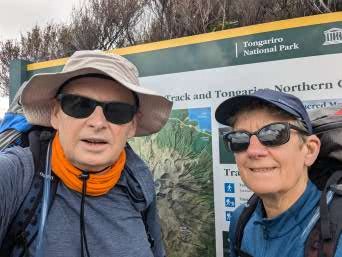
(David) Now I know that this is a cycling blog – but this next few entries have no wheels and only describe a walk – or a “tramp” to give our activity its local name here in NZ.  For those who are only interested in cycling, I suggest you “look away now”.  For the rest, this is a description of one of the NZ “Great Walks”, the Tongariro Northern Circuit, also known as the “TNC”. 

The TNC is a walk in the Tongariro National Park.  It takes up to 4 days and goes around the conical Mount Nguruhoe (2287m), a classic volcano which looks like a mountain that a child would draw – straight sides and a snow covered top.  The smaller mountain, Mount Tongariro (1967m) is north of Mount Nguruhoe, and the walk crosses the saddle between the two mountains. On the other side of the valley is the much higher Mount Ruapehu (2797m) which is longer and has an extensive snow covering at this time of year.

We drove from our accommodation in Turangi (having failed to find time to go fishing in a world fly fishing mecca) to the strangely named “Whakapapa” village to start the walk.  We later learned that it was pronounced “Fu-whack-a-pappa”. The road took us gradually up to the village which is at about 1150m.  The landscape was high altitude moorland, dominated by the two volcanos to the north, Nguruhoe and Tongariro and the Mount Ruapehue (2797m) range to the south, where there is extensive skiing in the winter.

There are huts along this walk but they were all fully booked before we got our act together and so camping was the only option.  Overall, this was better for us as it meant we got a good night’s sleep most nights, as opposed to the hit and miss of a night in a shared hut.  Having sorted out renting a locator beacon (being either intent on being as safe as possible or as pessimistic as it goes) we put on our packs and started walking.  A word about our packs – and thanks to our great friends Gill and Peter who provided advice and encouragement from their many years of trekking.  We got lightweight rucksacks before the trip, good poles and a few other items such as a gas burner, but most of the kit was the same as we have used for cycle touring.  The difference was we also packed freeze dried meals and other food for 5 days – 4 days plus a spare.  The packs were heavy but not ridiculously so; probably about 14g for David and a bit less for Bernie.  

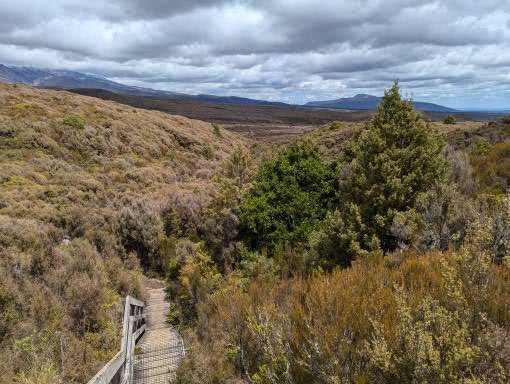
We started our trek in the dry, but with cloud over the top of Mount Nguruhoe.  The terrain was marsh/mud which went up and down across numerous streams that flowed down from the mountains to our right.  Heather was introduced to this area to provide cover for grouse in the early C20th, but was a disaster as it wiped out the native species.  Grouse never survived and so the original plan of turning the slopes into Scottish style grouse shooting never occurred.  But heather spread at pace, with local fauna declining.  The invasive heather is now a pest which the NZ Department of Conservation is attempting to remove – but it is a massive job as it has spread over vast areas. 

The walk was steady rather than dramatic.  There were a few others on the track – some overtook us and others came the other way.  We could tell instantly if someone was a day walker – small pack – or a multi-day walker – big pack.  The day walkers were faster (of course) and most of the multi-day walkers were faster than us (again of course).  Lots of jolly greetings along the way.  As we walked, the shape of the mountains changed – but far more slowly than on a bike.  Gradually the top of Mount Nguruhoe cleared of cloud, revealing its classic shape, and we got to see the saddle we would have to climb tomorrow.

After 3 hours of sliding along muddy tracks we reached the Mangetepopo Hut at about 3pm, and found a place to set up our tent.  The huts are hugely sociable places and we chatted to other walkers, all of whom had come to the hut under their own steam.  There was no warden, no electricity and no hassle – everyone just getting on with things.  We chatted to a couple from Tasmania who were about our age, a young couple from Boston, USA who were on a delayed honeymoon having negotiated 4 weeks holiday (amazing in a US context) and lots of New Zealanders.

Our first experiment with freeze dried meals was about 75% successful – we will get better with them – but it was tasty.  By 8pm we were in our sleeping bags as the temperature began to fall and the light faded.  This was both remote and not remote.  It was remote in the sense that there were no roads, we were in a tent and felt tired from a decent walk; but it was also not remote in the sense that another tent was pitched very close to ours and we were on a fixed and very popular walking route. That seemed about the right balance to start getting used to the experience of tramping.  If it goes well, we could explore more remote settings at a later date.  For now, this was as good as it gets.

Timber Trail Day 2.


We woke well before the alarm went off at 6, as we were surrounded by a cacophony of birds. I opened the tent flap to see a cluster of quails hopping around – soon dispersed as I came lumbering out. The ground was wet but we were dry and it was almost sunny.

Oh it had been so tempting to ask for a room at the lodge last night with it’s lovely lounge, wood burner and hot showers but as the only people in this huge campsite in the early morning it was quite magical. I had been exhausted last night but felt invigorated.

Our routine of packing up camp fell back into place, fitting in 2 cups of coffee and honey flavoured porridge mixed with last night’s crumble – delicious. We had our packs back at the lodge by 8, ready to be taken down to the end of the trail and we were on our bikes and on our way again.

The trail passed through the bush and amazing forest.  The only people to be seen were the handful of bikers who had also started the trail yesterday, leapfrogging each other as we rested at different places – although the ebikers eventually were way ahead of us.  We were in no hurry, wanting to savour the environment, especially as the sun came out.  They say there is something different about the blue of the sky and the green of the land in New Zealand and it certainly seemed that way.  Maybe it’s the lack of ozone – an odd quirk of the climate catastrophe. 

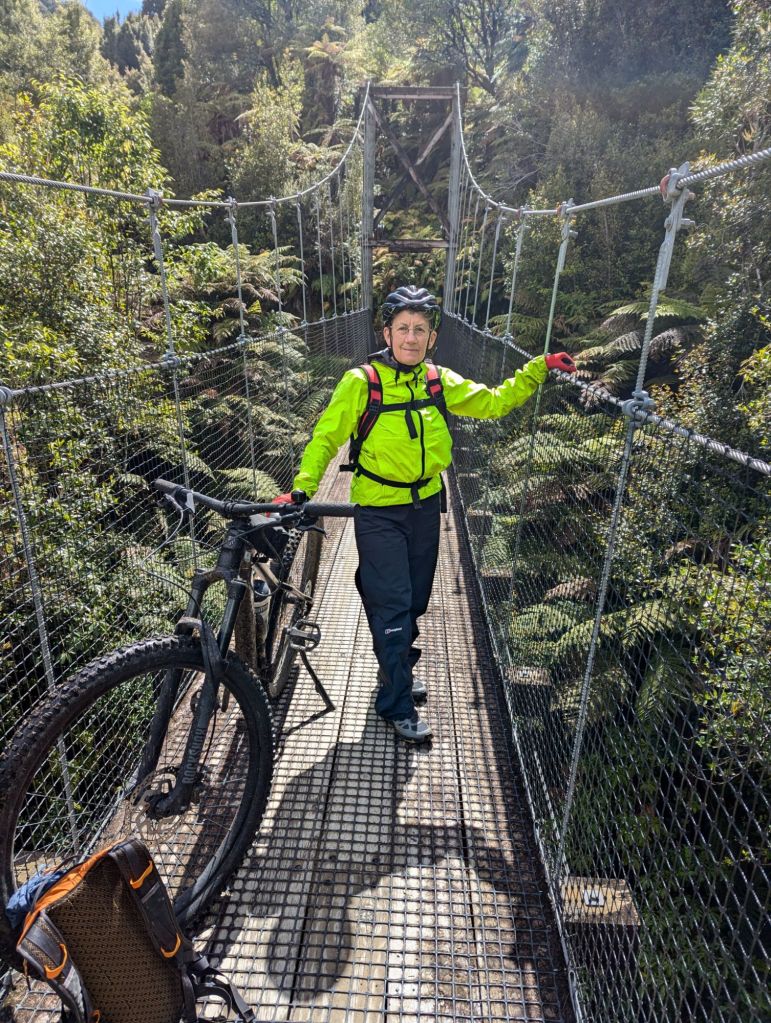
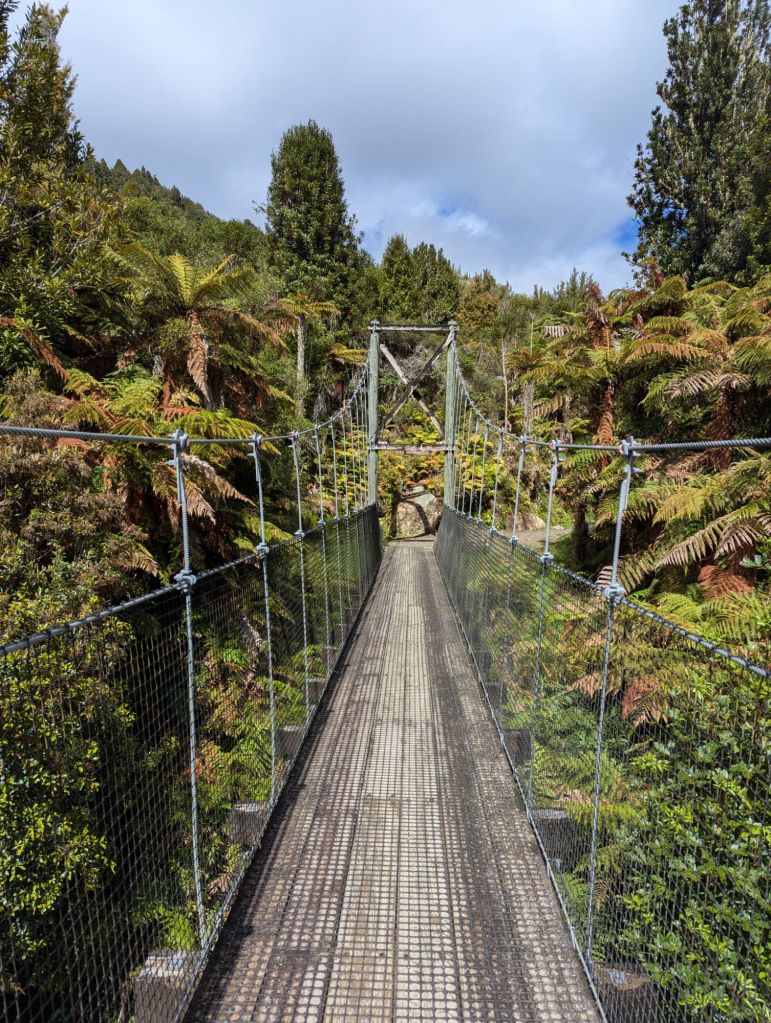
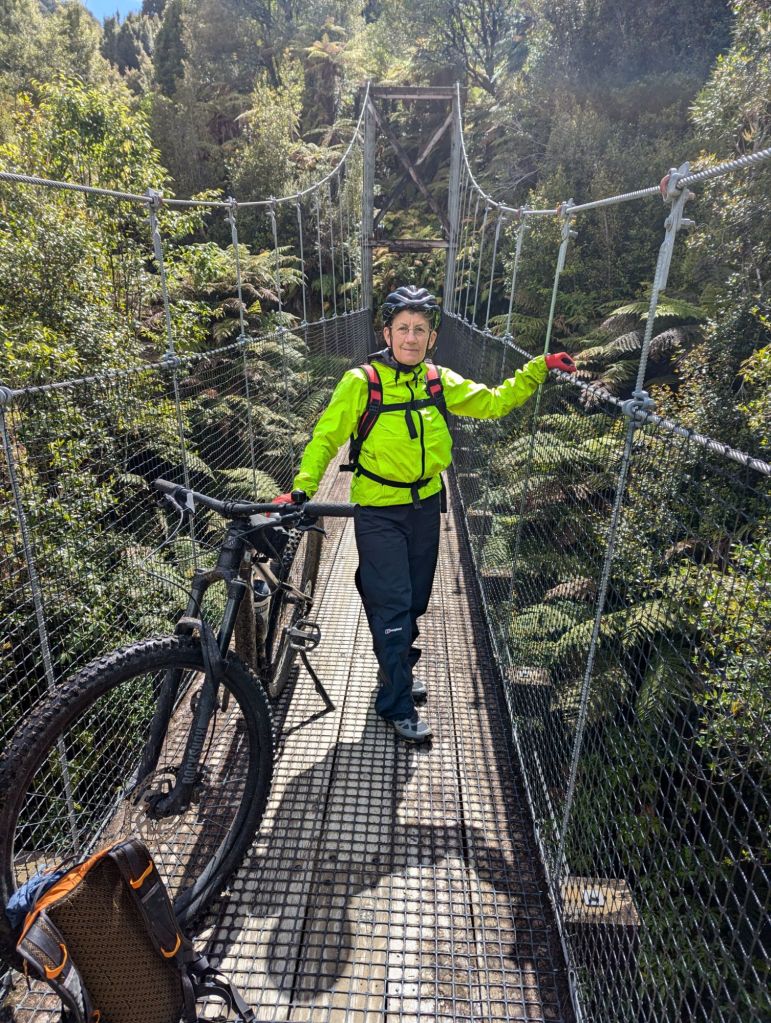
I am not a mountain biker but was really enjoying the off road cycling.  Sometimes the trail was a narrow weaving track and more often today, a wider trail following the tramway where the logs were hauled out of the forest. It must have been lucrative business to justify the engineering blasting cuttings through rock and another series of amazing bridges across deep chasms to rivers below.  The old wooden bridges are now replaced with modern suspension bridges.  Not a fan of heights I kept by eyes ahead and peddled across them with a fixed stare – allowing myself more leisurely looks when safely the other side.

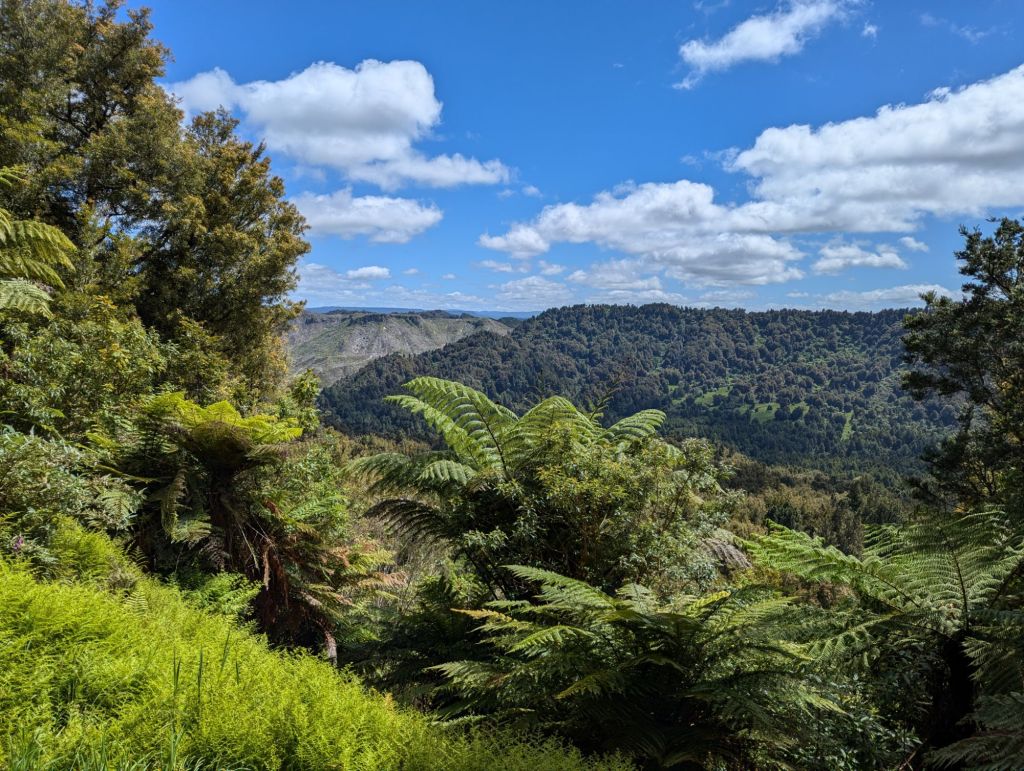
There was less climbing today, and generally the route was less steep, but my legs were still tired from the previous day. At the 70km mark though we started a glorious gradual descent.  I was more confident on the mountain bike and felt I could let the bike go. The forest gradually opened out into a wider valley with the last few Kms through meadows of grass, foxgloves and yellow broom.

Back at the car, our packs had arrived and we were off to stay in Turangi an hour or so away to rest up before our next adventure.  I was totally exhausted and was in bed by 8 but a brilliant ride and fantastic introduction to the amazing outdoors offered in New Zealand.


Timber Trail Day 1:  New Zealand

It seems a very long time since I last tapped away at a keyboard after a day on the bike, recording our travels and trying to make sense of the world.  A small explainer – I was fit and well in March last year as we left Vietnam and by January this year I could not walk more than 200m without huge difficulty.  It seems as if – for reasons that are entirely mysterious –  the arteries in my heart clogged up and I was getting less and less blood flow around the body including to my head.  The wonderful cardiology team at Wolverhampton sorted me out with a quadruple bypass in late January. 

Then it was a period of slow recovery, and gradually getting my fitness back.  By the summer I was back to walking and climbing mountains and a week ago we left for New Zealand to escape the UK winter and put my recovery to the test.  So that is why we found ourselves cycling mountain bikes along the Timber Trail in the middle of the North Island of New Zealand.

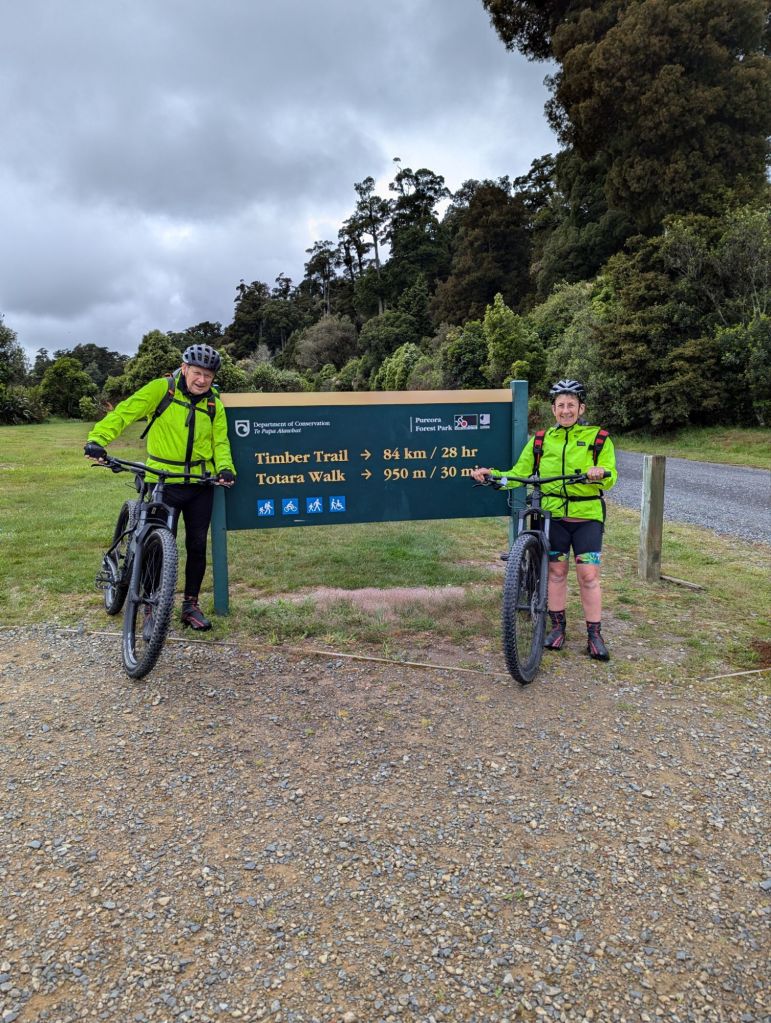
The Timber trail is an 84km long off-road cycle and walking route that was created by the NZ Department of Conservation and teams of volunteers between 2009 and 2013, when it was opened.  It is located in Pureora Forest Park and has 35 bridges along its route.  This is former logging country and the southern half of the trail follows a former tramway that was used to pull logs out of the forest called the Ellis and Burnand Tramway. 

We left our B & B early and met up at the end of the trail south of Ongarue where we picked up hire bikes.  Bernie’s brother had been kind enough to offer us their bikes but cycling around urban Wellington and cycling across the bush are wholly different and we decided to fork out for bikes that stood a better chance of withstanding the rigours of the trail.

A minibus took 4 of us from Ongarue to the start of the trail at Pureora.  The bus ambled through farmland with forest up on our right.  This is tough sheep and cattle country, as is so much of rural New Zealand.  It was overcast and rain threatened.  We had left the start of winter in the UK and it was spring here but definitely not yet summer. 

Our group included Anja from Holland, who was travelling on her own and a NZ man who was helping his brother and a friend who were walking the Te Araroa, the 3,012km walk from one end of Aotearoa New Zealand, to give the country its full name, to the other. 

Jackets on we started out on the trail – and that is what it was.  No roads here and just a meandering trail through the bush.  Tall podocarp trees flanked the trail with birds calling out to warn others of our presence, or maybe just calling out because they can.  There were occasional signs that is was an area of forest operations.  The peak of forestry was between the second world war and the 1990s, delivering timber to build houses throughout the country’s post war economic development. 

We were not alone on the trail, but it was never crowded.  Occasional groups of ebikers would (of course) pass us as they glided (seemingly) effortlessly along.  Most appeared to be NZ nationals but there were the inevitable Dutch riders.  Wherever we go in the world we meet Dutch cyclists.  The combination of cycling and travelling seems part of their national psyche.

This route is well marked and we were only aiming to do 39km on the first day.  But mountain biking is not like road cycling, there is far more rolling resistance, especially in the mud, and the trail went up to 917m at its highest point.  We reached the high point after 14km, and had the pleasure of cycling across the 115m wide Bog Creek suspension bridge, with its spectacular views over the forest below.

The track merged into an old logging road and gradually descended, but with some more steep climbs.  By this point we had got used to the foibles of the bikes and Bernie’s confidence was growing.  The bush was dense throughout the day and the overcast weather limited the views.  There were numerous signboards along the way pointing out local fauna, flora or explaining how the forest operated as a working forest. The boards were clearly put up when the trail was new and, of course, the forest changes and develops all the time.  That meant that some of the “views” were obscured by vegetation but that is a good thing as it shows the forest recovering from being plundered.

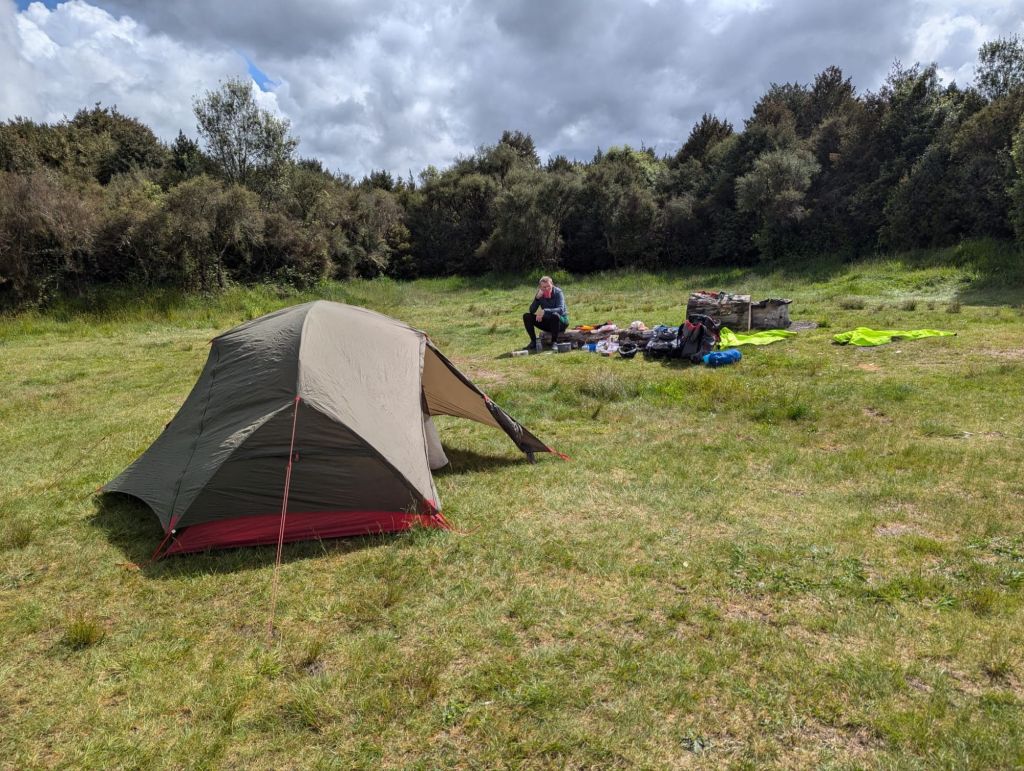
 Eventually we reached the end point of the day, Piropiro.  There is a lodge here where most trail riders were staying but we had elected to camp.  Part of the transport service we signed up to dropped our rucksacks at the Lodge and so we stored the bikes and walked the 500m down to the “campsite”.  This was a field with a pit toilet and access to river water.  The Lodge was not built until several years after the trail opened and so, at that stage, camping was the only option.  Now an expensive night awaits those who prefer not  to spend the night under canvass; which we discovered was almost everyone apart from us.  There was a second “glamping” option at Epic Campsite but we wanted to test out our camping gear before going on a 4 day trek and so opted for the basic campsite.

We got the tent up in the dry and then the heavens opened.  Sitting inside the tent with hail hitting the roof, we wondered about the wisdom of our choice but it was all fine when the storm abated.  We ambled up to the Lodge for a beer after a home cooked supper, but found that they could only sell alcohol to residents!  Ginger beer in front of  log fire was an excellent alternative. The residents – many of whom we had exchanged greetings with on the trail were just finishing their evening meal.  We fell in to chatting with a South African couple who were finding the trail hard, even on ebikes.  They expressed “surprise” we were camping and, a few minutes later the woman turned to us and said in a conspiratorial whisper that if her husband ever asked her to do what we were doing, she had told him that he would need to find a new wife!  It was unclear whether he took this as a threat or an opportunity.

The Lodge staff were really friendly even though we were not staying there, and they even offered us some left over apple crumble; and then, as we were leaving, the cook pressed us to take more apple crumble. Over catering has its benefits.   That turned into a marvellous breakfast but, for that detail, you will have to read on to tomorrow.

Day 67:  Doc Let beach to Nha Trang:  53km and postscript.

So we have arrived at our final cycling destination, the modern city of Nha Trang.  It was 50km, mostly along our “friend” the QL1 – or the “one and only” as we have christened it.  We have now covered about 3,140km since we left Bangkok on 8 January, some 10 weeks ago. Our longest day was 112km and the shortest cycling day was 23km (on Cat Ba island), but we have had plenty of days off the trikes.

Coming down the one and only we had the usual range of lorries coming a bit closer than we would have liked (but never too close) and motorbikes going the wrong way along the hard shoulder for no apparent reason (irritating but that is how things work here so bury the irritation).  We also had our fair share of motorbike gawpers – people who ride along side us looking at the trikes (or possibly us) in wonderment, saying nothing but getting so close to be a complete pain to both us and anyone trying to overtake.   None have caused an accident as the traffic here mysteriously weaves around anything in its way, and we have nearly got used to these inspections. But when I reacted to a particularly irritating gawper, Bernie accused me (justifiably) of being “Mr Grumpy”.  She was right – it is their country and they are entitled to gawp if they want, andI resolved to do better – even if I don’t quite make it to being Mr Cheerful.

At one point we stopped at a place titled “Motel and Coffee Land” and asked for coffee – but were told no, we don’t do coffee!  The fact that the title is “Coffee Land” is sort of irrelevant because everyone knows that we don’t do coffee!  Andfor all manner of reasons, that sums up part of Vietnam.

So what are my reflections on the past few months?  We are both significantly stronger and slimmer than we were on 6 January.  The trikes have been tricky to maintain at times but overall a real success; we cannot imagine touring now on conventional bikes.  They can be a bit slower when climbing, do attract a bit more attention and the gawpers can be irritating (there is me being Mr Grumpy again) but this is far outweighed by the comfort, the smiles, the thumbs up and general expressions of approval.  They are great on the flat, fast downhill, stable and the scenic view is far better for most of the time than on a bike.  However, perhaps the biggest benefit for those of us who reluctantly admit that we are nearer the finish line of life’s race than the starting blocks, is that they are kinder on the body.  Fewer muscle aches, no neck aches and a more comfortable seat.  

We have not camped a great deal on this trip and done no wild camping.  This is not surprising given how many hotel rooms we have secured for less than £10 per night, but perhaps we are getting a little soft or maybe a tad less hardy in our 60s.  I still love waking up in our little tent with the dawn streaming in, but real wild camping only works where there are long light evenings.  When it gets dark by 6pm, it can be a very long time without light before dawn and a tent is a small place to spend those hours!  

The best book I have read on this journey is, without doubt, “A history of loneliness” by John Boyne, which is a study into the mindset of those who closed their eyes and minds to clerical sexual abuse in the Catholic Church Ireland in the period from the 1960s.  It is not so much about the mindset of the abusers or even those who directly covered up known abuse (evil as both groups are), but focuses on those who sort of knew but put their heads in the sand to ignore the obvious signs amongst their colleagues and said nothing.  The book is about those in the priesthood in Ireland, but as a lawyer I have seen the same behaviour in teachers, those working in other contexts with children and in relation to other forms of sexual abuse in other contexts.  It is not an easy read but wonderfully written.  Perhaps, trips give us the time to read books which are not an easy read and the cycling gives us time to dwell on the insights of others, be it in literature, in politics or in art.

There are so many fantastic places we have been that it would be invidious to single out any one place and say that this was the highlight of the trip. The Gibbon Experience will live long in the memory, as will the fantastic rock shapes of Halong Bay.  But one of my strongest memories of this trip will be the loud laughter of the nurses on that terrible evening when they were putting stitches into Bernie’s head wound after the stove exploded.  That memory sticks out because, applying our British (or even European) approach, it was so inappropriate.  Laughing at pain is inimical to our way of thinking but equally it was so typical of the approach in Laos.  Our experience is that the Lao people laugh at virtually everything, are masters of the practical joke and see the funny side of any tradegy.  They are a poor people who objectively one would have thought do not have a great deal to laugh about.  But happiness, jokes and fun are hard wired into the national psyche and come out all the time – even when stitching up a head wound in hospital.  It is a great way to tackle adversity and reminds us of the importance of laughter – and we have done a great deal of that in the last 10 weeks. We have laughed a lot – between ourselves and in company. It is a habit we must not loose when we get back to the UK.

Some of the temples –  largely in Thailand – were also trip highlights, mainly because they were places of calm contemplation and beautiful artwork in the middle of frenetic cities.  They were soulful in places where we struggled to find souls! We were also suprised by the extent to which Vietnam is a catholic country – there are churches everywhere but we have not seen a single mosque. That seems astonishing given that it is so close to other countries that are deeply Islamic.

We also noted that there are virtually no Vietnamese men with beards. We wondered why and the internet provided two answers. First, the genetic makeup of most men here means they do not grow extensive facial hair but just in the chin area and upper lip – hence a more modest confusian type of beard. However a better answer is the Vietnamese saying “ram rau sau mat” which roughly translated means women see men with beards and deep eyes as “barbaric, cruel, uneducated and likely criminals”.

This has been a different trip to previous cycle tours because my work as a working barrister (like a trial lawyer) has come to an end, and so I have not been worrying about cases and answering emails as I have gone along as been the case with all previous trips.  This has given me an intellectual  freedom to read, think and write which I have not had before.  I come back to the UK with the yoke of practice removed from me – like having the albatross taken off my neck.  Day to day life will certainly be different when I get back.  I will just be a part time Judge now – not a full time barrister and part time judicial office holder – so not quite a pensioner but on the way there.  

One of the things which always astonishes me is the fact that, almost however uninteresting the landscape is, we rarely if ever get bored during the long hours in the saddle.  It is partly the need for physical effort the whole time, partly that there is always something to see and partly because we both, to an extent, live in our heads when we are cycling.  By that I mean that our minds freewheel whilst our bodies are doing the work.  This produces an effect that Bernie and I have observed on far too many occasions for it to be a coincidence – one of us will say “I was just thinking X” only for the other to confess to having a near identical train of thought.  It can often be about something pretty obscure, but it happens at some point most days.  So I think what is happening is that we are thinking pretty solidly for much of the time when we are cycling, but not just about the passing scenery but about our children, family, friends and wider issues in our lives.  And yes, we are going to explore getting a treehouse when we get home!

The trip has had ups and downs of course – physical, emotional and psychological.  The exploding stove was a low point but we were just (if not more) as affected by seeing Bien and his wife grappling with the terrible consequences for their son of developing a serious and difficult to treat autoimmune disease which developed quickly and came from nowhere – but for the luck of the draw (or the grace of God), their anguish could be any parent in any part of the world.  We continue to hope for the best for them.  If we were people of faith, they would be in our prayers but we are not so we can just have hope for them.  

So we come to an end of another fantastic journey, and hope you have enjoyed following us on this blog.  We write it for multiple reasons.  In one sense, it is selfishly for us – capturing memories so we can re-read it at home and it will bring great times back to life when the bikes are packed away and the flabbiness has returned.  But it is also for our family and friends – to persuade them we are still going, share thoughts and persuade them that, whatever the hardships, we are enjoying ourselves. 

And the blog is also for people we have never met but who might get some benefit from reading about our travels.  We hope that Jack and Kiera – who of course we have met – will find it useful for their trip  – they are the lovely couple we met yesterday who are battling the winds to cycle north – doing much of our trip in reverse.  Maybe it is also of interest to people who have never packed a pannier or cycled off into the unknown, but who just fancy the idea of it or want to follow someone’s travels from an armchair. This blog is for you too. 

I am signing off now – hasta la vista until the next trip.
Day 60:  4 March: Duc Lan, south of Quang Ngai to Dam Tao O Lake. 85km

Today was a better day than yesterday which, we felt, was not that difficult.  The hotel was like lots of travellers hotels in this part of the world – clean but basic.  Judging by the cars in the ground floor area, a few people had arrived late but we saw no sign of other visitors.  We made porridge on the balcony, packed up and were ready to leave at 7, but were detained by a cloudburst that started just as we put the panniers on the trikes.  Rain here can be proper “stair rods” rain – loads of water falling for maybe 10 minutes and then just drizzle.  So we sat out the stair rods and took off in the drizzle.

Our route took us on the QL1 (main road from Hanoi to Ho Chi Minh city) for about 10km.  We carefully stuck to the hard shoulder, only moving out (and then gingerly) when there was a parked lorry or someone was driving the wrong way – something that is far more frequent than one would expect.  The convention appears to be that the person going the right way along the road moves out and lets the person going the wrong way have the inside lane.  I cannot imagine that working on the M25!

We then had a delightful 12km across flat farmland – and it would have been even more delightful if the rain had not resumed with some gusto.   We stopped at a cafe and put on full raingear – with the inevitable watchers-on.  One of the things we have noticed here is that people with mild (and more) learning difficulties are not hidden away.  They are often part of the family running a cafe and, often having less inhibitions than others, come up to us and try to speak.  Today the man who watched us put on our weather gear could not speak full words of Vietnamese and equally could not understand how we could not fully understand what he was saying – or trying to say.  Language is not a complete barrier and we got some messages back and forth, mainly about how mad we were in trying to cycle in the rain!  On that we tended to agree with him.

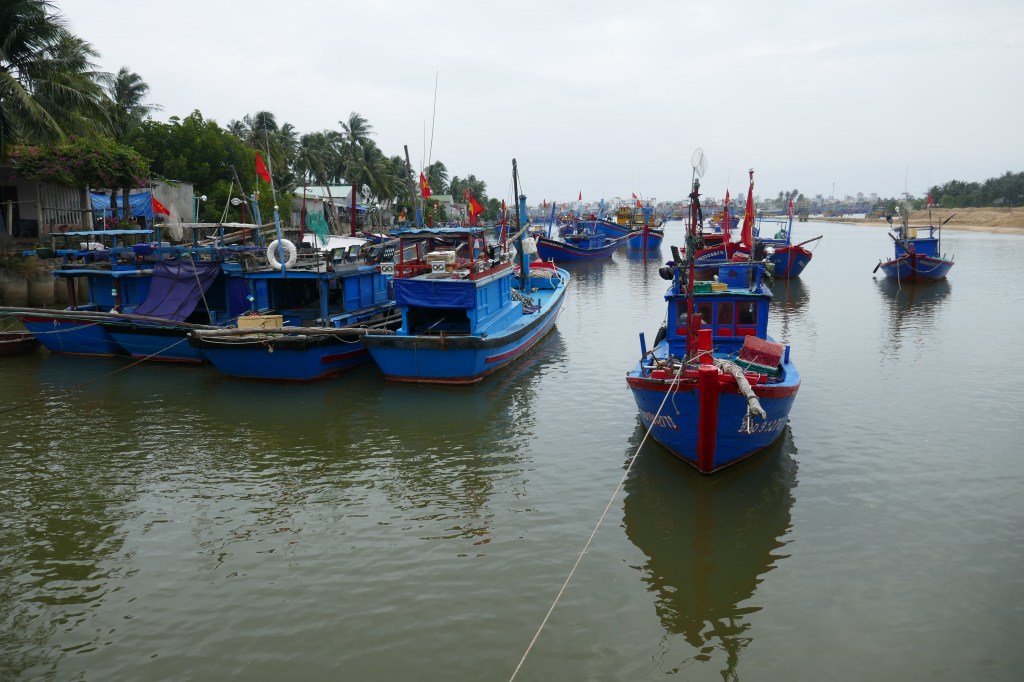
The rain did not last long but this gentle section of the route came to an end after 10km when we rejoined the QL1.  We stopped for coffee in Thanh Duc, a fishing town with a good coffee shop.  10km more on the QL1 and we bare our farewell to this arterial road and went onto smaller roads for the rest of the day – some of dubious surfaces that slowed us up and others of which were fine.  The route took us south, along the coast but we found that we almost never saw the sea, as there was almost continuous development or wooded areas next to the shore.  At one stage we went through a fishing town, Thanh Xuan, where there were hundreds of small fishing boats in the harbour, as well as fish drying on the side of the road.  Fishing is a major industry here and fishing is done at night, with the boats having a range of lights to attract the fish.  To us, almost all the boats appear tiny (or at least we did not see any bigger boats).  
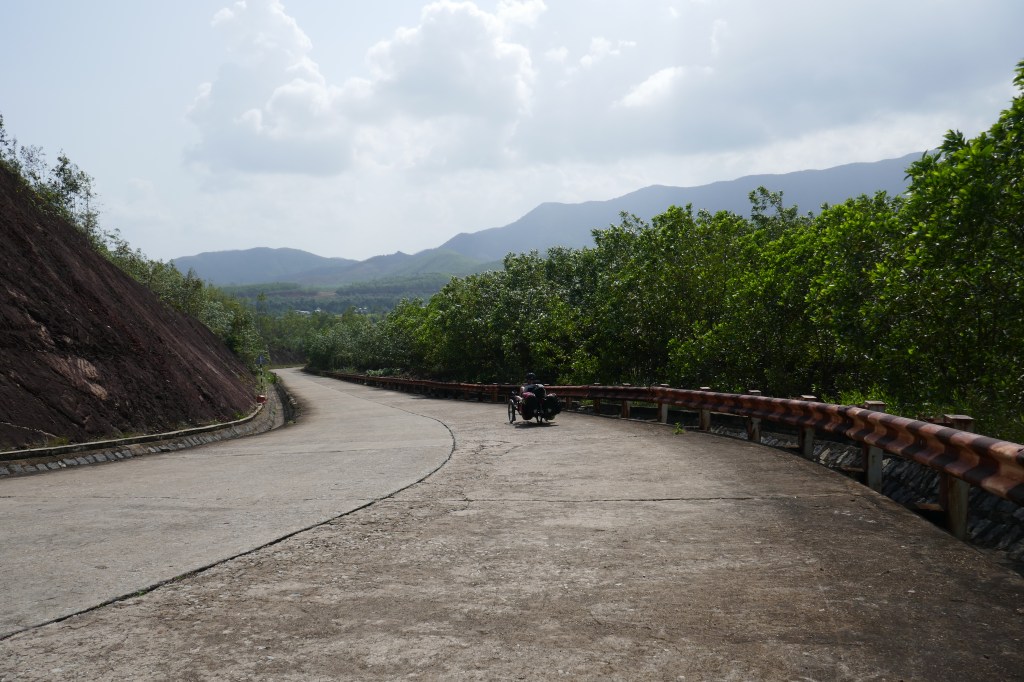
The road took us across another major river, this time the Song Loi Giang, and we hit a section where a line of East-West mountains comes right down to the seaside.  That means the road has to climb through the end of the mountains – and we needed to get out our climbing legs again. These were two tough, tough climbs. Only 150m and 120m, but the slopes were up to 17% in places and this was the heat of the middle of the day.  I abandoned my helmet and even my sunglasses as the salt from the sweat was hurting my eyes.  It was tough climbing but we got up them.  We saw no other cyclists – what a surprise!

The section of road between the two hills was right along the sandy beach, and was totally unspoilt.  We stopped and took in the sheer beauty of the surroundings.  It is captured on this video and pictures.

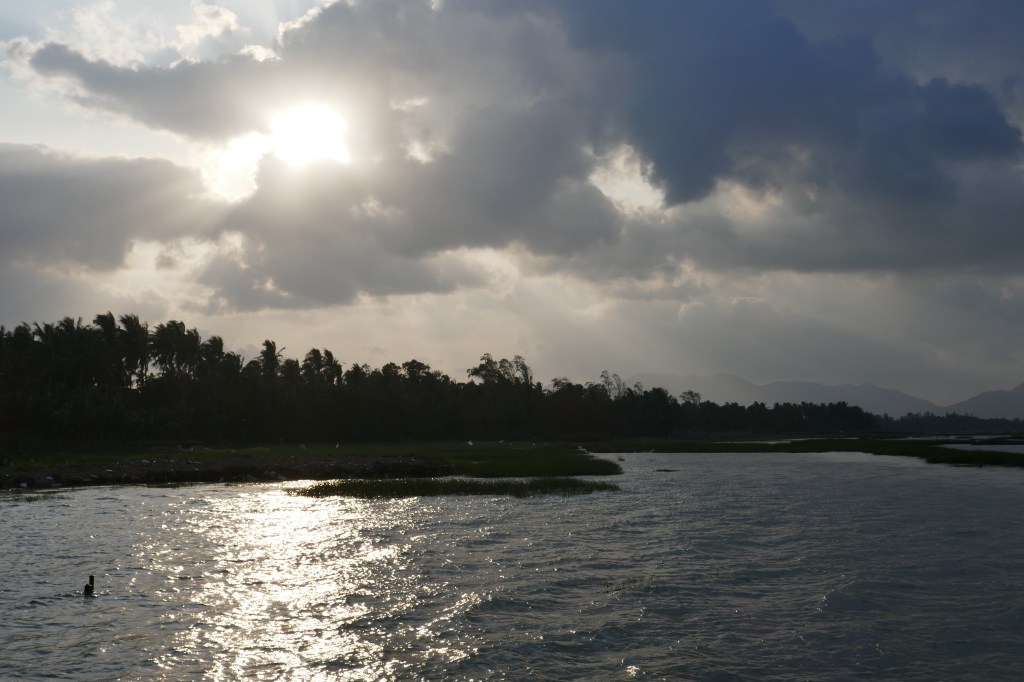
Following the last descent, we started to look for food and found a tiny market – but with everything we needed for supper.  We filled our panniers and then headed to the “homestay” we had identified as our destination for today, located on large inland lake.  This had great reviews but we noted they were all pre-pandemic.  We had called ahead and spoken to the owner (who spoke English) but he said he was “elsewhere” and his mother would sort us out, which she duly did – again googletranslate and the son on the phone making it all happen.  

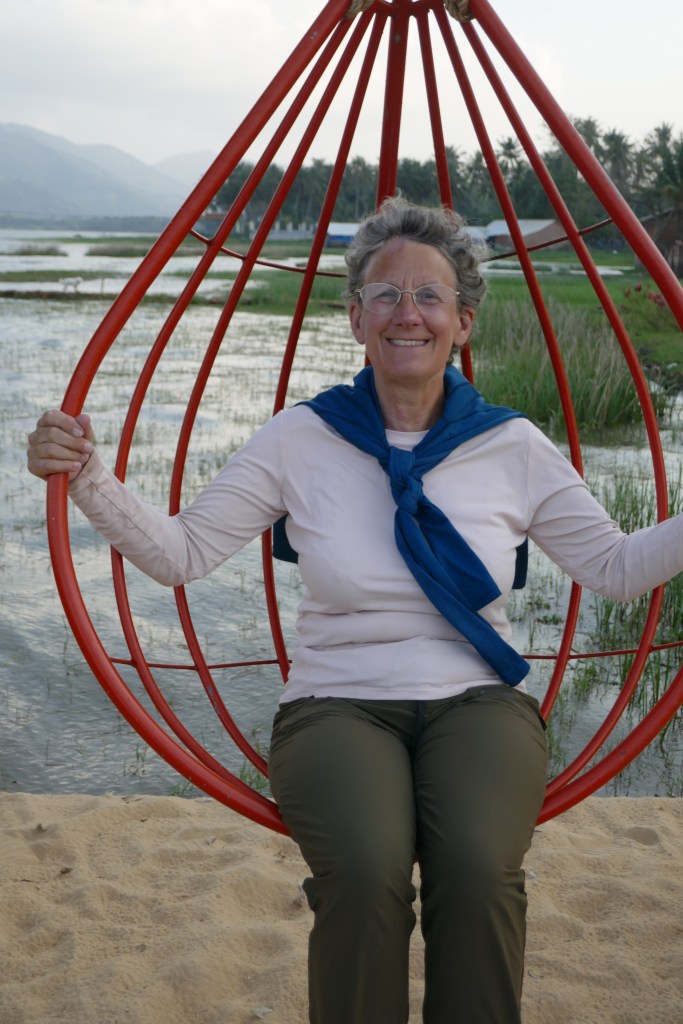
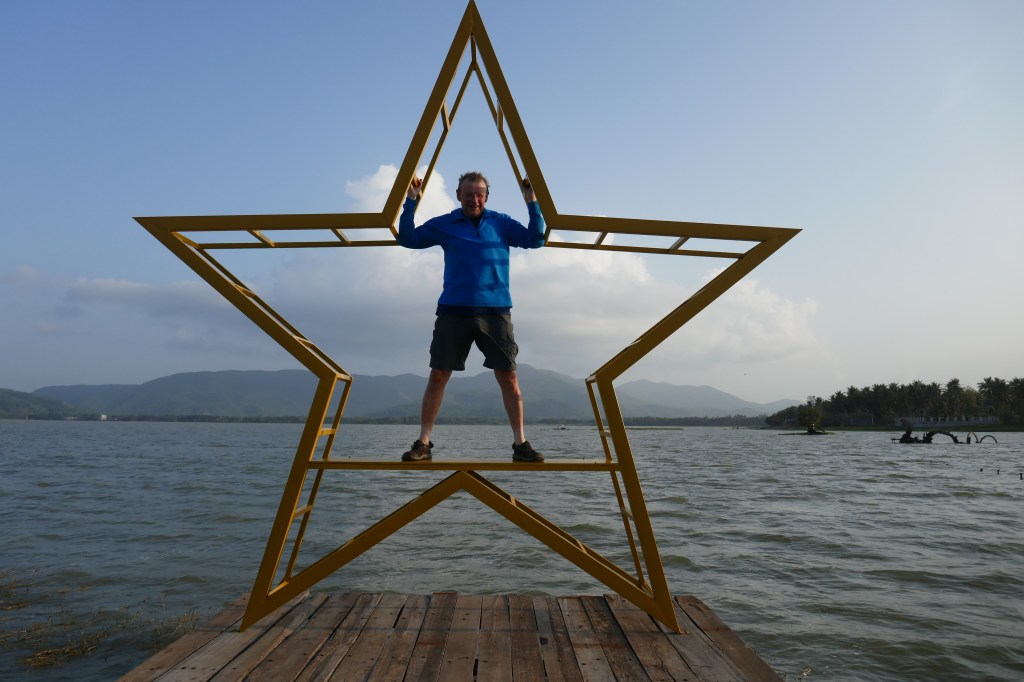
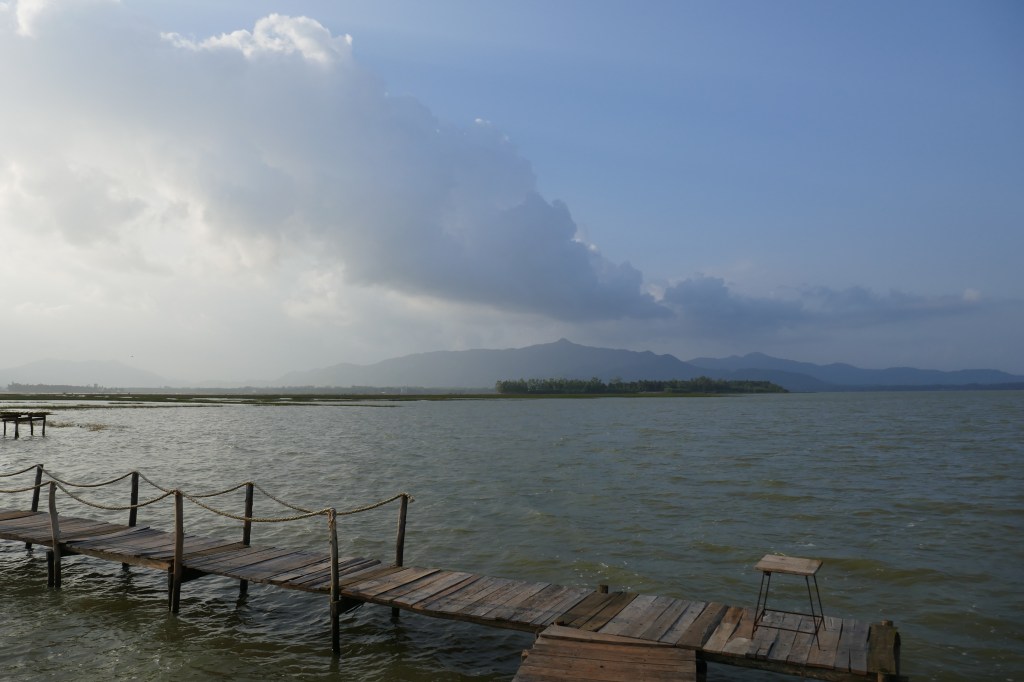
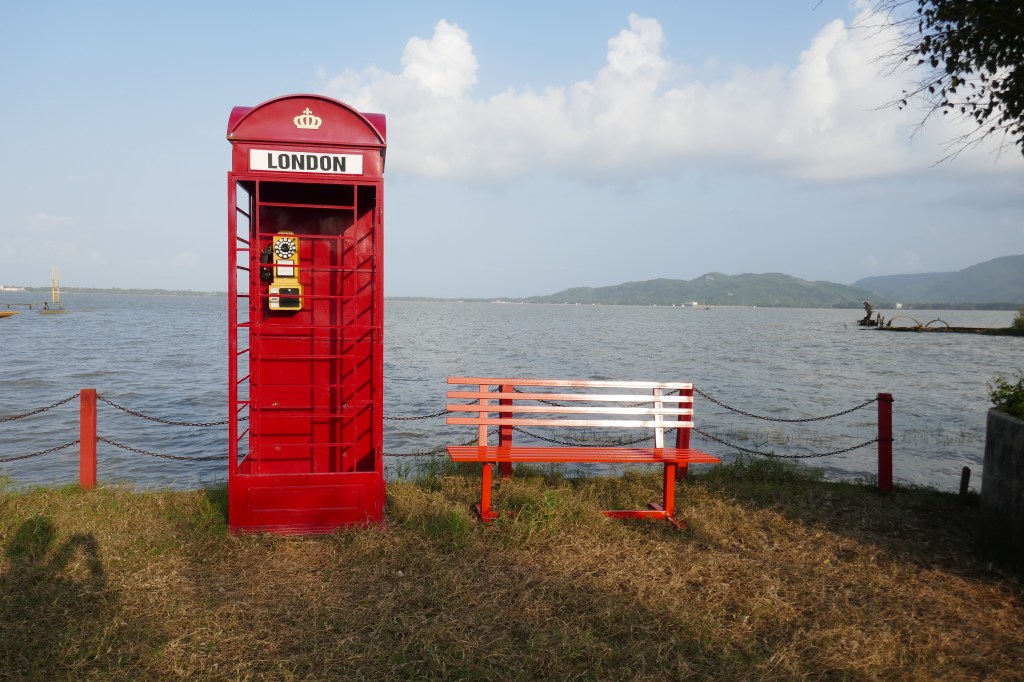
The homestay is well set up, on the shores of the silver lake, but it had a slightly run down feeling.   There was some developed area for visitors, including walkways into the lake, boats which may have been for hire, places to swim and some fun structures – including an English red telephone box!

But we were the only visitors today and had the impression we may have been the only visitors for some time.  It was unclear whether the business has been mothballed (possibly as a result of the pandemic) or only operated in the summer months.  This is supposed to be peak tourist season at the moment but it is unseasonably cold.  The rain we have cycled through is not supposed to start until May, but the climate appears to be changing, and it does not give the appearance of a place for peak “winter sun” tourism.  Anyway, we arrived early enough to relax in the light, walk to the lake, take some silly pictures and then Bernie cooked a lovely meal.  

This time next week we are due to be in HCM airport, waiting to board our flight home.  It has been an amazing trip so far but, as we go into the last week, our thoughts are starting to head for home, the family we are looking forward to seeing and our friends who we miss.  However, we are determined not to wish away the last week but to make the most of everything.