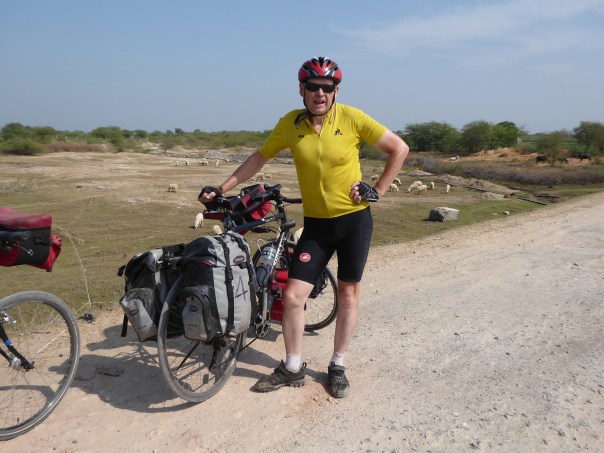
Today the short version is we cycled 146km (which is about 92m). It was the longest day on our several trips, as ever loaded with panniers. As I write this there is only one word – Exhausted!
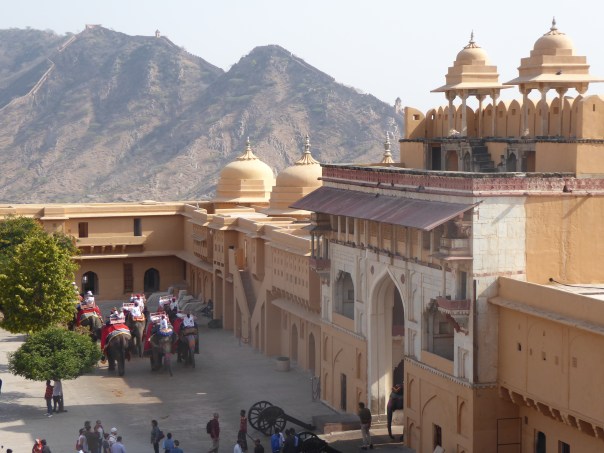
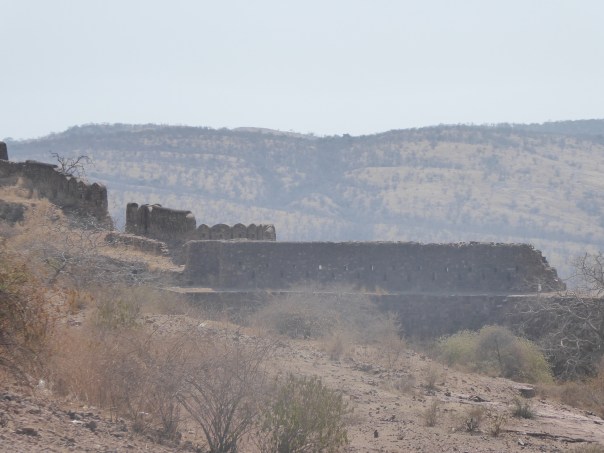
We are still in Ranthambhore because we took 2 days off the bikes. The main event today was visiting Ranthambhore Fort. This fort, along with 5 other forts of Rajasthan, are UNESCO World Heritage Site under the group Hill Forts of Rajasthan.
That includes Kumbhalgarh which we saw last week. Inside the fort there are three Hindu temples dedicated to Ganesh, Shiva and Ramlalaji constructed in 12th and 13th centuries from red Karauli stone. There is also a Jain temple of Lord Sumatinath (5th Jain Tirthankar) and Lord Sambhavanath.
The fort was about 12km from the hotel, so we cycled and I got another rear tyre puncture. I suspect the outer tyre is decaying so we swopped it for the front one and went on our way. The front has less pressure on it – but its only a temporary fix.
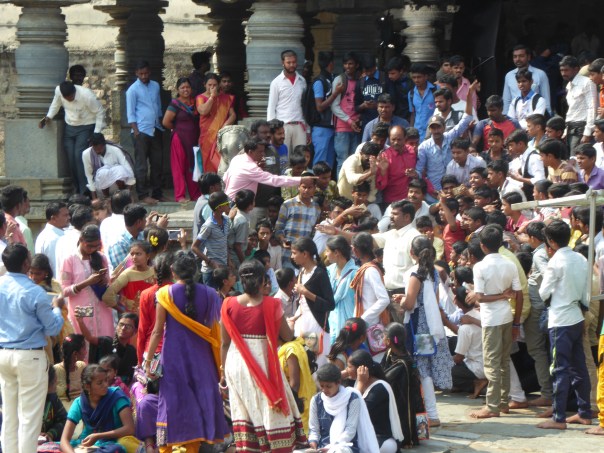
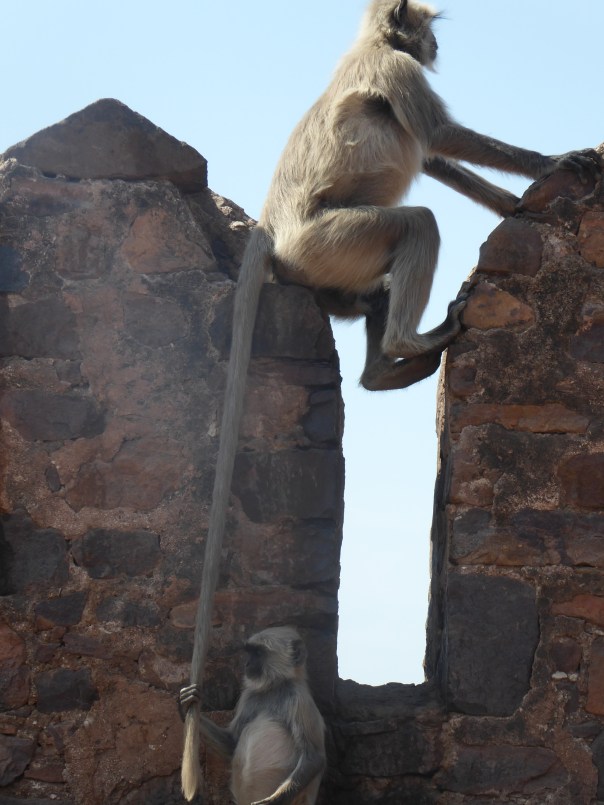
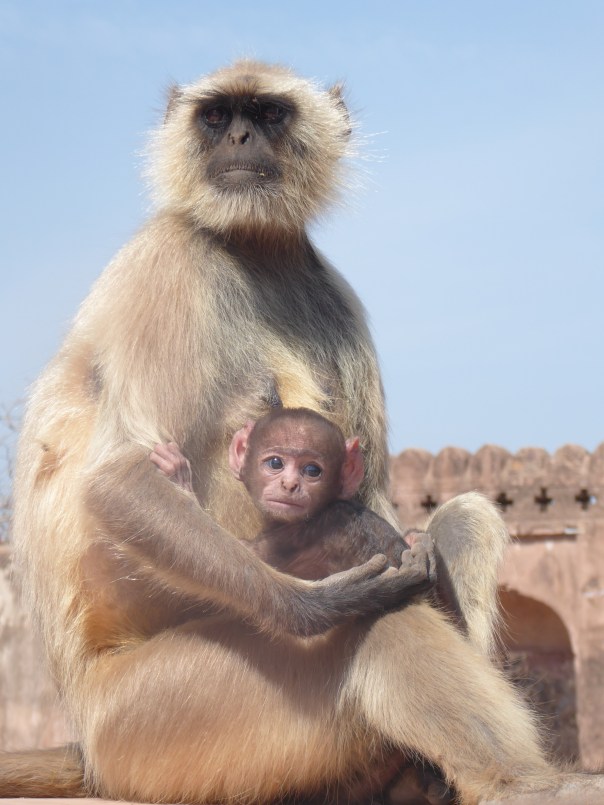
The route to the fort took us up a cobbled road – so not quite Paris-Roubaix but you get the idea. The road was full of jeeps, motor bikes, cars and the occasional minibus taking people up to the Fort. The vast, vast majority were Hindus coming to visit the temples; described to us by one chap we met as a “very holy place”. This made the whole thing intensely colourful and chaotic. There were also more monkeys in one site than we had ever seen in one place before – maybe intrinsic to the holiness of the site.
A long tailed monkey – with a friend treating it like a bell rope
I could describe the fort – but the pictures do it better. However what struck us most was that all of India was represented in the car park. The road was steep and narrow. It flattened out at the top but was still really narrow. That was where the trouble started – because there was totally insufficient parking and so everyone was jockeying for position to try to get into the small area, to get out or to turn around. If there was a small gap between 2 cars, 15 motor bikes would try to get through. All engines were kept going all the time, so the air was heavy with diesel and horns were blown continually and at random. People got out, walked around in the road at chatting at random and so left even less space for traffic to pass.
Despite this scene, good humour prevailed, no one lost their temper, no one shouted and the traffic just about moved so that everyone got to see the fort – but goodness knows how. It looked total chaos but it was not.
However we got about 4km down, going very slowly because of the cobbles, before any four wheeled vehicle overtook us. There had been a total logjam at the top (which we wheeled our bikes around) and could not see how it could possible be solved. It felt like one of those children’s puzzles where each piece had to be moved before another could move – and who was going to move first. But obviously it was solved and eventually the traffic moved again.
David was still feeling under the weather so we had a quiet restful morning. Breakfast was good, we were upgraded to a much nicer room and the morning cloud gradually burnt away so that improved our mood.
The machinations of booking a safari in Ranthambhore Tiger reserve, about 10km from the town, were immensely complicated when we had tried to book something in advance. The safaris can be done in a ‘Gypsy’ jeep, that seats 6, or a ‘Cantor’ that seats 20. We had been told that all the jeep safaris were fully booked (only official government vehicles are allowed into the reserve and the numbers are strictly regulated) but we coughed up money to our hotel the evening before and we were assured we had a trip booked in a Gypsy and we would be picked up between 2-2.30pm. At just after 2.30 our jeep turned up with guide and driver, which we shared with 4 German people.
The Tiger reserve is divided into 10 zones. The drivers are allocated a zone randomly each day, so when you book you do not know what zone you will be in. Zones 1-6 are meant to be best for Tiger spotting. We were allocated zone 7.
We drove the 10km to the entry to our zone and were soon bumping along sandy tracks.
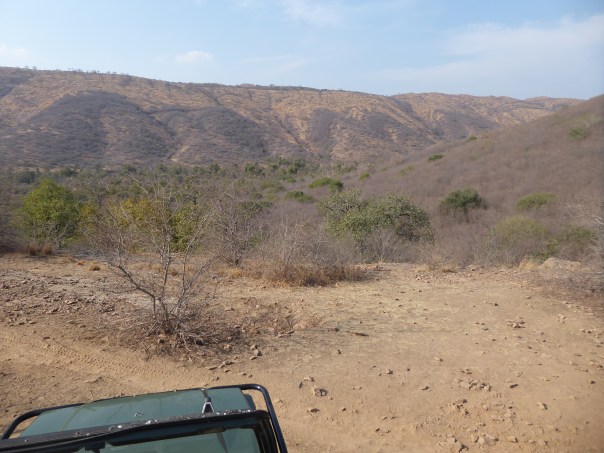
We were then taken on a real white knuckle roller coaster ride up and down a ridge. No Cantors here – how the jeep got up and down what seemed like near vertical tracks to me was incredible. We were hanging on for dear life!
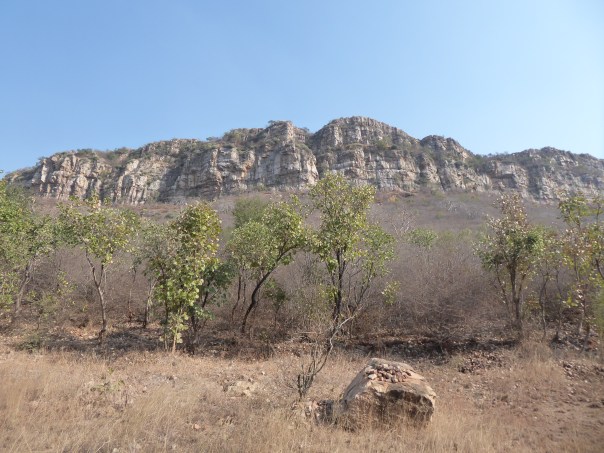
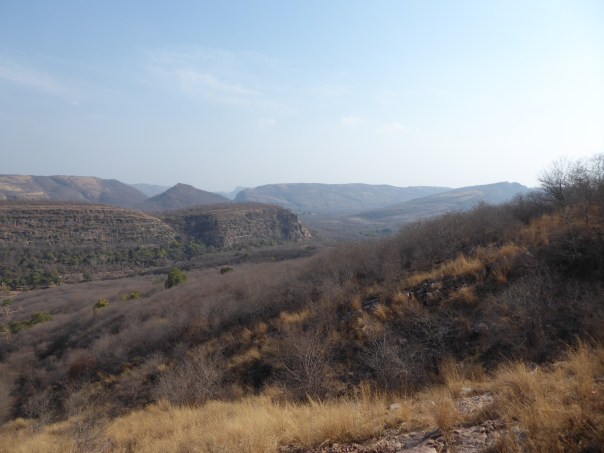
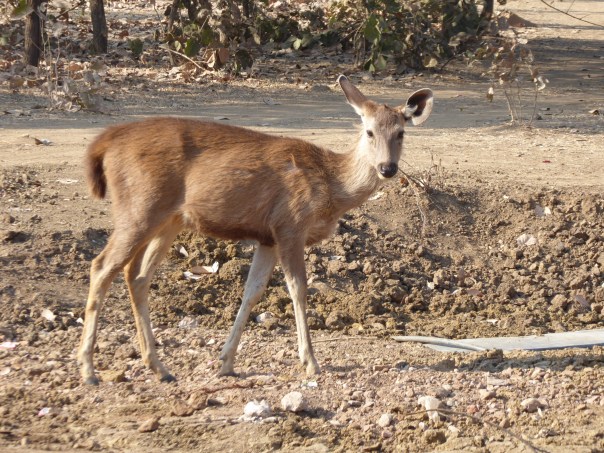
The scenery was spectacular but little sign of any animal life. Our guide told us there were few animals in Zone 7 but it was one of only 2 zones that was not flat. We saw several large Samber deer and a few small antelope in the distance but that looked like it would be the sum total of wildlife for the day.
Male Samber deer with a bird on his back.
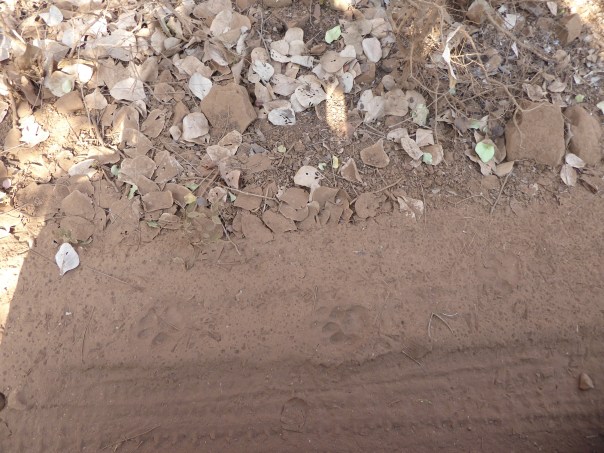
Earlier we had passed some tiger footprints alongside the track. We were told they had not been there that morning but we were sceptical to say the least.
Tiger paw prints
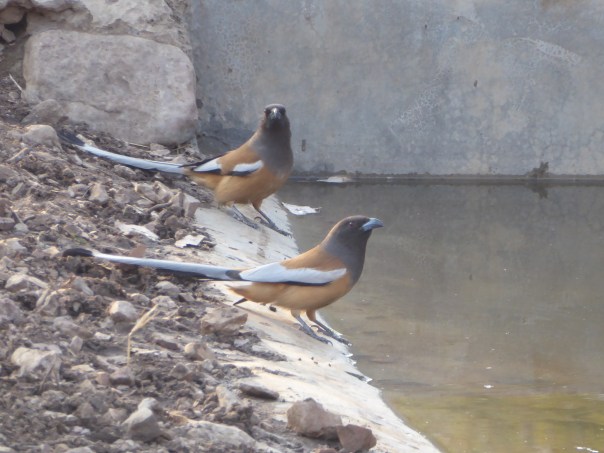
Towards the end of the safari as the sun was going down we stopped for about half an hour at a waterhole and at least saw some varied bird life coming to drink.
‘Tiger is coming’ our guide said, but we were still sceptical. Several more jeeps turned up and everyone was hanging around. After the sun dipped behind the hills some of the jeeps gave up and headed off. ‘Tiger is coming’ said our guide.
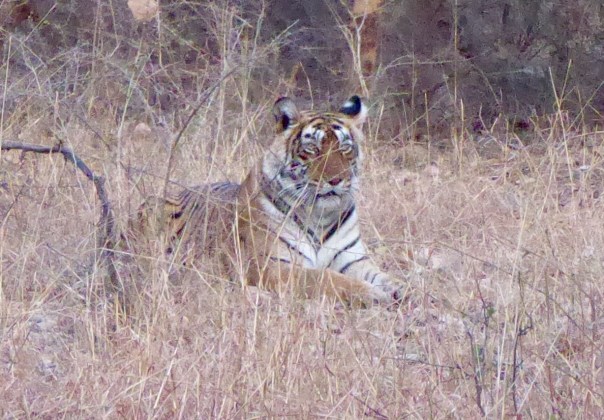
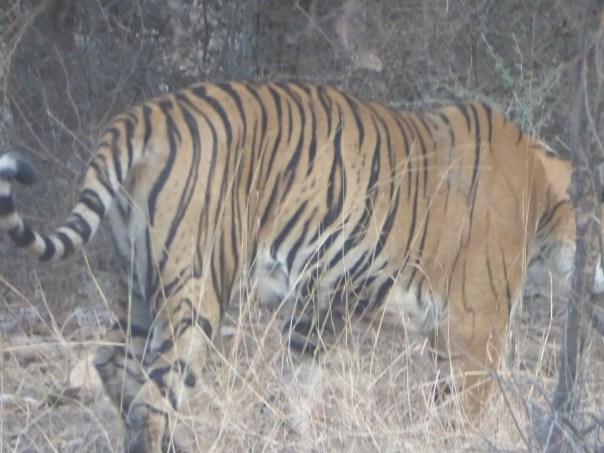
Suddenly there was a whoop from another jeep. Within a few seconds our driver had done the most incredible 180 degree turn which almost tossed us out of the jeep and careered into the bushes…and there, sitting under a tree as calm as you like, was the most beautiful, magnificent large tiger just about 10m away from us. We were staggered.
All the other jeeps piled in and he just stood up and strolled away. We saw him for perhaps just 10-20 seconds but an image that will be forever imprinted in the memory – and David had the where-with-all to take a fantastic photograph. The 3 and a half hour safari was worth it just for those few seconds (and we really enjoyed the rest of it too).
Our guide and driver were ecstatic! “So lucky, so lucky” they kept saying. The driver then put his foot down and took the track out of the park at incredible speed. We weren’t sure what the frantic hurry was, but our guide was on the phone clearly relaying the news to someone. The pace picked up even more for the 10km back to town. All the jeeps from all the zones were heading back as darkness came and they seemed determined to overtake them all, shouting out their success! We were all smiling and laughing. The chances of actually seeing a tiger seemed so small but it was definitely our lucky day.
Touring cycling has its actual as well as metaphorical ups and downs, and this was perhaps an example of mainly the latter. I had developed a sore throat at Bundi and felt pretty crap, and yet we had a 120km cycle day to undertake. Some things just have to be done.Continue reading Day 43: Bundi to Sawal Madhopur: 122km and 300m of climbing→
We liked the pleasant town of Deoli but were glad to leave the hotel, which had been unhelpful and the first place to overtly try and overcharge us for the room. I guess this was not a town tourists would come to and therefore the hotel does not live or die by its booking.com (or equivalent) reviews.
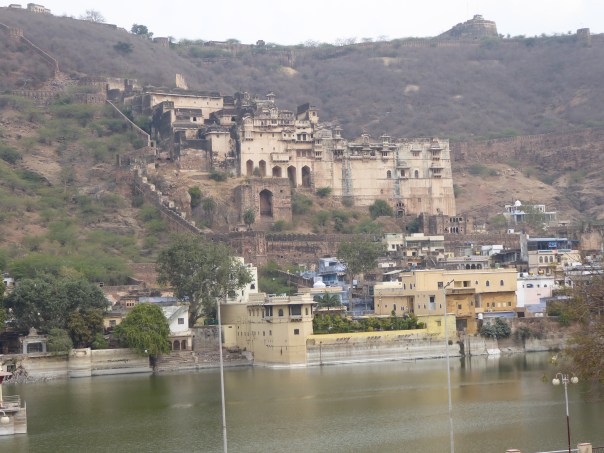
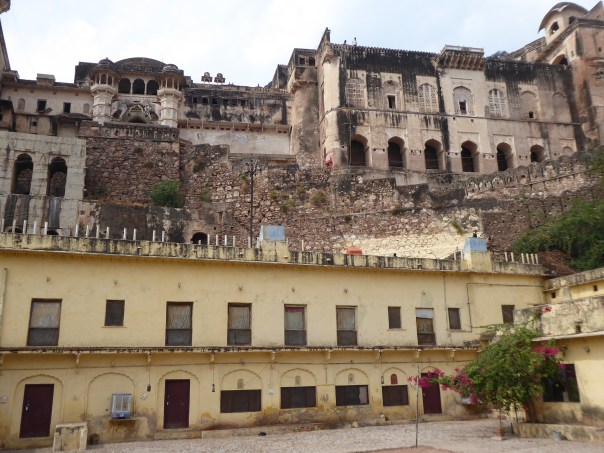
We only had a short hop today to Bundi and 48km of flat on a main road were done by mid morning. As we turned into a small range of hills and rounded a corner we could see the spectacular palace emerging from the rock face. We settled into our simple guest house then went to explore.
Bundi could best be described as shabby but had a charm of its own. There were some tourists but not many and no stalls of tourist tat lining the streets. The palace dated from around 1620 and had clearly been spectacular in its time but had fallen into ramshackle ruin.
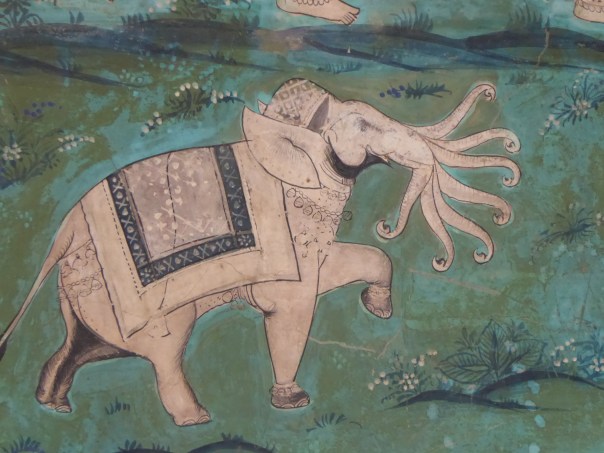
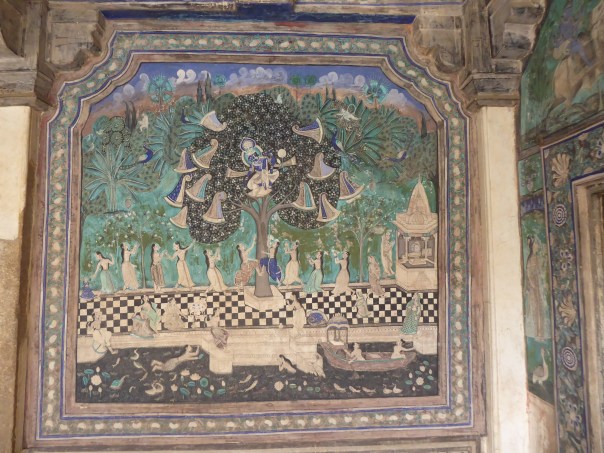
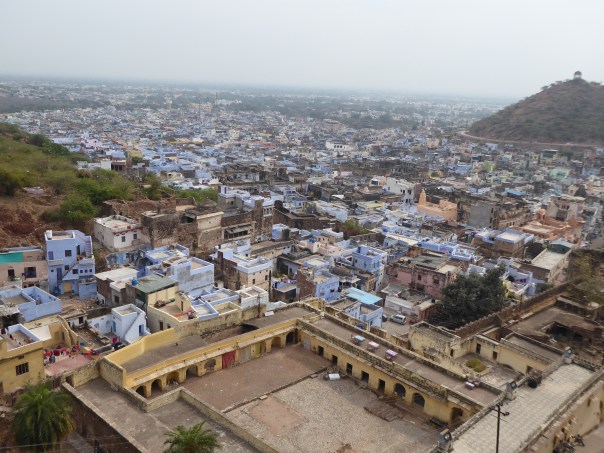
Some renovation had been done and gave a flavour of what it was like, including some fabulous murals, but all the upper floors were shut to the public. The views were amazing and showed a number of dilapidated buildings in the old town.
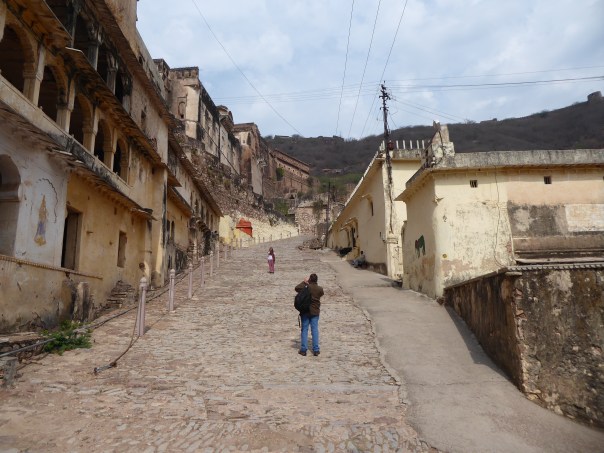
Now that we are connoisseurs of Rajasthani palaces and forts we could recognise the steep cobbled approach with sharp twists as being a deliberate defence to elephant charges.
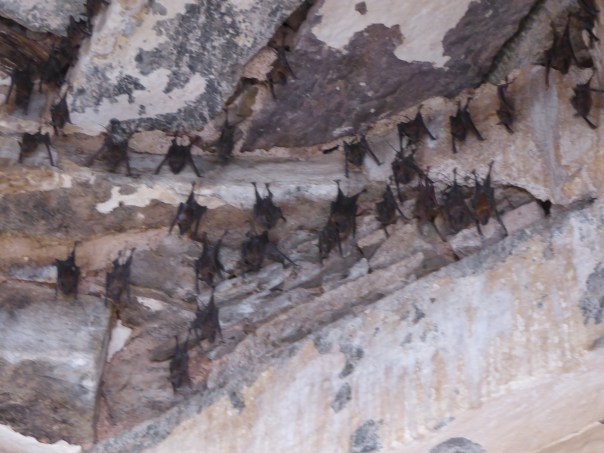
High above the place was a even more dilapidated fort, which presumably the royal family retreated to if the defences were breached. The place certainly had atmosphere with bats hanging in the corners!
One day someone may be able to invest a very significant sum to restore the site to glory, when it will certainly rival those we have seen in Udaipur and Jodhpur. There the deposed maharajas reinvented themselves after independence to become custodians of local culture and set up Trusts to convert their fading buildings into national monuments and museums. What happened to the Bundi royal family is not known to us.
We strolled the old town and saw the active market and did our ‘jobs’ (cleaning our stove, getting money, buying provisions, recharging our Indian SIM card). At our now very relaxed pace this took most of the rest of the day and recharged our legs a bit in preparation for a longer cycling day again tomorrow.
Today was the ultimate A to B day – so, in the absence of exciting things to describe, its time for some stats. To date, we have done 2,824km in India. If we had left Kanyakumari and driven directly to Delhi on the shortest route, we would have arrived in Delhi today (as the distance is 2,810km, which is slightly less than we have cycled so far in India).
The distance by air from Bewdley, England to Hobart, Australia (our projected final destination) is 17,652km. Since we left home in 2014, we have covered 10,138km. That means that, in 4 years – 40% of our “decade” – we have covered about 57.4% of our goal, which is to cycle the distance (as the crow flies) between our home and my brother’s home in Hobart. Mind you, it would be one hell of a crow! But it does mean we are on target to achieve our goal and may even end up covering a few extra km along the way.
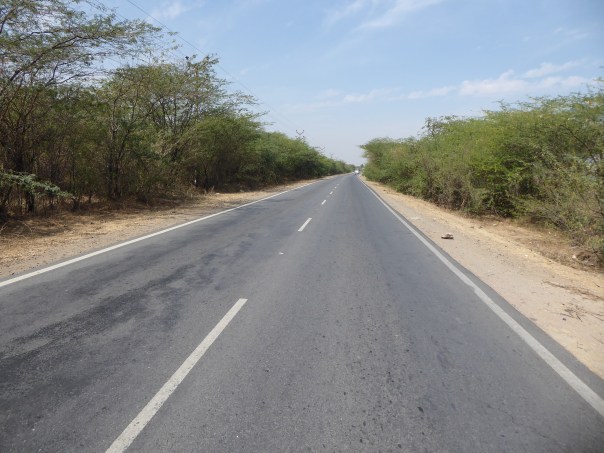
All those numbers make up for the fact that today was about 100km on a virtually straight road, slightly downhill in places, with scenery that was virtually unchanged all day.
This was an interesting bit of road as it has a bend at the end.
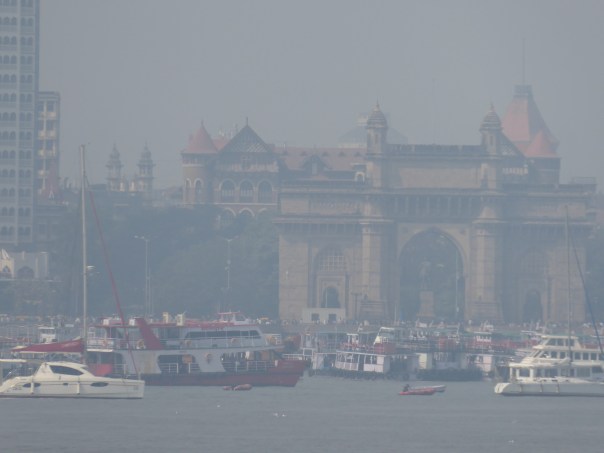
Ajmer was a great city but the air pollution – as with all of India’s cities – is a major issue for cyclists (and for everyone else of course). Factories, fires burning in the countryside, lorries, tuktuks and motorbikes give off huge quantities of noxious fumes which are slow to clear. It is a major challenge. India has a low per capita emissions of greenhouse gases but, with a large population, the country as a whole is the third largest emitter of greenhouse gases after China and the United States. A 2013 study on non-smokers has found that Indians have 30% lower lung function compared to Europeans.
We gradually cleared the city and the air improved slowly. Then it was head down and 23km an hour steadily over the plain, but with a good road surface. This was cultivated countryside, with big fields and occasional tractors. These are often fitted with 2 large speakers (on each side of the tractor driver), blasting out Indian pop music to keep the workers happy. We cannot tell the difference between the songs (yet), but bounce along to the music.
After about 80km we got to Kekri, and bought some fruit (which I then left on the stall). Clearly my brain is deteriorating with the fumes! We pressed on with the main road going off to the south. We should have stuck to the main road and done the extra 10km. Instead we followed the straight road which had a much worse surface. We bounced from one pothole to another, and in places the road had no tarmac at all.
We crossed the vast Bharatpur Reservoir, which provides irrigation water for a vast area, and eventually reached the little town of Deoli where we had booked a hotel.
A little “contra-ton” followed as we insisted the bikes should be locked inside and the hotel staff could not understand why we could not lock them up outside. The staff were astonished we stood our ground (and we would never have done so a month ago), and then they compromised and found a place for the bikes inside. It is really hard to explain that our bikes are not only worth thousands of pounds, but that all the parts are nearly irreplaceable in India and so any small theft of a saddle or wheel may bring our tour to an end. However I think they finally understood and accepted that these really strange westerners have to be accommodated with their unusual requests.
We ambled around this lovely small town, confident in the knowledge that we were the only Europeans here (and getting strange looks from those who had the courage to stare). But we also had an excellent vegetarian meal and so felt pretty good about the whole place. Only 60km to Bundi tomorrow.
We were woken at 6am to a tremendous din of bells and music. I would call it a rude awakening except that it was due to the devotions of the faithful on the Ghandi Ghat, which was virtually under our hotel window. As it was only a short hop today between Pushkar and Ajmer, we allowed ourselves to snooze again and have a leisurely start to the day with breakfast on the terrace overlooking the peaceful lake.
The road from Pushkar to Ajmer took us over Snake ‘Mountain’ (less than 100m climb) from a small Hindu town to a largely Muslim city of half a million people. As we came over the pass we could see the city before us surrounding a large lake and we were soon into the heart of it. Finding our hotel was rather tricky as ‘googlemaps’ took us straight through the main bazaar area and its mass of narrow winding alleys, battling with people, motorbikes and tuktuks. When we finally found it we found that we could have come a longer way round on a proper road! Would have been more straightforward but not as much fun!
We were settled in by noon and soon set out to explore the city. Plunging back into Diggi bazaar was far easier without the bikes. A riot of colour and people, it’s narrow alleys had a different feel to other cities with similar snaking backstreets. Difficult to put a finger on just how, but the Muslim influence seemed to make the place feel distinctly different. The part we walked through first was a mass of food and sweet stalls, and we had a quick samosa with a delicious sizzling sauce.
We were heading towards the Dargah of Khwaja – the tomb of the Sufi saint Khwaja Muin-ud din Chishti, who came to Ajmer from Persia in 1192 and died there in1236. It is a major pilgrimage centre. Just as we approached the Friday ‘call to prayer’ sounded from the mosque within the complex and hoards of people were surging in. So we decided this was not the right moment to try and visit!
As we walked away from the shrine from the main entry gate the roadway was lined with hideously deformed beggars – seeking funds from those on the way to the mosque, not tourists (there were no other tourists). We have heard the stories of beggars being deliberately maimed and ‘pitches’ being highly organised and sold. We don’t know the truth of it but it was gruesome and macabre. The deformities could not be downplayed but there was a lot of rolling around in the dust and dirt, which did seem exaggerated. None of the faithful streaming towards the mosque seemed to be giving any money to them (but maybe they got money after prayers). We hurried through and when we returned later made sure we did not go that way.
Our next stop was another totally extraordinary place. The Nasiyan Jain temple was built in 1865. The outer part was of red stone but the inner double temple hall was an amazing gold ‘diorama’ (a model representing a scene with 3 dimensional figures), depicting the Jain concept of the ancient world with continents, oceans, golden cities and flying gondolas. It was abut the size of a two or three squash courts, and was quite unlike anything we had seen before! The wall posters explained the history of Jainism and how the mystics developed their views of the world. It was a strange, unscientific view of the world but was no more absurd than the Pope’s attacks on Leonardo da Vinci for suggesting that the earth rotated around the sun.
Taken through glass – but you get the idea.
Strolling back through the bazaar took us into different areas, for example one was a series of what looked like jewellery repairs – small alcoves with men sitting cross legged using intricate tools. One of the delights of a city like this is wandering – not knowing what is around a corner and finding a ruined palace, Anglican church (St. John the Evangelist – just around the corner from our hotel) or a series of shops that just sold motor bike parts.
It’s tough waiting for someone to take your rickshaw.
Later in the afternoon we went back to the Sufi shrine. Again it was quite extraordinary, although in a completely different way. The complex could be entered from different gates within the heart of the bazaar. Once we had removed our shoes and entered, the contrast between the noise and dust and narrow alleys of the bazaar with the marble floored area of courtyards, mosque and shrine was marked. It was full of pilgrims and we felt rather out of place and a bit voyeuristic, but no one seemed to mind and we were probably over sensitive. No photos though. There were numerous stalls selling devotional nicknacks and baskets of flowers that were being brought to offer within the shrine.
People were sitting in groups and individually, many round the walls of the shrine offering their prayers. We did not try to go into the heart of the shrine, as the lines of people with their offerings seemed strictly controlled and it seemed lacking in respect to do so. Although there was something about this place that we could understand, it felt a profoundly holy place.
Back in the mundane of our hotel we felt in need of a ‘brew’. We often use our little stove in the ensuite shower rooms. This one was rather posher so we hesitated but there was a door opening onto a ventilation shaft so we thought it would be ok – and then realised we had forgotten to fill our fuel bottle this morning (the stove- a whisperlite – burns pretty much anything flammable but we usually use petrol as it is available everywhere.)
The drive for a cuppa had us out again looking for a petrol station. Eventually we found one after a long walk down a road with hundreds of tuktuk and motorbike repair shops, and lots of oily men who plainly work wonders with engines. We found a garage and asked for our 50 rupees of petrol. They did not seem to think it too unusual that 2 white people strolled into their petrol station with a small fuel bottle and asked for it to be filled – or if they did they hid it well! Back to the hotel just as it was getting dark and had our well earned drink!
So today was a day in a fascinating Indian city, so different in many ways to anywhere we had been before but also, in many ways, so typical of the delights we have experienced over the last month or so. An England only occupied by the English may seem pretty drab after we return, but luckily that England disappeared a long time ago and, particularly in London, we will have plenty of international colour to keep reminding us of these precious days.
Today got off to a slightly delayed start but – so what! We agreed to have breakfast at 7.30am so we could get a reasonably early start. There was no movement at 7.35am, so I went to find our host. He seemed startled at being disturbed, looked at his watch and said “15 minutes”. Knowing that would be at least half an hour I said “But we agreed breakfast at 7.30”. “5 minutes, 5 minutes …” was the surprised response. 15 minutes later we got omelettes (rather good) and toast. We were on our way by about 8.15 or so – with a good tip for the team (despite the slightly peculiar nature of the stay).
The cycling was a repeat of yesterday with 2 changes. It was broadly the same scenery – fields and desert – and the same mixture of good and bad road surfaces. The first difference was that it was only 85km today and not 125km. Ludicrously, that felt like a “short” day now.
Secondly, there was 50km uphill. When I say “uphill”, that is a bit of an exaggeration – the road was an upward slope for more or less 50km. But it only went up 250m and thus was going up about 5m per km. It was like cycling on a very flat plain which had been ever so slightly tilted so that it rose at a more or less constant rate.
We passed a few desert towns with nothing particular to recommend them except sand on the main street which brought our bicycles to a grinding halt and the usual range of shops, stalls and cattle. Between the towns the road surfaces were mostly reasonable, but occasionally it was more sand – but of the harder variety. We saw a few more camels, lots of young men on motorbikes and lots of women driving cattle or walking back from collecting firewood with the day’s collection on their heads.
There was also a high quotient of “selfie-seekers” today – all young men. One young man on a motorbike was quite offended when we said no, we would not loose all momentum by stopping cycling so he and his friends could have selfies with someone he did not know and would never meet again. We are such kill-joys but we can just continue peddling. If they catch us when we are stationary, the line of least resistance is to say yes, but stopping when we are underway is a different matter.
Rajasthan seems from our brief acquaintance to be a place where female emancipation has some way to go. The way that some young men leered at Bernie as they passed on their motorbikes was fairly transparent and did not reflect well on them (despite the fact Bernie is senior enough to be their mother or possibly even their grandmother). Seeing a woman’s legs in public is pretty unusual here and I suppose the reaction is understandable even if I felt like knocking some of them off their bikes for the cheek of it.
Having said that, this was very much a minority reaction. The vast majority of people we meet are friendly, wave and say nice things. But roles seem pretty rigid here, with 95% of people on bikes or in cars are men and not a single man collecting firewood. On the plus side, judging by the evidence of school uniforms, school attendance seems to be by both boys and girls, well into the teens. So girls are being educated. What happens next is not something we have enough information to comment on.
Pushkar has a reputation as a “holy place” for Hindus and as a magnet for backpackers – a slightly unusual combination; but the backpackers originally came in part for spiritual enlightenment so it is not that surprising. It is centred around a lake, nestling at the foot of a mountain. The setting is superb and invests the air with the feelings of mysticism. It is the place where Mahatma Ghandi’s ashes were scattered here. One of the things we have noticed is the extent to which Ghandi is still the moral father of the nation. His sayings are on posters in railway waiting rooms and restaurants, reminding modern Indians of the values that drove the creation of the nation. Hence choosing Puskhar as the final resting place for Ghandi’s ashes gives this little town a huge national significance.
We watched as Hindu pilgrims bathed in the water, much in the same way as adherents to religions all over the world are cleansed by the wonderful properties of H2O. “Holy water” is a timeless concept that stretches from Catholicism through to Hinduism and with a great number of religions between.
Today, away for the lake, it is a maze of shops selling the type of clothes that no self-respecting Indian would be seen dead in but are popular with the backpackers as “Indian” style clothes. There are cafés here and loads of young westerners, exploring their inner selves.
After we arrived we went looking for a snack and ended up a falafel wrap stall – delicious but not something we have seen in any other part of Rajasthan. There were a group of delightful young people in their 20s – and we felt a bit “old” in their company. We chatted and eventually disclosed what we were doing, and they were stunned; totally stunned. They could not believe anyone as old as us was doing anything as crazy as we were doing (and had done). I felt a bit bashful at their response, assuring them that we were not super-fitness-freaks and that most of the roads we went on were quiet and well off the beaten track. Nonetheless, part of me was quietly satisfied at dispelling some of their assumptions about what folk can do when they reach the other side of the great 5-0. I did not dare tell them that one of my best mates – who is the other side of the great 7-0 – was on a 2 month mountain bike tour of New Zealand. There are some things that 20 year olds may simply disbelieve. Chapeau Malcolm – love the blog posts.
Then back to the quaint hotel for some R & R – reading, writing (making progress with the book chapter) and a rather indifferent “tourist grade” meal. Pushkar gets the thumbs up as a peaceful, spiritual place despite al the tourist trappings.
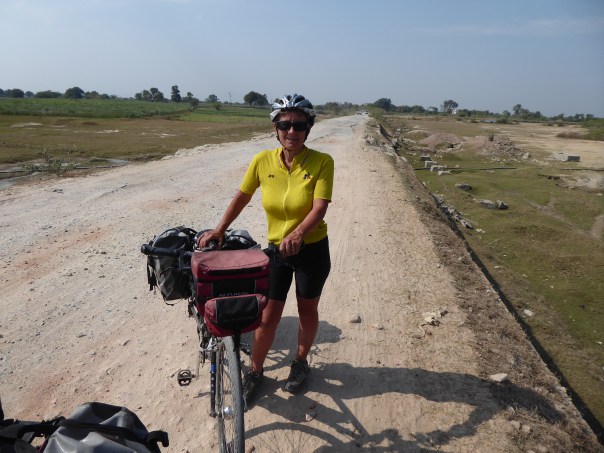
For a day where nothing much happened it was immensely enjoyable. We did our longest day, but at less than 200m climbing it was no where near our most difficult day and we got into the meditative rhythm of ‘flat’ cycling.
Today was a day when the work returned for the first time this trip. I cannot say who I was advising or what it was about, but it would not wait until my return so half a day was spent sitting in a hotel room with dodgy internet, writing an Advice. I suppose it will pay for a few days (or more than a few days) travelling but it brought me back to reality with a bump. I remain of the view that work is way overrated as a pastime.
An evocative face – at our tea shop
However, we started the day at about 9am – late by our standards. We ambled out of Jodhpur, up and down a few narrow streets and managed to avoid being hit by motor bikes or hitting any cows – but it was a close run thing on both at times.
The outskirts went on for a long time, then turned into a series of quarries so it was not that great, but we were soon out in the open countryside. Cycling in the flat scrub desert can sometimes feel like one is on an exercise-cycle in the gym. It can be fairly monotonous, then something of interest comes along.
We stopped for a tea break at one point and became the centre of attention. There was no doubt that the most weird thing about us was not that we arrived on bicycles, or even that we came all the way from England. We were really marked out as mega-strange because we asked for black tea with no sugar. The locals warmed to us, exchanged views about cycling and tutted about our strange choice of beverage.
One side of the road with no irrigationThe other side of the road with irrigation
After 55km we arrived in Oisin, well before lunch. It is a desert town that has seen better days, but used to have over 40 Hindu and Jain temples because it was a crossroads for the caravans coming from the west. Most temples are now discarded and in various stages of decay, but a few have survived. We visited one after lunch that was clearly set up for mass pilgrims, with lots and lots of places for people to file along before doing their devotions. It had some good carvings but overall did not impress me.
A beautiful and peaceful place
I then had my period of work, and just before 6 we went out to try to find another temple. It took some finding around the backstreets but once we got there it was well worth the hunt. This was a C8th Jain temple and was exquisite in all respects. It was peaceful, the carvings were beautiful and the whole atmosphere was amazing. We were the only visitors and ambled around for about half an hour taking in the feel of the place. Then, as the light was fading, we returned to the hotel and had an excellent (vegetarian) meal in the next door café.
One of many statutes of dancing women – temples seem to embrace this side of life.
Tomorrow is a proper cycling day so this is a short blog!
Today started with 2 shocks – one was being in a state of half sleep, half awake and hearing the call for prayer reverberating round the city but being able to drop back into slumber again. The second was waking properly and finding a cloudy day. We haven’t seen a cloud since Ooty – way back weeks ago. Our fears that Rajasthan may be too hot totally unfounded. Even the sunny days have only peaked in the high 20s and today much cooler.
After a very lazy slow start to the day we ventured out. First was the famous ‘omelette shop’ at the entrance to Sadar Market where a multitude of different types of omelette can be rustled up, slapped between 2 slices of white bread and consumed sitting on plastic stools by the stall. Delicious and a good meeting place, where we chatted to 2 travellers from the UK and one from Bangladesh.
We then climbed the hill up to Mehrengargh fort, a huge complex that broods over the city. We took the audio guide, which is one of the best we have ever done, and made our way round the huge battlements, doors with steel spikes to deter marauding army elephants and then into the palace complex.
The architecture was stunning but they had also created a fantastic museum of paintings, fabrics, armouries, palanquins etc. It was fascinating, interesting, intelligent and with stunning views over the city. We really enjoyed the visit.
The rest of the afternoon was spent back at the guest house. David continued his book writing on the rooftop, I did ‘chores’ (washing , filtering water, shopping) and spent time reading.
In the evening strolled out and went to the ‘step well’. We weren’t sure what this was but it was an amazing structure of steep tiered steps down to a pond.
We then went to the ‘best restaurant in town’ and had a fantastic meal. We bumped into a couple from New Zealand that we had walked up the hill with to the fort, Peter and Erica, and joined them in good conversation, great food and amazing 360 views up to the fort and over the market area. All on all a great day off.
Today was a breeze – in all senses of the word and hardly felt like doing any serious cycling at all. We packed up and left the anonymous but friendly hotel in Pali, and turned South to access the Pali by-pass.
This was a 2 lane highway with a shoulder – flat as a pancake with a following wind. It was Sunday morning but there were quite a lot of trucks about, although with the 2 lanes they gave us wide berths and loud toots on horns that played tunes as opposed to just sounding warnings. The packing of these trucks is a serious and impressive business. They carry vast quantities of goods with tarpaulins over top, bulging out at the sides and back, all held together by a complex system of ropes. It looks as if the whole load will shift off the side or back at any point but we have never seen this happen. Added to that, they are brightly painted and have numerous instructions and commendations on the sides, all in English. The utility of these must be questionable as I am not sure how many drivers can read English!
The first 34km passed quickly – indeed we did 21km in the first hour alone. That may not seem a great speed for those on road bikes but we are loaded with panniers and our bikes are built for endurance, not speed. Come to think of it, that description may apply to us as well.
After about 30km, we passed the most bizarre Hindu temple yet – all constructed around a Royal Enfield motorbike and with young bikers paying homage to the gods of the bike, seeking good karma for safe journeys. The Triumph Royal Enfield has a “Rolls Royce” or perhaps “Harley Davison” type status amongst the millions of motorbike riders in India. When Triumph motorbikes ceased production in the UK, someone from India bought the rights to the name “Royal Enfield” and design and began manufacturing them in India. The design must have been improved over the years, but the same shape and Easyrider style has been retained, and they are hugely popular.
The temple is said to have arisen when a young man was killed at this spot, when his Royal Enfield hit a tree. The police retrieved the bike but it is said to have mysteriously keep moving itself back to its lasting resting place, by the tree. This caused the legend which led to the Temple. It is now visited by bikers who are (slightly paradoxically) seeking good karma and safe travels on their bikes. All very strange but, in a delightful way, the merging of the ancient and the modern in a very Indian way.
We stopped for “tea” at a roadside café, just as we were due to leave the main road. The boys running the tea stall had some English and were very excited by the prospect of foreigners on bikes at their restaurant. Their attention to Bernie was a little too close! I suspect they may see foreign women in a slightly sexual and negative light, no doubt influenced by the media. They also tried to overcharge us for the tea, no doubt thinking that as foreigners we were clueless as to the cost of anything. To their surprise, we stood our ground and paid the usual rate, which they of course accepted. Even that was probably more than they charge locals, but then locals don’t make the weird request of having black tea without sugar!
Cycling along a desert road – another busy road!
The next 40km were on flat side roads with a good surface (outside the villages) that were largely unoccupied. It was a total delight. Without irrigation, the land here cannot be cultivated. But there is water and large sections were developed fields, with an unseen system of cultivation. The road more or less ended at each of villages and we cycled over hard, rough sandy paths. This had (I assume intended) the effect of slowing the (very limited) traffic to a walking pace. Small children, women and men all gave us cheery encouragement when we passed. Touring cyclists are a rarity here but maybe not as much a rarity as elsewhere.
Banana stop.Dry river bed.
By lunchtime we rolled into Jodhpur, a city of a million people. The old city remains intact and is dominated by the fort (which we will visit tomorrow). The network of alleys is designed to keep cool in the summer. They are so narrow that even tuktuks cannot go down most of them. But that does not prevent motorbikes doing so, often at quite high speeds. So anyone walking the narrow alleys does so at their own risk and with eyes and ears fully awake. We wound our way through the tiny alleyways to find our guest house.
‘Old soldier’ and his wife who came to chat while we paused finding our way into Jodhpur.Battling our way through the bizarre with panniers was fun!Colourful india.
In the afternoon we ambled around the market, read and I did more book chapter. Then we had a delightful vegetarian meal in the evening and bed. We had dinner with a young Dutch man who comes here to buy textiles for his online business in Holland. He has done so for 7 years and was fascinating to talk to. He expressed the view that the British are bonkers in trying to leave the EU and go it alone in the world; a view with which we agree and may even be shared by an increasing number of people in the UK. Sadly, the leadership of neither of our main political parties appear to have moved away from Brexit la-la land but we assured him that there are small signs that collective sanity may be returning.
View of the fort from the rooftop restaurant at our guest house
Today was an A to B day that took us from mountain terrain to the desert. It was a chilly start at 900m, even though we had treated ourselves to a lie in and started at 8 after breakfast at the hotel. We even put gloves on – but they soon came off again.
This may have been our last day with any significant climbing. Most of Rajasthan is fairly flat and so this sojurn amongst the hills may have provided us with the last acquaintance with our bottom chain rings.
We spent the night being tossed and shaken on our sleeper train but also lulled into sleep, at least on and off through the night. The train drew in more or less on time and we held our breath that our bikes had been loaded onto the train and arrived with us. We needn’t have worried – they arrived safe and undamaged and released back into our care after David had leapt across various railway lines to the parcel office to sign his life away again.
A short ride from the station took us to a guesthouse in the heart of the tiny lanes of the old city. Feeling slightly woozy from the night we revived after having breakfast on their little roof top terrace and a hot shower. We were last here in 1988 – where we splashed out and stayed in the famous Lake Palace Hotel (featured in one of the Bond films) for 20 dollars. It is now about 600 dollars a night! We were perfectly happy this time in our little guest house which was bright and clean with a very friendly owner.
Udaipur is a beautiful city full of palaces and temples. We set out into the sunshine and strolled down to the lake then through the streets to Jagdish Temple. The streets were picturesque and atmospheric but potentially lethal as motorbikes and scooters zoomed through at tremendous speeds with little regard for pedestrians. We felt safer on the bikes!
Jagdish temple was constructed in 1651 and covered in beautiful sculptures. Inside devotees were singing loudly and playing drums in front of the black stone image of Vishnu. All very lively.
Then on to the main event of the day. The wonderful City Palace. Dating from the 15 hundreds it was added to by each subsequent Maharana of Mewar. It was full of intricate architecture, beautiful courtyards, carvings and stain glass. We took our time with an audio guide and sucked up the atmosphere. It gave us an interesting introduction to the history of Rajasthan. We know we have a feast of palaces, temples and forts coming up over the next few weeks so decided on a tactic that we would see one place well and in detail rather than try and see every ‘site’ in a town or city.
The rest of the day was spent planning out our next 3 weeks in some detail to make sure we have a ‘tour’ that gets us to Delhi at the right time. We then treated ourselves a delicious evening meal to fortify ourselves as we get back on the bikes tomorrow.