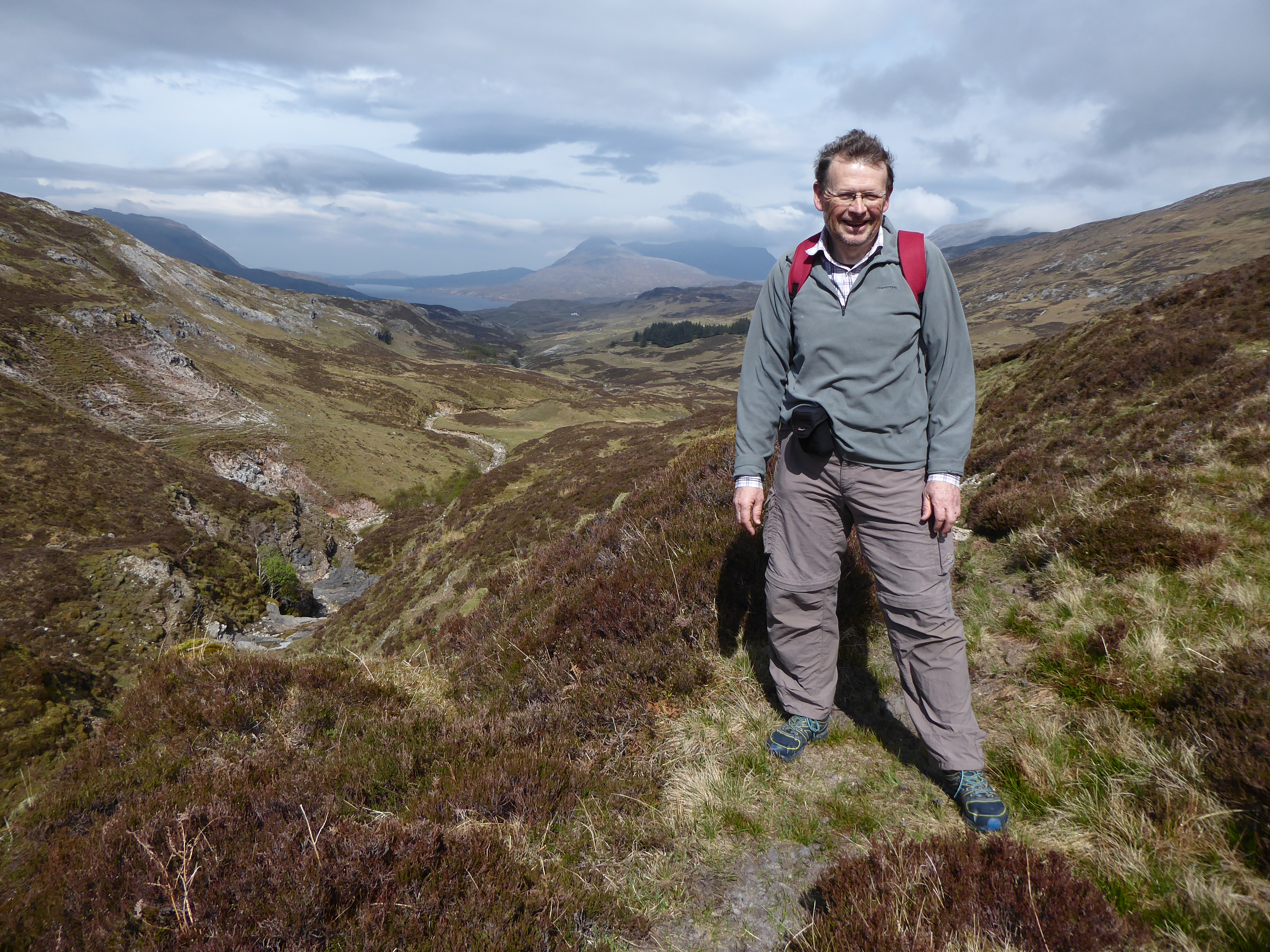
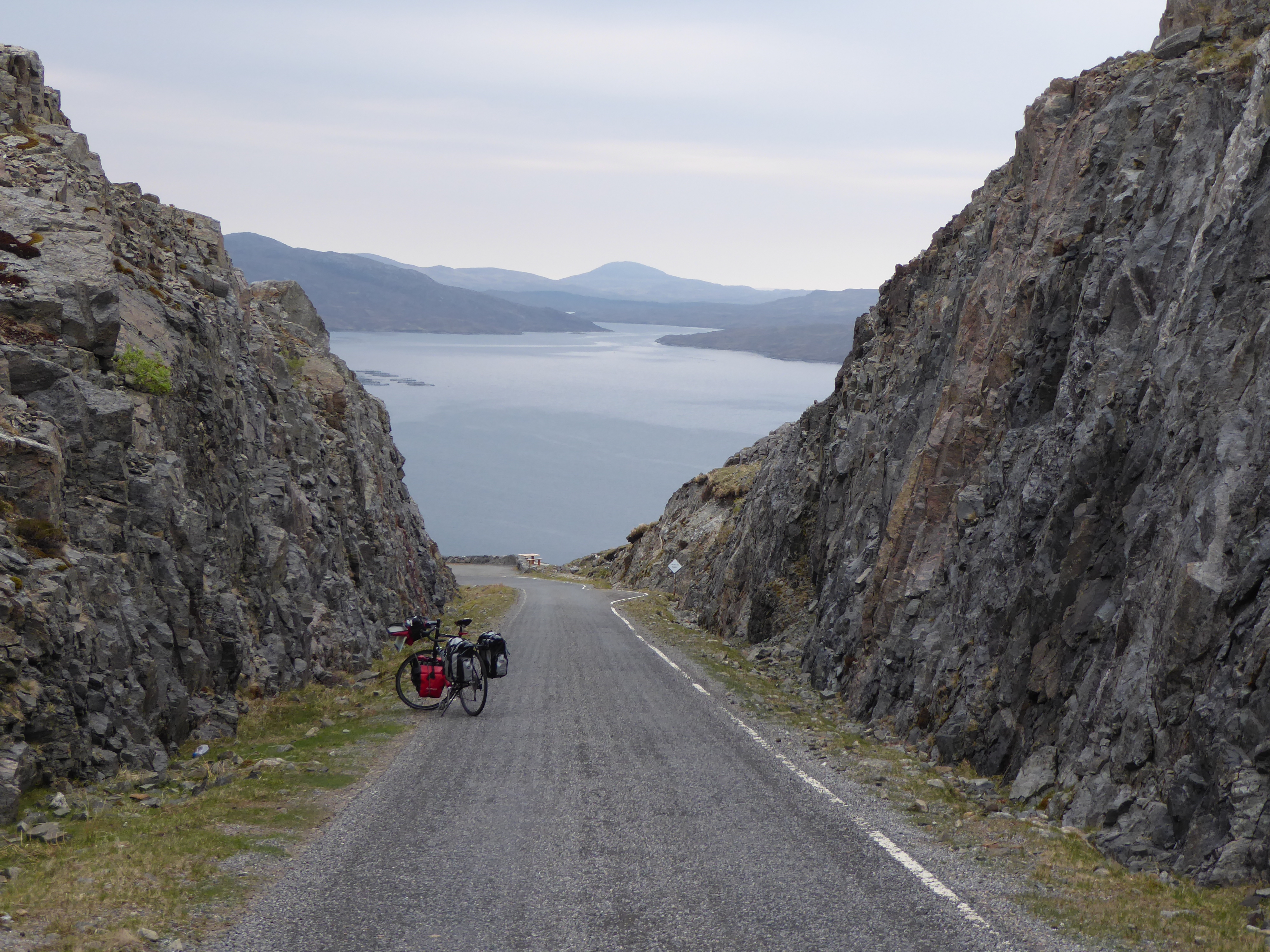
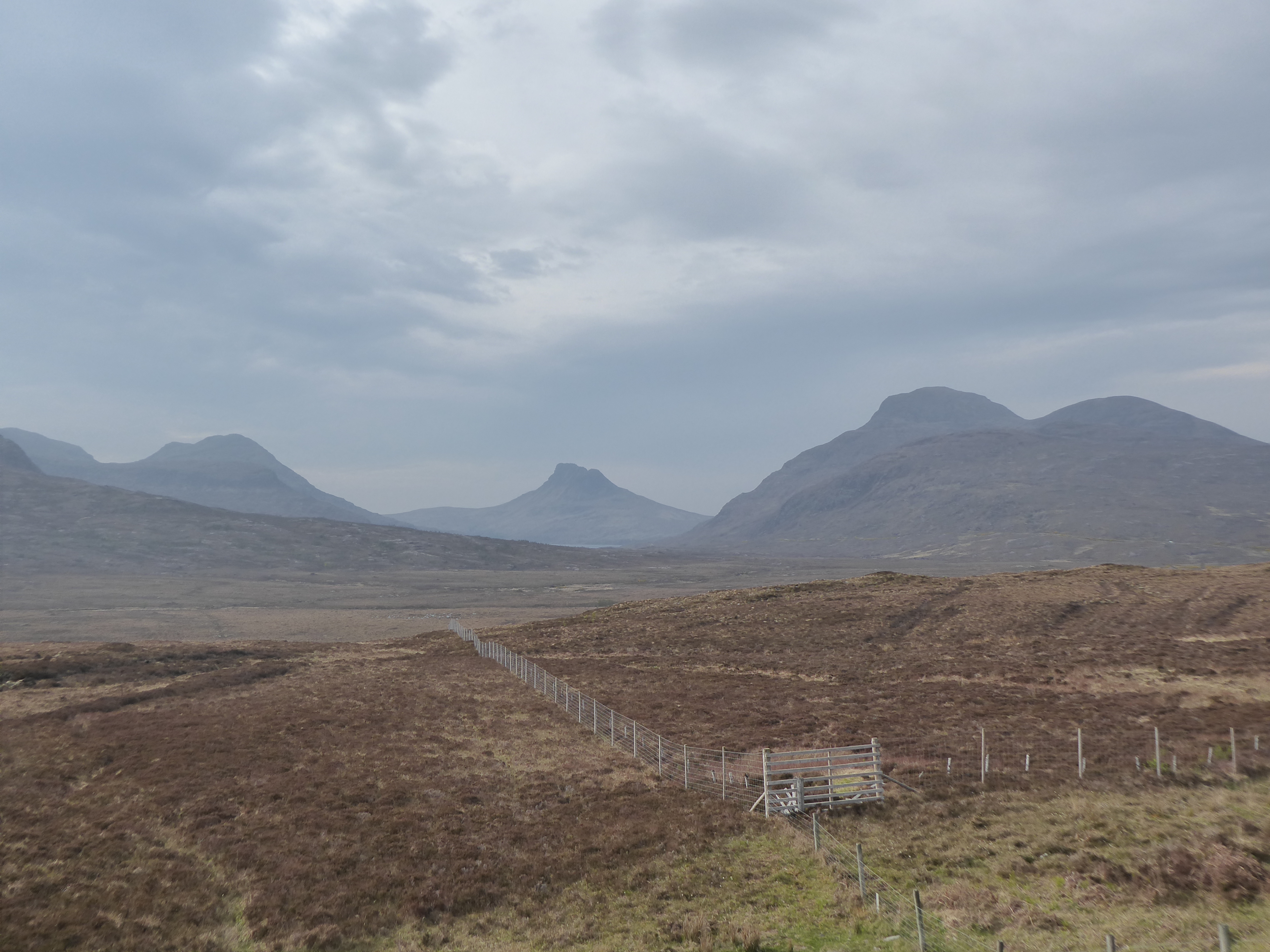
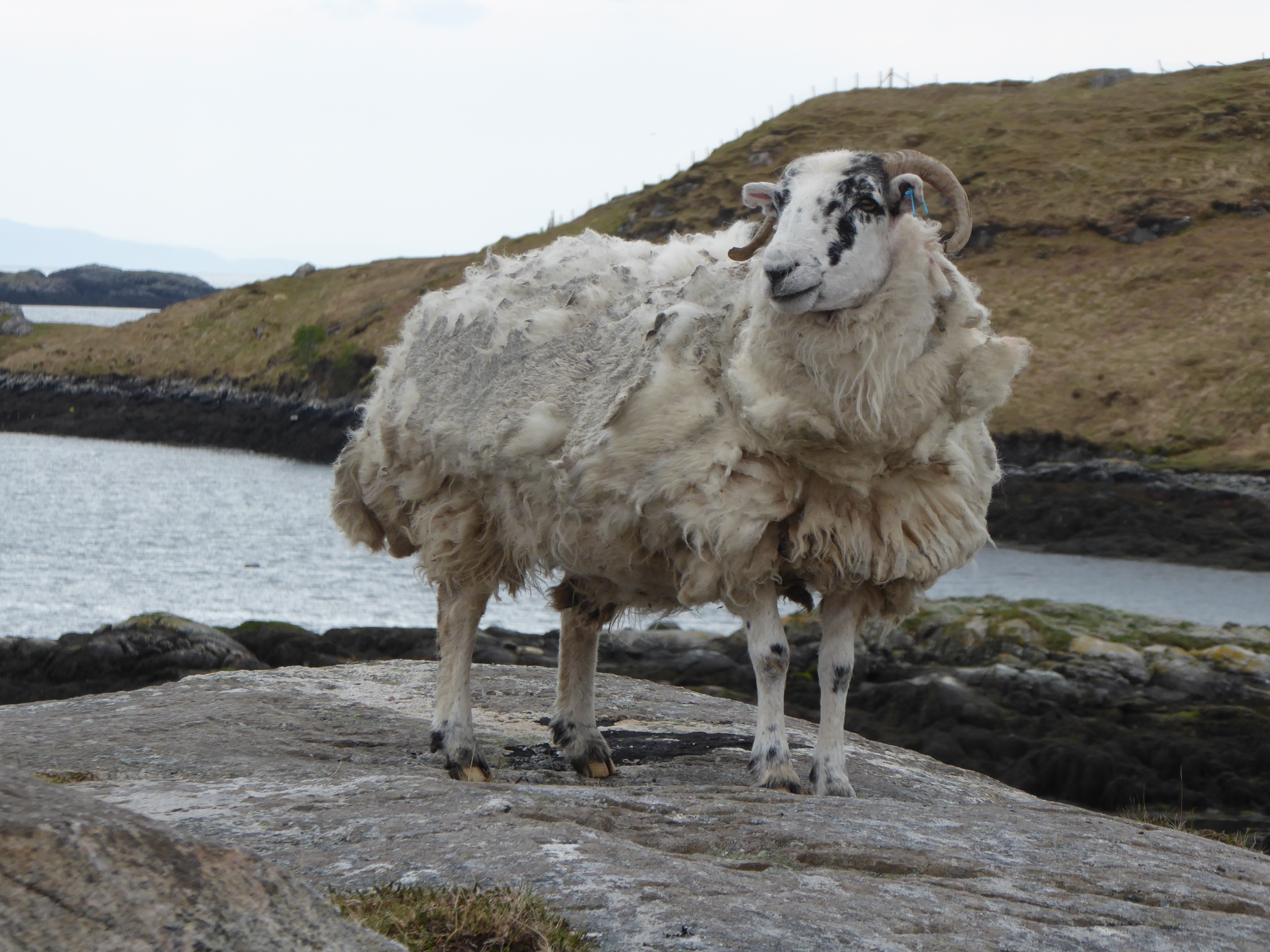
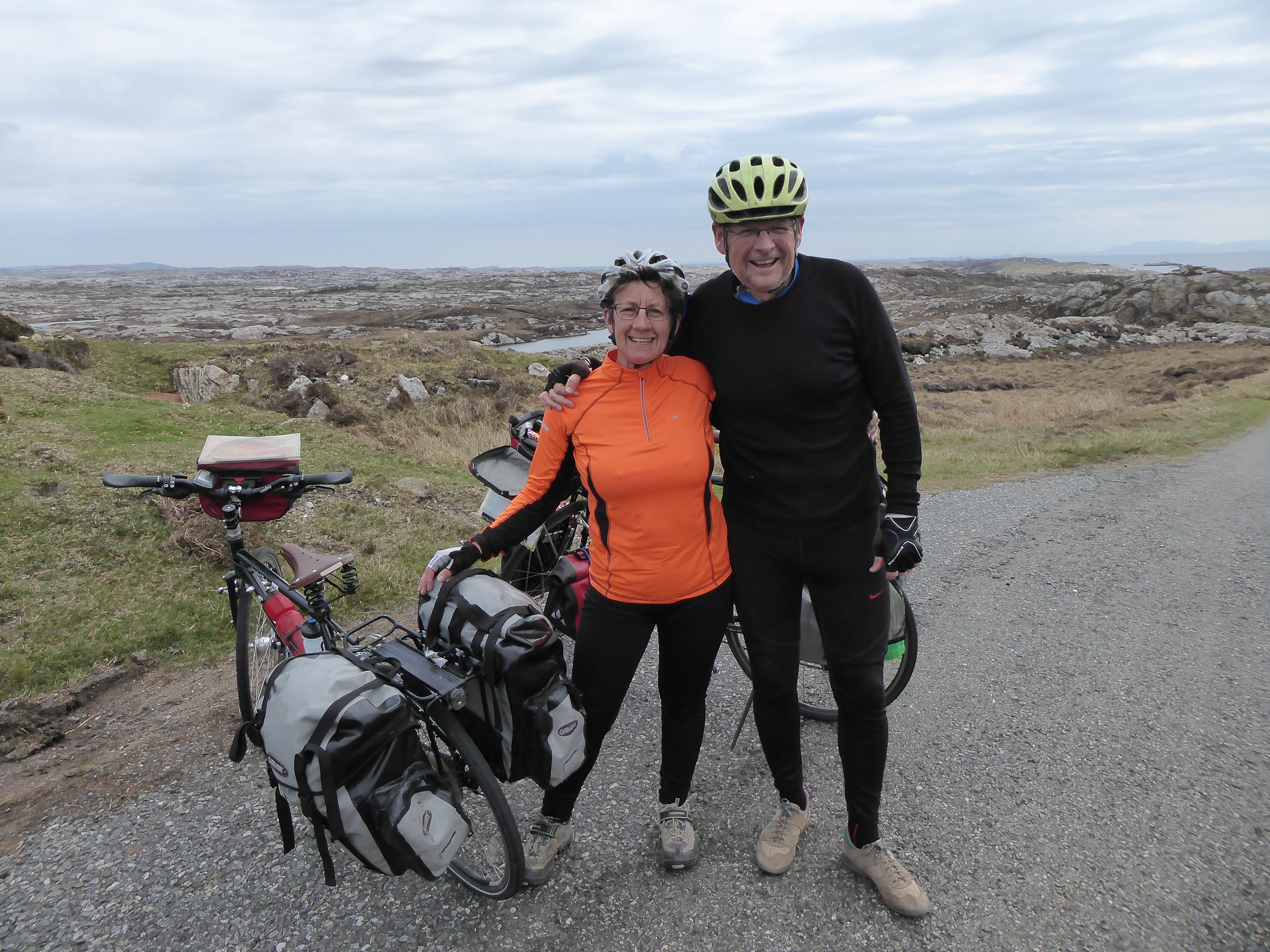
Day 12,  Braemar to Archan.  66 miles. 1100m climbing.

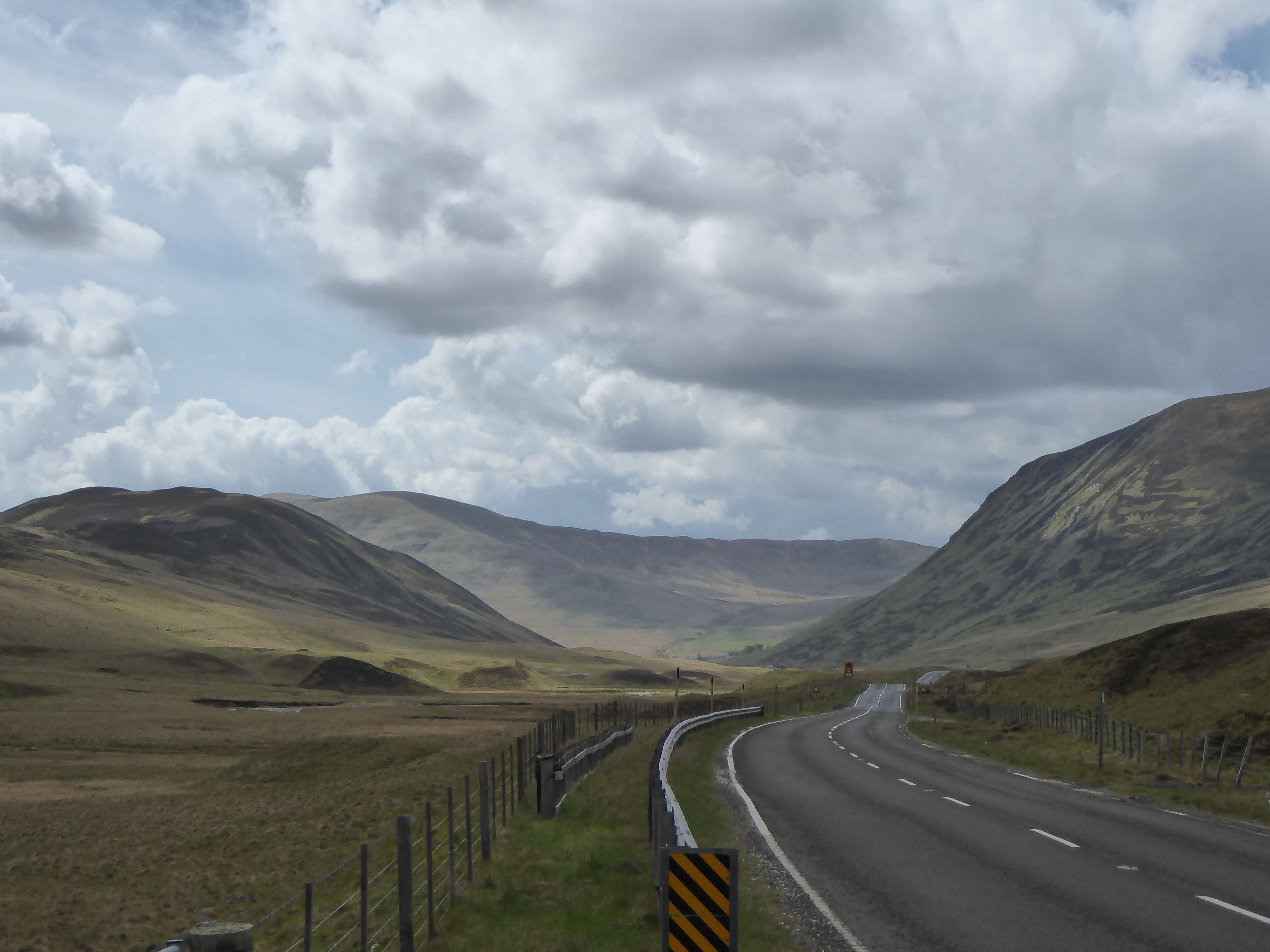
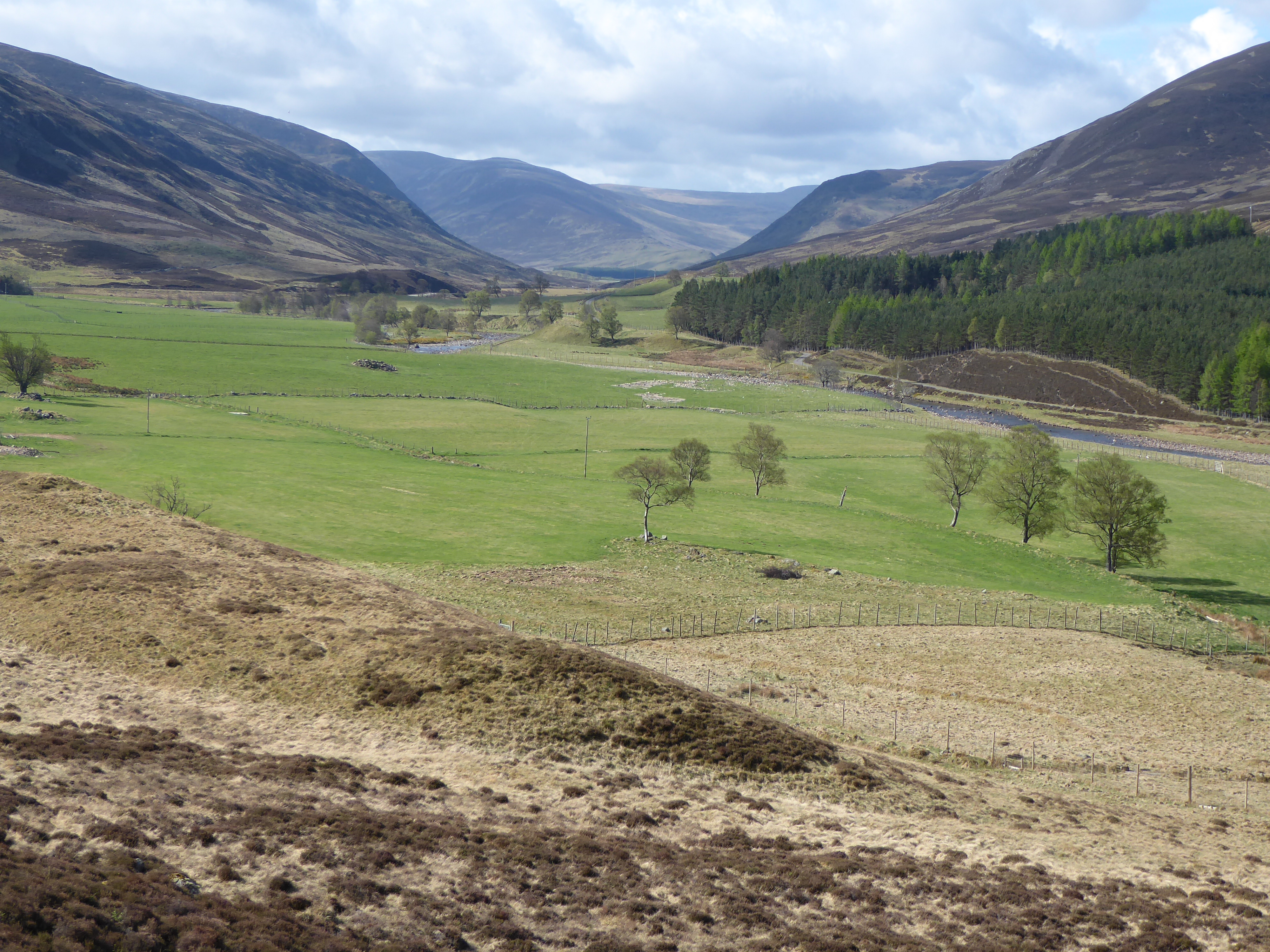
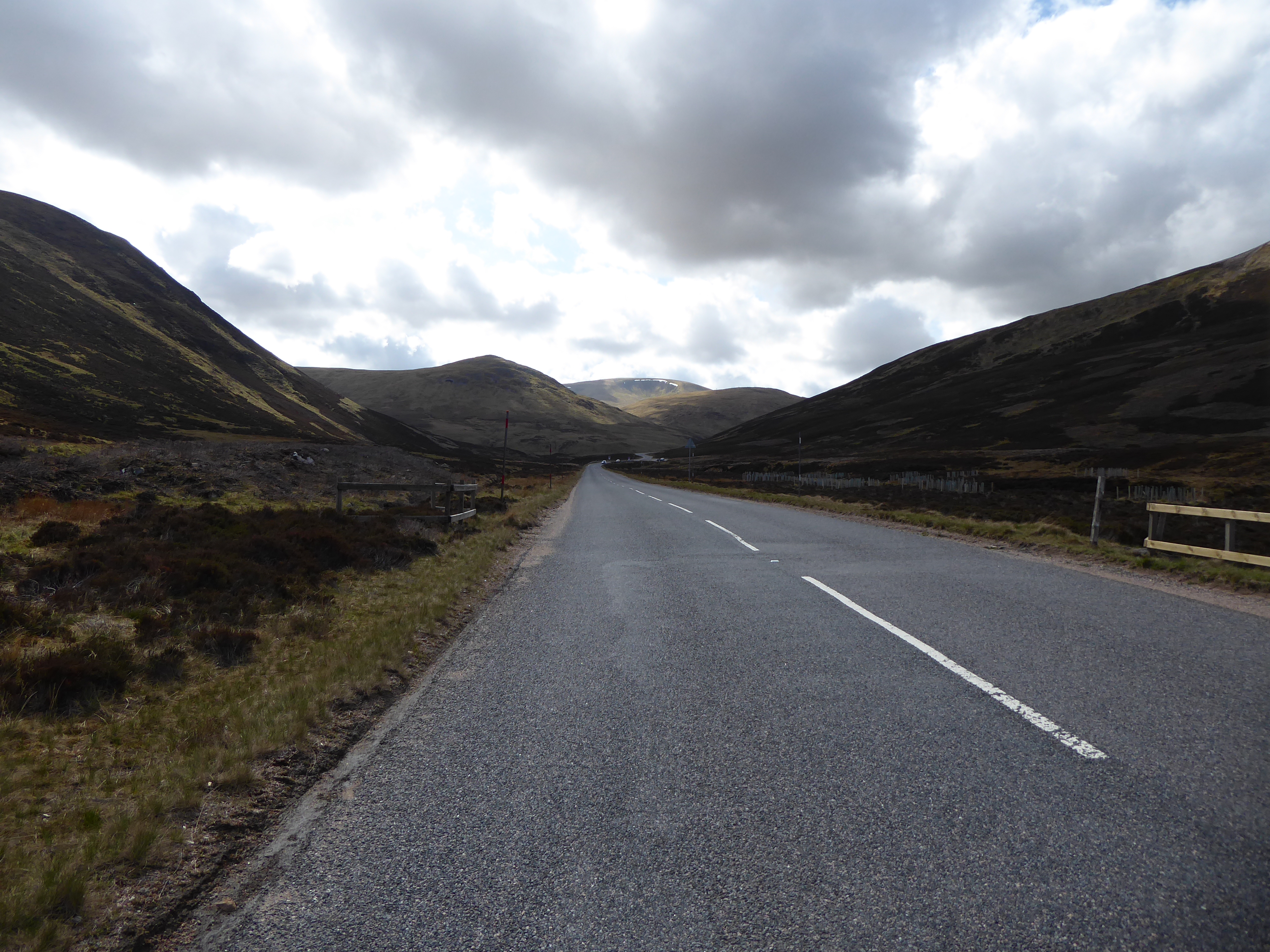
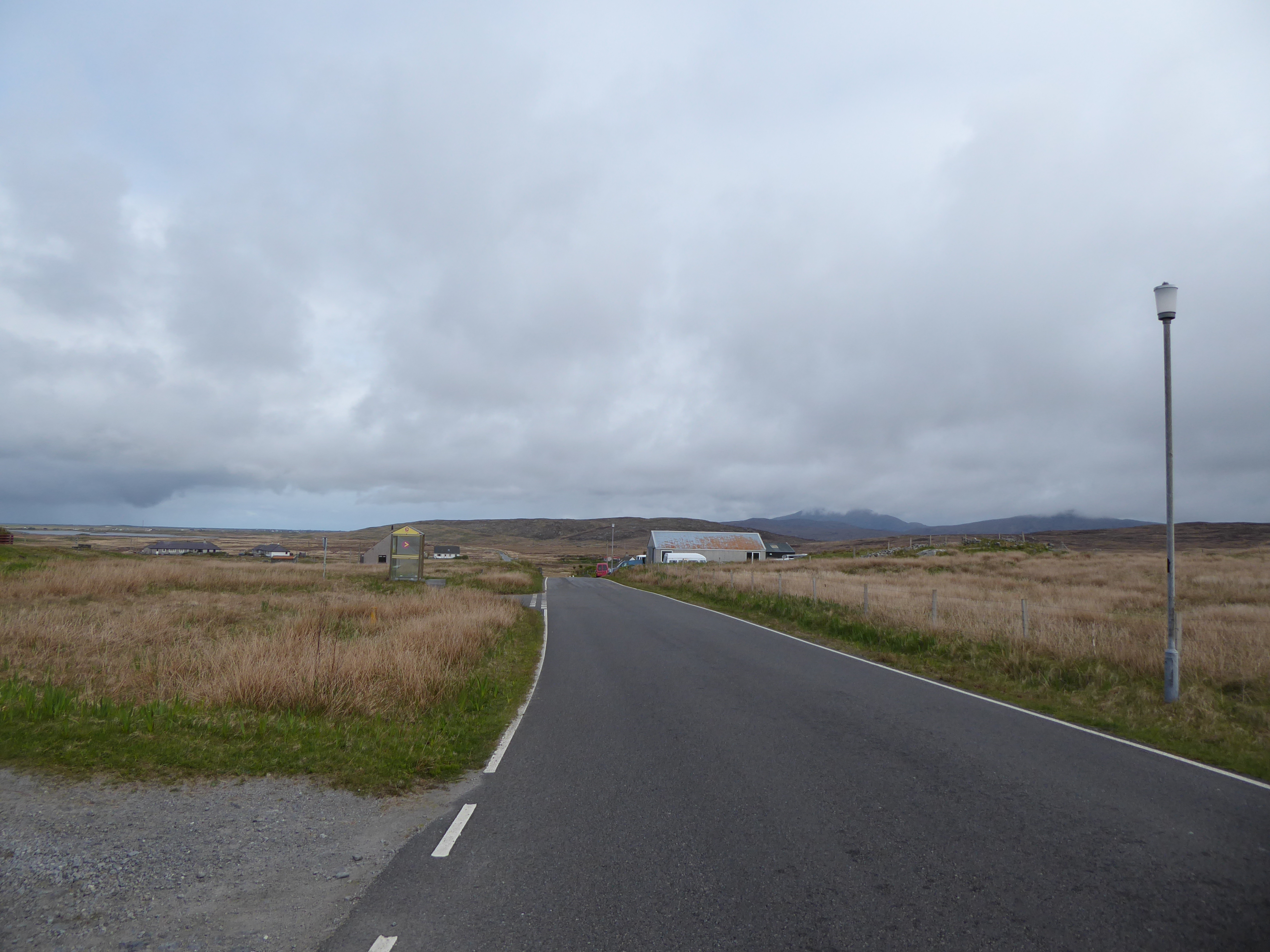
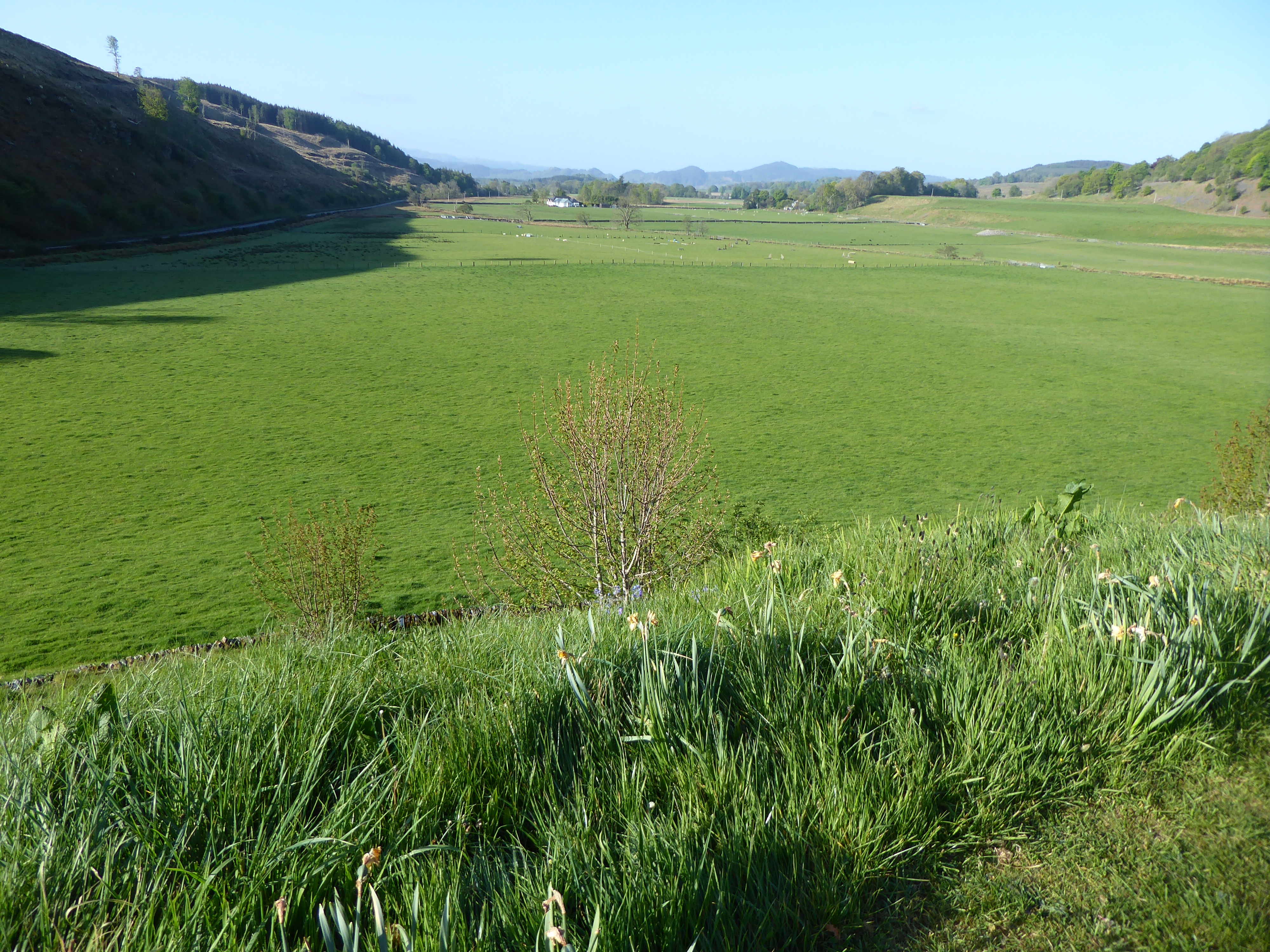
We did not rush this morning as we were expecting an easier day. We had 2 days blog to catch up in the comfortable hostel sitting room and had our breakfast in the enormous hostel kitchen.  We woke to sunshine but our hopes that the wind will have blown itself out were unfounded.   As soon as we set off we were straight into headwind. We should have had a few miles of very gentle climb before turning the corner up to  the major climb of the day to Cairnwell Pass and the Glenshee ski area.  The valley was beautiful but the headwind vicious. Again David headed the wind and I tucked in behind as close as possible. At one point I decided I really should take my turn to head the wind, but that lasted only about a minute as I was almost stationary when it the wind gusted!
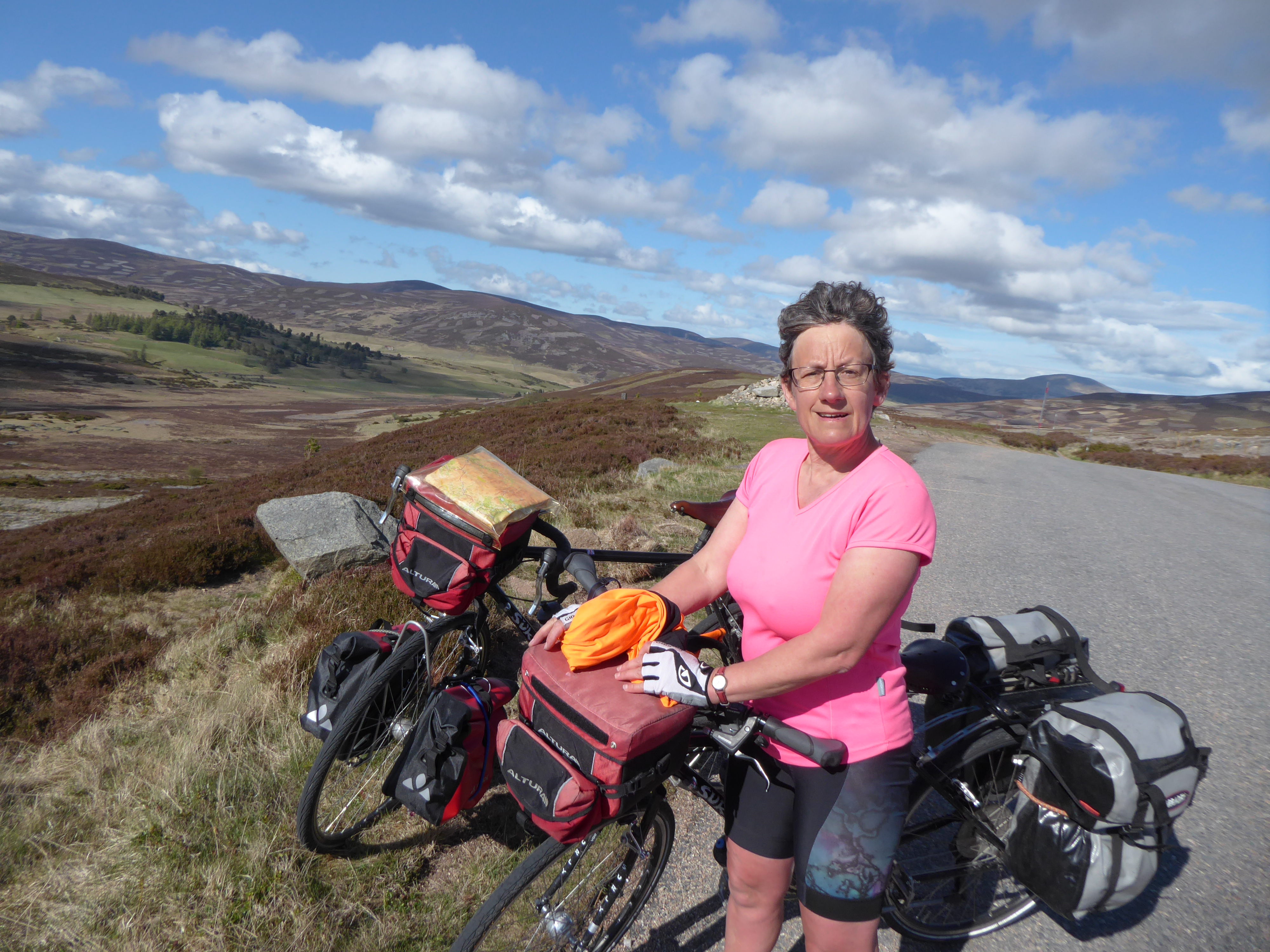
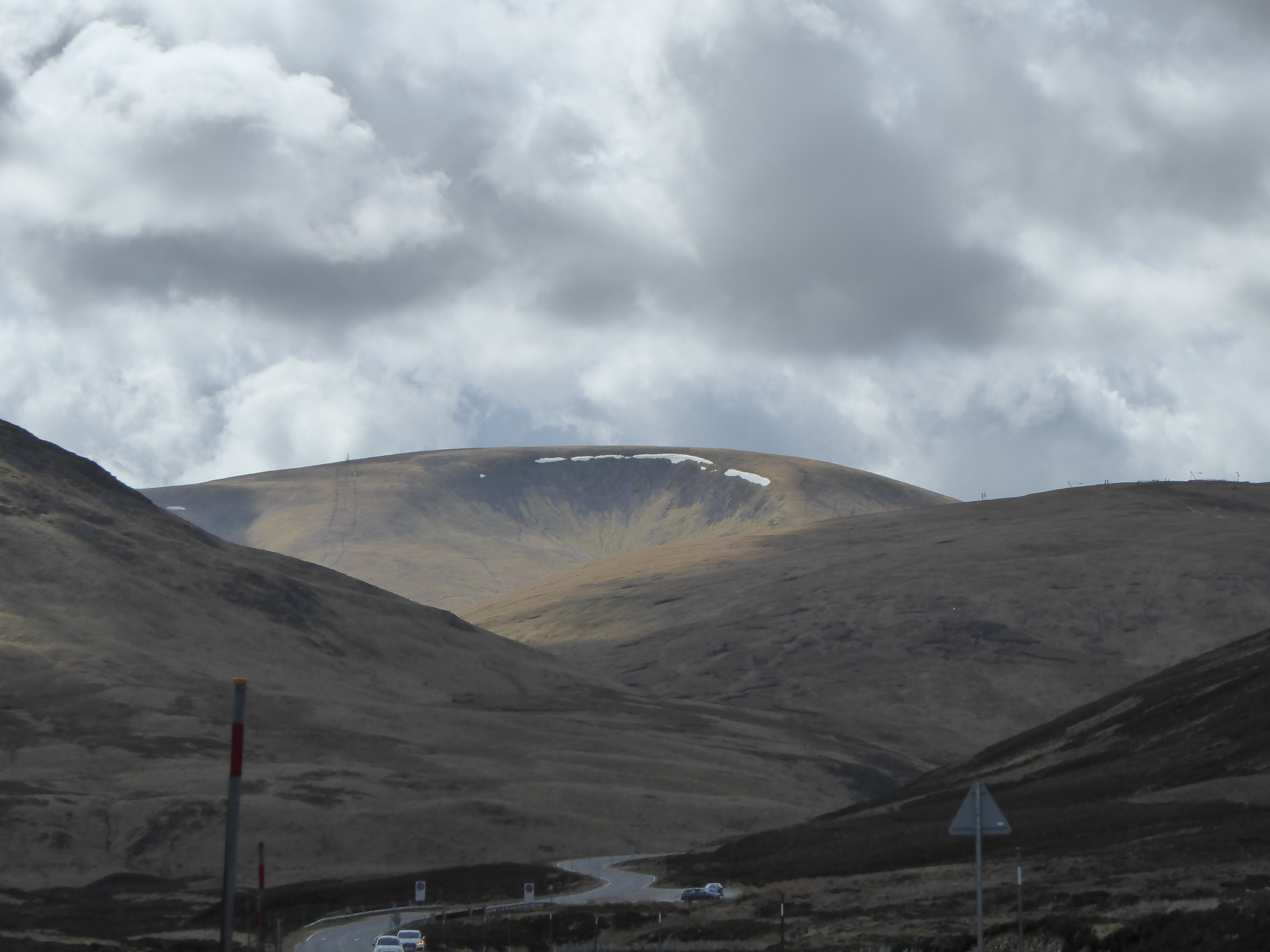
We plodded on and up, Making more progress when we were sometimes a bit more sheltered from the wind by the turn of a corner – but always knowing as soon as we turned again the wind would buffet our ears so much you could not hear cars coming behind – luckily there were few.  The fantastic scenery sustained us and then the site of the summit and a cafe where we pulled in  only 8 miles but it had taken us a hour and a half but we were at the highest road pass in the UK at 670m. 

After a reviving coffee and a rest we layered up for the down hill.  It was still a couple of hundred meters ride along the almost flat to the true summit – and after 100m we were putting on more layers and full gloves as the gale whistled over the top.  Then 2 miles straight down hill at 13%  – and I did not have to put the brakes on once as the wind gave us a very controlled descent!  Unlike yesterday the wind was head on and not buffeting us around so it was not too scary. The beautiful Glenshee valley then flattened to a gradual down hill with the wind scale downgraded to ‘windy’ rather than gale force and we could enjoy the scenery and birdlife as we meandered down, the high moorland merging into green farmland.
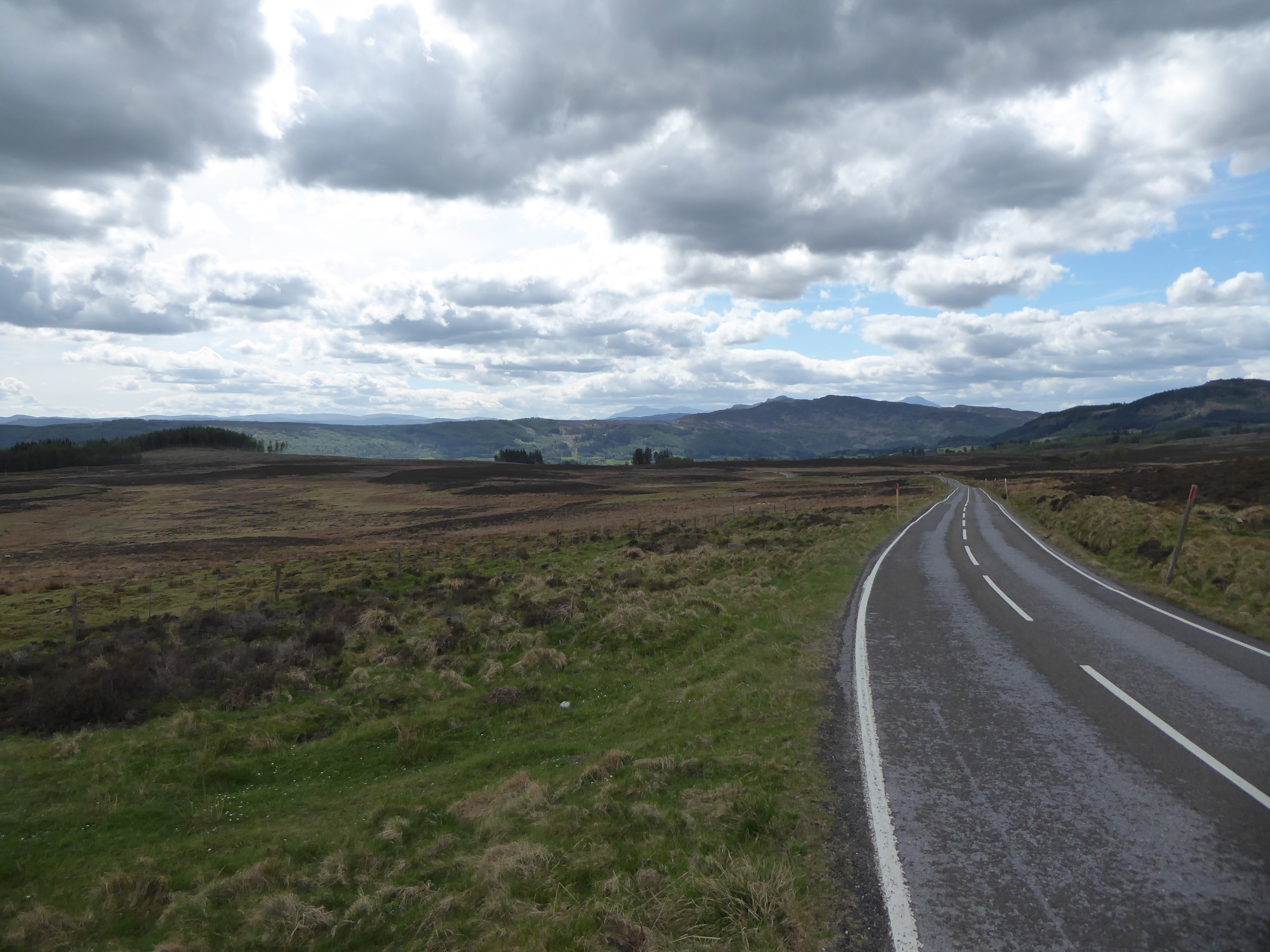
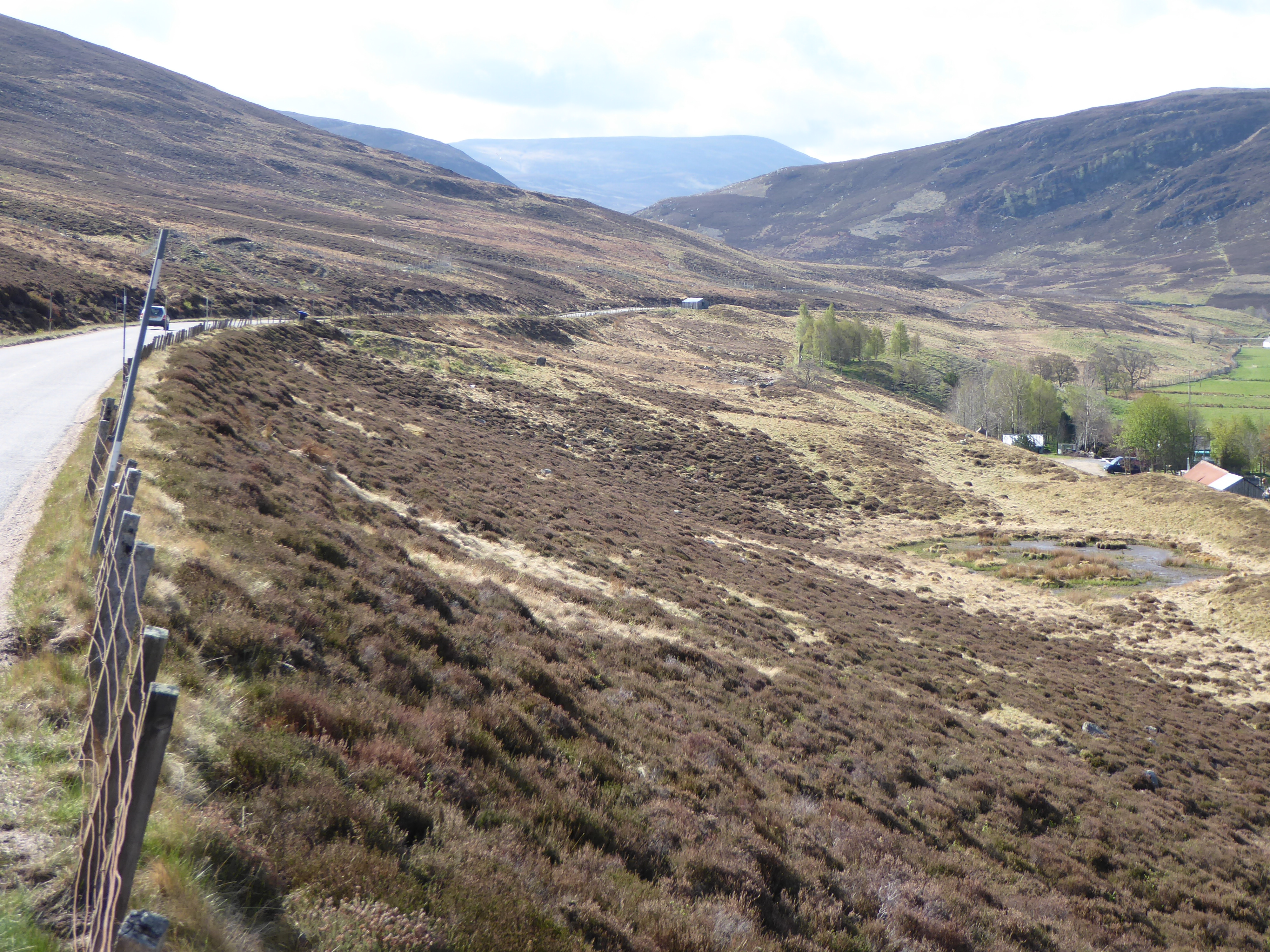
Eventually we turned out of the valley down a small side road to Pitlochry where we picnicked on someone’s convenient garden wall, in a sheltered spot.  Then on to the next ‘main road’ but again with hardly any cars.  We followed a very pretty river upstream and again the scenery quickly transitioned from farmland to moorland at about 1000ft.  We had been pleased at how we managed the big morning climb but that and the wind had taken it out of us and the climb up and over to Pitlochry, although not very high had my legs feeling very tired.  But then it was down, down, down to Pitlochry to below 100m. Time for another tea and cake stop in Pitlochry  a pleasant town invented in Victorian times when they put the railway in as a tourist destination. 
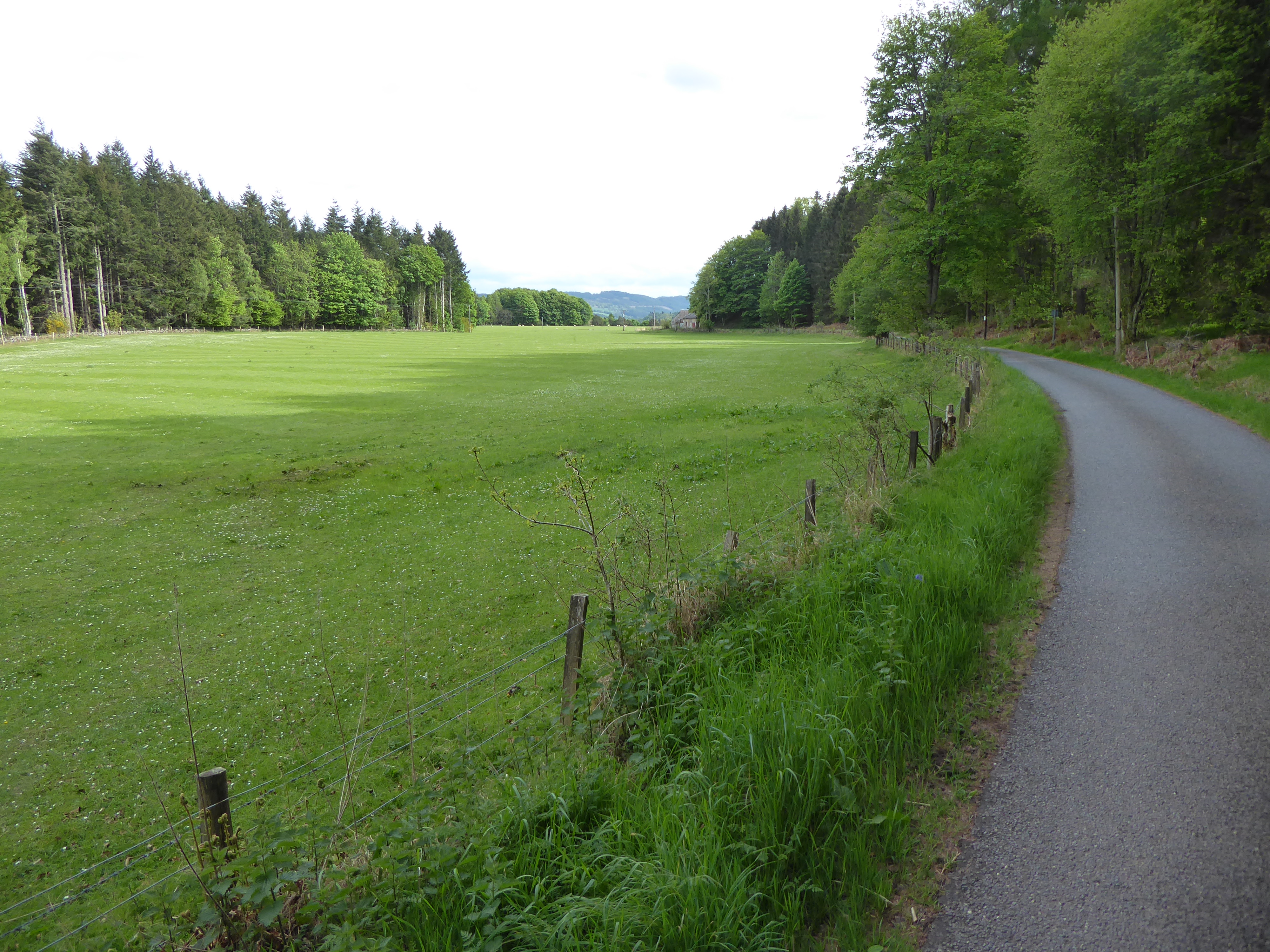
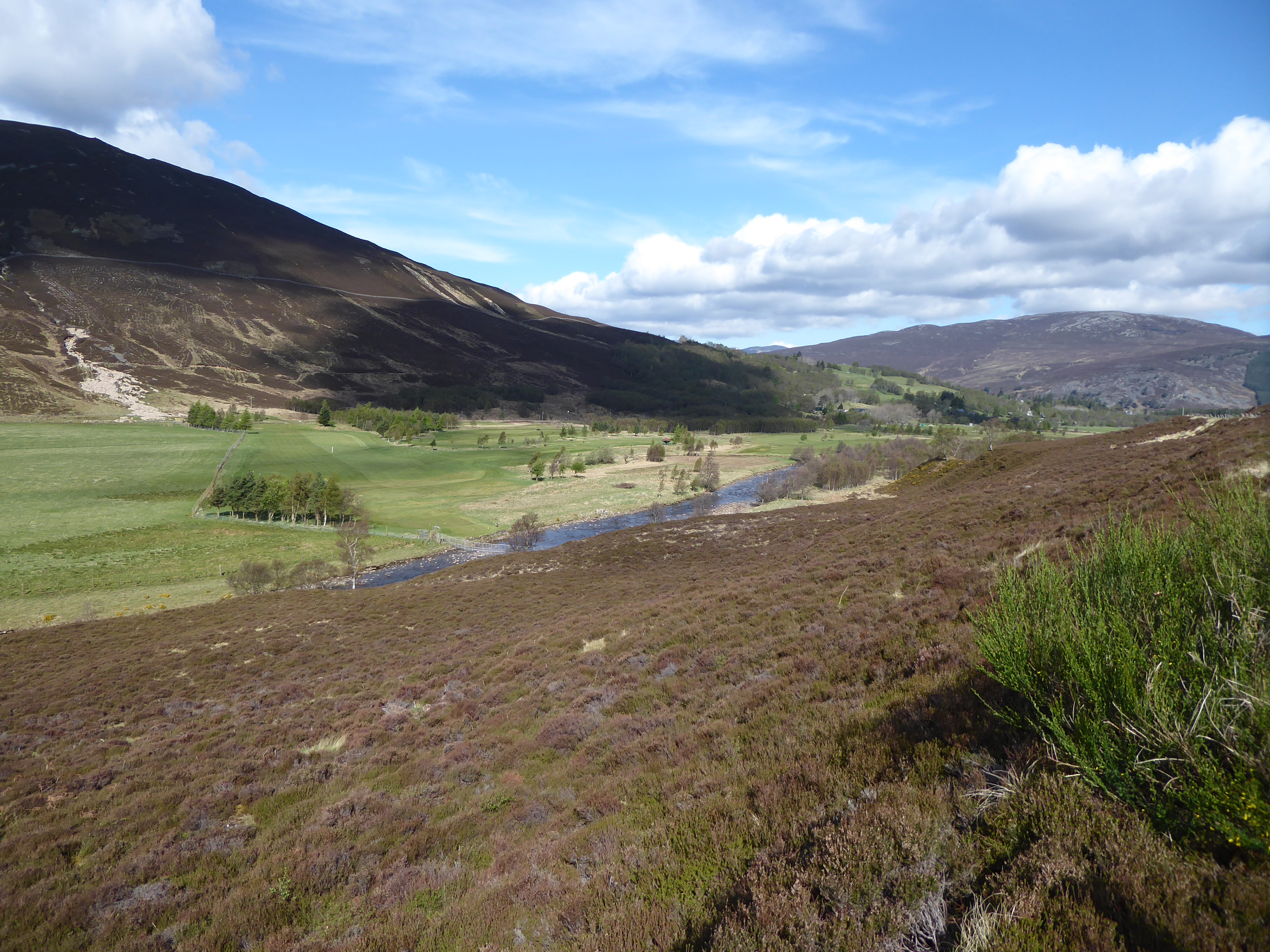
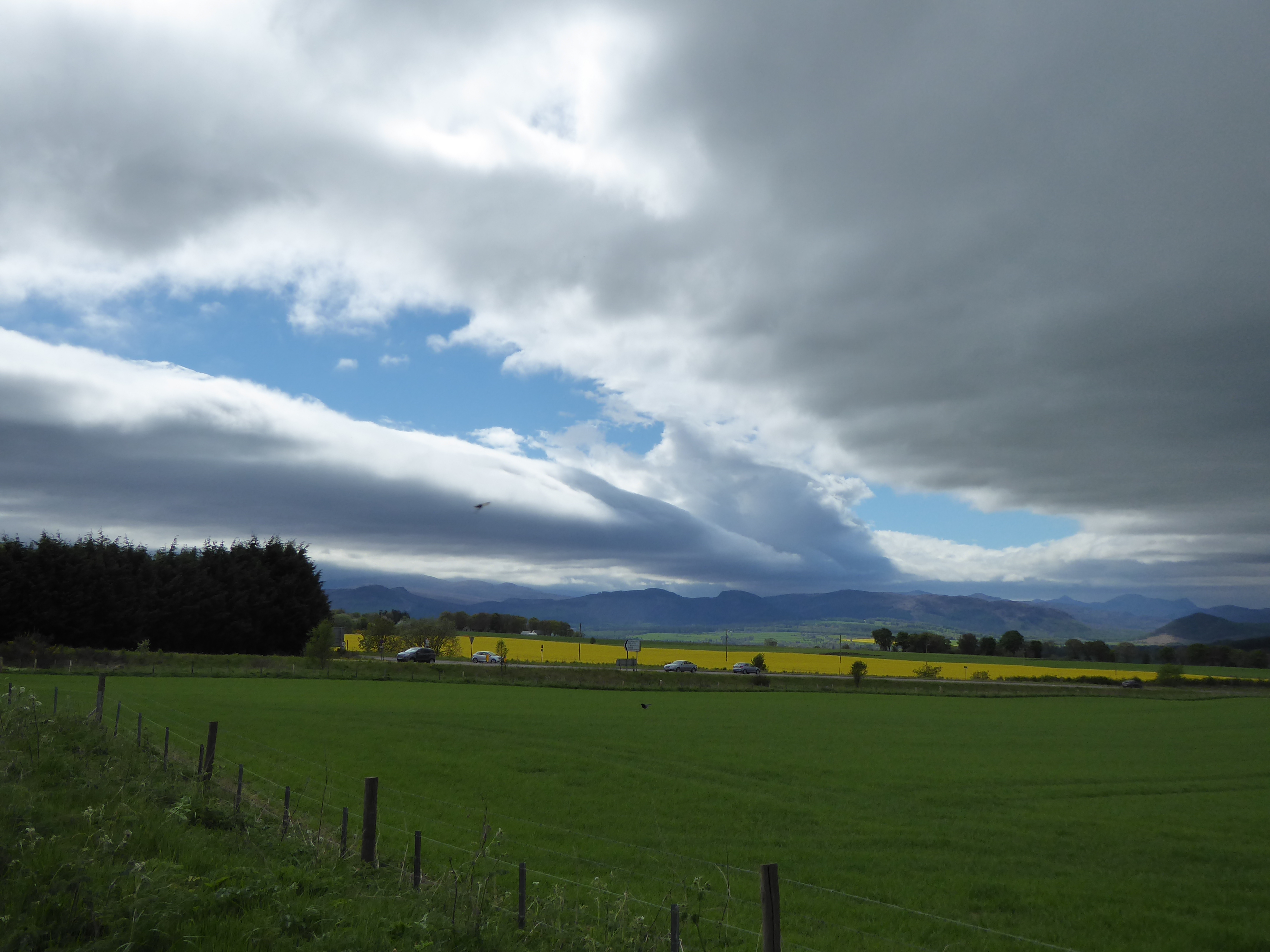
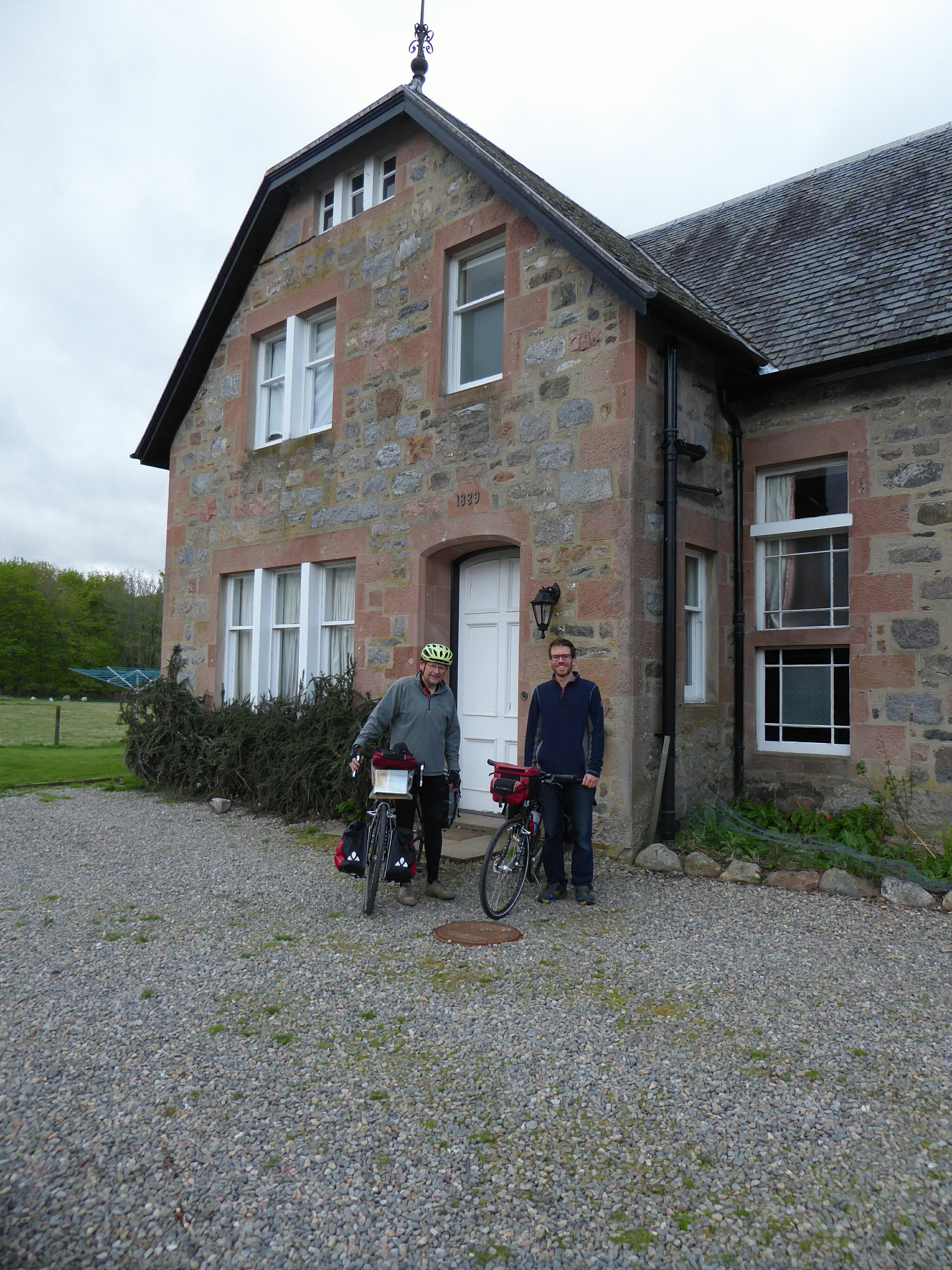
The final stage to Loch Tay took us alongside the Tummel river.  The sun was still shining and the wind now down graded to ‘breezy’, although tired legs still felt every little up and down. The banks were covered in blue bells and we were occasionally lasted with wild garlic.  We passed some enormous houses, built by the rich for their Scottish playground for hunting, shooting and fishing.  One last hill then down to Loch Tay and our airbnb with Charlotte and Adam, great hosts in a lovely old school house which we shared also with 2 sisters who were just starting a road trip to find their ancestors in Assynt, very near to where we were staying in Inchnadampf.  Crashed into bed hoping for a windless day tomorrow!
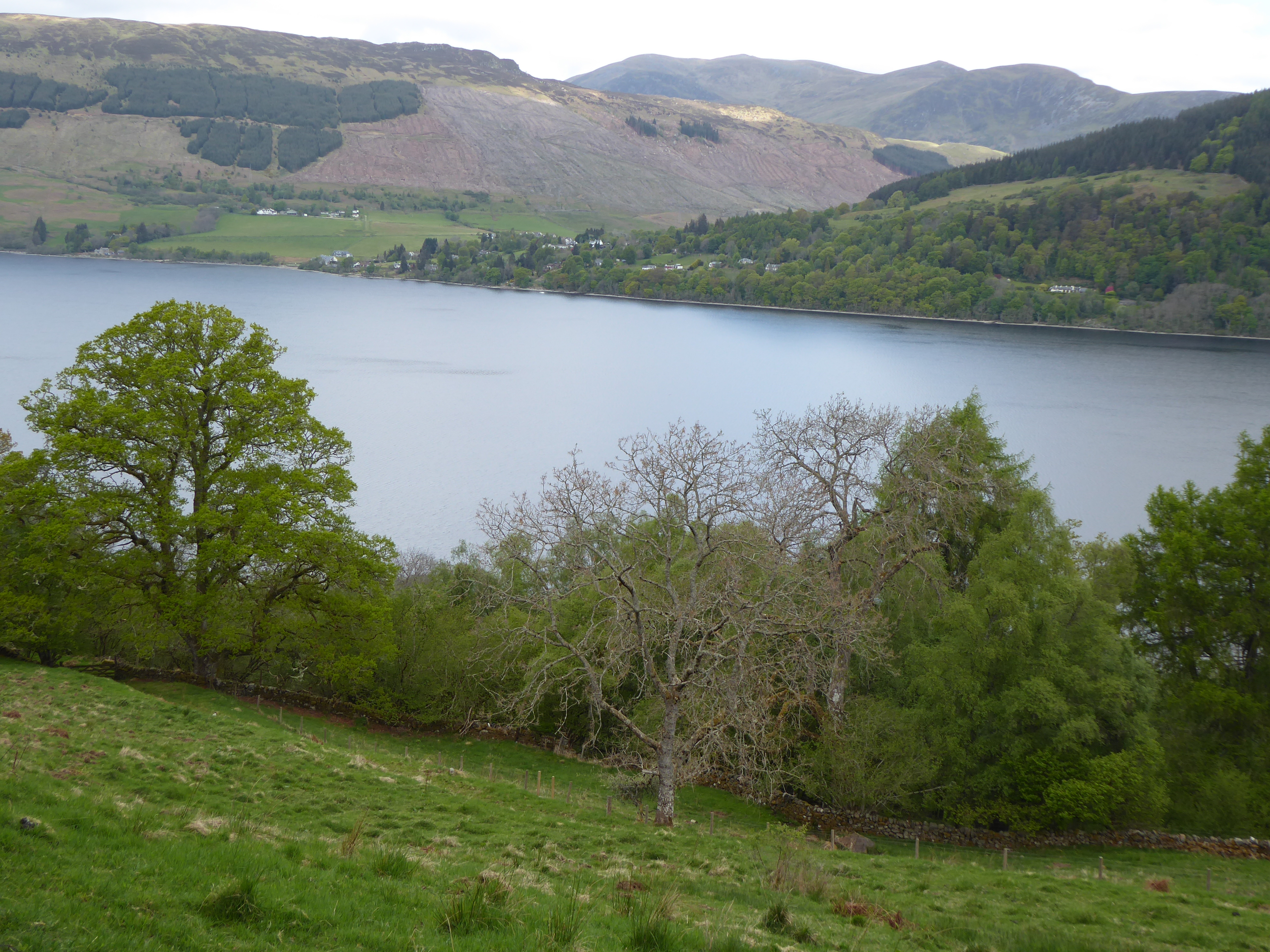
Day 11:  Moy to Braemar:  Summits, headwinds and views

Every cycling trip has a day which is “the big one”.  This was our big one – 72 miles and 1600m of climbing, topped off by the fiercest head wind I can ever recall cycling against for many years.  But it was also memorable in the best ways and for so many reasons. 
We started by being provided with breakfast by Nick and Charlotte who continued to be fantastic hosts.  Charlotte was off to work and Nick was luxuriating in a day without 10 minute appointments to see patients in his role as a GP.  We had scrambled eggs from their own chickens and chatted over tea.  When we could not put it off any longer, we said our goodbyes and left.

The first few miles followed cycle route 7.  Even though the route followed the A9, we never needed to share space with the lorries.  It was a mixture of side-roads and bike-path along the main road, gently undulating.  After about 8 miles we got to the “Slochd summit” at 405m.  Given that we had started at 270m, it was not really fair to call it a summit but it might get prizes for being the most unpronounceable place we have passed so far!  
We then descended to Cartbridge.  It did not feel that we had put in sufficient miles to justify a coffee stop so we carried along the valley to Grantown, aided by a strong South-Easterly wind.  We could see the larger hills of the Cairngorms out to the south of us, looming up in the morning light.  

We reached Grantown after 23 miles, which is a tidy, chic, Victorian feeling place.  Stone buildings dominate with the slight feel of the type of Scottishness based on country sports for the English elite which was either re-discovered or invented by the Victorians (depending on your views).  But they built fine buildings and developed a sustainable tourist industry for this remote area to supplement crofting, so it was not all bad (even if they invented lots of traditions at the same time).  We stopped at an excellent coffee shop for coffee and cake, and looked at the map for the route ahead.
My route finding skills departed me as, first, we cycling down the main street and failed to spot the Co-Op (so disguised by heritage that we missed it) and then took the wrong road out of town.  So we ended up cycling up and down the same road 4 times, looking like complete idiots.  Eventually we found the right road and dropped down to the river Spey before starting the first major climb of the day, over a 430m pass to Tomintoul.  The landscape was big – grouse moors extending for miles either side – and the odd patch of snow clinging on from the winter.  It was steep but not too bad and we plodded up.  The wind helped at times and hindered at others.  It is hard to speak of the direction of a wind in the mountains because it all depends on the topography.  It whistles around the shapes of the mountains and there are times when one feel’s it should be against us but is in our favour and, regrettable far more common, occasions when it is against us and instinctively we feel it should be a side wind or in our favour.  But it is what it is, and we just had to deal with it.
The descent from the pass was as difficult as the climb.  A 20 to 30 mph side wind threw the bikes around if we went too fast, so it was brakes on all the way down.  Then we came to the drop to Bridge of Brown, which warned of a 20% slope.  We managed it and then climbed at nearly the same gradient.  Eventually we reached Tomintoul.  This proclaimed itself to he the highest village in the UK at 345m, and also was influenced by the Sassenach pound, as it had a large hotel and a series of twee stone cottages.  We lunched in the main square and noted the wind seemed to be increasing in strength – if that was possible.  Then we re-joined the A939 to inch our way up the valley to make the climb to the Lecht ski resort.  The brown heather moorland stretched out on either side, the traffic was quiet and, although it was overcast, the rain stayed off.  The combination of the slope and the wind made it slow progress but eventually we turned a corner and saw the buildings of the ski-resort high above us.  There were a series of “arrows” on our map which indicated a steep slope.  As a rule of thumb we can manage a single arrow but have to admit defeat with a double arrow.  We had to stop and push at one point where the combination of a strong wind against us and the road, which felt nearly vertical (probably only 20%), defeated us.  But the top got nearer and nearer and eventually we made it.

There is something depressing about all ski resorts without snow.  The snow covers the ground and makes ugly buildings look less ugly, and the sight of happy skiers justifies the intrusion of large buildings on remote slopes.  But empty ski resorts and stationary ski lifts in the summer are a blot on the mountain landscape in the alps and are, even more so, in Scotland.  It was, of course, closed!  We could not even get a cup of tea to celebrate climbing to 2090ft (that is about 640m)!  Then, a few minutes later, we topped another rise, lost the sight of the resort and the Cairngorms spread themselves out before us looking fantastic.  
The descent was hairy – strong side winds made it tricky but we managed it, as well as a steep descent down to the interestingly named, Cock Bridge.  The, joy or joys, we had the wind in our favour as we sped down a gentle hill towards Colnabaichin (properly spelt I assure you but equally improperly pronounced).  Before then a tea and cake stop emerged like a mirage.  “Two mugs of tea please” we said.  “You look like you need cake too came the response” from the young chap who in charge of the mirage. 

Refreshed we tackled the next climb which was “only” another 150m, but did have an arrow which seemed to extend for a long section.  By now our legs were starting to answer back.  There was a famous Dutch Cyclist whose catch phrase was “shut up legs”, as he answered back as his legs complained. We knew a little of what he felt.  But the scenery was again stunning and we then had a lovely descent towards Ballater.  But the road to our destination, Braemar, turned off before reaching Ballater and so we climbed our final 150m climb of the day.  By this time we were directly into the  wind and it was unrelenting.  Sorry to go on about the blessed wind so much but a 25 mph headwind makes going on the flat feel like going seriously uphill.  
Going up a 13% slope with a 25 mph headwind is a young person’s game.  It is not recommended for normally sedentary workers in their 50s and we felt the folly of our choices.  But the hostel was in Braemar and we had to get over the hill to get there.   The compensation was more remote grouse moor, lovely shaped hills and the feeling of remoteness.

The descent took us into trees and so the wind dropped, and it led us to Balmoral Castle.  This was a key part of the Victorian recreation of the myth of a romantic Scotland, and work started on the castle in 1852.  Having not had an invitation to drop in for tea (no doubt it got lost in the post) we did not drop in but turned East to battle up the Dee Valley for the last 9 miles to Braemar.  We made it – not without a few stops and probably did not appreciate the beauties of late afternoon sun in the valley.  

We arrived at 6.30pm, having been on the bikes since 8.15am with a series of relatively short stops, having covered 72 miles and climbed 1640m.  We normally think 1000m shows a “big hill” day and aim to limit ourselves to about 60 miles.
 It was an astonishing day even if it left us without a great deal of conversation for each other at dinner.  The body is an amazing machine.  We had started the trip out of condition due to injuries but had build up fitness through the previous week.  The only question was how we would feel facing another day on the bikes tomorrow!
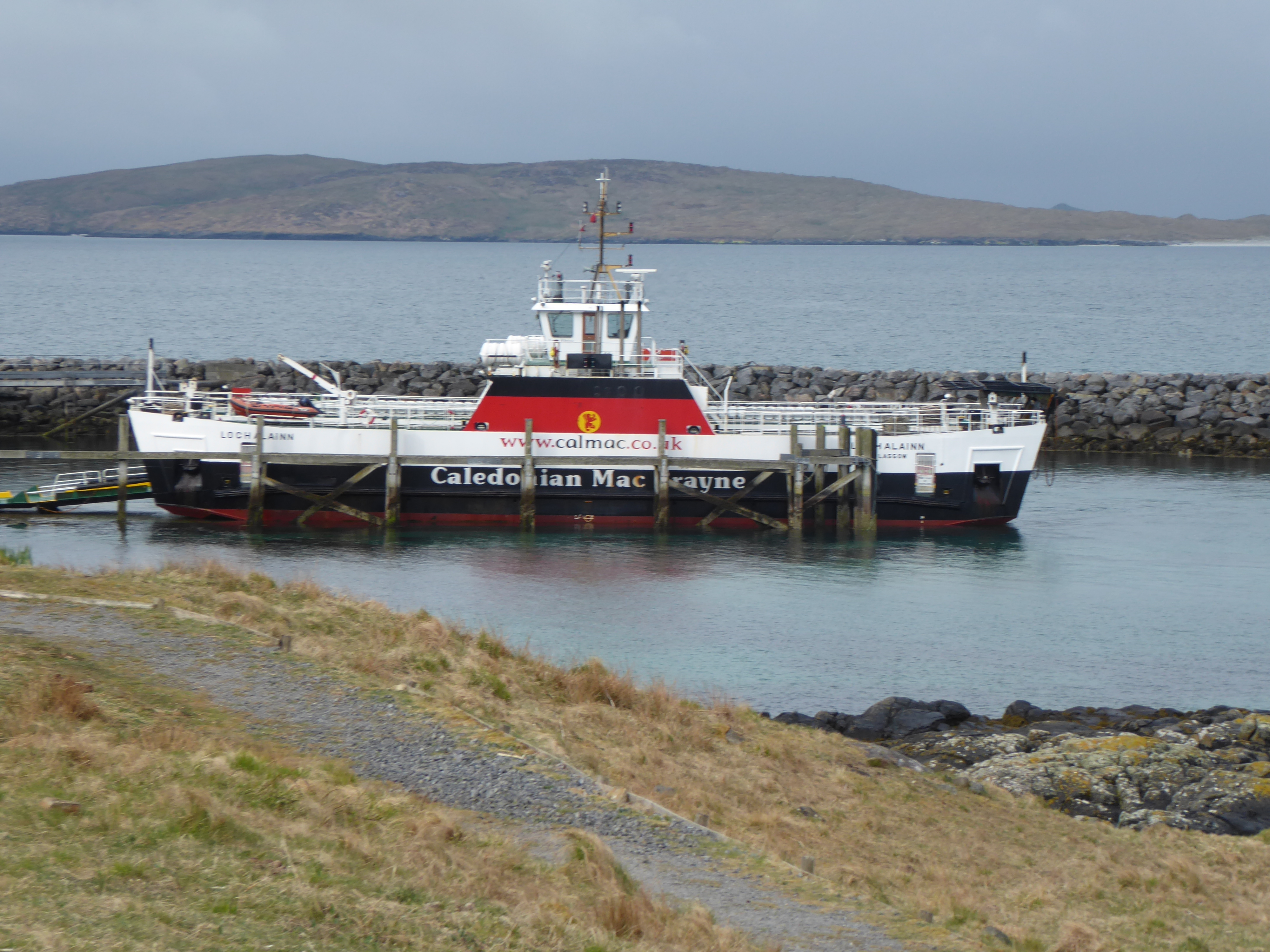
​Day 10:  Tain to Moy : 58 miles

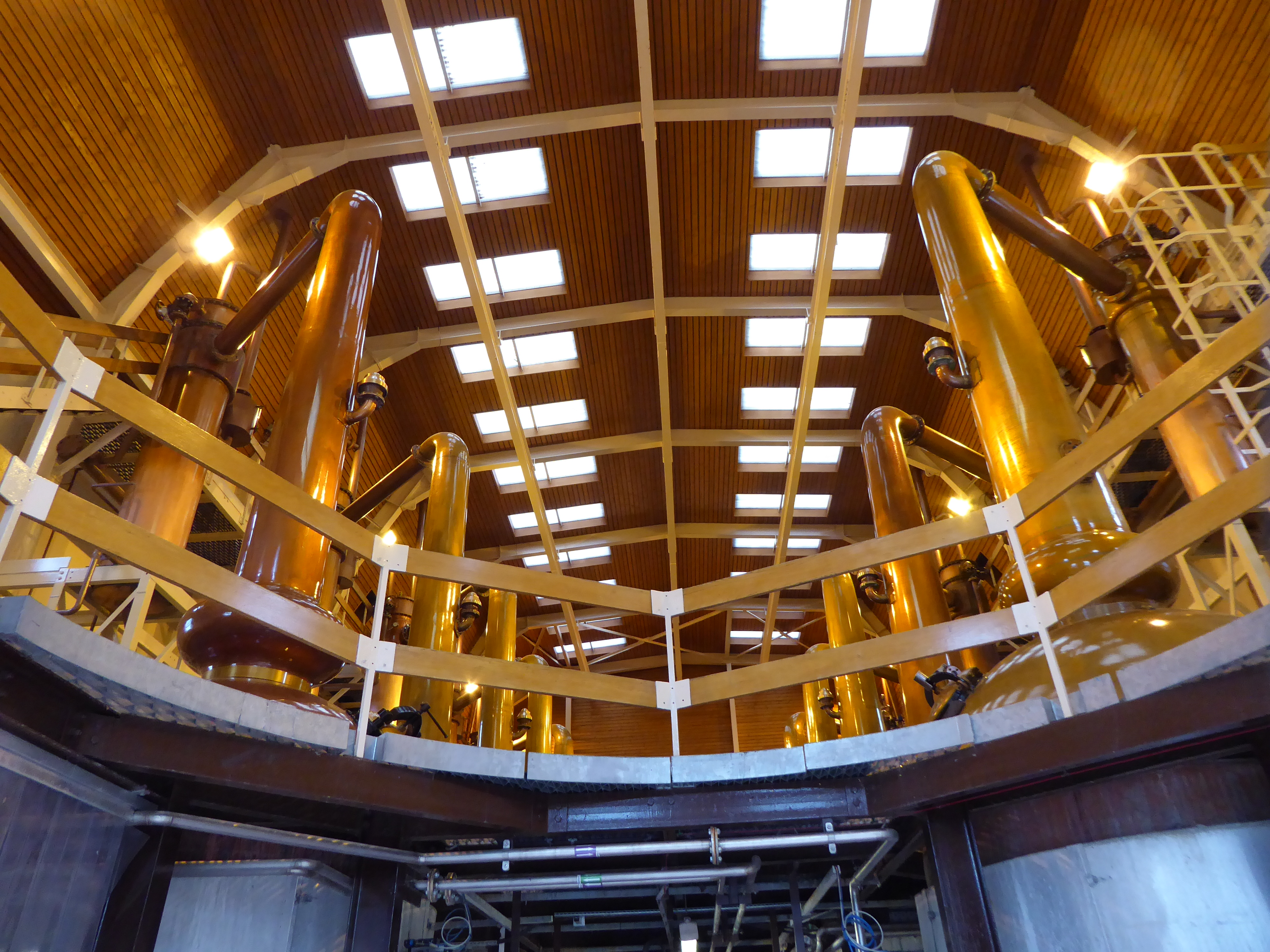
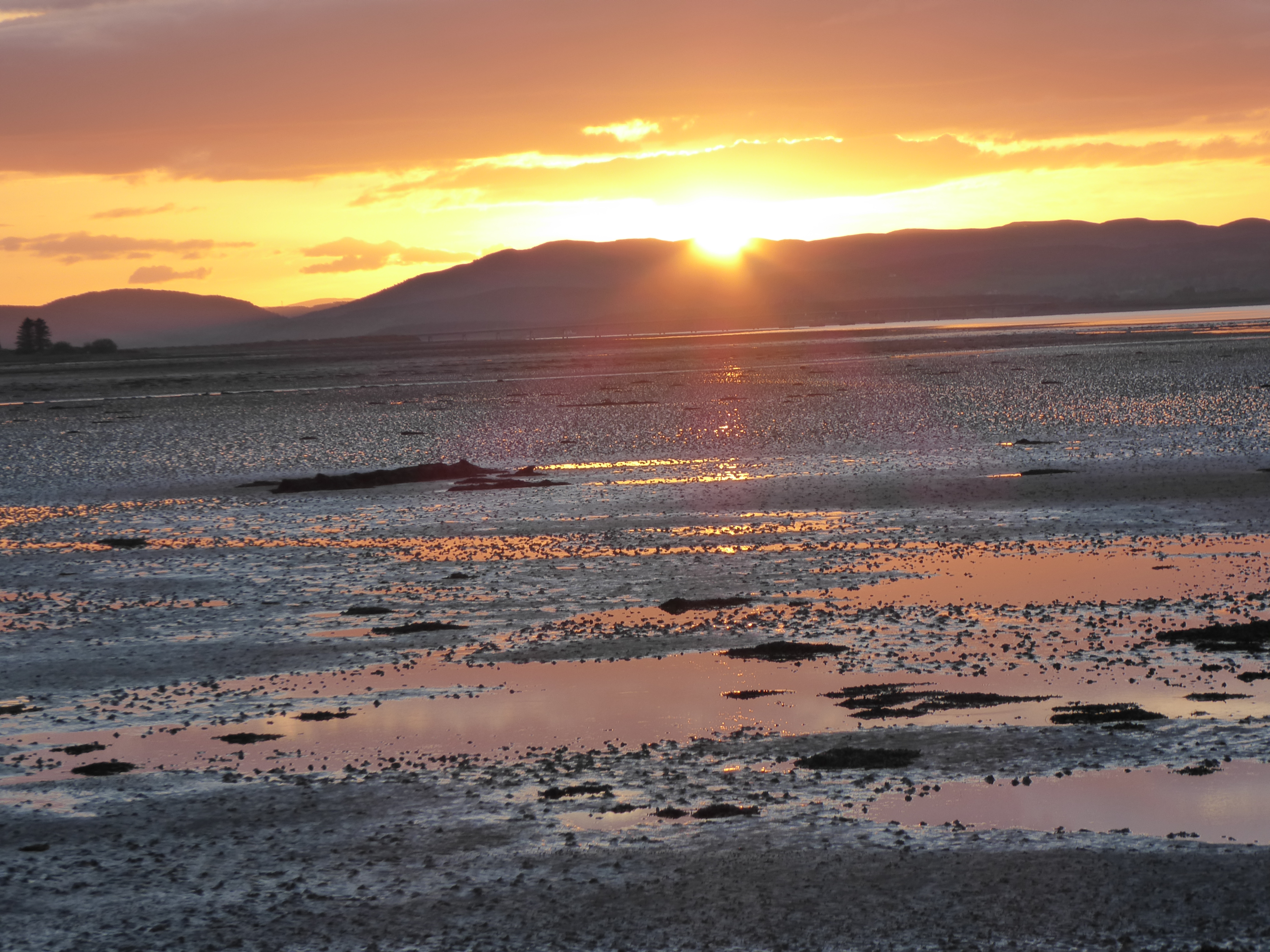
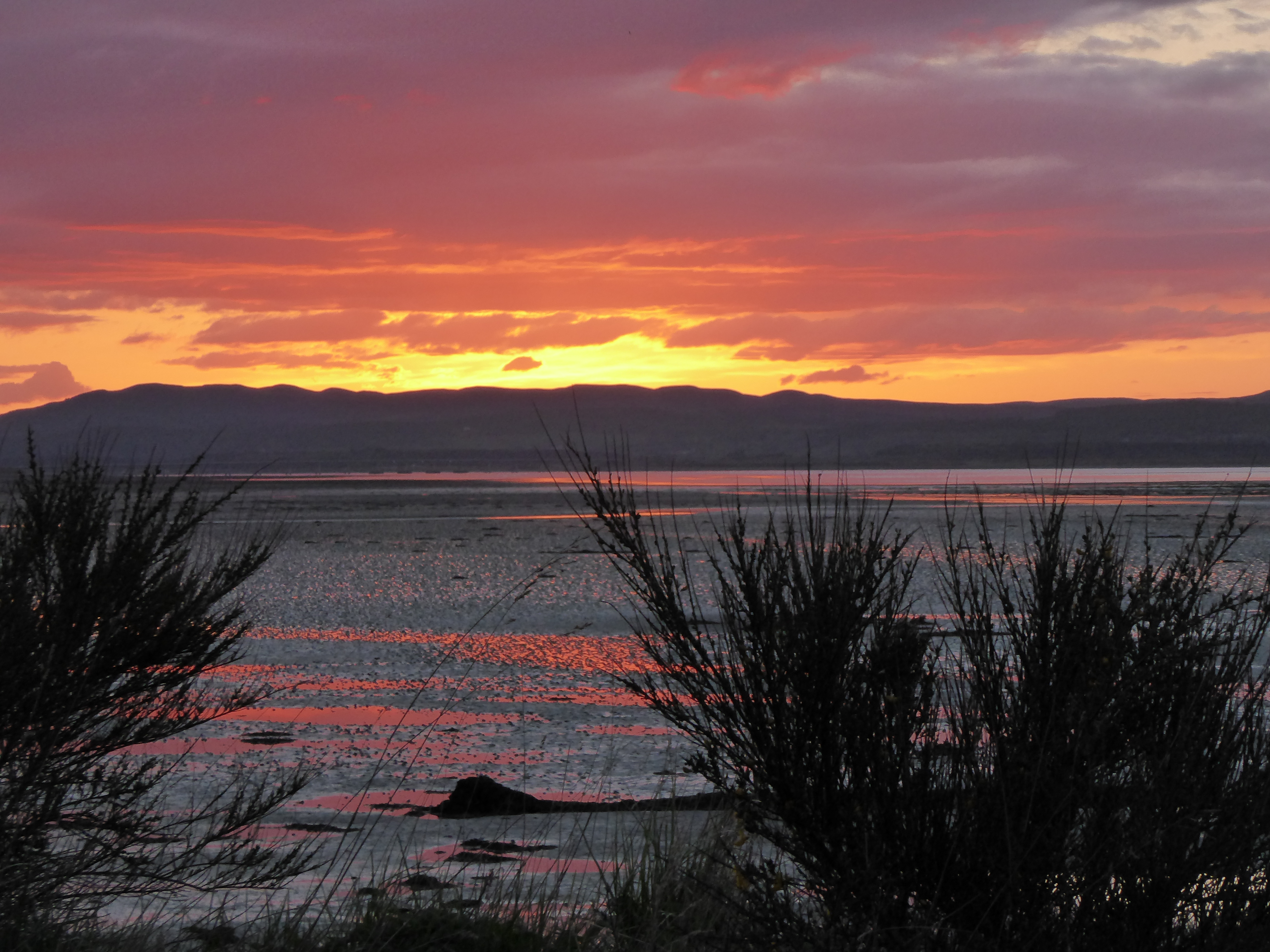
We had been treated to a wonderful sunset – the yellows, oranges, reds and purples reflected in the mud flats of the Dornoch Firth at low tide.  This morning though we woke to drizzle and cloud. We were planning a late start at we were not wanting to arrive at our destination before 7 so we had a lazy breakfast then pedalled (without panniers) the couple of miles to the Glenmorangie distillery for a guided tour.  The first thing we learnt was that we southerners had been pronouncing the famous whiskey name incorrectly all these years.  Its Glen – morangie, rhyming with orangie!  We set off with a mixed international group round the distillery process.  
The ‘malt’ of malt whiskey is the process of allowing the barley to start germinating before drying (this process is now done off site), it is then ground coarsely to make ‘grist’ (presumably the source of the saying ‘grist to the mill’. The grist is ‘mashed’ then the outflow is stirred with the yeast – all in gleaming vats and very technically regulated.  Then the actual distilling (they proudly have the tallest stills in Scotland) and finally the aging in oak casks – this is in ex bourbon casks sent over from the USA where regulation only allows them to be used once).  The distillers are called the ‘men of Tain’ and to date there have been no ‘women of Tain’.  In all the distillery only employs 23 people but it exports this symbol of Scotland all over the world. Many of our fellow tour folk were off to their next distillery tour but I think seeing the process once was enough!  Having sipped our small dram at the end of the tour (11am a bit early for whiskey) we cycled back through the drizzle and packed up for departure. 
The rain had stopped by the time we left but there was a strong wind but this eased as we took the side road inland to avoid the manic A9.  This pleasant road took us through woods and fields, showcasing the fertile land with it’s relatively temperate climate.  A long gentle up hill gave us views over the Cromarty Firth followed by a more precipitous descent into Dingwall.  There we found a bike shop to pump up our tyres with a hand pump and a pleasant picnic spot on the shores of the firth – with our first few midges.

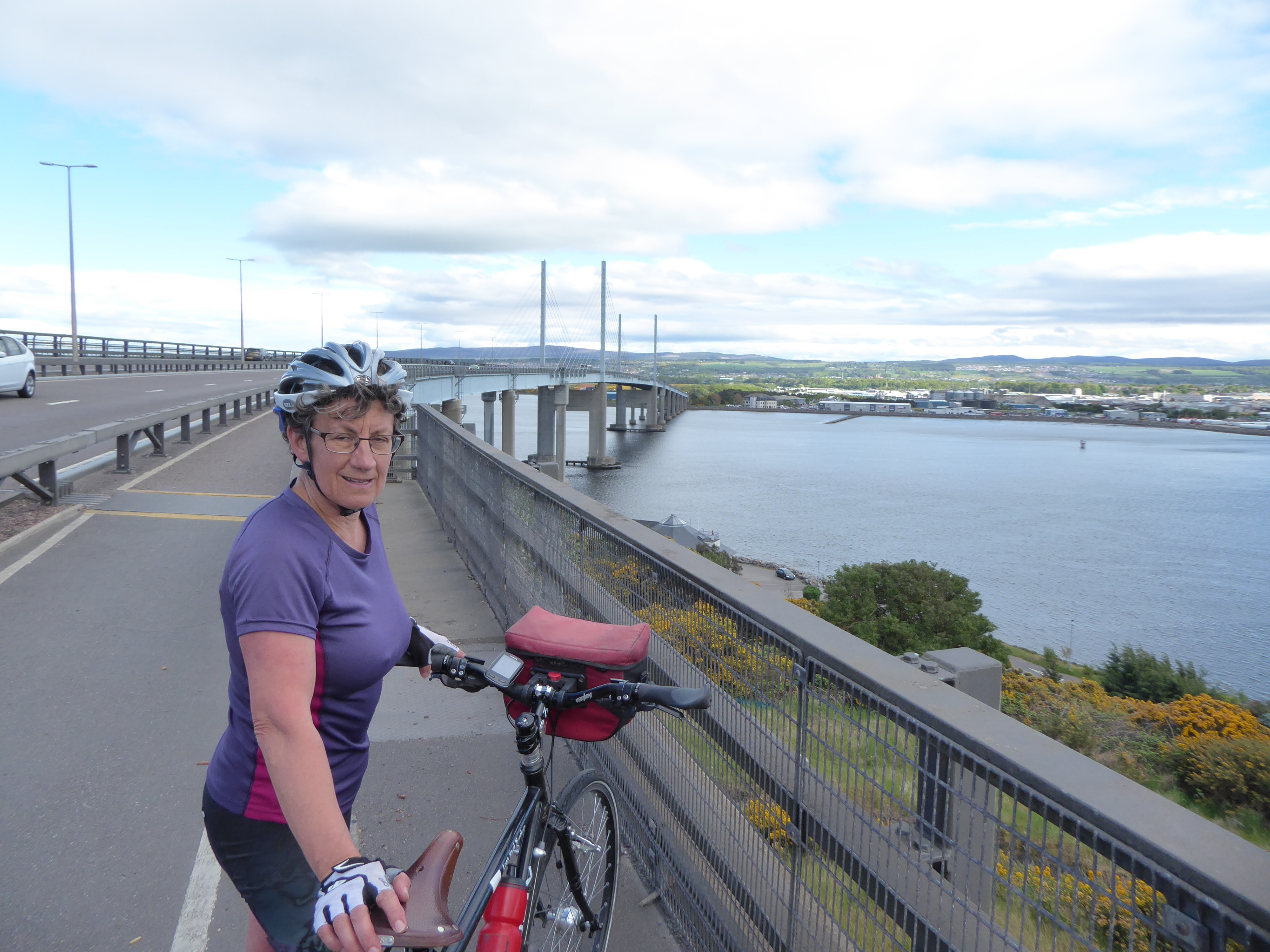
There was no choice but main roads out of DIngwall, although they had bike paths alongside it was still noisy and not particularly pleasant.  After a while we were able to branch off and picked up a beautiful little road right alongside Beauly Firth with flower strewn verges , completely flat road and the wind behind!  This took us right to the bridge over into Inverness.
After a reviving cup of tea we picked out way of Inverness with David’s usual excellent rout finding (in and out of cities being the hardest navigation when cycling).  The formal bike route takes a big loop to avoid the A9 but we weren’t in the mood for that so we took a route where we braved 3 miles on the dual carriageway – no hard shoulder or even ribbon to cycle on – but it was nearly all down hill and not too busy so it was only a short stretch and we lived to fight another day as we turned off onto the road to Moy.  Just as we were starting up the hill we heard voices calling us.  It was Charlotte and Nick, our Warmshowers hosts for the night. After the briefest of hesitations they packed our panniers into their van and cycled the last hill weight free – felt as if we were flying up.
For those who are new to our blog ‘Warmshowers’ is a touring cyclists website offering free accommodation, in return offering your home to passing cyclists.  It is where we have had our most enjoyable stays over the years and this evening was one of them.  Charlotte and Nick are both doctors and recently moved to the area for Charlotte to start her Urology rotation (‘plumbing specialist in Charlotte’s words). They are renting an amazing farmhouse high on the moors.  By one of the quirks of coincidence they know our very good friends in Bewdley, John and Linda Iles – Charlotte’s parents being very old friends of theirs.  In fact John and Linda are attending their wedding in a few weeks time. Their hospitality was wonderful, they cooked us a superb meal and we had enjoyable conversation until eyelids drooped and it was time for bed.  A memorable stay and we wish them all the best for their wedding and their future together.

Day 9:  Inchnadamph to Tain:  55 miles and a following wind

There are bad days, moderate days, memorable days and very memorable days, and this was the  last of those categories.  

We woke in our second floor little room and packed before breakfast.  The diligent Imperial College students were finishing their work before starting on the second week of their field trip in Glencoe.  They worked til 9pm at night, and later for some, having been out on the fells all day.  Such diligence and politeness was never noted amongst students in my day but they were astounding.  

We set off by 9 with the weather overcast and had a slight headwind for the 60m climb up to the loch.  This retraced our steps and so meant climbing the 4 mile downhill section of the A837 that we had so appreciated 36 hours before.  

At Ledmore junction we left the Ullapool road and continued on the A837 in a south-easterly direction.  The wind was with us and the road was broadly flat.  We ambled along the single track road which had virtually no traffic at all.  The scenery was breathtakingly beautiful and it all felt very remote.
After about 16 miles we got to the watershed between the East and West Coasts and, of course, descended.  It was one of those lovely descents, following the River Oykel valley, which is steep enough to pick up speed without pedalling, but never made the bike run so fast that we needed to brake.  After about 3 miles we got to Oykel Bridge, where there was (by complete coincidence) the Oykel Bridge Hotel.  

It served great coffee and we chatted to a Mancunian retiree who was walking the Cape Wrath trail and a younger Dutchman who was doing the same, but having a day off after  continuous days walking.  The trail runs from Fort William to Cape Wrath in the North East corner of Scotland.  There is no “route” as such and often no paths on the trail most people follow.  For details see https://www.walkhighlands.co.uk/cape-wrath-trail.shtml and be impressed with these hardy walkers, some of whom are well into retirement.  We chatted and then said our goodbyes, only to find the nice Dutchman, whose name we never got, insisted on paying for our coffee.  Thank you kind sir!
Then it was up a bit and down a bit and up a bit more as we followed the valley towards the sea.  We bypassed “Lairg which had a significance for me as I was the Junior Minister to Lord Irvine of Lairg – a man with colossal abilities, vast intellect, great integrity as well as a few faults of near equal proportions.  If his Lordship had been in, we might have diverted to visit his baronial pile but we assumed (maybe wrongly) that he was not and followed the Oykel valley as it meandered to Bonar Bridge instead.
Lunch was a brew up in a park by the now calm river, supported by provisions from Spar.  Then we followed the banks of river as it became an Estuary to Tain.  Tain is a pleasant town, with old buildings and the Glenmorangie Distillery.  That is pronounced “Glen – moran – gie” not “Glen – more – angie”, we soon learned.  

Our overnight stay was an AirBnB  studio apartment on the beach that was wonderful.   We went for a lovely foreshore walk as the sun descended and picked out birds with the binoculars – or tried to.  It is a hard life this cycling – I am sitting in a lovely apartment overlooking the estuary having been for an evening walk, with a glass of wine and double smoked scotch salmon, purchased in Stornoway and carried here.  Good night.

Day 8.  Day off in Inchnadampf.

Ahh, a day off the bikes to give the legs a rest and time to recuperate. We slept for 10 glorious hours and had a leisurely breakfast looking out to the glorious setting of mountains and Loch Assynt. The weather forecast was better for the morning than the afternoon so we decided to take a stroll up the valley and were soon surrounded by mountains and bog – but extraordinarily dry underfoot. The area was limestone and full of an underground network of caves – at one point we got a glimpse as the river dived underground through the undergrowth.
Walking back down the valley at a path intersection we met another chap  who had set off at 5am to ‘bag’ a couple of Munros.  He has done 98 so far.  He was in the army and based in Edinburgh and did this as a hobby. He told us there was a complicated grading before a mountain qualifies as a Munro and there are about 5000 people in the UK who have climbed them all. A hobby that will certainly keep you fit.
The rest of the day we had a very lazy time and enjoyed reading and chilling. We then decided to take a trip and hitch hike into Lochinver, the nearest town, about 12 miles away. We soon got a lift from a couple staying there on holiday and as we did the forecast rain started to drizzle. It did not take long to walk round a rather damp Lochinver but in the process stopped at the ‘Pie Shop’ that makes an incredible array of pies and brought some for our lunch tomorrow and then had a great meal at Peet’s Restaurant – highly recommended if anyone is out this way! Wonderful seafood and I then had Chicken stuffed with haggis in whiskey sauce.  Very delicious!

Is that a receding hairline I see before me?

When we waddled out of the restaurant, equally stuffed, it was proper raining – the first we’ve had this holiday.  We were sure that cars were bound to stop if we were standing bedraggled in the rain – and I am sure they would have but after 40 minutes not a single car had passed us in the direction back to Inchnadampf! The guide book I read that morning said that the population density in Sutherland was 6 people per square mile – well seems they all stay indoors when it is raining.  Now you might think we are mad but we did have the forethought to take a taxi number with us and when we managed to get the phone dry enough to tap in the numbers we were fortunate that the taxi could come straight away and the pleasant lady taxi driver wasn’t at all concerned that we were dripping all over her car.  She ran the taxi herself every day and 6 nights a week but could not make it pay…and now someone else had set up a taxi in the town and she said there just wasn’t enough business to go round. She would often stay up to 1am on a Friday night and not get a single call. Such a contrast to the last taxi we got – an Uber cab in London where the technology tells you there were 25 cabs in your area and someone was there in a couple of minutes.  Never mind Scotland being a  different country, this part at least is a totally different world with all its pluses and minuses

Day 7: Rhenigidale to Inchnadamph, via the Stornoway/Ullapool ferry.   

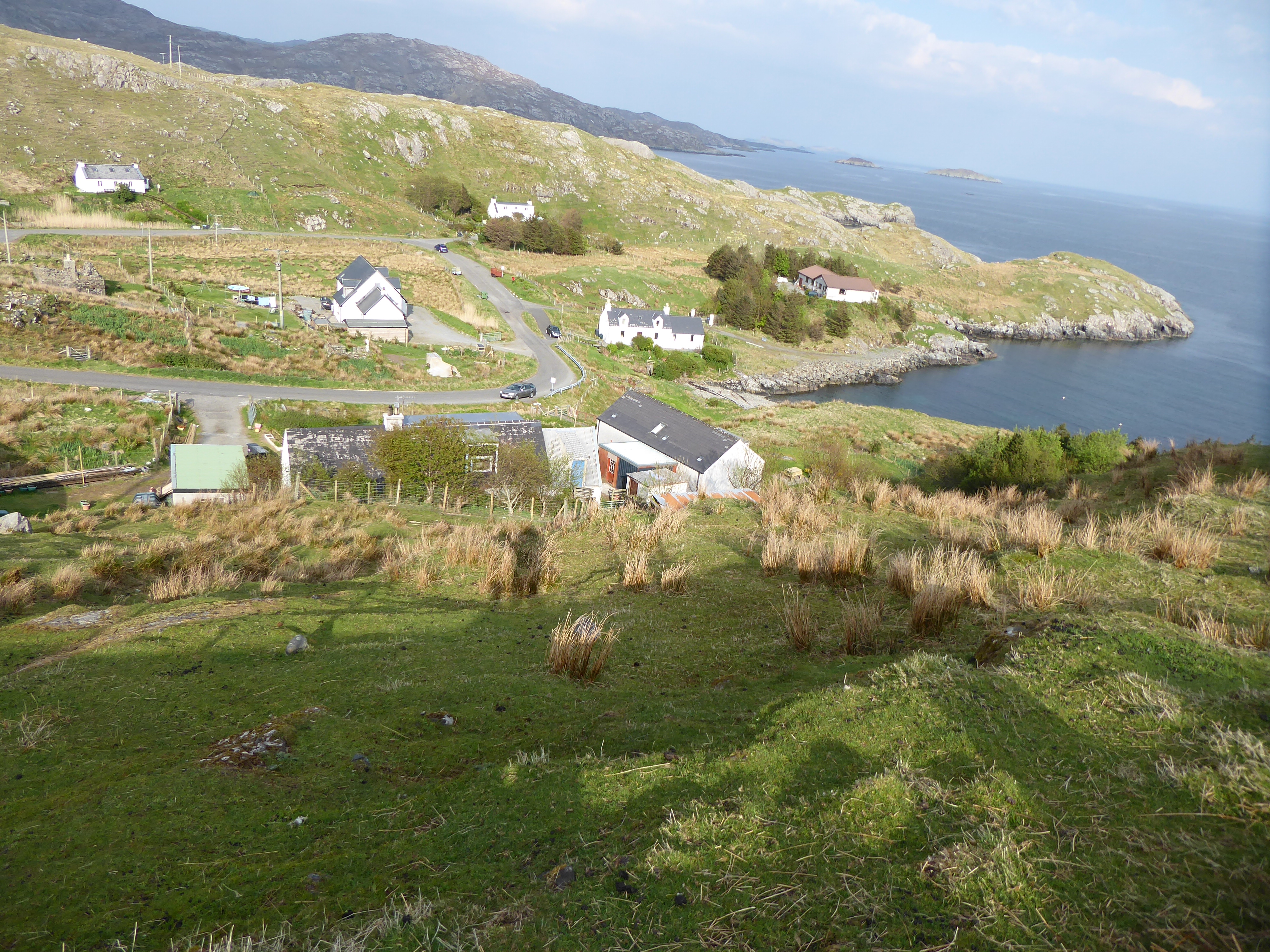
Rhenigidale hostel is by the sea, in a delightful little cove.  We had a peaceful night (except for a persistent cuckoo who sang out for half the night) and left by 7.30am.  The first hill hit us with a 15% climb before we had a chance to warm up (or possibly even wake up).  But it was only a short amount of pain, topping out below 200m.  We then dropped back to sea level as the sea loch, aptly named Loch Seaforth, twists around the hills. Rain was forecast and threatened but largely stayed away, but it was overcast.
 Then it was another climb up to the main road – “main” being a relative concept.  A bit more climbing and then a glorious descent to re-join Loch Seaforth.  It was then up and down all the way to Stornaway.  Half way along we left the “Isle of Harris” and joined the “Isle of Lewis” – but it was all one landmass.  It was all very strange because neither is an island in the usual sense of the word.
The scenery in north Lewis is a bit mundane – flattish peat bogs and occasional fir tree planted forests.  There was the occasional bird of prey, which always dipped below the skyline when we got the binoculars out, but otherwise it was a case of covering the miles.  We did pass the point where Bonnie Prince Charlie landed after the disastrous battle of Culloden which was the start of the suppression of the clans and the Highland Clearances, where sheep were more profitable than crofters for landowners.  A bleak period in Scottish/English relations. 

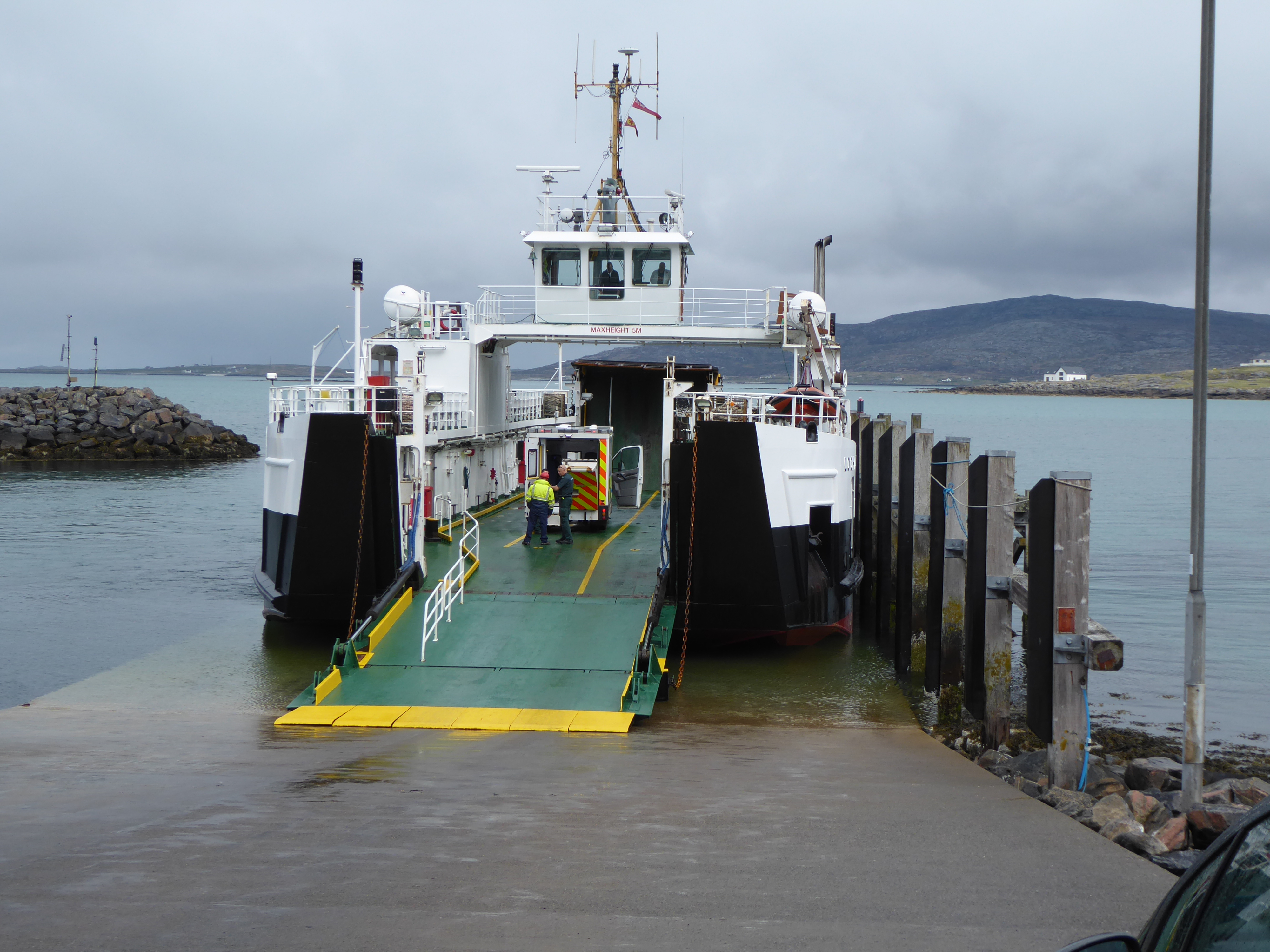
We arrived at Stornoway about 11.30 for a 2pm ferry and had a pleasant few hours ambling around having coffee, exploring the town and chatting to other touring cyclists as we waited to board the ferry. 
 

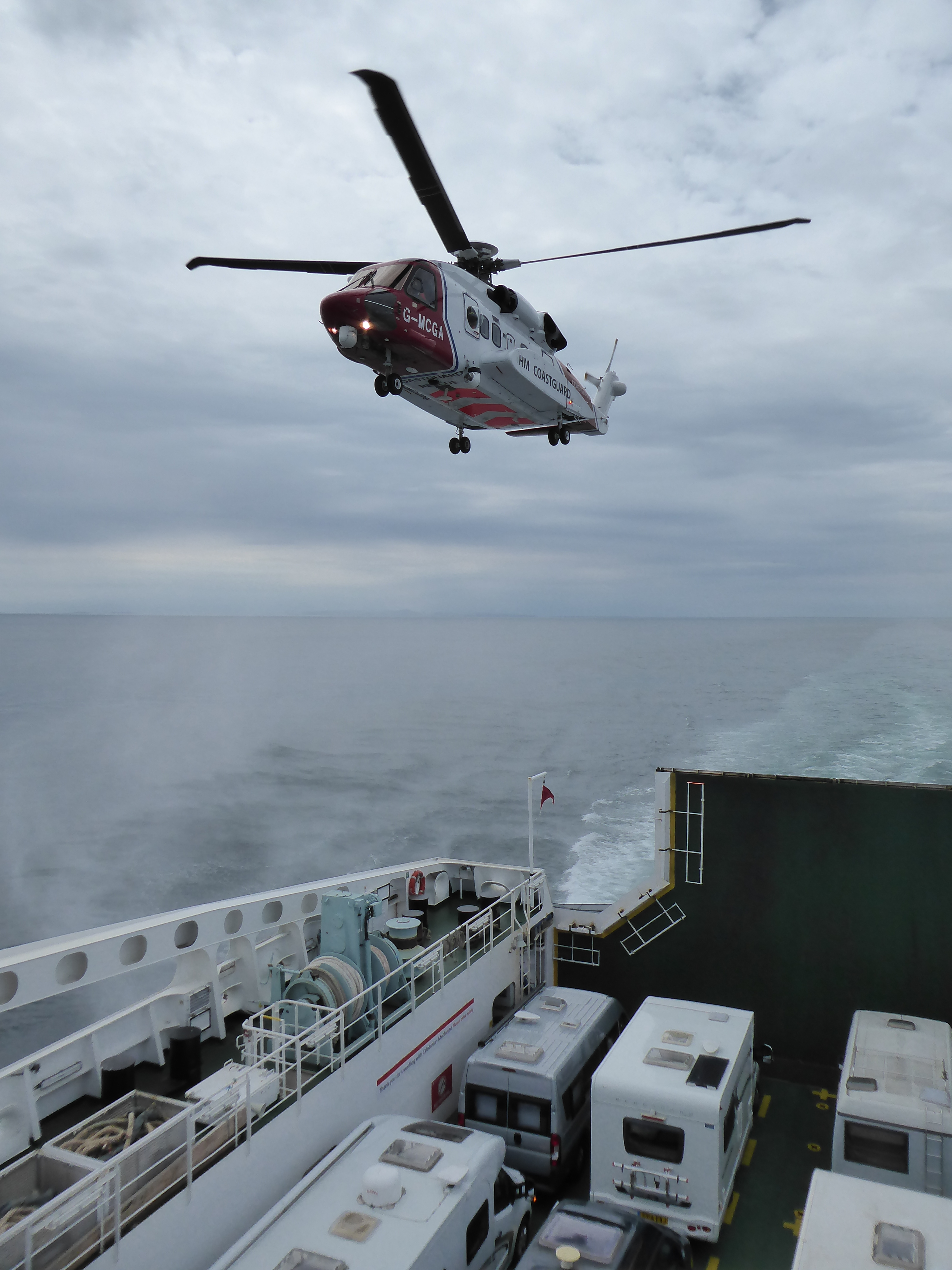
The highlight of the 3 hour ferry ride was a training exercise by the coastguard who brought a helicopter to hover just over and alongside the ferry as it was going along.  The waves were affected by the rotors as the pilot held the helicopter metres over the ferry.  It was all very impressive, albeit done on a sea that was like a millpond.  

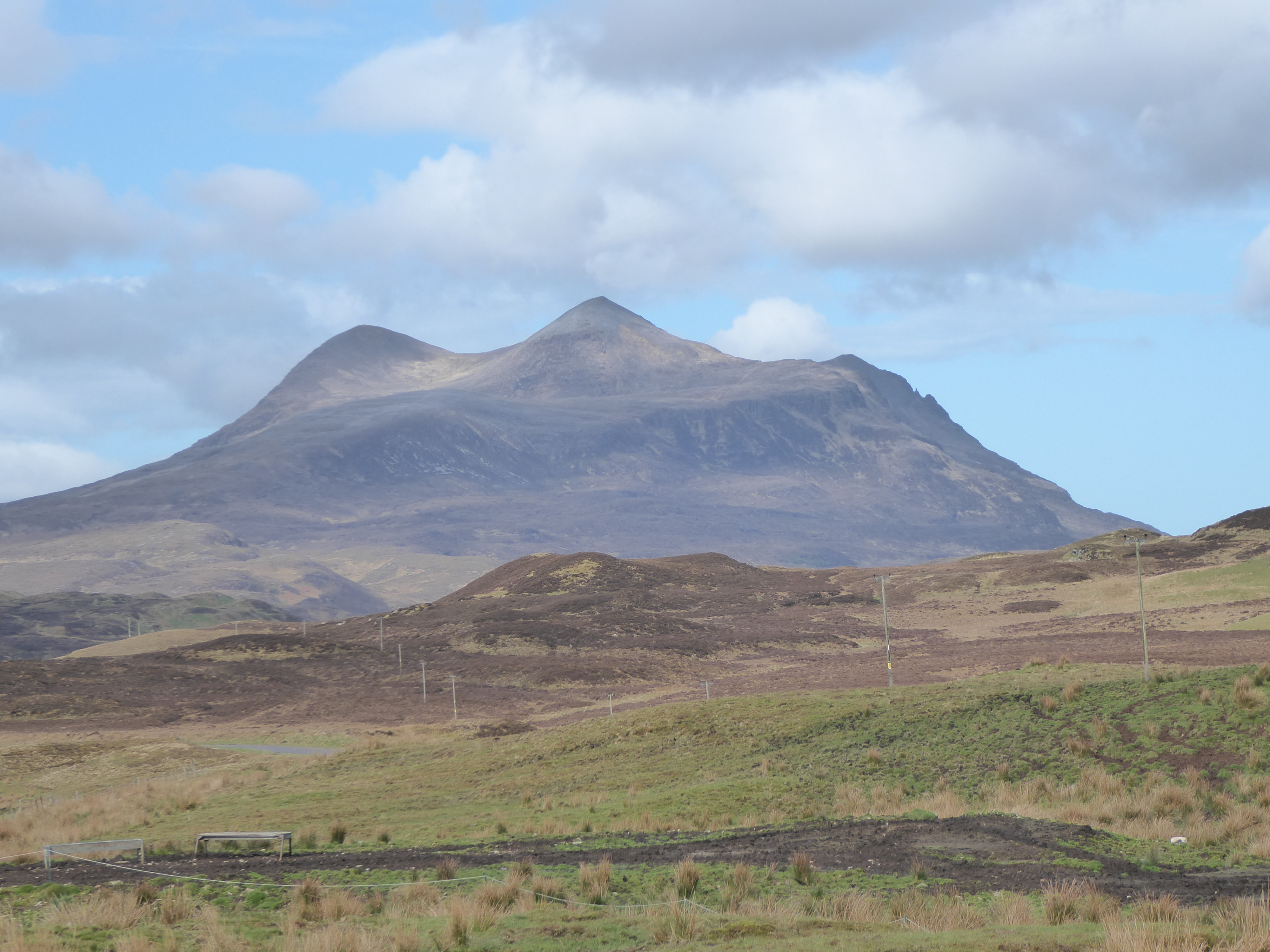
Arriving on the mainland again we knew we had 25 miles to reach the hostel at Inchnadamph.  We left Ullapool just before 5 and plodded out of town with the sun shining but a worrying wind brewing.  The wind was a north-westerly which is just what we did not want as we were going in a north-westerly direction – and is was strong.  Battling against the wind is every cyclist’s pet hatred because it is relentless.  It was particularly tough as we battled uphill – to the highest point of the ride so far.  The scenery was jaw-droppingly beautiful and kept us going.  Vast areas of barren moorland with high mountains and long ridges.  Quiet but decent roads which took us over 250m high and gave up wonderful views in the evening sunlight.  This far north it does not get dark until about 9.30 or later at this time of year, but the low light picked out the features of the landscape in a unique way.  Eventually we reached a crest 4 miles from Inchnadamph and started to pick up speed as we descended.  That was most frightening of all because the occasional gust knocked the bikes sideways by several feet.  But we got there.
We had planned to eat at the Inchnadamph Hotel but we told it was “residents only for food.  We later found non-residents who had had a bar meal there, and that the policy seemed to vary for different people!  It may have had something to do with our English accents or maybe just was a cantankerous hotel owner who only served customers he liked the look of – and after 60 miles and 1250m of climbing – it would be fair to say we were not in that category.

Conversely we got a warm welcome at the hostel, bought some ready-meal lasagne and had that with salad.  Ready-meals have never, never tasted so good.   

Day 5 Sollas to Rheinigidale.  43 miles, 1000m climbing.

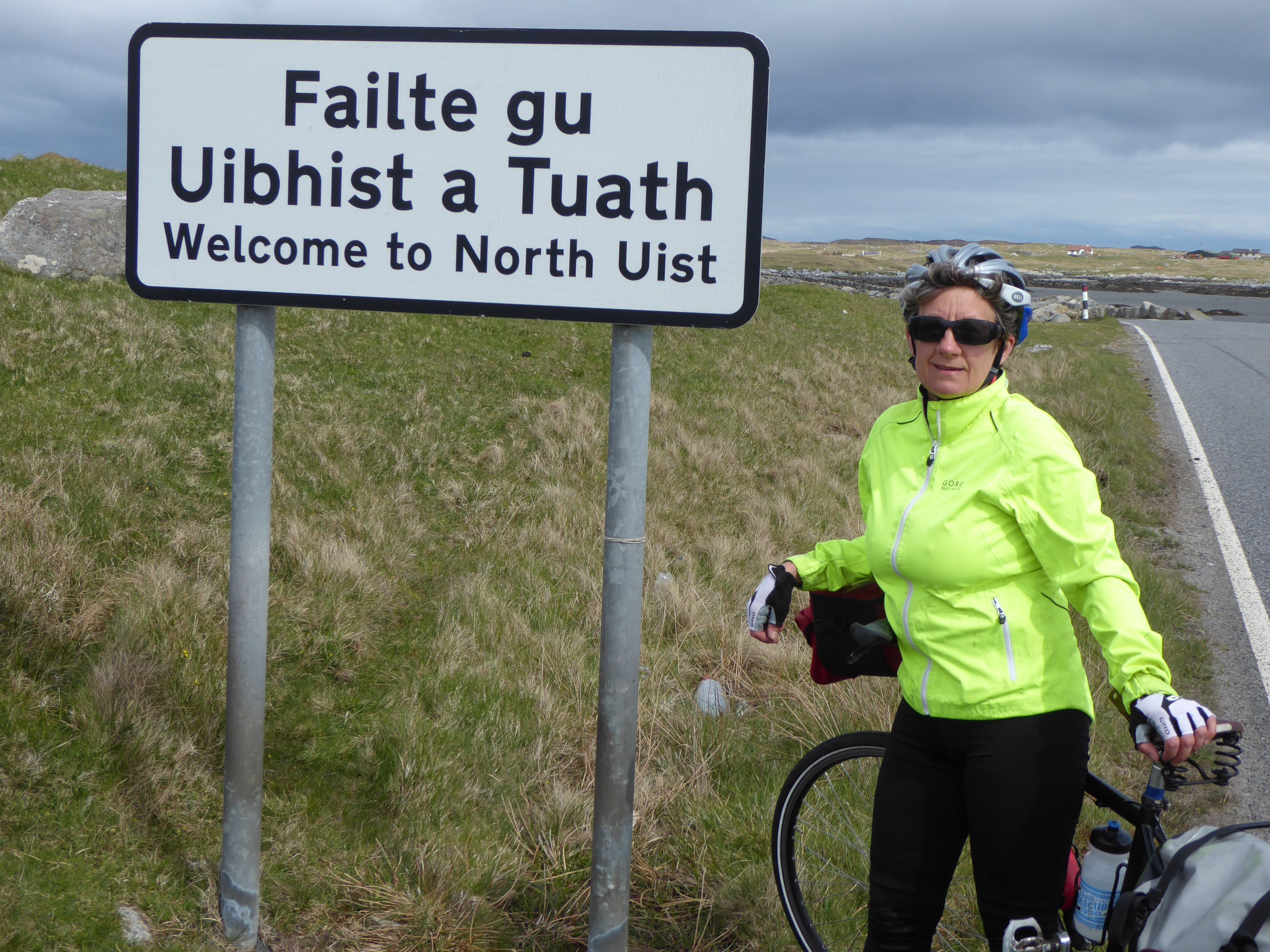
I’ve always felt a bit allergic to B and Bs as previous experiences have usually consisted of ‘this is a polite notice’ followed by a list of instructions.  But we landed at a good one with Peggy and John.  A comfortable room, a proper bath with lashings of hot water and fabulous breakfast that included fresh crab caught by John’s brother the night before.  Peggy had an interesting accent.  At first we thought she was Scandinavian.  However she explained she was an interloper in North Uist, having been born and bred in South Uist.  But the norse influence is strong in the history of these islands and that seems to have persisted in her lovely accent. 

Well fortified, we set off for the 11 miles to the Berneray ferry over to Harris.  I’d had a definite ‘day 3’ day on the previous day, with legs aching and body objecting to this lark of having to cycle every day.  My legs were still aching today, but the scenery was remote and magnificent and I really enjoyed it.  The ferry to Leverburgh was full of cyclists but most opted to take the road round the west of the island where there are meant to be magnificent beaches.  Being contrary, we opted for the very minor road round the east of the island which is a rocky moonscape. One person had warned us against it (it’s just rocks the road is continuously up and down) but we thought it was incredibly beautiful and remote. The wind had also put people off but in fact was not a problem.  The road was very ‘up and down’, which I find the most tiring sort of cycling, so we were tired when we stopped for our picnic lunch.  We brewed up some coffee as a ‘pick me up’ as we looked at the steep hill we had to climb back to the main road.  “Main” being relative here.   One of the things I love about the islands is that the A road is often a single track with parking places.

With renewed vigour we  took the hill in one go, then coasted down to the village of Tarbert. We hunted for the supermarket only to find it was a very friendly little mini market” but it enough to stock up with provisions for the evening where we were heading for a hostel.  So how far do you cycle in a day the friendly shop-keeper asked.  “About 50 miles” I replied.  A look of total horror came across her face and she said “I was expecting you to say about 5”.  It is funny how perspectives are different.

We had been warned there was a big hill out of Tarbert and the warnings were right.  It was very steep to start with then eased off as we carried on climbing to just short of 200m.  Just as we reached the top we saw an eagle – close by to start with but by the time we got the binoculars out it had drifted far away.  

We turned off the main road towards Rheinigidale – plunging back to sea level and then climbing the same again to almost 200m, this time in permanent bottom gear with legs definitely objecting.  A final zoom down to the tiny settlement and a gorgeous little hostel, well equipped, warm as toast hot shower and views to die for. The road was only put in in 1990 – before that the group of 8 houses could only be reached by sea or by walking. It seemed mad to leave ourselves with 2 massive climbs again tomorrow morning as we have to go back the way we came but it feels magical place.  After a reviving cup of tea we took a short walk along the old walking track alongside the loch and David got a good view of 2 birds of prey, which he identified as looking a bit like sea eagles but they were big, dark plumage and had spaces in the wing feathers.  They might have been another bird of prey, in the binoculars before they again decided to fly off behind the cliff but even with our aching legs it was worth the walk in the evening sun feeling as if we were almost at the ends of the earth in total peace. 
?

​Day 4:  5 islands from Barra to North Uist and the Phoney Book: 62 miles

Barra is almost at the foot of the string of islands known as the Outer Hebrides.  It is, perhaps, even more remote than the others.  There are (virtually) no trees and the land does not look too fertile.  I say “almost” because there is a small string of islands to the south of Barra, and these make Barra look like a thriving metropolis.  Vatersay is linked by a causeway to the south of Barra.  Vatersay has a population of just 90 compared to 1200 for Barra.  Life in Barra must be rough in the winter, but the boat sails every day to Oban and so it has a clear link with the rest of the country.  There is a Co-Op which, once one get’s inside, looks remarkably like a Co-Op anywhere else.  However our attempt to buy bread, nail clippers and lens cleaning spray produced a one in three result – but the bread was very good.

Anyway I woke early and had a magical hour reading Maya Angelou’s brilliant autobiography of her childhood, “I know why the caged bird sings”.  The far west of a remote Scottish island and Arkansas in the 1940s probably have little in common, but one of the delights of travelling is that I have both the time and the energy to read wonderful writing.  She paints pictures of life as a child growing up in the segregated south of the USA that show two communities living totally separate lives.  It is as horrendous as it is totally absorbing.  But this blog is about cycling, not reading so I will leave others to discover the delights of this book and comment on it more intelligently than me.

We breakfasted on muesli and coffee, and were on the road by 8.15.  It was overcast and grey, and the hill out of Castlebay was sharp but not long.  The Garmin was claiming not to be getting reception from satellites, which somehow seemed appropriate to our setting.  However there is only one road so it was pretty irrelevant.
The barren scenery absorbed a surprising number of houses, placed to compromise between getting a sea view and not being too exposed to the elements.  Lots of places did B & B and I suspect many others were second homes,  like the family we met on the boat who had connections to Barra and now had a family holiday home there.

After 8.5 miles we got to the ferry port for the 40 minutes crossing across the Sound of Barra to Eriksey.  Port is probably an overstatement.  It was a slipway with a toilet.  However we did our usual cyclists trick of passing all the cars and going to the front of the queue.  Works in Croatia so why not in Scotland. By now it was more than overcast but was in that transition between mist and real rain, so the crossing was pretty cold.  But there was a passenger lounge (actually little more than a corridor) for the about 20 vehicles and 10 cyclists on the crossing.   I ventured up on deck and met a couple from Hereford – small world.
We did not book in advance (because you cannot as a cyclist) but were told to “queue up for a ticket on board”.  We queued, paid our £2.90 each (many thanks Nicola for the subsidy) but got no ticket. No one checked we had bought a ticket and no one seemed to mind terribly.  It is a system that works on trust and  as far as we could see – it works fine.

The weather improved as we swopped stories and plans with the other cyclists (mostly young but a few old fogies like us), and then braced ourselves for the steep climb out of the harbour.  We were overtaken by almost all the youngsters who clearly were riding on a flatter road.  One of the great deceptions of youth.  We all then had a glorious descent to the village and the one shop on the island (where they stopped and so we overtook them).  We then played tortoise and the hare all day – I will leave you to decide who was who.

The ancient guide book I read indicated that Barra, Eriskey and South Uist were all “Catholic” islands and that it became “Protestant” from North Uist upwards.  It is unclear how much of this remains true today, but there do seems to be lots of Catholic churches in this part of the world, as well as some roadside Marian shrines (always a give away for a Catholic part of the world).
There is a causeway between Eriksay and South Uist which we cycled over with the wind across us.  Then we turned into the wet weather to struggle Eastwards before hearing north.  We made it to Dalabrog (at the junction to Lochbosidale – the main port of South Uist) and decided that Pooh was right about elevenses.  A convenient hotel out of the mist and rain produced some excellent coffee, as well as an internet that was good enough to download 2 days of photos.
Refreshed we pressed on through the beautiful but bleak landscape.  We lunched about half way up South Uist and then followed the road as it passed over a series of inland lochs, each linked into the next.  At one stage we thought we had crossed to the next island, Benbecula, but it was still the flooded marsh regions of South Uist.  Eventully, just as the weather was improving, we hit the causeway between South Usit and Benbecula and left island no.3 of the day to start island no4.

Benbecula is tiny but much more intensively farmed and densely inhabited than the islands we had passed through earlier that day.  We took a side road to go all around the island and saw cows, arable crops and an airfield.  There is an RAF base there and lots of military activity.  

Most businesses seem to be owned by someone called McCloud.  There are several McCloud transport companies, a McCloud construction company and even a McCloud bakery.  It may be that most people are called McCloud.  The people we met on the ferry said there is a locally created phone book – wonderfully called “the phoney book” – and half the entries are people called McCloud!  That may , of course, be an exaggeration but I love the idea of “the phoney book.

After Benbecula we both felt tired – lack of training was kicking in big time.  But we ambled across the barren landscape of North Uist along a cut through across the centre of the island called “the committee road”.  History does not recall which committee decided what, when or who paid for the road, but it cut 5 miles off the coastal route so we were grateful for their deliberations. 

Pretty tired, we arrived at John and Peggy’s B & B at Malacleit, just outside Sollas.  Their children gave us a warm welcome  as we made ourselves a well deserved mug of tea.

Day 3. 9th May.  Crinan to Castelbay, Barra:  38 miles cycling and 5 hours on the ferry.

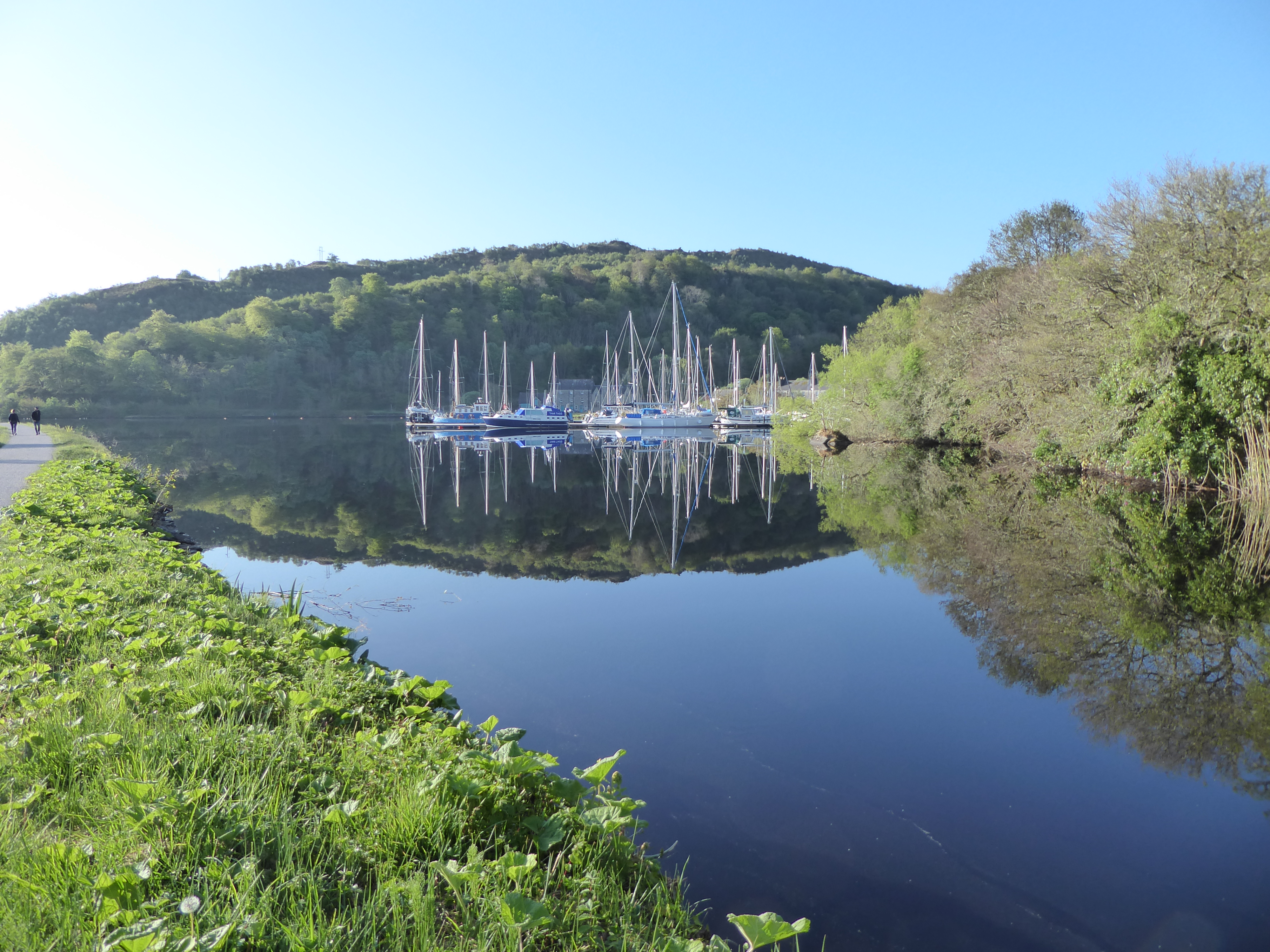
We woke early to another cloudless sky and sunshine – although cool in the morning at 6.15 at 5 degrees. Breakfast and great coffee with Richard and Sally set us up for the day before chugging back in the little motor boat back to the mainland and back to the boatyard to pick up our bikes. We said our goodbyes to a very special place and vowed to come back and visit again, when they can put us to work. We peddled out of Crinan  along the tow path (thus avoiding the hill into town) sandwiched between the canal and the loch.  It was perfectly still and the reflections meant the canal water worked like a greenish mirror.  
Just a couple of miles took us to the turn to Oban – a tiny road across the ‘golden moor’, where the reeds in the bog glint in a sea of yellow. 5 lovely flat miles over to Kilmartin Glen – which has the highest concentration of iron age excavations in the world.  We pedalled past burial mounds and standing stones, which in truth if they were signposted we might of missed.  The Neolithic activity here left lots of burial mounds and smaller stone circles to show for it.  We passed one in a bluebell wood which oozed ancient wonder.

We climbed slightly up to the village of Kilmartin and then properly up into beautiful highland scenery.  We cogitated briefly whether to take the cycle route to Oban rather than the main road but it was much longer and we had a ferry to catch so opted for the main route – but at only a car or so every few minutes and the odd lorry or campervan, the road was hardly overrun with traffic.
A well timed hotel in Kilmelford did an excellent coffee as we sat outside in a sun trap which boosted us for the next shorter but steeper climb. More fantastic scenery before swooping down to the very pretty Loch Fauchon here we fairly sped along the shore. This produced a “first” for this trip as David asked me to slow the pace a little! This was a brief respite before a sharp 100m climb over to Oban.

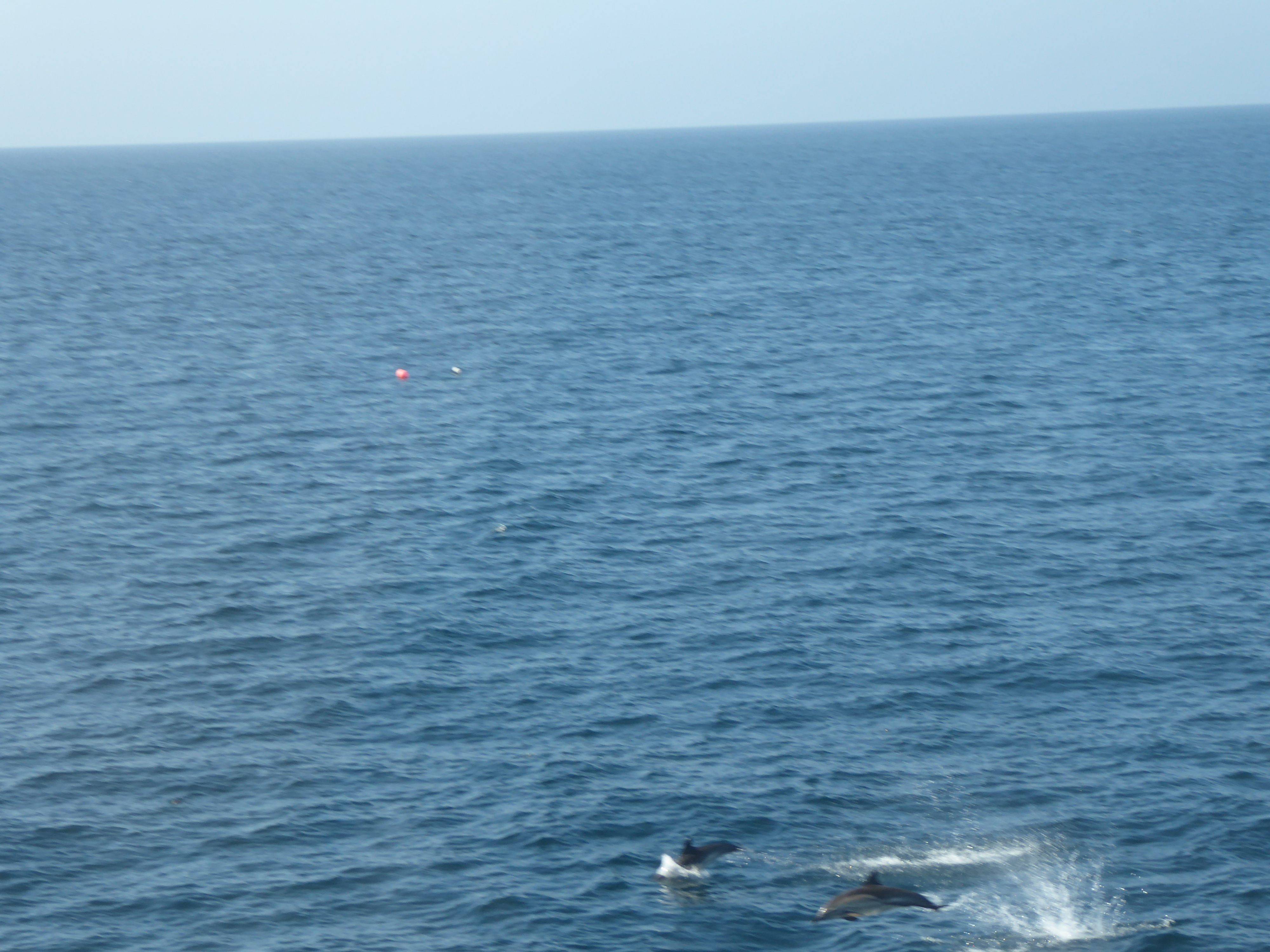
We arrived in good time to buy our ferry ticket to Barra, which sits at the bottom end of the Outer Hebrides line of islands,  We topped up with shopping and then made our way back to the port. Bikes were ‘boarded’ first so we ate our picnic and settled onto the ferry before it set off for the almost 5 hour trip to the island. The first part of the journey took us through the sound of mull with the Island of Mull on our left and the jut of mainland to which it presumably was attached many millennia ago, on our right then out into the open sea. We saw flocks of Manx Sheerwaters, cruising over the waves.  On 2 or 3 occasions, pods of dolphins came to play next to the ship, jumping out of the water in 2s, 3s and 4s, a wonderful site. The ship’s tannoy announced that, as well as the dolphins, a whale was out in front of the boat.  This presumably had been picked up on their radar system but the combined straining of eyes and binoculars by passengers peering out of the large front windows could not spot even an imagined hump or blowhole. 
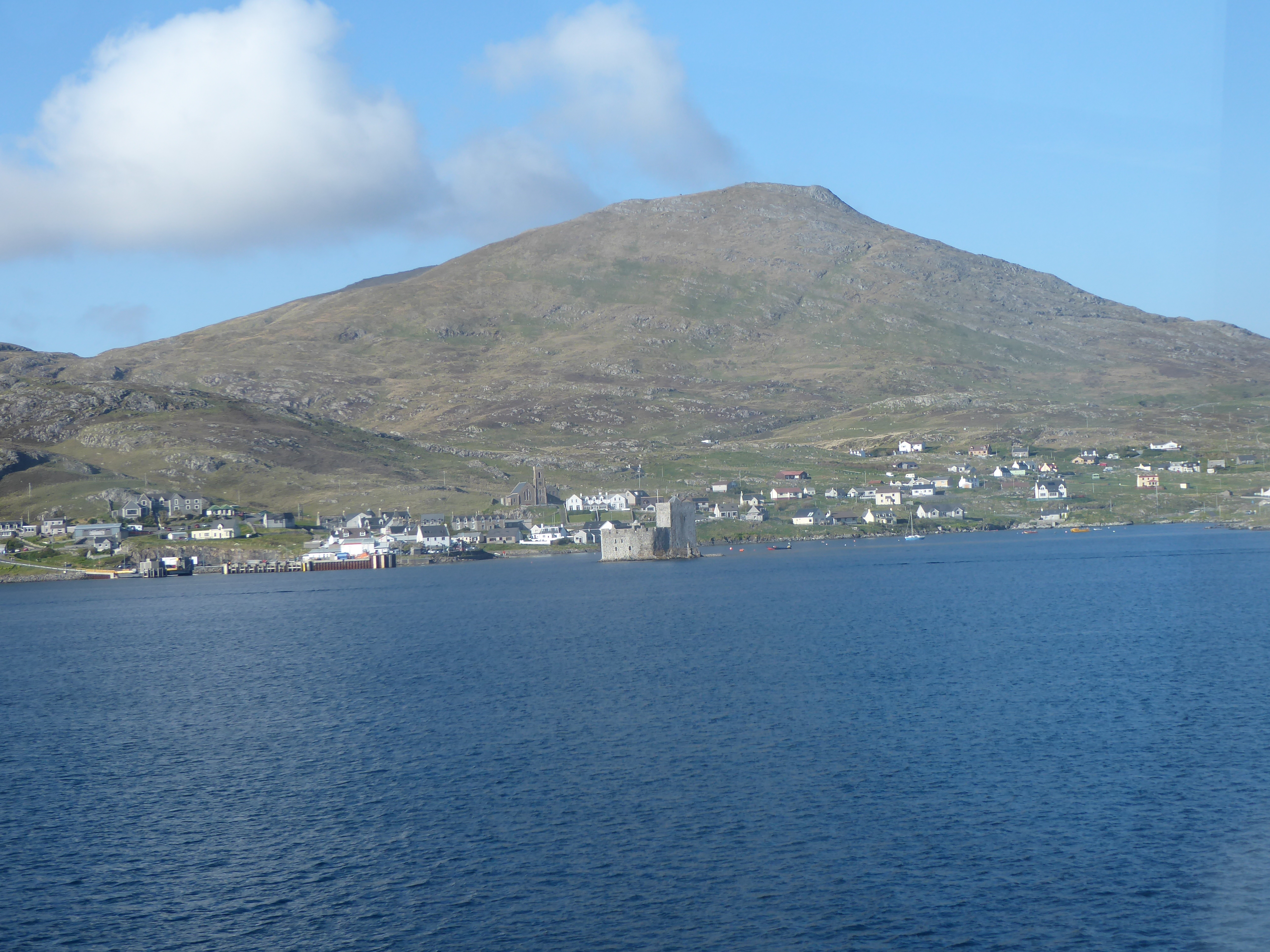
Finally, land came into site and we cruised into Castlebay harbour in the evening sun. The small but perfectly formed Kisimul castle in the middle of the bay had nobly defended to islanders since the 1400s. It was built on  small outcrop of rock that amazingly had a supply of fresh water. No one was marauding today so the ferry slid past to its docking without trouble.
Just a few hundred meters from the ferry port was our destination, Dunard.  This proved to have comfy rooms, a good hot shower and lovely sitting room overlooking the bay.  David cooked and I wrote this blog – a fair division of labour.  Castlebay seems a great stop for the night. 


Day 2:  Coffin cheaters:   Kintrye Peninsular to Crinan: 50 miles

Today we covered 50 miles and it felt good to be back in the grove.  We started with a superb Scottish breakfast.  Normally these breakfasts are to be avoided because there is a heavy price to pay on the scales the following day but, heh, no worries.  We are cycling, so sausage, beans and bacon are all on the “acceptable yes please” menu.  Restraint will reemerge in about 2 weeks.

The best comment of the day came from a fellow cyclist who shared a conversation with an old lady he met.  It went like this 

Old lady:  “I see you are on your bike – are you retired?”

Cyclist: “Yes, I now have the time to cycle”

Old lady: “Do you know what we call your type?”

Cyclist (slightly concerned): “Err, no, what do you call us?”

Old lady: “Coffin cheaters”

Needs no further comment really – save that I aspire to become a coffin cheater.

We got on the road by 8.30 and it was mercifully flat.  One of the problems this year has been that the usual “must get fit before we go” regime was replaced by a “are we too injured to make it?” dilemma.  The fact that we are here answers that question but we have started without having got ourselves as fit as usual.  It is boring to go on about Bernie’s torn ACL in her right knee (left one is fully functioning) or my back (painful after trying to get a tree stump out) or ribs (multiple breakages following mountain bike falls).  But the downside is that we have not cycled more than 20 miles fully loaded this year.  So we set of to cycle 50 miles with a little trepidation. 

Flatness is temporary, hills are permanent.  So it was inevitable that we would hit a hill after a few miles, and we did.  But not a large one.  From the top we could see across to the islands of Gigha and beyond that, Jura.  The islands are sparsely inhabited but with few jobs other than subsistence farming and the occasional fish farm, they would probably abandoned entirely without tourism.  Part of the reason they are kept going is that the ferry system is heavily subsidised by the Scottish government – just as rural bus services are subsidised in England (and probably in Scotland).  This makes the fares very reasonable and keeps vital contact between the islands and the mainland.
Anyway, we were on a peninsular, not an island, and we ambled up the peninsular to Tarbet.  This is a pretty fishing village on a small spit of land that connects Kintyre with Knapdale.  Tarbet is, to be honest, a bit forgettable but we did manage to get a decent cup of coffee and bought a water jug for Sally and Richard, who we were visiting later. 

Everyone has heard of Kintyre (.. that song has a lot to answer for) but Knapdale is the next lump of land going northwards and is largely anonymous.  But it is stunningly beautiful.  We cycled up the east side of the peninsular, following the edges of Lock Fyne, to Lochgilphead. 
 Just before the town we came across the start of the Crinan canal.  This was built between 1777 and 1809 to allow access from Glasgow to the North West of Scotland and islands such as Mull and the Hebrides.  We cycled along the canal toe-path and then turned off to visit the town of Lochgilphead.  It was a pleasant little place with lots of local services.  We lunched on fruit on the grass edges of the loch and called Sally.  Having made arrangements we cycled the last 8 miles to Crinan and relaxed at the impressive Crinan Hotel.

Richard met us after a short time and we left the bikes at the boatyard, and packed all our panniers into a small boat – known as “Owl” – for the short trip to their own island, Eilean da Mhiane (I have probably spelt that wrong).  It is difficult to put into words the combination of total nuttiness and brilliance that Sally and Richard have shown by “retiring” from Clerkenwell to a small island off the west coast of Scotland. 

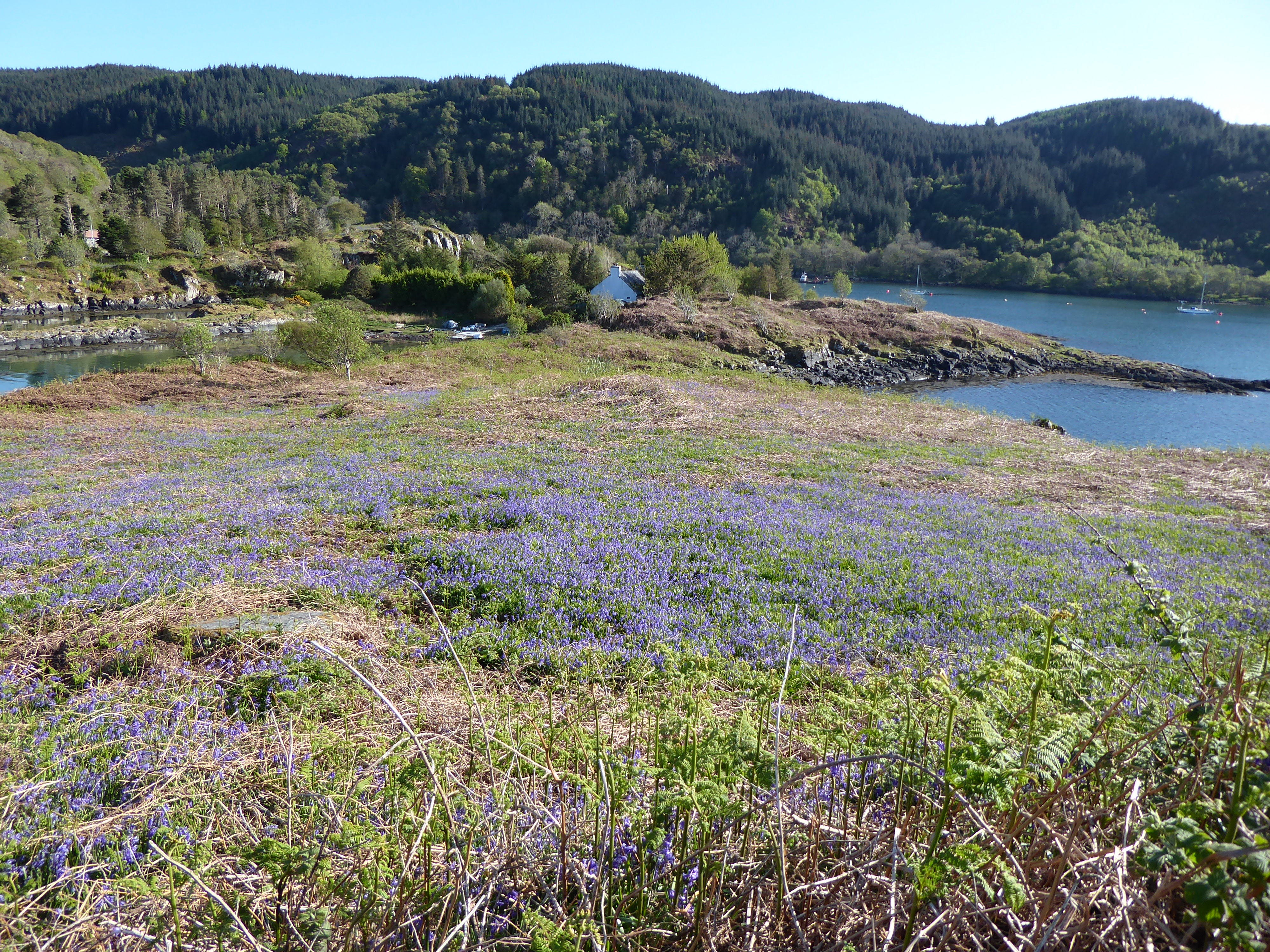
 The name means “island of 2 mines” in Gaelic.  They have failed to discover or indeed explode either of the mines so far.  A 2 bed bungalow style house was built on the island in the 1940s, and has not been modernised since.  The garden is way overgrown, has bluebells everywhere and 3 stags regularly swim from the mainland to feast on the island’s delights.  

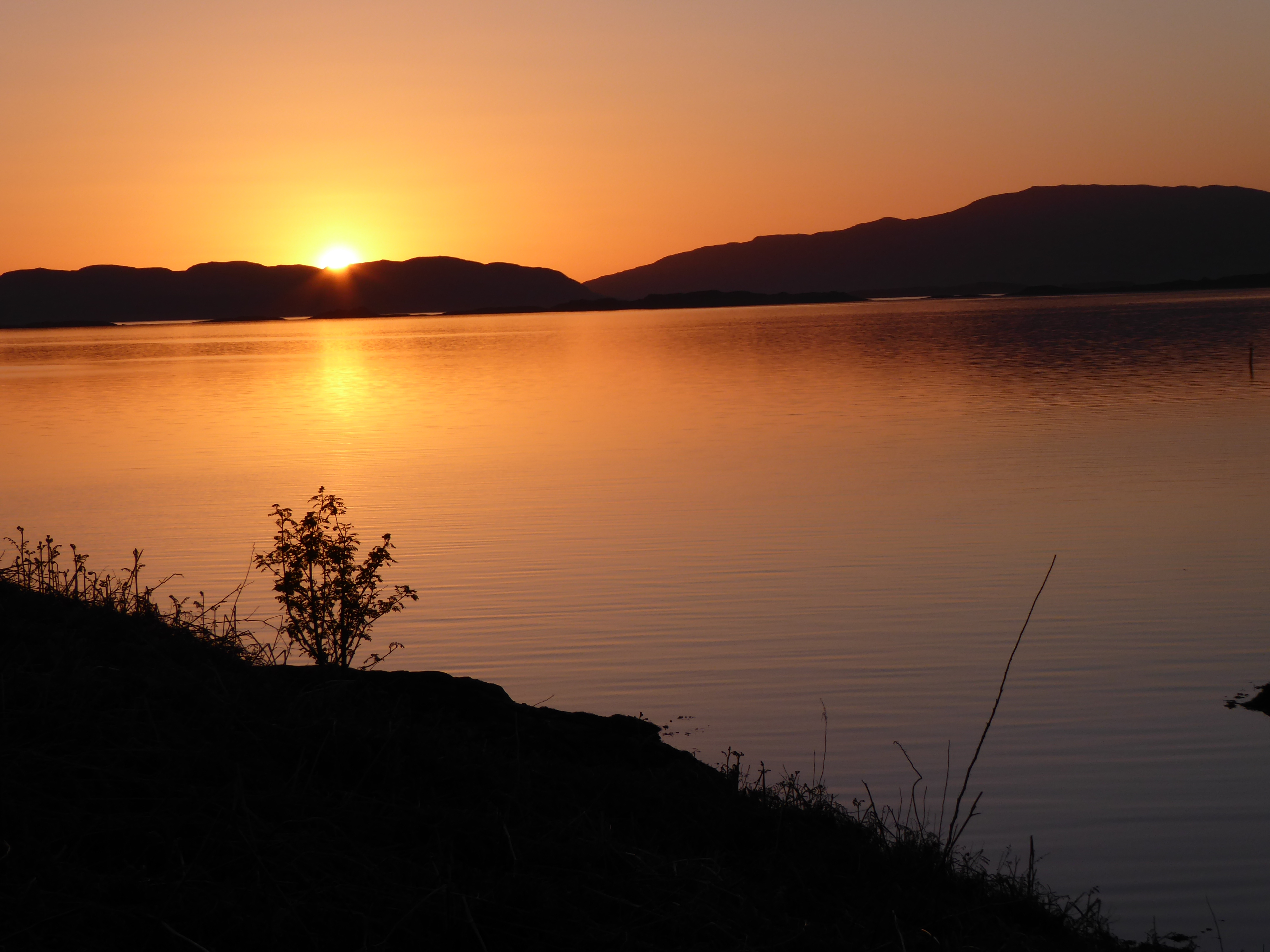
We spent a magical afternoon and evening with them.  I hope I have set Sally up with a blog:  www.sallylion223@wordpress.com which will record their adventures.  The photos tell a better story than words but perhaps the highlight was watching the sun go down over Jura, just over the bay.  
It is a truly magical place and whilst you have to be mad to embark this type of adventure, it is the very best form of madness.  

They both seem energised and excited by challenges ahead – and there will be many.  Winters will be tough but it was perfect on a hot afternoon in May, pre-midges (mostly) and with a cloudless sky.
We retired to the “guest wing” at about 10.30 full of admiration and a little envy.

Day 1.  7th May,  Ardrossan to Bellochantuy, 10 miles

The 4.30 alarm was not welcome but heralded the start of our new trip.  We quickly packed the car and set off to drive the 300 miles from Bewdley to Ardrossan.  A breakfast stop at Tebay (no doubt the first of many) then over the border into ‘Nicola Land’. Will we need our passports soon I wonder.  We reached Ardrossan by mid morning.  Parked the car in a side street and packed the car. Relief as all the panniers fitted on the bikes (a Heath Robinson adaption yesterday after we realised the new front panniers I had brought did not fit our front rack  – we really ought not test these things out at the last minute!) and off we pedalled for the ferry.  We encountered the usual problem of trying to by half a litre of petrol for our camping stove but were directed to a petrol station that was happy to receive our 62p to ‘fill it up’.  Various pre trip injuries (David broken rib and bad back and Bernie with a torn cruciate ligament in the knee) meant we had decided to do this trip the cheats way and not camp.  That means we have a bed and shower every night (wow, every night) so that we did not have to use the trailers. But we decided that we could not forego our ‘brew ups’ so have packed a dedicated pannier for the camping stove, pans and mugs.  We never travel light!

Scotland? Not Tblisi or some far off country ending in stan? Family things mean we need to  stay closer to home this year but we have both really been looking forward to exploring Scotland, even if it is a slight diversion on the way to Australia.  We last cycled in Scotland when we started our very first cycle trip and did Land’s End to John O Groats with our daughter, aged 18 months in a prototype cycle trailer.  The design of trailer has come on somewhat since Becky was transported in something resembling a bright yellow upturned bucket .  She has come on too – now aged 27, a beautiful young woman who is completing her Masters in Human Rights. We did wonder whether the trip would merit a blog but after strong representations (PW, you know who you are), here we go.
Back to the ferry in Ardrossan.  We sat in beautiful warm sunshine waiting for the Campbelltown ferry to the bottom of the Kintyre peninsular.  I was more worried about sea sickness than the fact that I had only been back on my bike for weeks and missed a month’s training (the physio having assured me I could not damage my knee further I promptly ignored his advise to increase my rides by 10 minutes a time by doing a crash fitness course and increase by 10 miles a time!).  However the crossing was so sunny and calm even I could not feel the slightest bit sick.
We cruised into Campbelltown harbour and then we were off properly.  Only a 10 mile ride in beautiful evening sun to the Argyll Hotel on Bellonchantuy Bay.  Sitting on the terrace right on the beach still in evening sunshine (hope Scotland is always like this) out appetites whetted for tomorrow.

Scotland 2017

Well folks, it is time to stop working at a desk and start cycling again.  We are sorry but family matters confine us this year and so we will not be able to go back to Tbilisi in 2017 and start again where we left off.  So this year we are doing a variety of trips closer to home, starting with a trip around Scotland tomorrow.  

I am really looking forward to getting back to Scotland on a bike.  The last time Bernie and I cycling in Scotland was in 1991, when we just had one child, Becky, aged 18 months and she was in a trailer on the back of my bike as we cycling from Lands End to John O’Groats.  Becky is now 27 and working towards her Masters Degree.  

We start tomorrow by driving to Ardrossan, which is west of Glasgow, and then get the ferry to the Kyntyre peninsular.  So we should be able to post some good photos tomorrow evening.  

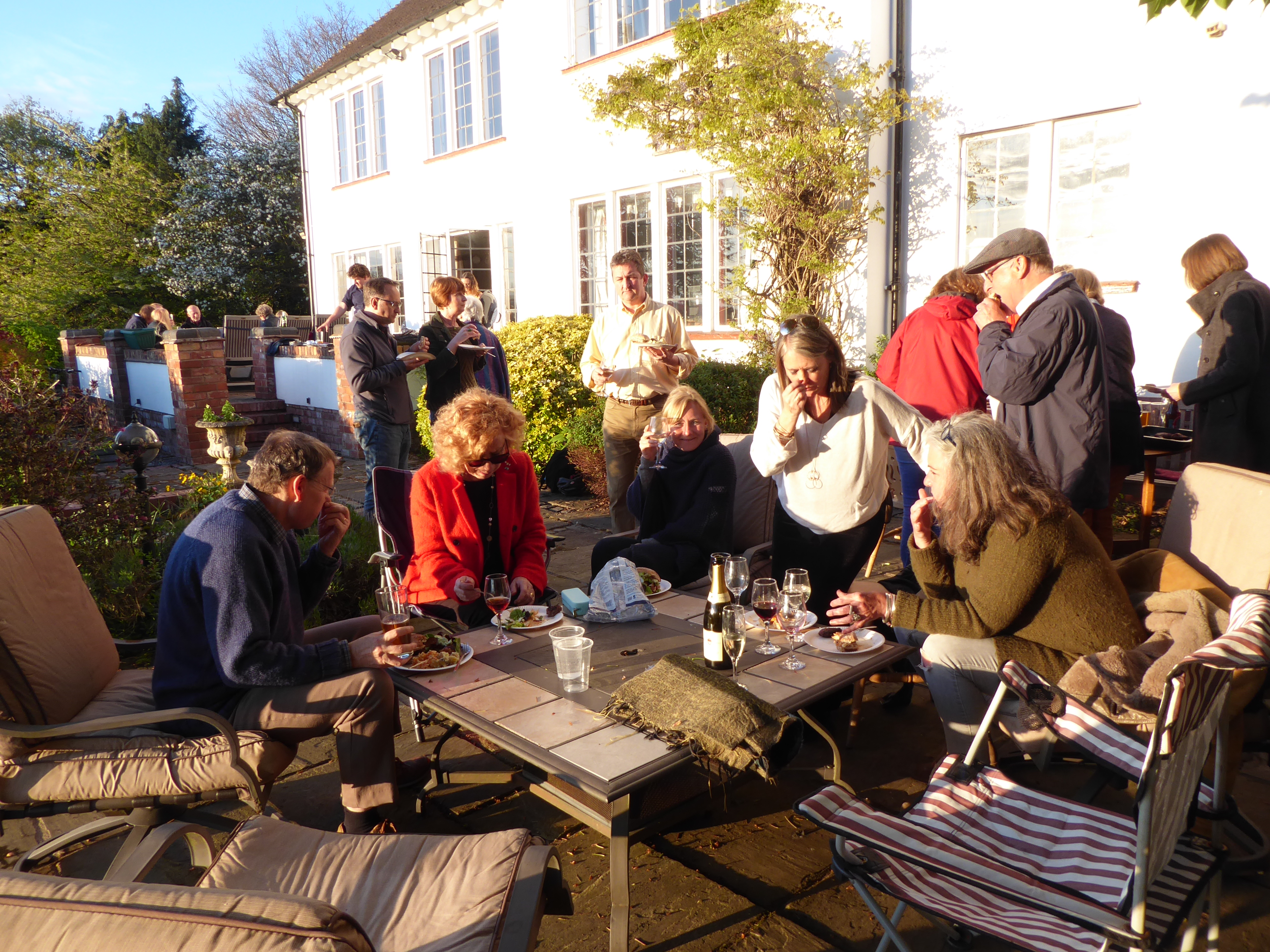
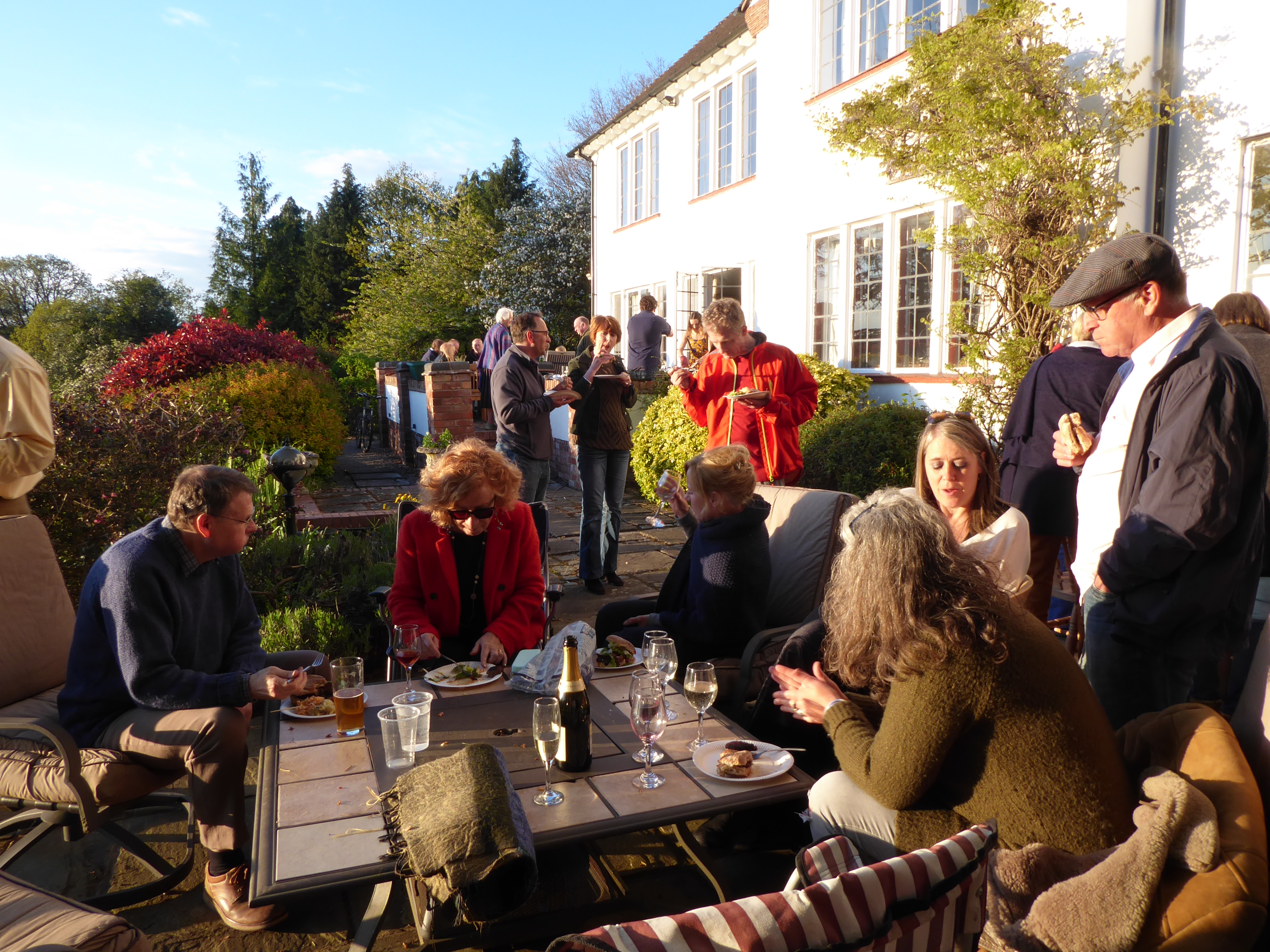
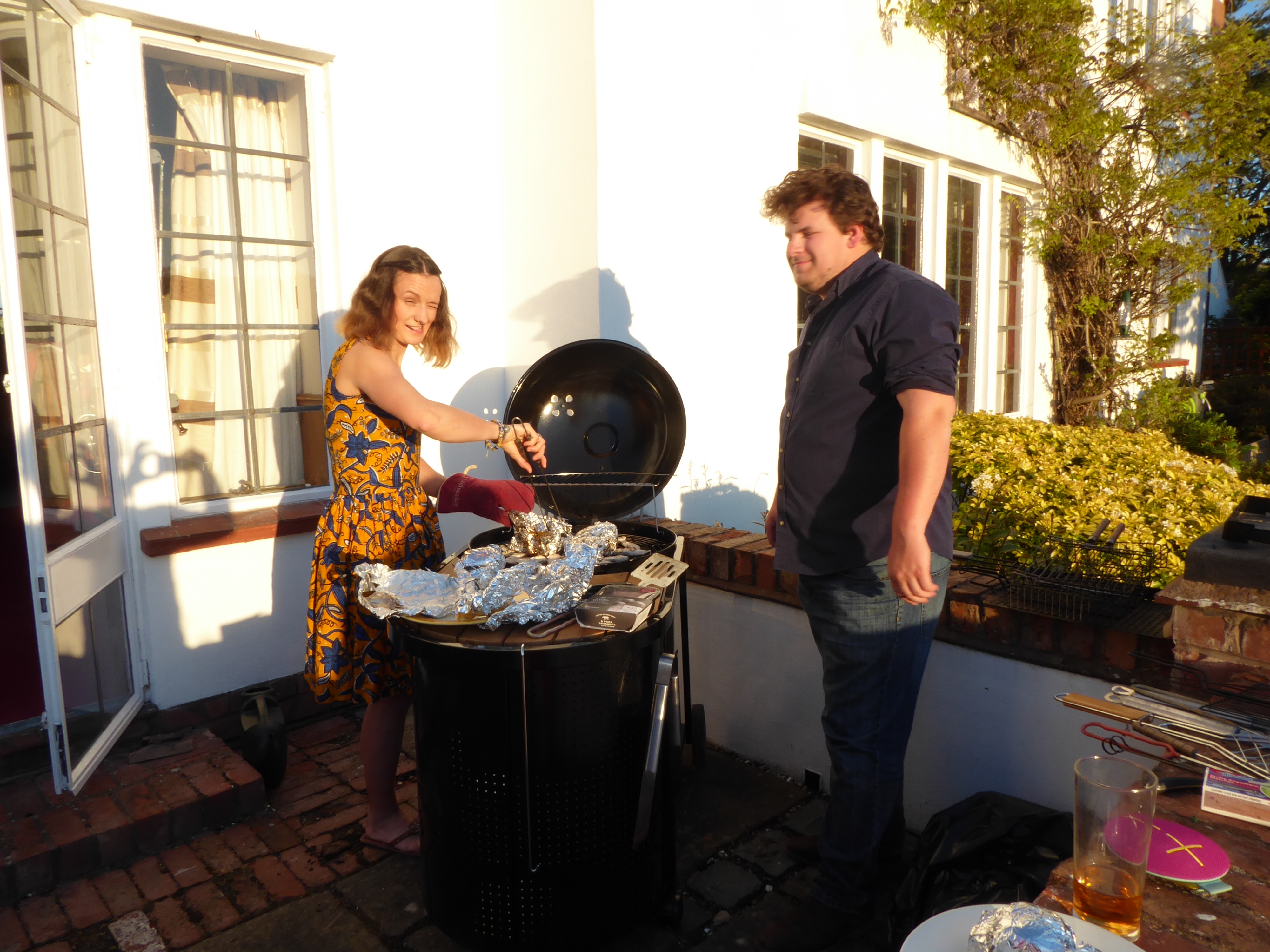
Meanwhie here are some photos of earlier this week when we had some good weather and a barbeque for family and friends. 

Day 38: Gori to Tblisi and the end of part 3: 87km and 530m of climbing (Total 7314km from Bewdley)

All good things come to an end and so it is with this part of the trip. At about 4.30pm yesterday, and 2513km after leaving Istanbul, we cycled into Tblisi old town and so ended this part of the tour.  

Bernie and Lea, our host in Stalin’s home town

We started with a wonderful breakfast prepared by Lea in the Nitsi Guest House in Gori. Omelette, home made cheese and wonderful scones set us for the delay ahead. Lea divides her time between her village, which is just in South Ossetia, and the town house in Gori. She has 2 daughters at university in Tbilisi (one in international school and the other in medical school) and her son is still at school in Gori. She hosts a wide range of international visitors including Russians, but the Russian army bombed Gori as recently as 2008 and many locals in that city lost their lives in the conflict over South Ossetia. Her village, where she lives with her husband and father is now in land de facto controlled by Moscow. Politics intervenes in the lives of lots of people we have met in Turkey and Georgia. The one thing that ordinary people cannot understand is why on earth Britain would want to leave the EU. A striking common theme is that people see EU membership as a set of guarantees for ordinary people against the excesses of government and to avoid conflicts.

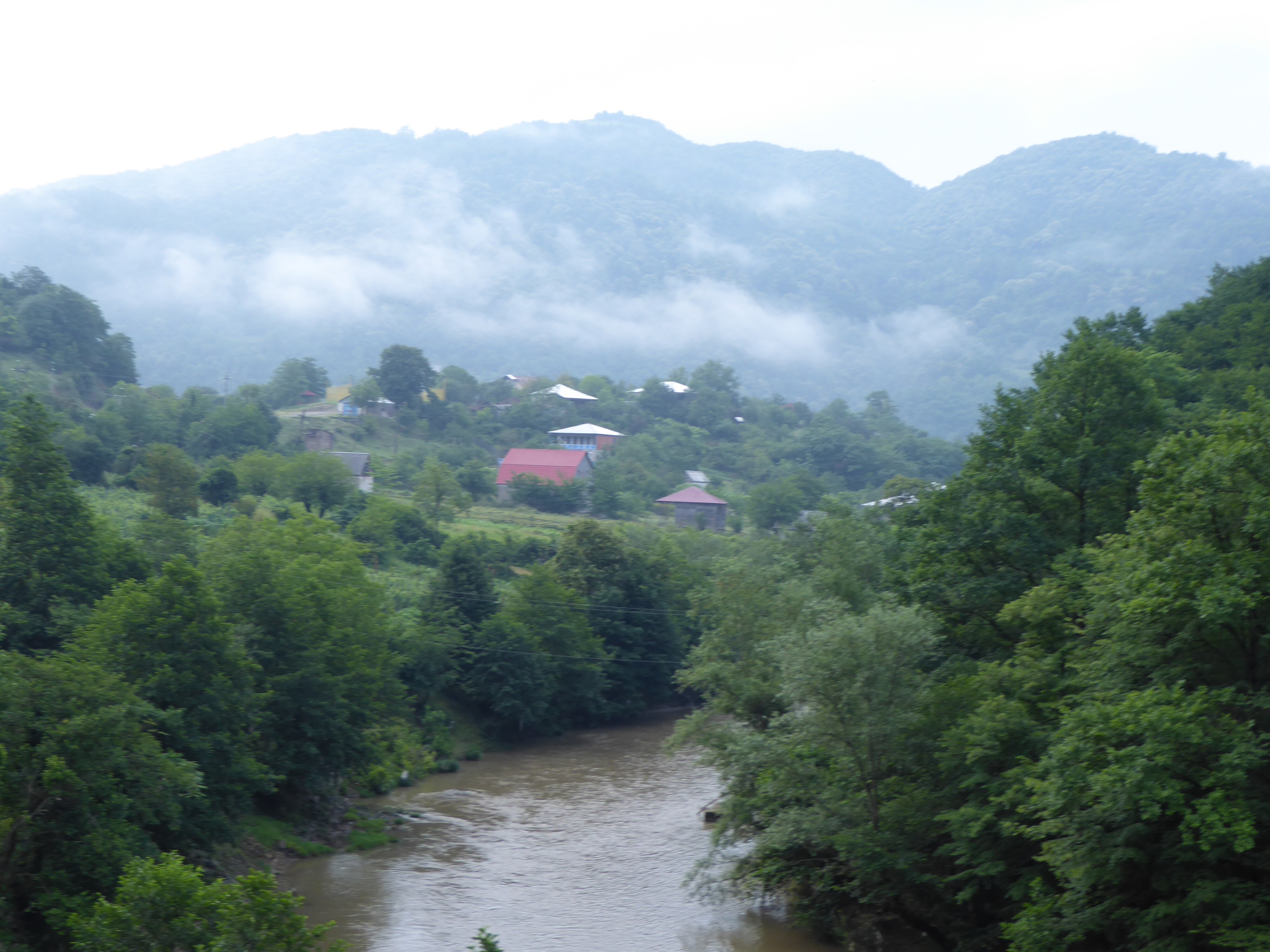
Images of rural Georgia

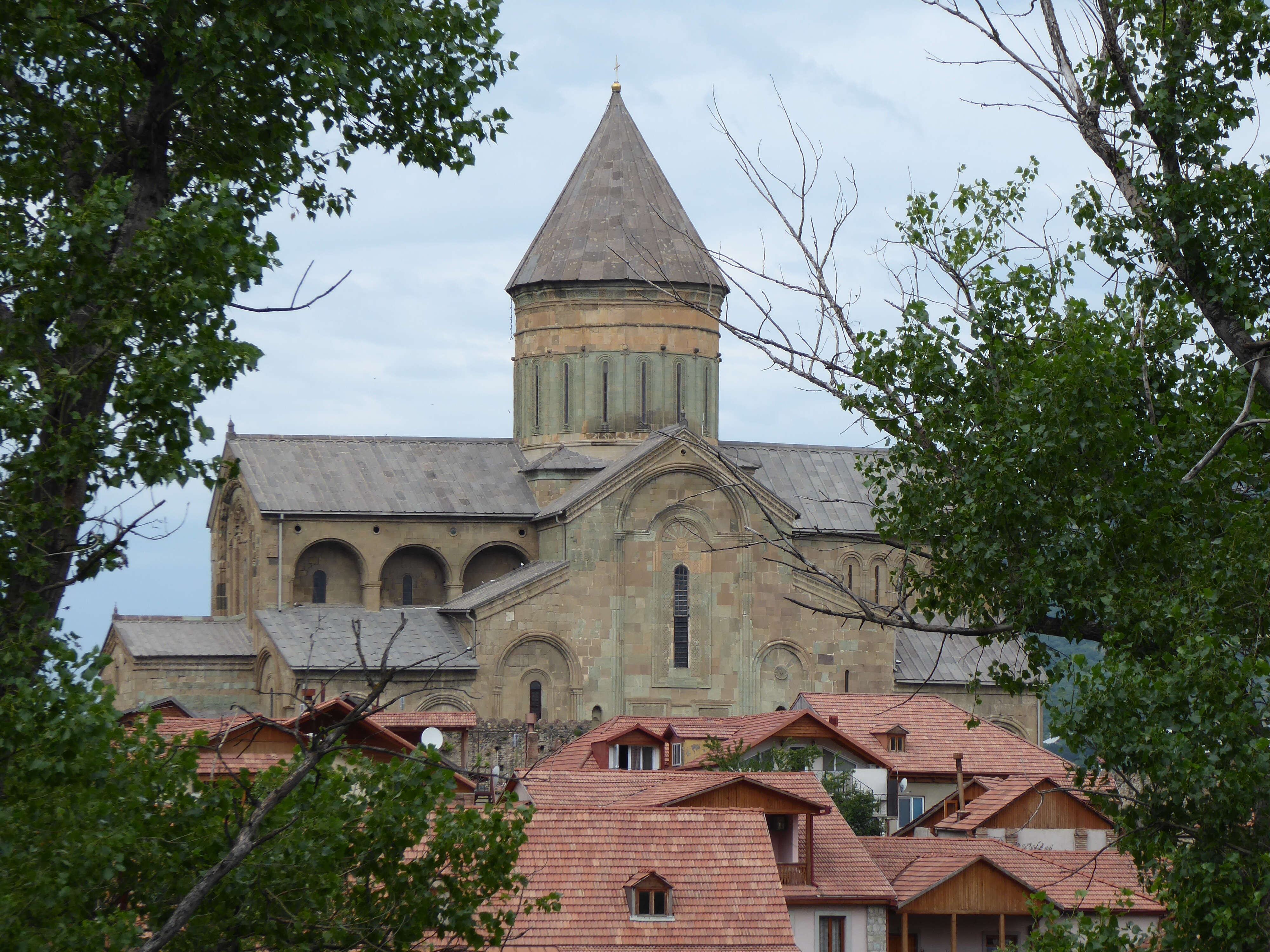
We ambled out of Gori and back onto the same minor road heading eastwards. We have been heading broadly eastwards since Venice and so I suspect our bikes could find their own way onto any road heading in that direction.  The morning was overcast but the promised rain mostly held off. This was well functioning, rural Georgia – neither poor nor well off. Here and there we saw relics of larger buildings from the soviet era, mostly now abandoned and rotting away. But life is thriving here amongst the relics of the past. We cycled across the valley floor and moderate hills towards Mtskheta, which was the ancient capital of Georgia. We arrived at lunchtime and had the most brilliant cappuccino coffee (albeit at tourist prices) outside the cathedral. 

The catherdral from across the river

The ancient town is now little more than a village with a cathedral for visitors, but it would be wrong to characterise it as only for international tourists. The vast majority of visitors are Georgians who come to pray at the cathedral church. The Chritian Religion in Georgia is less obvious than Islam in Turkey (where headscarves symbolise religious affiliation for many women). But 83% of Georgians affirm their adherence to the Orthodox Church, it has a special place in the constitution (which nonetheless separates church and state) and its work has a 95% approval rating across the country. What would the Anglican or Catholic Churches give for those statistics!
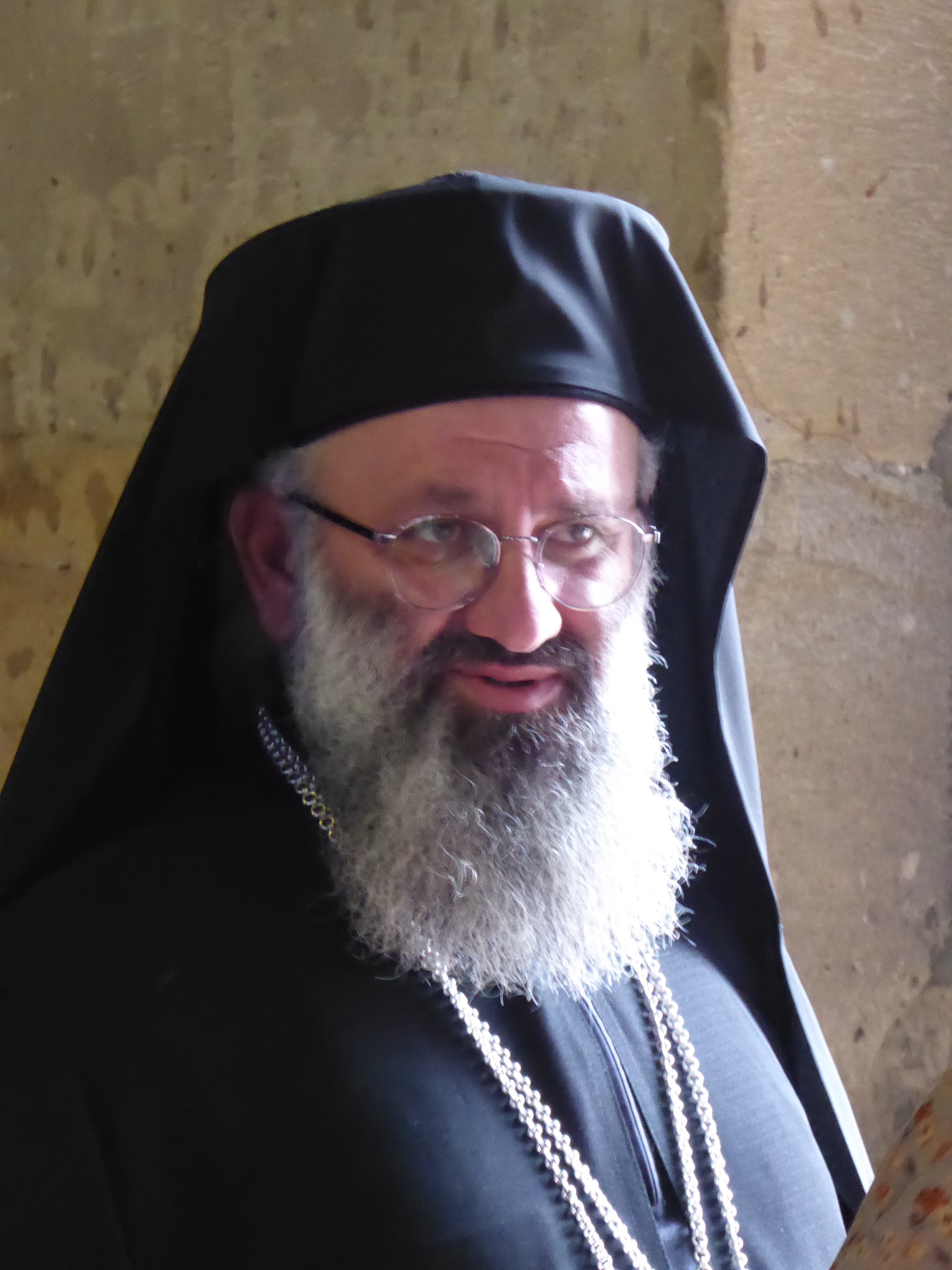
The senior priest dispensing blessings
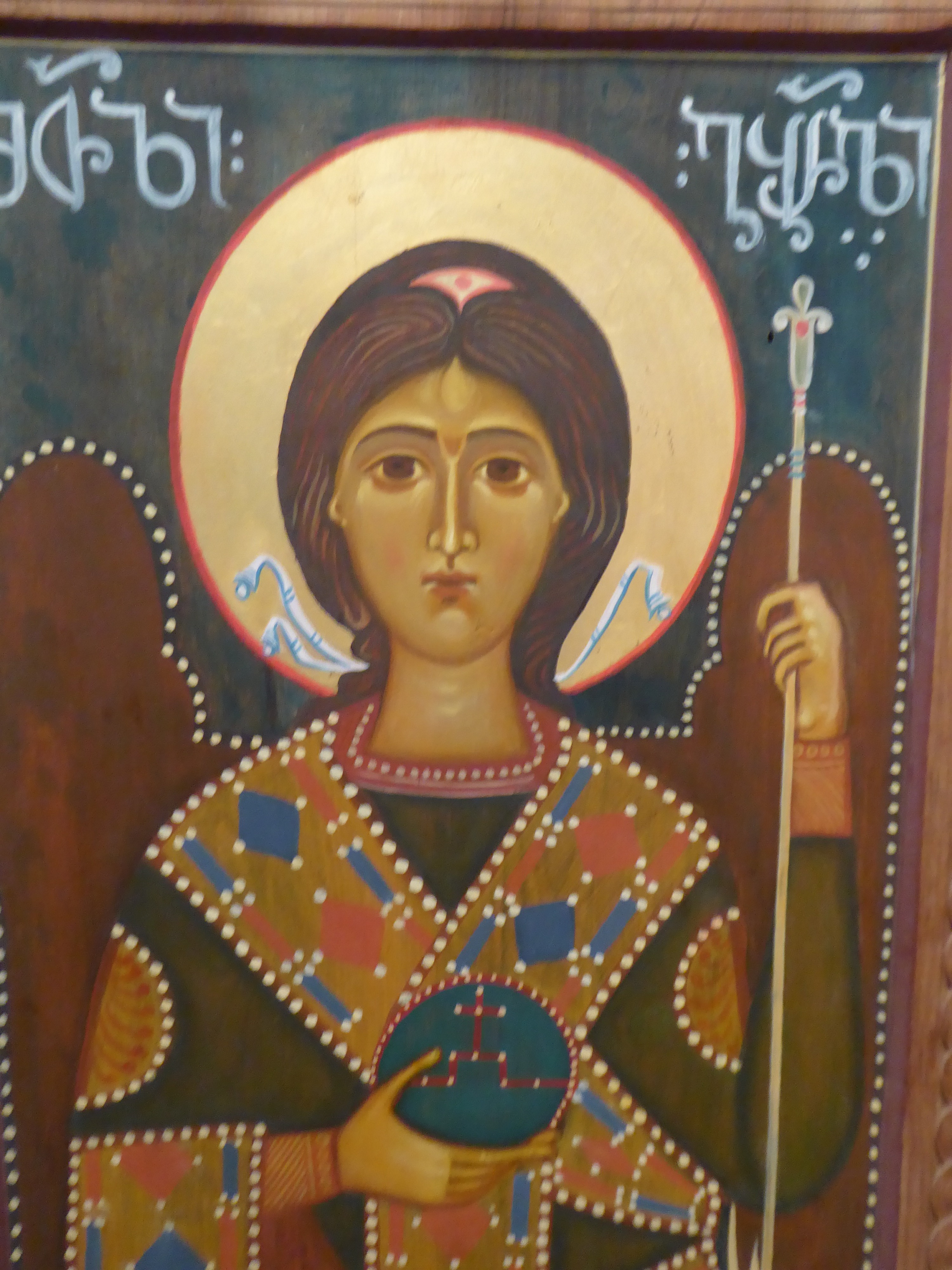
One of many icons in the cathedral

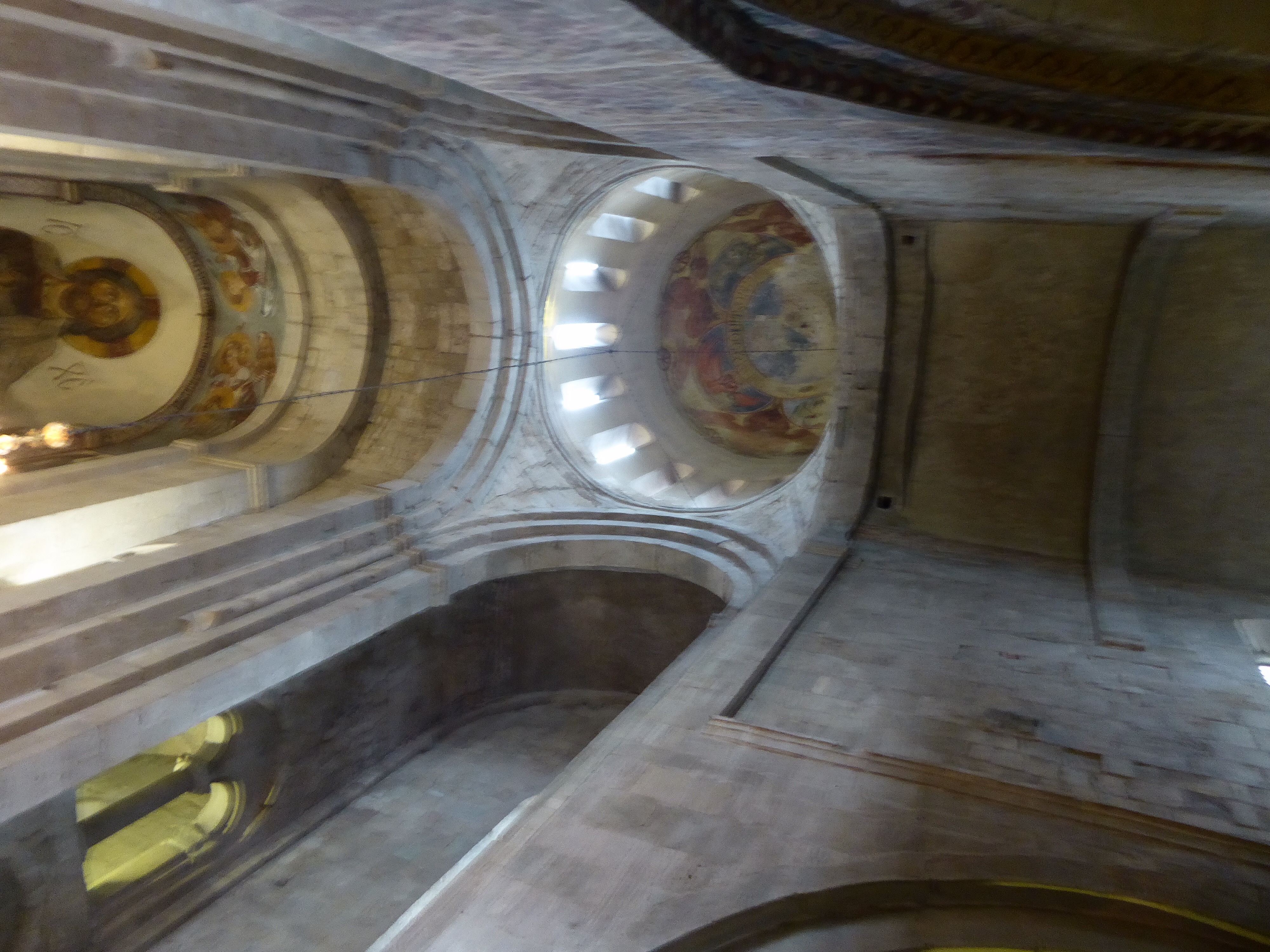
The 11th century cathedral was fantastic. Enormous with a simple beauty.It was built around an original 4th C church which is still within one of the chapels. Being a Sunday the piety and faith of adherents was on show in the cathedral – with multiple kissing of icons, repeated crossings and the touch of the priest was clearly a sign of acknowledged subservience by the laity. This was not religion on show but religion being practised. However people chatted during the service and there were priests on mobile phones inside the church. 
There were also elderly women seeking alms outside the church in a manner which must have been replicated for hundreds of years. The individuals may have changed but the role is identical.


We left thinking that we had glimpsed an almost mediaeval mindset with a common faith and an acknowledged spiritual hierarchy but in a world where sophisticated modern citizens were choosing to adopt these practices. Lots to think about and ponder.

Then it was back to the road and the last 30km into Tbilisi – which was inevitably on main roads. Getting into capital cities is the worst cycling and this was no exception. However it was all gently down hill as it followed the river valley and so we sped along the 4 lane highway (which for us is better than 2 lanes as we largely had the inner lane to ourselves). It was also Sunday and so maybe not quite as busy as a weekday.  

Georgia is the spiritual home to generations of Mercedes Benz cars. About half of the cars on the road seem to be Mercs, in various stages of repair having been built over the last 40 years. There are a few new ones but no Mercedes in Georgia can ever be allowed to die, however old. They are repaired and repaired and then repaired again. It’s a tribute to the original engineering and to the ingenuity of mechanics here, but I suspect having a Mercedes is also a symbol of having made it as a Georgian man.

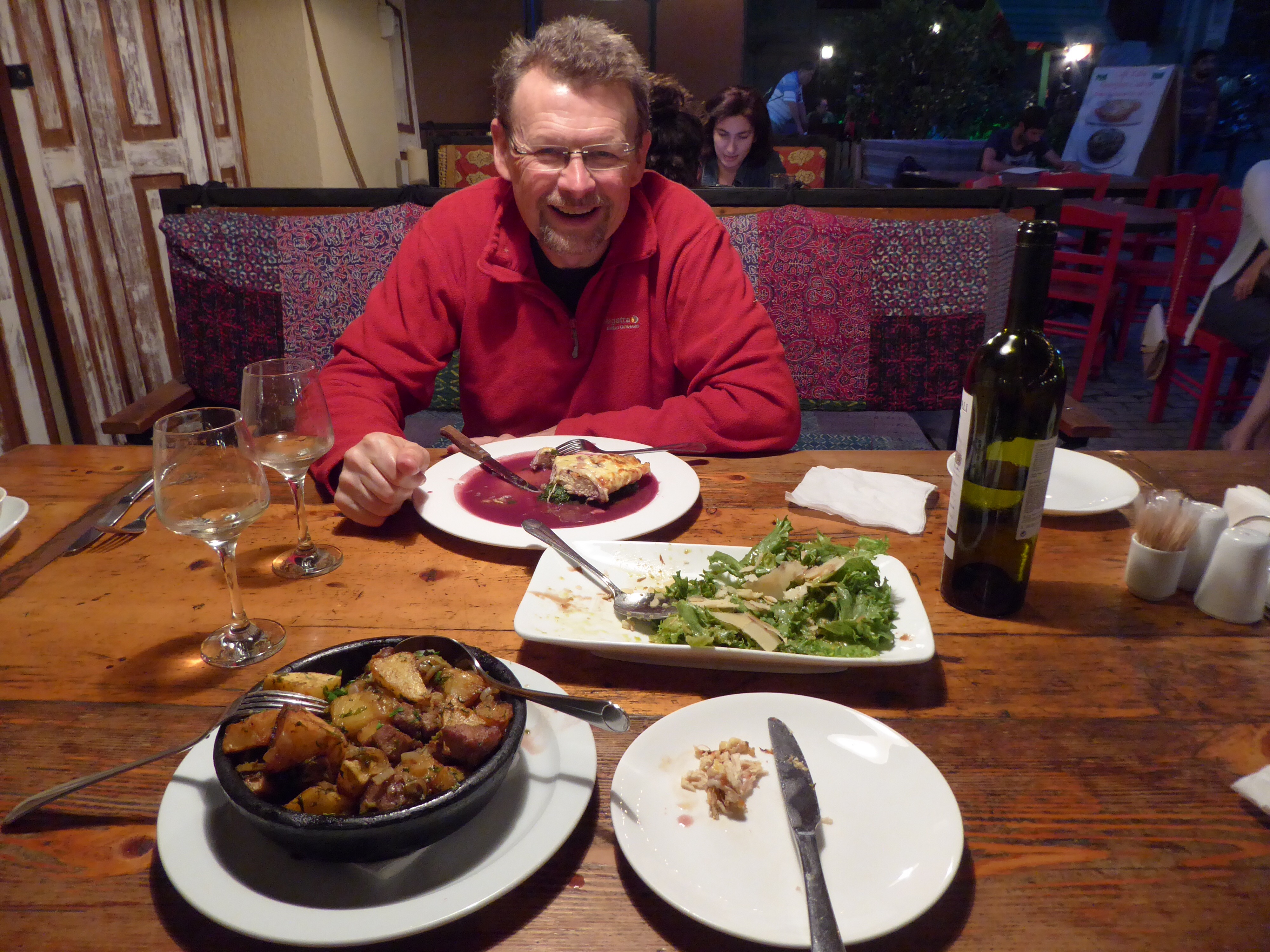
We found the apartment with little problem and then went out to the old town for a lovely meal, with a bottle of wine. We felt satisfied rather than ecstatic at having made our goal. The whole journey just felt like a huge privilege.

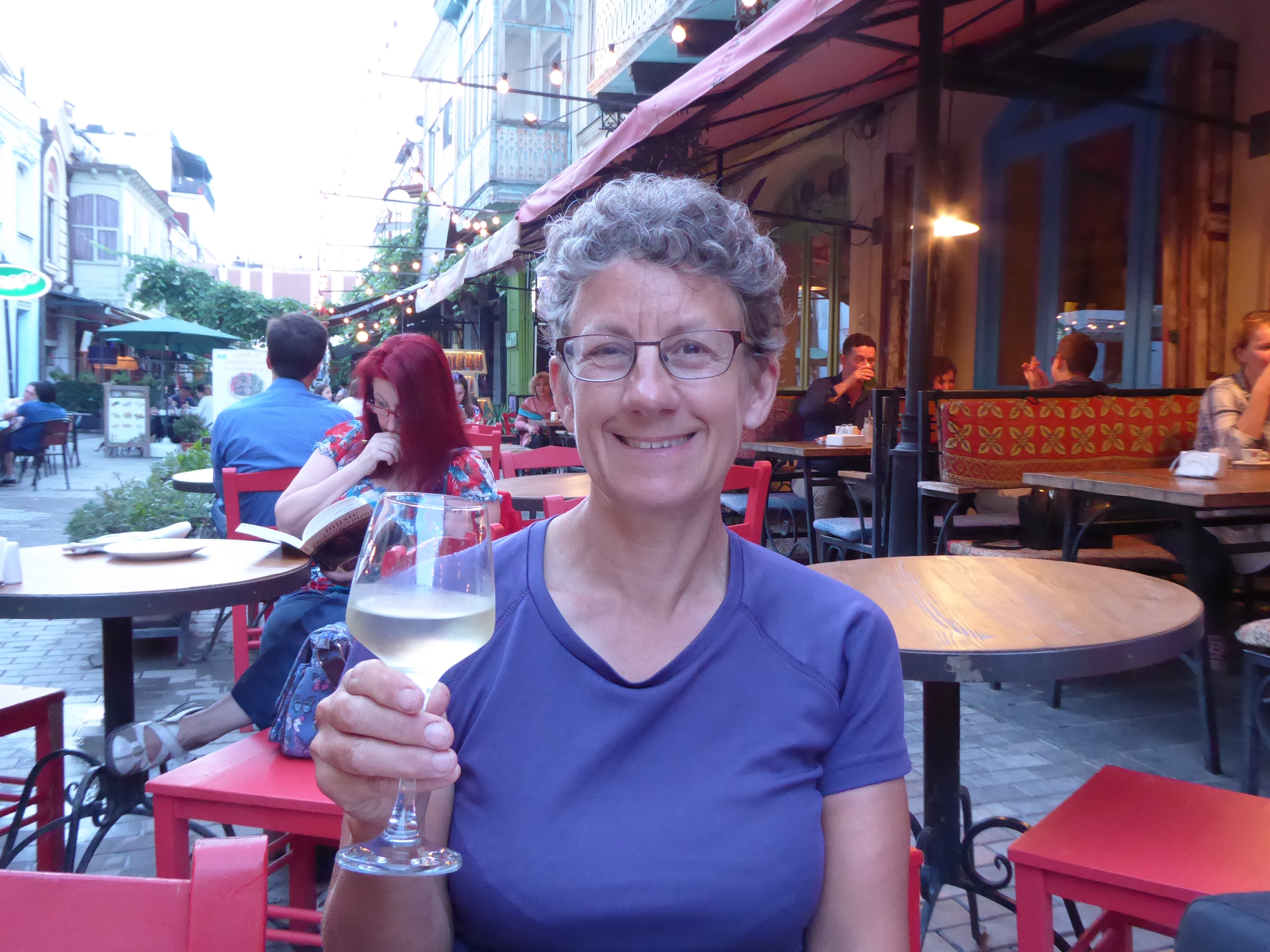
A celebratory glass of Georgian wine
Perhaps the last photo of the goatee beard!
 

If you have enjoyed the blog, can we ask a favour. Please add your comments and made a modest donation to Walk for Life (through the link on the website). This is, in part, a charity ride and that only works if we can gently persuade people to support this wonderful charity.   Thanks for reading – signing off now until 2017 (perhaps).

Day 37. Kharagauli to Gori. 114km. 1208m of climbing (7227km from Bewdley).

(Bernie) I began to think the Georgia leg of our trip was jinxed. Accident at the border, hot and humid the next day, ferocious headwind the next, raining on our day off and then total road wipe out yesterday. But today everything got back in to order and we got back on schedule.
We set the alarm early to try and beat traffic for at least a few hours on the main road that we now had to follow. Backtracking the 10km to the main road first thing was a bit dismal as we followed the road up and down – at least it was more down than up this time. So at 7am we were back at the place we had left at lunchtime the previous day.  

The early start was worth it as the traffic was light (it was also Saturday) and we saw the early morning mist on the green hillsides. Riding on the excellent road surface was a treat and the river valley we followed up was beautiful. The first section was very gentle climbing so all in all it did not feel too bad that we had to change plan. 

 We had only managed to breakfast on jam tarts, cherries and coffee (all that Kharagouli shops could offer) so after a while we found the first restaurant that was open and stopped for coffee. We thought we had ordered some food but when nothing seemed to arrive it appeared that we had somehow misinterpreted the signs and only had coffee, so off we set again and continued the climb on sugar laden snacks instead.

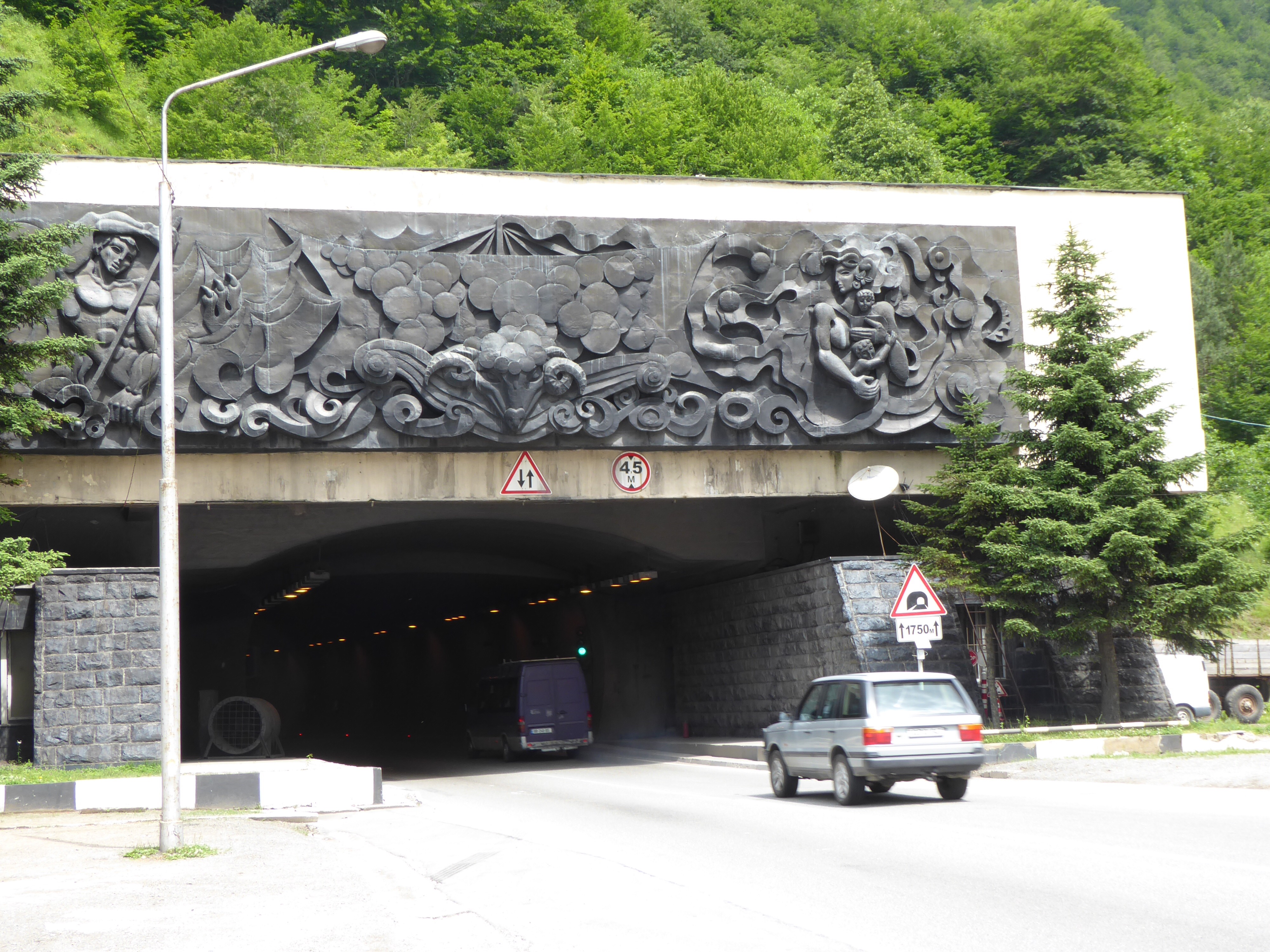
Traffic built up but was not dreadful. Sometimes lorries passed a bit too close for comfort but more alarming was overtaking traffic the other way, coming directly towards us at speed! The gentle climb turned steeper and at that point the road widened to 2 lanes so traffic was able to give us a wider birth as we plodded on up. At 850m (we started at 200m) we reached the Rikoti tunnel that cut about 150m off the pass and had been described as ‘horrible’ on cycling blogs.  


We paused just before the entrance to debate what to do – there was a steep bypass road or we could just belt through as fast as possible with all our lights on. As we were standing there a man with a pick up truck pulled up. He declared the the tunnel was far too dangerous for bicycles and he would take us through with his truck. Fantastic! We quickly loaded up and were soon through the 1.7km tunnel. As soon as we entered it I was so glad I wasn’t cycling as the lanes were narrow and it would have been terrifying. The driver tried to persuade us to let him take us on to the next town. It is difficult to explain to non-cyclists that we wouldn’t want to be cheated of the downhill bit after we had slogged up the difficult bit but he politely set us down. Such a typical example of Georgian wanting to offer help.


We duly freewheeled our way down hill and soon reached a nice looking cafe where this time we got decent coffee and yummy pizzas Not Georgian traditional food but just what we needed. They were wonderful. We gently continued to descend to the Mtkavari river, still at 700m. We would follow the river all the way to Tblisi and we’re delighted that we would be going downstream and not upstream!  

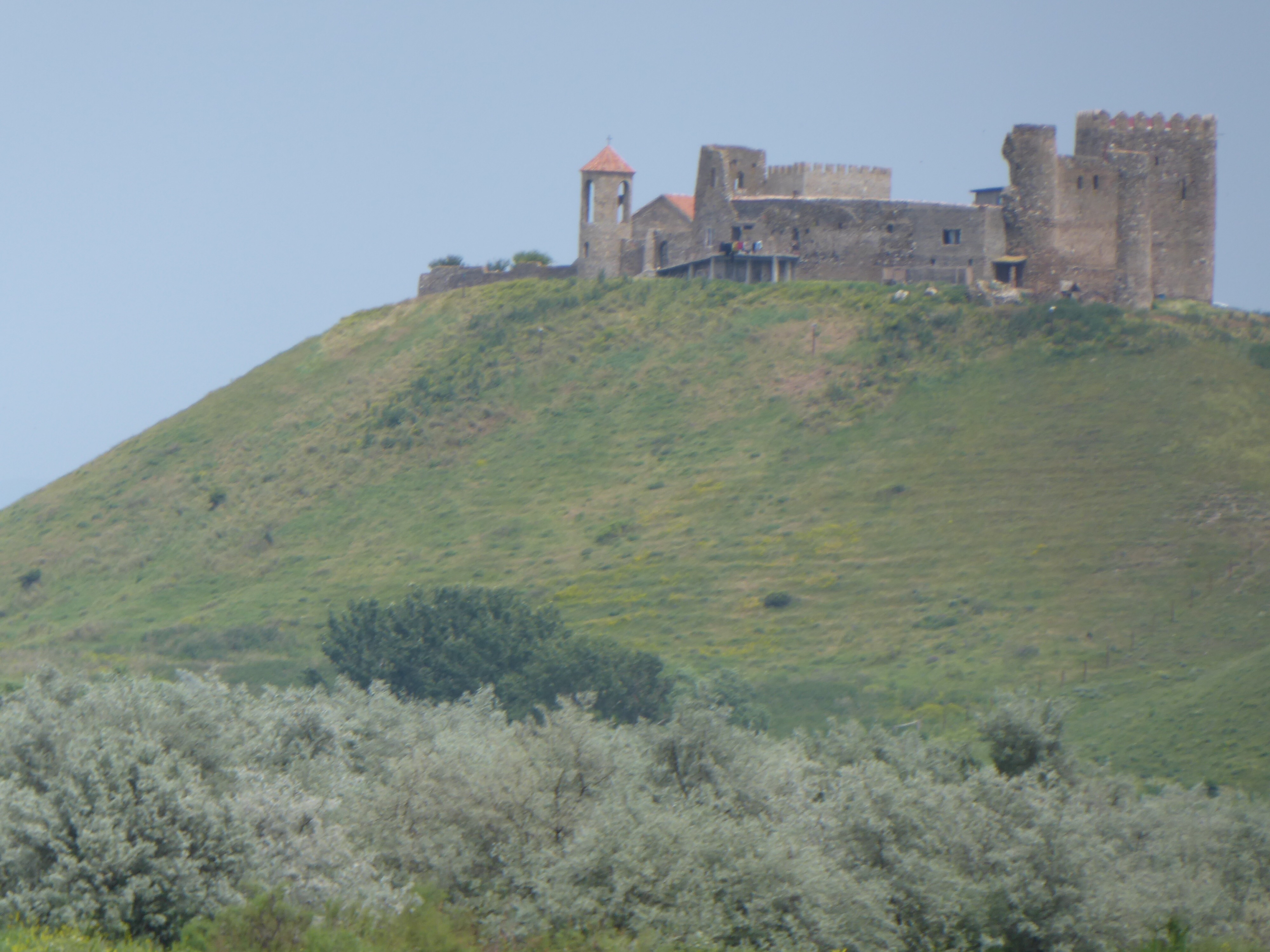
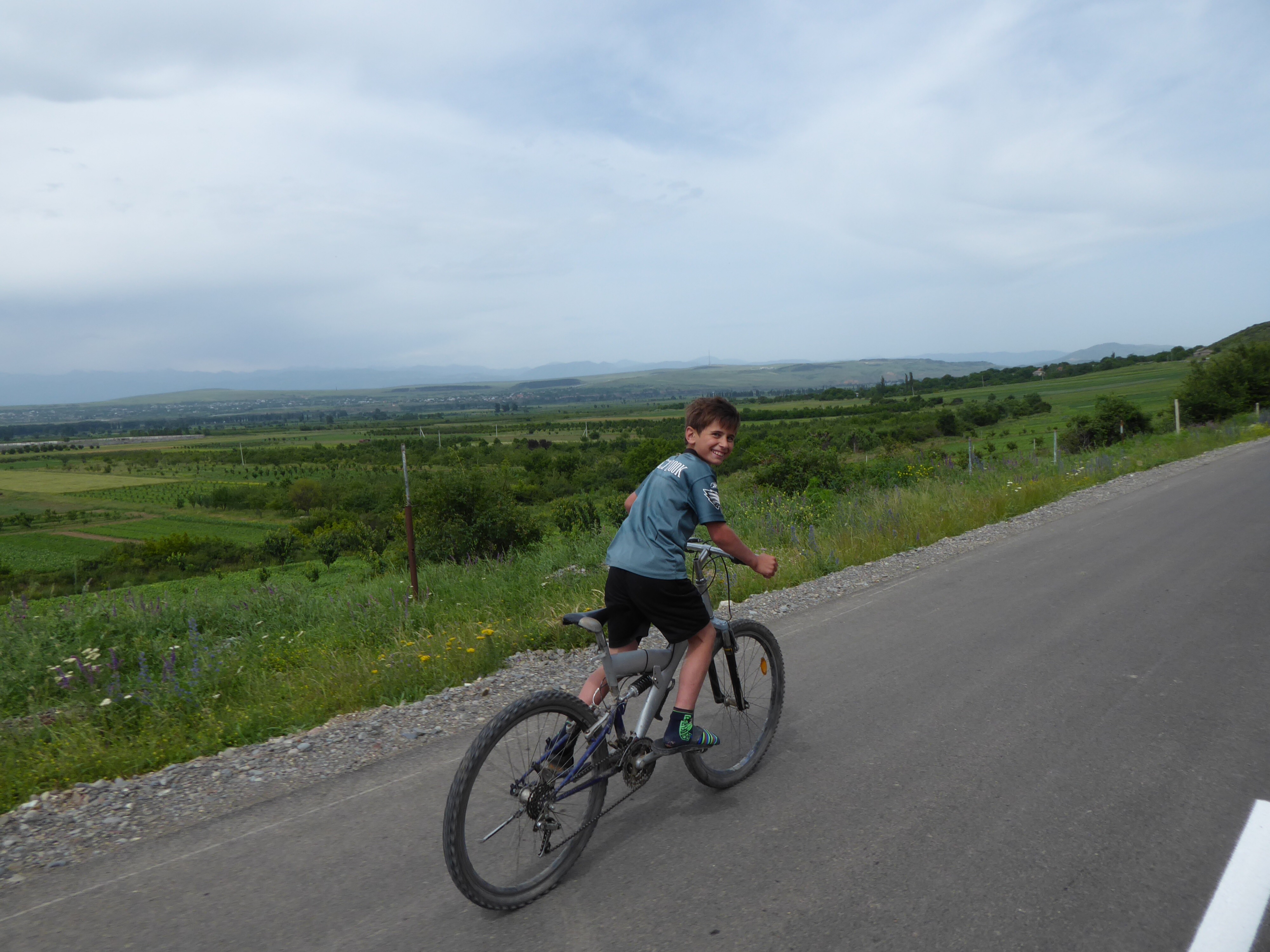
We at last were able to turn off the main road and on to more minor roads that ran south of the river. The road gently undulated along the foothills. This was cherry picking season and there were hundreds of farmers by the road with buckets of cherries to sell. We also hit the farm rush hour – as all the packers came out of the fields. We ambled at a slowish pace knowing that we still had all afternoon, passing a couple of old churches and a castle. The road turned slightly more into the hills – it was gentle climbing really but our legs were tired but it was worth it as we got good views across the wide valley and hazy views of the snow capped Caucasus Mountains in the distance that creat a huge natural barrier with Russia.     In one village we were accompanied for several Kms by 3 lads on their bikes. 


At last the road turned downhill – but with a final steep hill (as there always is) and we reached the industrial town of Gori. Gori’s only claim to fame is that is the birth place of Stalin and even when it became apparent that he was a psychopathic tyrant, the townsfolk were reluctant to let him go as a son of the city – if not a hero then at least a strong man who got things done. It was the last place in the former Soviet empire to still have a statue of Stalin in the main square. The statue was taken down quietly overnight in about 2006 with no further discussion with the people!  
We duly cycled up Stalin Avenue and easily found the friendly guest house we had booked in a pretty side street and we could finally collapse. Back on schedule and one more day to Tiblisi.

Day 35: Kutaisi to Khargauli : 86km and 880m of climbing (7113km in total)

(David) Sometimes the best laid plans of mice and men go astray – and today was one of them. The day started well with the rain easing off and us having breakfast with the “Dragoman” team. They were mostly Australians who were travelling the world in an extraordinary truck, doing a mixture of camping and staying in pre-arranged hotels. The tour started at Istanbul and ended somewhere in the Far East, possibly Thailand. They drop people and pick people up along the way, visiting interesting places as they go. They whetted our appetite for places to the East but that will have to wait for next year.

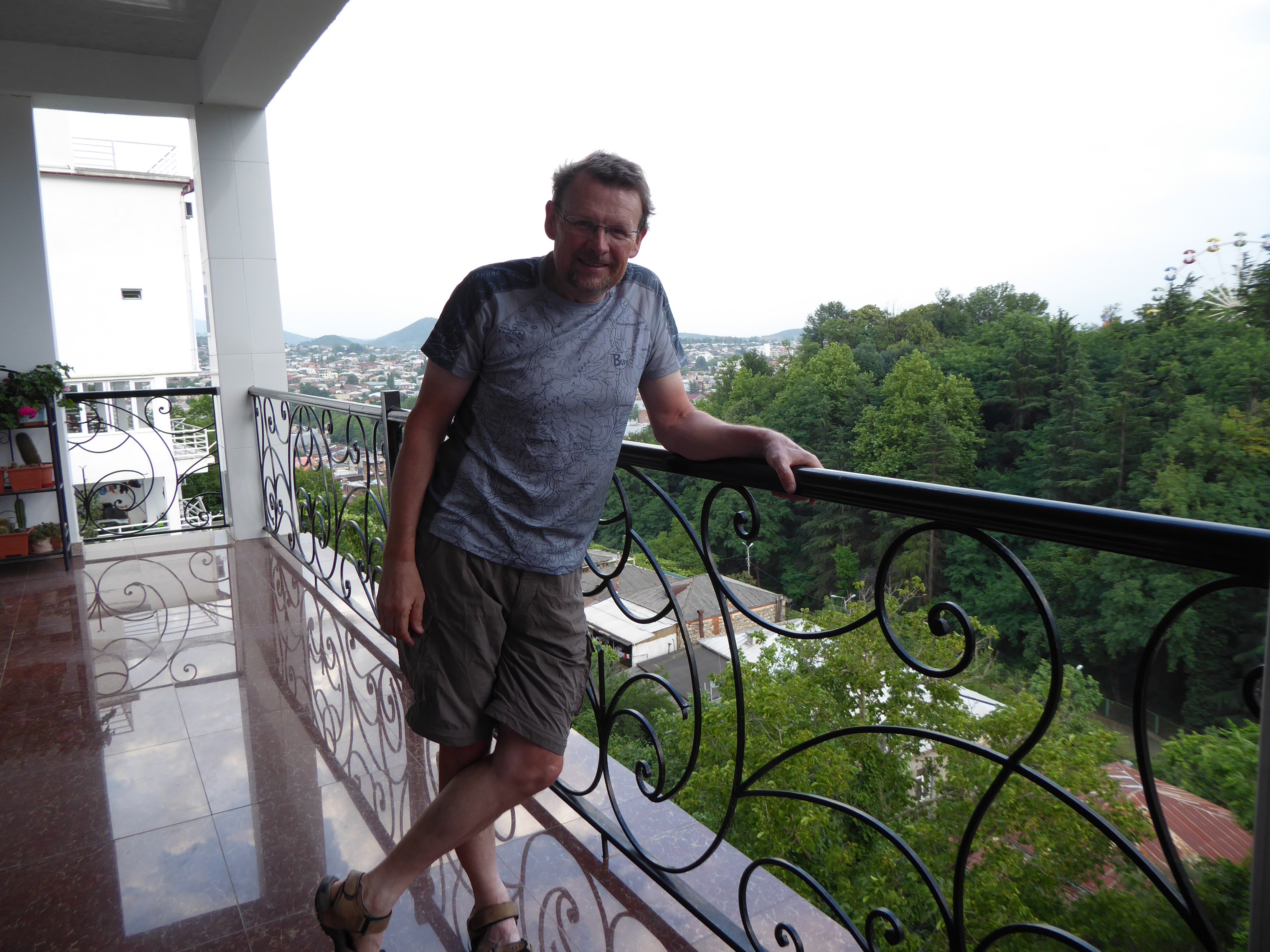
David on the balcony of the Argo Palace hotel
 
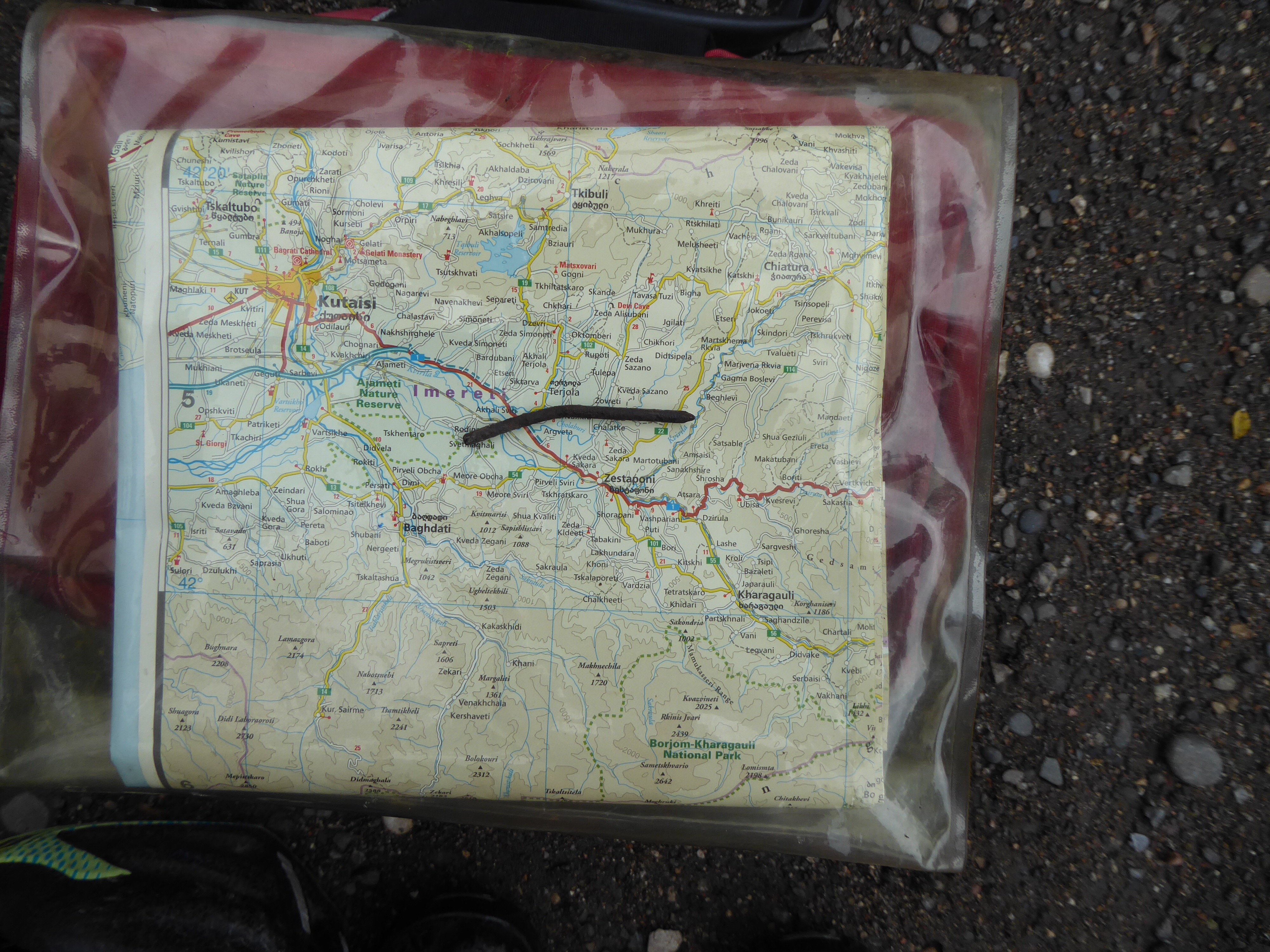
We go off about 8.30 and whizzed downhill out of town, back along the way we had come for 15km. Just as we were crossing the Rioni river my back tyre went down in an instant. We found the culpable nail – massively indenting itself into tyre and inner tube! New inner tube needed as this one is a goner!

Nail vs Inner tube is no contest with a nail this size!
20 minutes later we were back on the road, not before being offered help and spiritual assistance by some well dressed Jehovah’s Witnesses who stopped to help (and possibly convert us). We declined both and proceeded by seeking to respect all religions but ascribing to none, as before. They were charming about it mind you!

The road took us through a forest and then into open farmland, and finally along the “Winers route”. Georgian wine is famous throughout the world and this was one of the prime grape growing areas. However there is a catch. Vines grow best on steep slopes where the water drains quickly away – and there were plenty of steep slopes on this part of the route. The road signs helpfully (or dispiritingly depending on your perspective) gave the percentage for every slope. We had signs for 7%, 10%, 14% and even one lung busting hill was described as “19%” up (and was 19% up). 

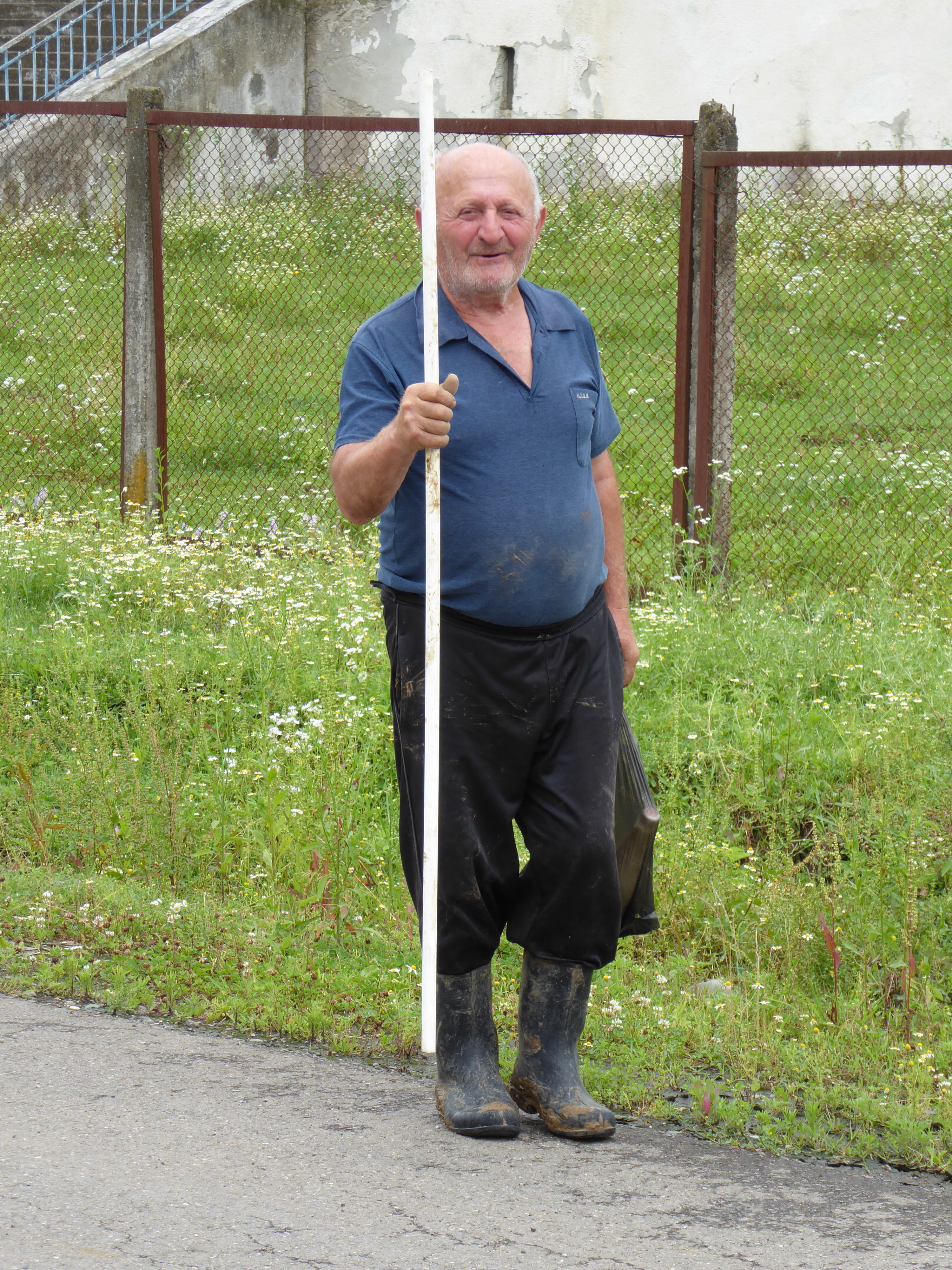
A passing farmer – wearing life on his face
Eventually we surmounted the last hill and flew down to the valley and across to meet the main Batumi to Tiblisi road. Hills or trucks – take your pick!
We soon got to Zestaponi – a forgettable place where the sun never shines (well not on the day we were there), the buildings are drab and cafes advertise coffee but have none (and no tea either). We soon left and rejoined the trucks for 10km.
Our plan was to divert off the main road onto the S56, which is a secondary road. Tertiary level roads in Georgia can be unpaved but, to date, “S” roads are almost all paved. The Guidebook warned that this road used to be terrible but had recently been upgraded and was now much better. Me thinks the guidebook author has not cycled this road recently! The first 3km were totally unpaved – but then a secondary road joined and it’s got a bit better. It followed a river and 80% paving to the town of Khargauli seemed bearable. The valle was lush with foliage and had little traffic. So all in all it seemed a good bet.

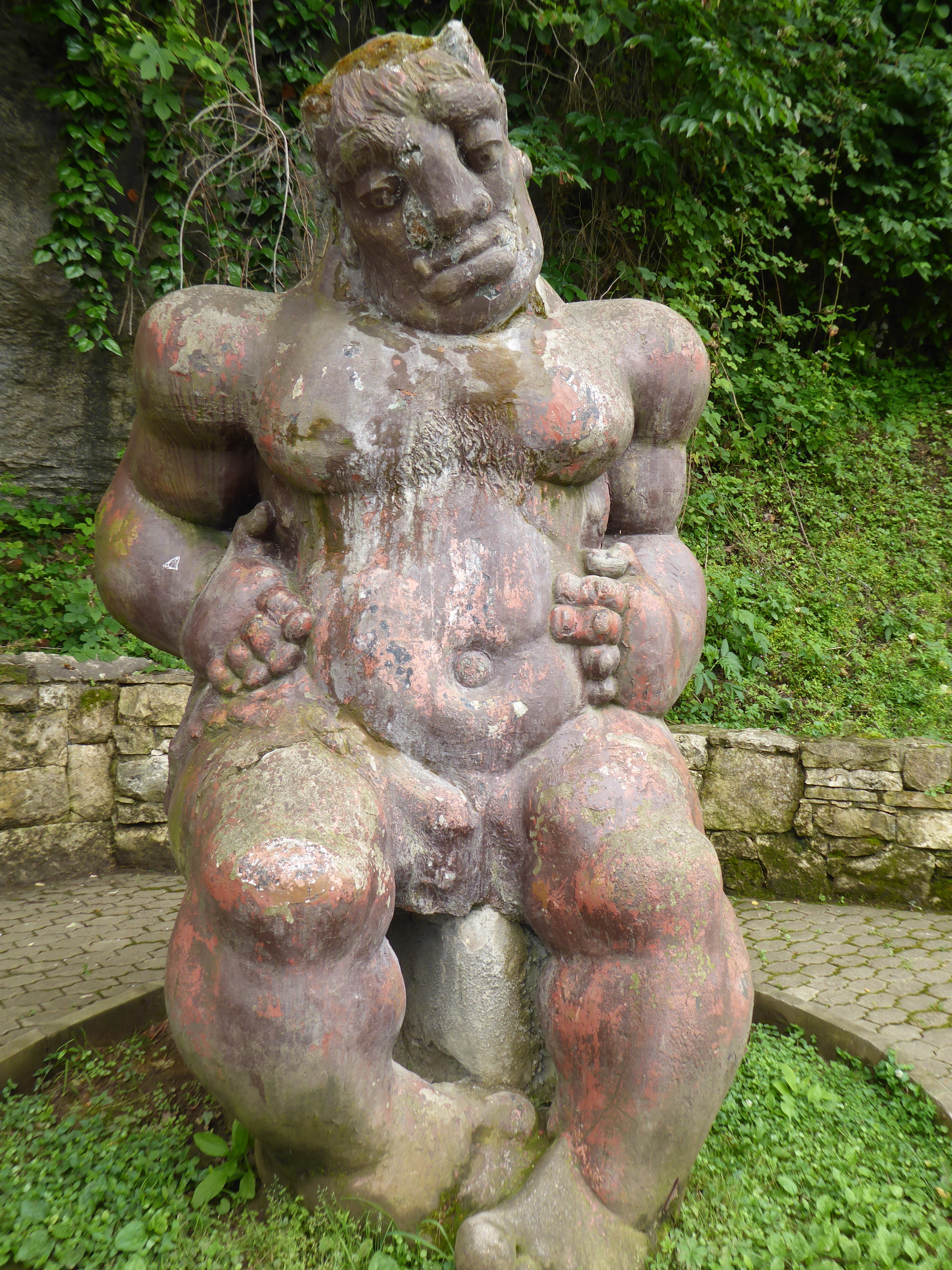
We have no idea what these statutes represent
 

We stopped after 60km for a late lunch, lolled around by the river and watched the trains pass on the railway that follows the same valley. After 11km we got to the town of Khargauli, stocked up with food and then met Pierre and Anna, from Bordeaux, who were cycling through Georgia as part of their 5 year trip around interesting places. They were delightful and gentle. They had a single tandem with a recliner seat on the front and various bags strapped to it (including a plastic balloon with a world map on it). We exchanged stories, perspectives and laughed about the idiocy of what we were both committed to doing. They are heading to Armenia, Iran and hopefully Pakistan. Tough route and I hope they make it.

Pierre and Anna’s extraordinary tandem
We said our goodbye’s and continued on the road up the valley. There was only one “road” but it was clearly in a terrible state of repair. The recent rain left the surface a sea of mud and watery potholes. It was very slow going and required vast levels of concentration. It would have been a fairly tough mountain bike trail but was near impossible for road bikes with trailers.

Mud, mud, glorious mud!!
1 hour in we had covered under 8km and it was, if anything, getting worse. Then a Dutch couple in a 4WD vehicle coming the other ways stopped Andy told us that we had taken leave of our senses if we intended to go on – as it got much muddier, steeper and was nearly impassible in paces. Not being Nigel Farage we were happy to take advice from those in the EU who know more than us, and so turned around and retraced our route.

It took nearly as long to go back down the road and, on the way, we met Anna and Pierre. They were determined to go on so we passed on the warnings and left them to their decision. Just after Khargauli we found a camping spot and collapsed. Tomorrow we will retrace our steps and face the trucks on the main road instead.


Just as we had our tent up, Anna and Pierre appeared again as they were also beaten by the road. It may be a “secondary” road in Georgian terms but there is a huge gap between first and second on this occasion!