It seems a long, long year since we had to abruptly finish our last cycling trip in the middle on Vietnam because of a family bereavement, and make our way hurriedly home in the middle of the Chinese New Year holiday. The sadness of funerals was leavened by 85th and 90th birthdays of David’s and Bernie’s mums respectively but the pall of Brexit and the generally toxic nature of UK politics seemed to overshadow the whole year.
The gross inaction by governments across the world in regard to the climate emergency added to our sense of gloom and foreboding – we will all have to act on climate change and the longer we wait, the tougher it will be. It was therefore with a tinge of guilt that we booked our long haul flights back to Bangkok (inadequately assuaged by carbon offset) but also with enormous excitement. This time the plan is to head south through southern Thailand and Malaysia and down to Singapore. Covid-19 (coronavirus) made the whole trip uncertain. Daily perusal of the numbers for Thailand and Malaysia have shown small rises but now on a par with numbers in the UK and once the numbers exploded in Italy it seemed safer to be on our bikes in the fresh air in Thailand than getting on the tube in London.
We left Birmingham at the tail end of storm Jorge. The third storm in quick succession, leaving Bewdley (our home town) and many areas of the country (almost) flooded – with the river barriers just doing their job. 17 hours later we emerged from the plane into 33degree sultry heat and we were in an entirely different world; switching back into our travelling mindset and the glory of leaving all those problems behind us for a few weeks.
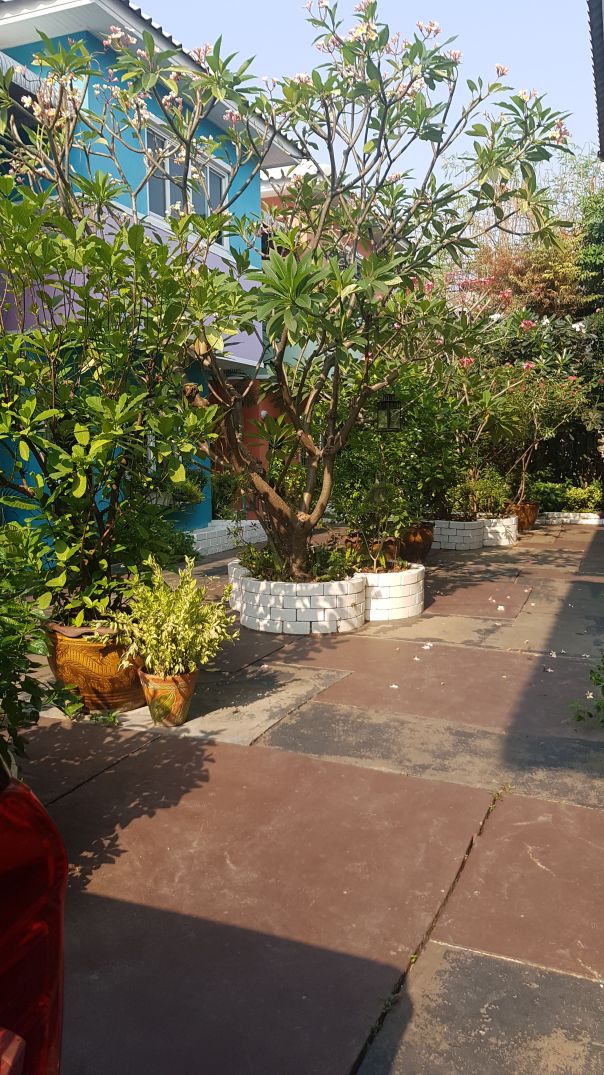
We reached our pleasant little hotel in a little backstreet on the non-touristy side of Bangkok. Plants and potted trees and brightly painted wall a pleasant haven, just back from a busy road with its impressive if frighteningly complex maze street cables, just above the pedestrians . Although we seem to be the only guests…is this a sign of things to come? Certainly the lack of Chinese tourists will make a big dent in the tourist economy. While Bernie languished in the air-conditioned room catching up on the missed nights sleep on the plane, David had a fit of activity and had soon rebuilt our bikes. We had arrived and were ready for our next adventure
Our last trip ended in sadness because my brother, Peter, a wonderful musician, devoted Dad and much loved brother died on 3 February 2019. He was a traveller who loved this part of the world and was responding with wit and perceptive comments to photos we sent to him by WhatApp up to a few days before he died. We all miss him greatly.
But Peter would have wanted us to carry on and so, over the Christmas break, we are planning the next leg of this amazing journey. At the moment we are planning to leave the UK on the 29th February for about 7 weeks, with a provisional plan to cycle from Bangkok to Singapore.
If anyone reading this has experience of cycling this route, we would love to hear from you. All tips, routes and information about places that must be visited (or must be avoided) would be most welcome.
It seems prescient to start the trip again on 29th February, the leap day of a leap year, and we will start the blog again as we lead up to our departure.
Happy Christmas to anyone reading this and our very best wishes for 2020.
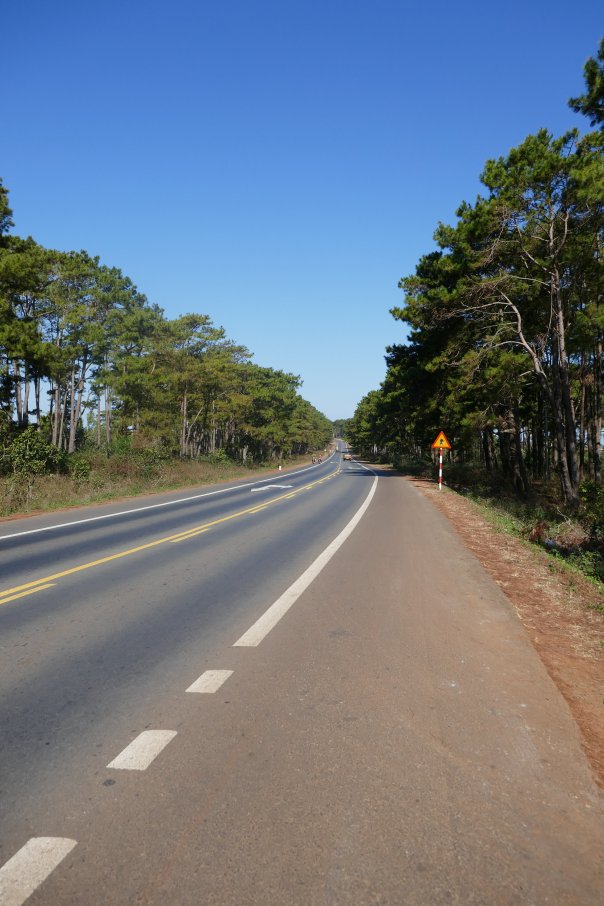
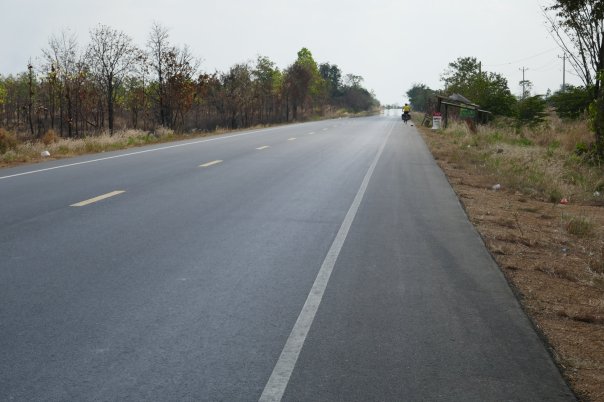
At some point today, Bernie (who was cycling in front of me) said “makes you think all this cycling”. Makes you think what I wondered – but the answer is that it just makes you think. There are lots of times of the day when the road looks much the same as it did for the last hour, and will look much the same for the next hour. Traffic was light, the surface was good and there were not too many kamikaze motor bikers doing 60kph on the wrong side of the road just to prove they were invincible. We duly got out of the way of the few who did – thus proving they were right, of course.
The “main” road we followed all day
We learned today the sad news that one of my favourite comedians, Jeremy Hardy, had died of cancer. It also would have been have been my father’s birthday today – he died 16 years ago. If he had lived, he would have been 94 – which would have been a far better age than the age when he was taken from us all so young. Jeremey Hardy was a year younger than me, at just 57. I met him about 18 months ago at a legal charity dinner; he was as funny, genuine and engaged in person as he appeared on the radio. Both were sad losses and died far too young.
So back to cycling – why do we do it? I recall a cyclist in Scotland who referred to cyclists as “coffin cheaters” which is part of the reason – though there are other ways that are probably more effective.
Other than that, going up hills is easier on a motorbike but fewer children wave excitedly at motor bikers but we get waves en route all the time. Going slowly on a bike also means that life happens in slow motion around us – markets are full of people and bustle; but we slide through on our bikes with few observers (other than the children). We get fit I suppose but that is a side product – like losing weight – but is not the main reason we cycle. I suppose I still think there is something magical about having travelled 2,500km in a month under our own steam, seeing a country at slow motion and being a “tourist-lite”. There are sights we see, smells we experience, and people we meet that add up to things we would never have got any other way.
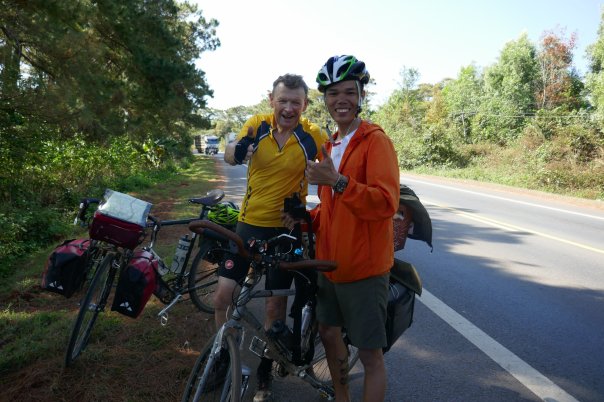
Viet in the way home for New Year
Take Viet for example. A fantastic young man who was cycling home to his family from Danang (where he worked) to BMT (see yesterday for an explanation of where this is). He was cycling the opposite direction today and we stopped for a chat – and it filled us both with great feelings of joy. Happy New Year to him and his family.
Then there are the times when things go wrong – such as today when 2 gear change cables snapped. We only have 2 spare cables and both are used up. It took me over an hour to work out why the first (and second) ones failed and then gingerly put the last one in place hoping it would hold (it did). Job for tomorrow in a city – replace spare gear cables. I know Malcolm would have been far better at sorting it out but, honestly, where is Malcolm when you need him in a crisis? I just hope the last cable will last until we get to Pleiku (about 50 km) tomorrow. But perhaps solving a problem such as a broken gear cable can be just as satisfying as a great view.
So back to Bernie and the fact that cycling makes us think. She is right – it does. There is plenty of time to reflect on what makes us tick, what is important, whether we live our values, considering past decisions about things that are important and things we have got wrong. In my case there is plenty of material for the last category but somehow the rhythm of the road means that, instead of destructive thoughts, the thought pattern is to accept where things have gone wrong, gently accept the delusion (or otherwise) that this does not make me a totally bad person, and try to learn the lessons from things that have not gone as well as they could. I have no idea why this process is better undertaken on a bike, but it is. So as long as the gradient is not more than about 5%, the mind is in overdrive. Of course if the slope is steep, all energy is focused on turning the pedals and cursing the climb. Not much profound thinking gets done when the slope is 7%.
We had a good day today – single road but at times a ridge with views on both sides. The overall feel of the country is definitely “pre-holiday” – like Britain feels on 20th December. Lots of people loaded onto motorbikes going home to loved ones for the new year. Some packing was better than others – and some came apart at the side of the road. But it was soon repacked and on the way – all to add to families reunited
Strange to think that this delightful, peaceful and (becoming) prosperous country was the site of a bloody war less than 30 years ago as the west fought to stop the spread of communism. The pointlessness of that loss of life on all sides is now clear but was clearly obscured at the time. If today’s Vietnam is communism today (which it sort of is and sort of isn’t – just like China) then there are things to be said in its favour as well as the obvious things to say against it. This is a country with private businesses competing for customers, funded by capital and with some people who wealthy and many who are doing OK. Corruption is problem (so we are told) but its GDP has grown by over 6% per year on average for the past 10 years, The population (97M) was growing at 3% per year in 1070 but is now growing at 1% a year. So economic progress results in a sustainable population growth – once again.
We have had some tough days since HCM City so decided to give ourselves an easier day today. Having splashed out an extra #1.50 for a “VIP room” with a huge picture window overlooking the lake we had a lie in (ie did not set the alarm for 5.15am and opened my eyes at 6 as it was getting light). We had coffee and breakfast in bed looking at the early morning light on the lake. We slowly packed up but were still on the road soon after 7.30am.
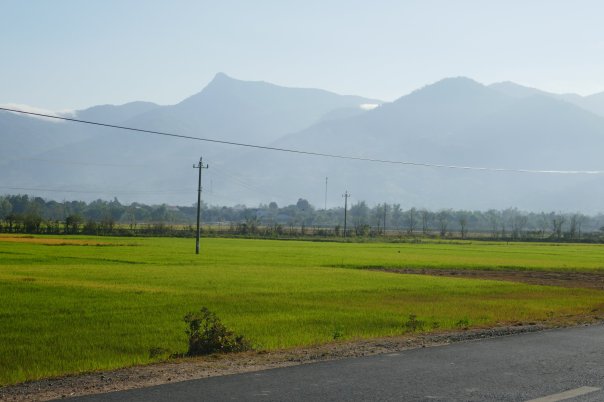
The first 10km were glorious as we rode round the lake and across the valley. Yellow light, green paddy fields and stunning surrounding hills. However the best laid plans do not always work and things soon changed after we had climbed a small ridge and wound through a few hills when we found ourselves in a different world – the world of modern Vietnam.
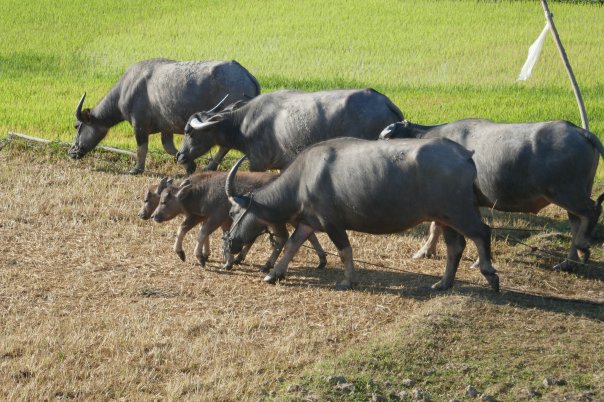
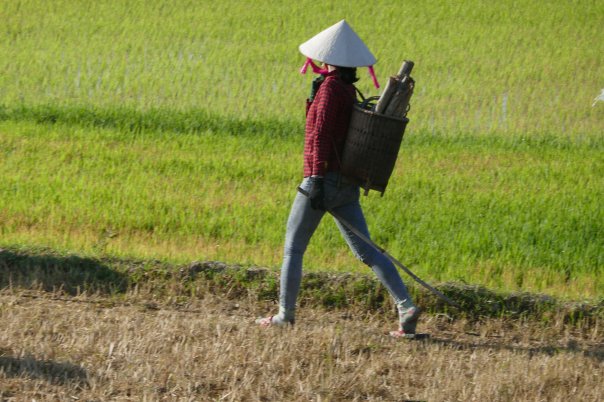
Buffalo on their way into the fields for the dayAnd the buffalo minder..
Busy roads and almost continuous development for the next 35km as we followed the road into the large city of Buon Ma Thuot (pronounced Boon me Tote or Burn my Tart or “BMT” as we referred to it as we could not cope with the full pronunciation).
Coming into the city we found ourselves on a large dual carriage way (not too busy) but, as the city is billed as the coffee capital of Vietnam, finding a coffee shop had to be our first port of call. We soon found a small coffee shop where we had an excellent cup of freshly brewed coffee. In Vietnam coffee shops only sell drinks but no food so the next hunt was for food. As a rarity there seemed to be a distinct lack of food shops or restaurants. However, aided once again by google maps we found a ‘mega supermarket’ just off our route. The shop could have been a large supermarket in Kidderminster – with very many of the same brands. Only a tiny proportion of the population shop at such places at the moment (and I refused to pay 50,000 dong for 1kg of bananas when we get them for 10,000 dong/kilo from street stalls and they are nicer) but, it was useful to stock up on some bits and pieces.
We then cycled out of the city along leafy tree lined boulevards – much nicer than our way in. However, we then hit our main problem of the day – WIND. We had a strong side wind most of the morning but were now changing direction into the teeth of the wind. The weather forecast said the winds were 17km/hr with gusts of 22km/hr. It seemed more ‘gust’ than anything and was tough going. We had taken a more minor road to avoid the heavy traffic out of the city but then had a triple whammy of strong headwind, poor road surface and a continuous 300m climb. I was finding it particularly difficult as the gusts would drive me back, so David took more of my weight from my panniers.
It may not look like it – but this road went uphill at 2% for 15km – and the quality of the surface was pretty terrible!
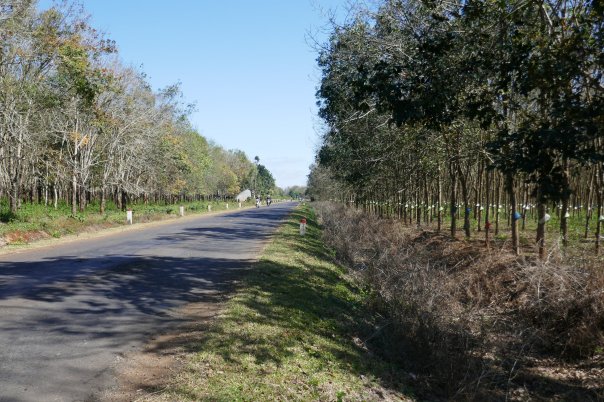
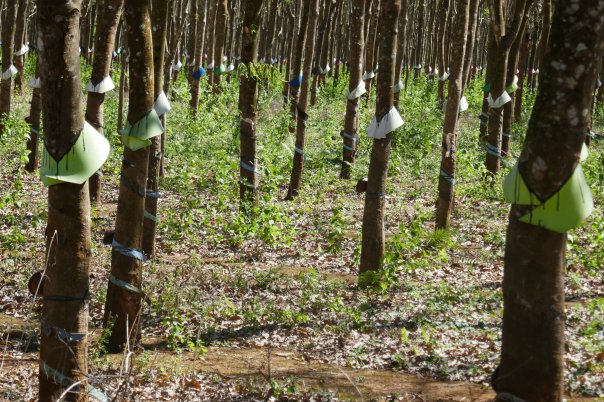
The km slowly ticked off passing coffee and pepper and a large rubber plantation (which provided a brief windbreak). We were glad to stop as planned where our road met the main road again. Our ‘easy’ day had also accumulated 850m of climbing so although not as much as the last few days, that and the wind left us with heavy legs.
Rubber trees with cups to capture the sap
We soon revived. It did not take long to look round our environs – the busy main road and a few side roads with the usual busy market of fresh produce. As much ‘real’ Vietnam as anywhere else but a world away from where we had started the day.
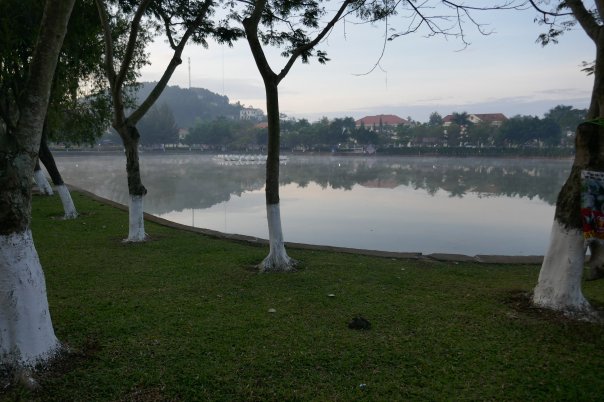
Bernie woke coughing at 4am and I was awake soon after. We pottered around but it was still 6.15 before we were ready to leave. The town’s lake – surrounded by flower stalls – looked lovely in the early morning light.
This is the point where we stopped going eastward and started going north. So we struck off north on the QL27 – which is a Vietnamese “B” road. It was paved (in places) and was not too busy. We knew from the maps that we started the day with a 500m climb from the town at 840m to the top at about 1340m. It was steady but not too steep. The road passed numerous villages and the morning rush hour was in full swing, with motorbikes, stalls, buses and the occasional animal all constricting the carriageway.
We manoeuvred our bikes through the melee, and managed not to knock anyone over. Both of us were feeling a bit weary from our efforts yesterday and the enforced early morning, but fitness kicked in and we ambled up the hills.
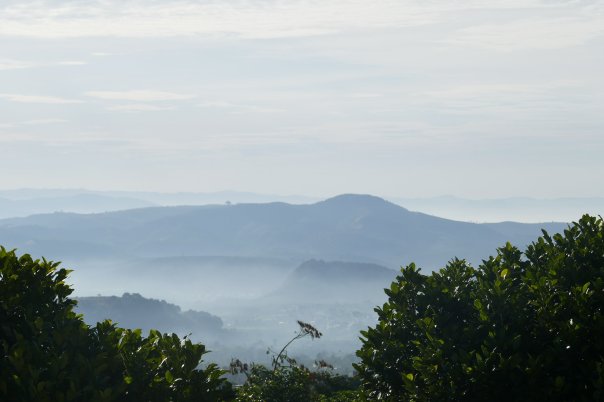
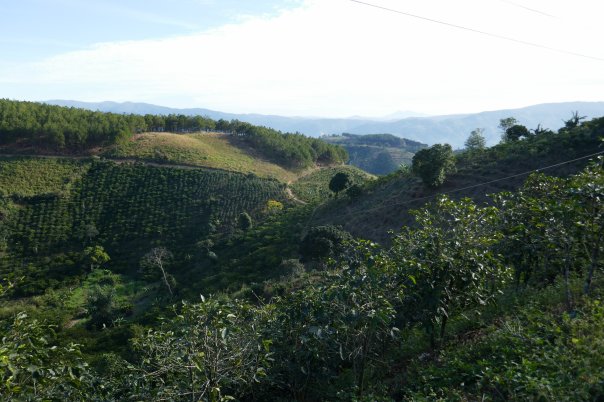
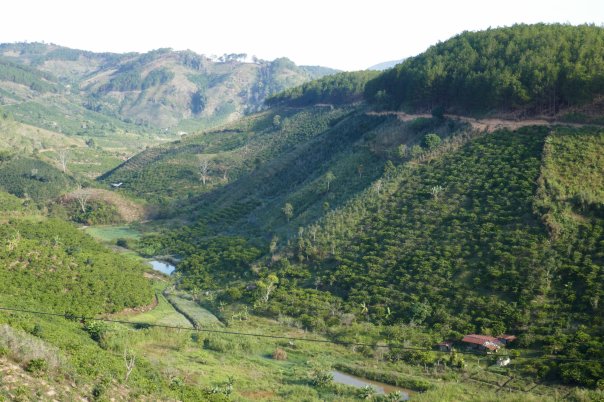
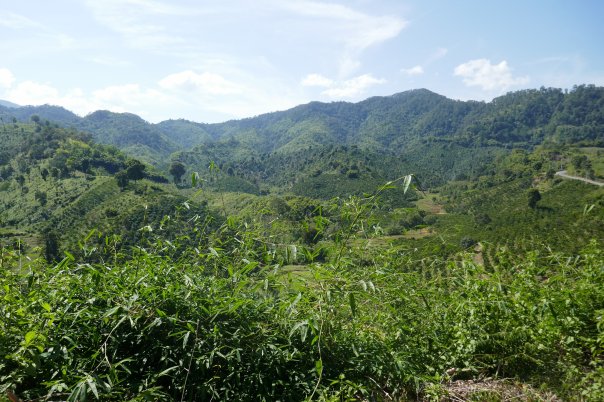
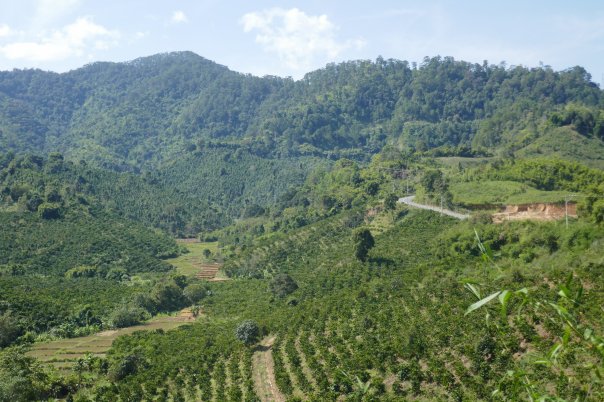
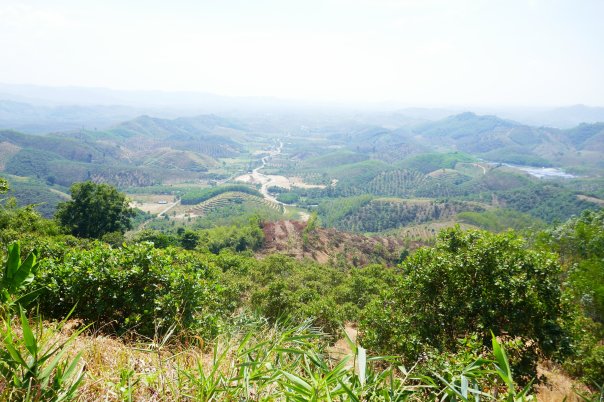
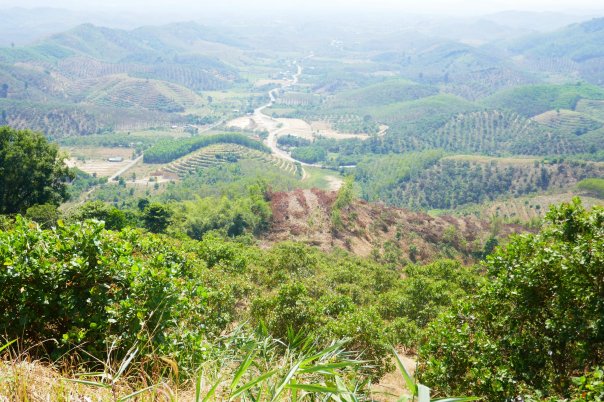
The valleys were cultivated right to the top. This was not remote mountain scenery or jungle, despite being higher than anywhere before on this trip. Coffee and cassava seemed the dominant crops, but there were also planted pine forests and crops we could not identify.
The surface deteriorated as we got higher, and was particularly bad on the steep descent. A mountain bike would have been better in places.
We stopped at a cafe that advertised coffee. They had fresh coffee but our efforts to get black, brewed coffee without sugar were pretty unsuccessful. It came in a micro-cafetiere, but the process did not really work and we ended up spilling it and having coffee to drink with granules in it. It was unclear if the equipment or us were the problem – probably a mixture of the 2.
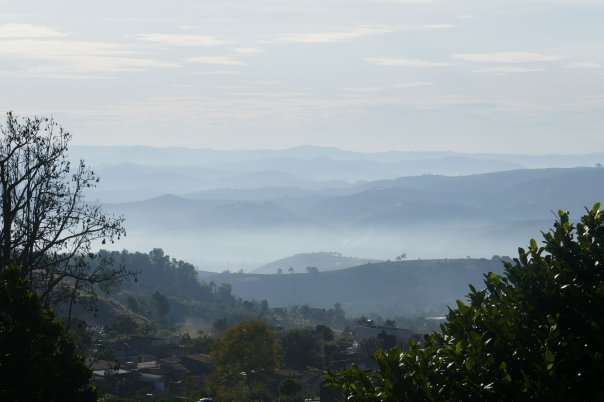
These are the mountains we descended from
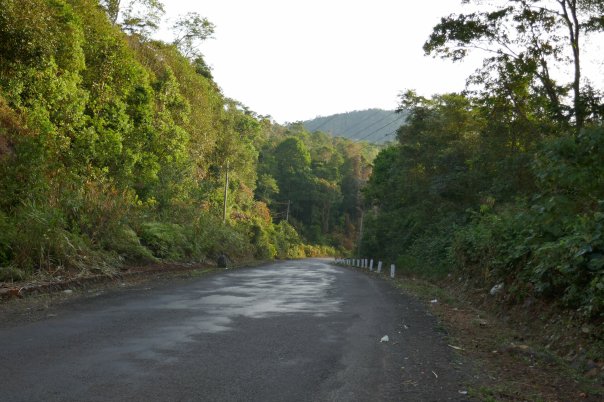
Next we struggled along the valley on very poor roads, with the track going up and down. This was a populated area but significantly poorer than some of the places close to HCMC. Then we started another descent and, miraculously, the surface was smooth and new. We swung down from about 1000m to 500m in jungle with wonderful bends to swoop around. Half way down we met a (grumpy) German wearing flip-flops and wheeling his bike on his own up the hill. He was only going to the top but seemed to have given up trying to cycle. A bit further down we met a Dutch couple who were cycling without helmets and he carried a guitar on the back of his bike. They were on the way to Dalat to try to get a new back wheel for his mountain bike (to support the guitar). We chatted for a few minutes, swapped route information and then said our good byes. These chance encounters with other touring cyclists on the road are part of the fun of travelling.
The day was heating up and the poor surface meant we were making slow progress. We stopped for lunch – the inevitable but welcome Pho – after 70km at a small town. There is a great deal of eating out in Vietnam – as there is in Thailand (less in Cambodia). It can be cheaper to eat out than to buy food and prepare oneself and many Thai homes are now built without a kitchen (a bit like apartments in New York). It was good and we were refreshed.
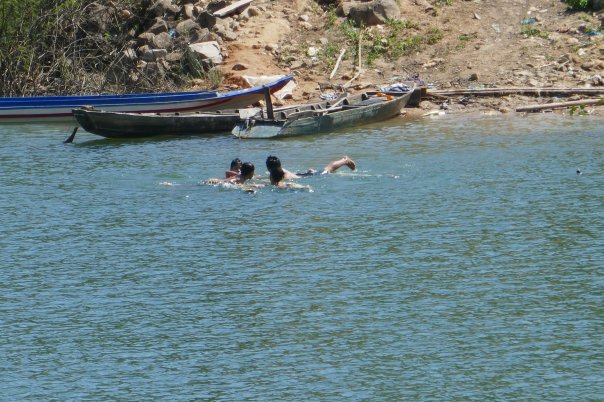
On we went through the fields and scrubland, and eventually crossed the river at the head of Lake which has no name on the map (or on googlemaps come to that). But there were floating houses in the lake and children playing in the water. We knew this was the beginning of the last climb of the day, but it was slightly frustrating. We climbed 70m, then the road bobbled about and dropped back almost to the altitude we had started at, and then we climbed again. It was about 250m of climbing to go up from 500m to 650m – but the scenery was pretty good and, by now, the heat of the day had started to fall off. There appeared to be a lot more peasant farming with small simple houses with a few paddy felds and maybe some pigs and cattle.
Then our second glorious descent of the day – also on good roads. We overtook motorbikes as we navigated the bends, just touching the brakes from time to time to keep everything in control. The final 12 km along the valley was tough as, by that stage, we were knackered. But we were determined to reach Lake Ho, which had such a good write up in the guidebook. We passed more rural scenes with emerald green paddy fields stretching across the valley floor, cattle and buffalo.
By the time we got to the Lake– about 3.30 – we were wiped out. But tea with lemon and a shower revived us. Lake Ho is the largest natural lake in Central Vietnam. There are bigger reservoirs but this lake has supported fishing communities for generations. They belong to a minority tribe and live in long houses, which we saw on an early evening stroll. Unfortunately, by the time we had recovered, the wind had got up and was blowing a gale and it was overcast. It made the lake look pretty uninviting, with only brave souls venturing out on boats into the wavy waters. However I can see that, on a calm summer’s evening, it must be delightful.
So, all in all, a good but tiring day, mainly due to poor road surfaces (lots of unpaved sections and juddering on the hands, arm and necks) and due to being tired from the previous day. But it sets us up well to explore the central section of Vietnam, heading towards Kon Tum.
Every trip we have one or two epic days. Today was one of them – with the highest amount of climbing in one day since starting our ‘Decade to Australia’ jaunt. It was a fantastic day…we are still functioning on the endorphins this evening.
We started with our usual early morning and were straight into a climb out of the valley – no warm up today.
Looking back to the village where we spent last night
Within a few km we were in incredible jungle scenery as the sun gradually rose above the hilltops. Bamboo and creepers and lush foliage, climbing steeply but just within what was bearable. We passed through a small cultivated flattish area with shimmering greens in the early light.
The jungle in the early morning light
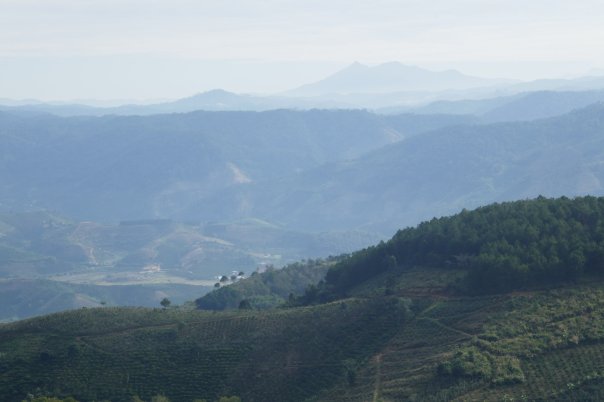
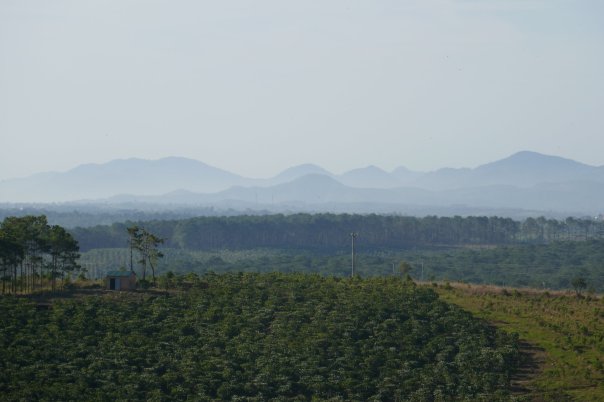
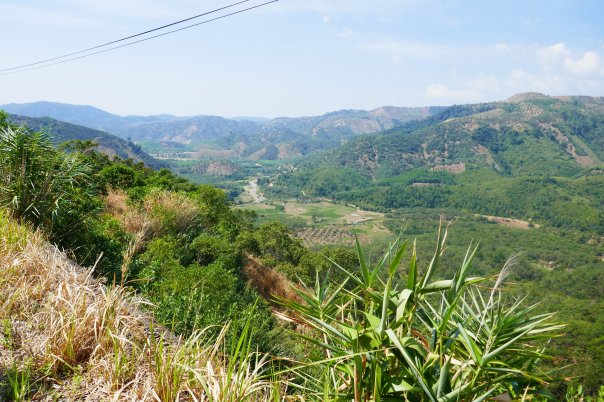
Up, up some more and we were into pine groves. Then we levelled out a bit along a ridge and suddenly before us opened out an amazing vista. A huge plateau with mountains in the distance. We took in the view as we ate bananas and recovered – we had done 450m climbing in the first 9km! Plateau it may have been but not a plain – there were still plenty of undulations. Some through pine groves with lots of bee hives. The day was warming up but we were now at 1000m so not too hot.
Looking out over the vista
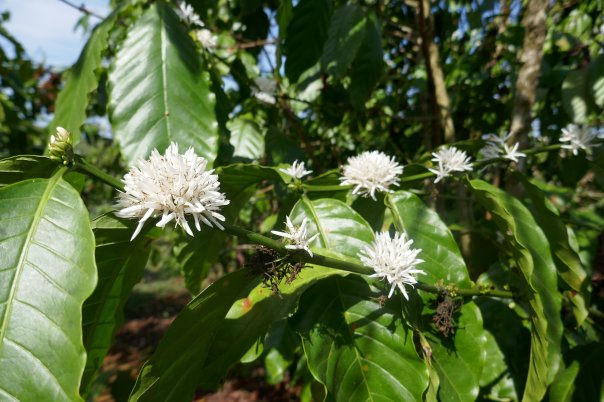
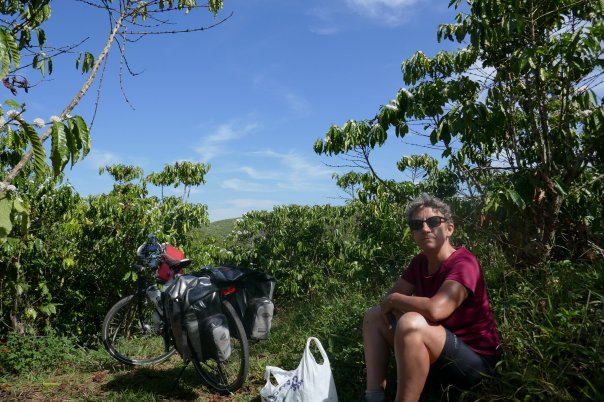
The kilometres ticked away a little faster and we got to a largish town. We passed a few nice looking coffee houses as we descended into the town but thought we would wait to get into the centre – a mistake as there were non there. We didn’t want to climb up the hill so got a little way out of town and tucked into boiled egg sandwiches under the shade of flowering coffee trees – eggs fresh from the hen yesterday (which we hard boiled and bread fresh this morning – delicious!).
Coffee plants in flower
The next section was through a large area of coffee plantations. The road more or less followed ridges but was still up and down.
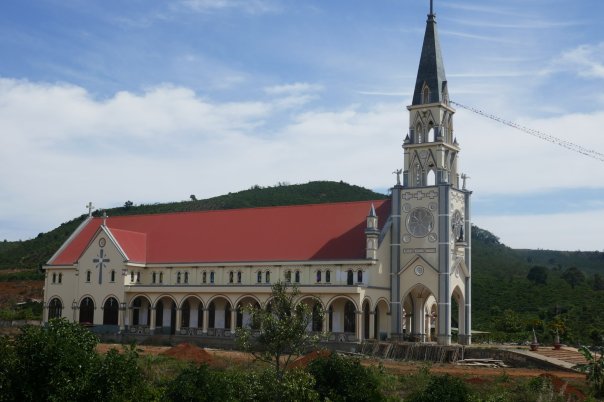
A large Catholic Church – under construction. Catholics have been in Vietnam for hundreds of years and the religion appears to be thriving despite everythingMurals on a wall at the side of the new church
Then a proper climb over a high ridge until we reached a little town at a road junction. Time for more food. At first we were told the nearest restaurant was 10km away in the wrong direction – but were then pointed to a small Pho (noodle soup) joint.
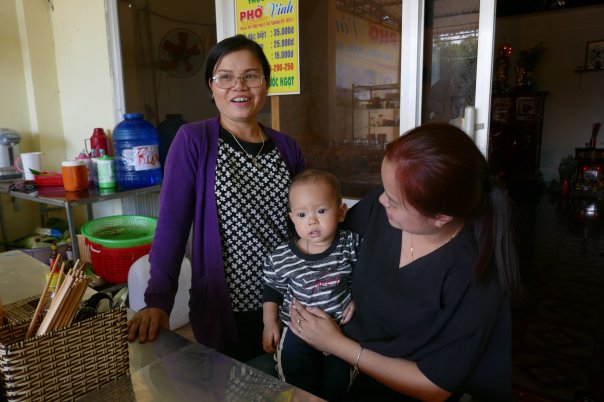
The makers of the wonderful Pho – and child
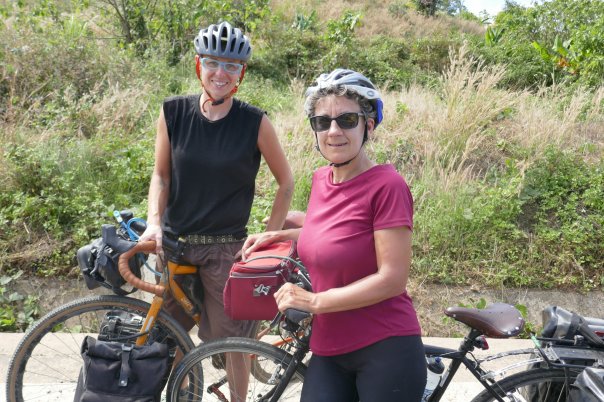
We had the most delicious beef noodle soup imaginable – not just because we had climbed 1200m and had been 6 hours in the saddle. The people were very friendly and after a good break we were ready to go again. We were further rested by then having a glorious 400m descent down to a river (erasing from our minds that we had to climb up the other side). Half way down we saw another cyclist making her way up. Megan was Canadian and had cycled from Hanoi – pretty much the reverse of what we were planning. She gave us some really useful information then we were wishing each other well and on our way again.
Best of luck Megan – good to meet you.
Down to the river and over the bridge – then into another 400m climb up the opposite ridge. The gradient wasn’t too bad and we were very much in plodding mode as we inched our way up to the next plateau. We stopped at a cafe for a drink and rest and a 16 year old boy came to chat and practice his English – which was pretty impressive. His school was opposite and he was clearly very proud of it. His 2 elder sisters were both studying in Ho Chi Minh City and he wants to be a professional goalkeeper. We did not have the heart to tell him that, at about 5′ at aged 16, he may lack some of the essential physical attributes – namely another foot of height. However with his social and language skills we were sure other opportunities will open up for him.
Into the final section – the last 20km. Nothing is flat so there were still undulations all the way – none severe but legs were definitely tiring. We crossed the threshold of our previous highest amount of climbing in 1 day and still had 15km to go. Head down and keep going. In the final 10km the road surface deteriorated just to make it a bit more trying then at last into the final 150m descent into Dinh Van – a pleasant thriving town with a small central square around a lake. We found a guest house on the square and finally collapsed!
We revived enough to go out and eat and had one of our best meals just to cap the day – enormous tiger prawns on skewers and seafood noodles.
Two Tiger beers finished the day of nicely. I doubt we could have done this ride 4 weeks ago but it is amazing how fitness improves. We are stronger, have more stamina and weigh less than 4 weeks ago – as well as having dark bits on our bodies which don’t wash off in the shower (but there are always parts that do!). However, more importantly, we know far more about the countries that we have passed through, have met some fantastic people every day and are thoroughly looking forward to the second half of our trip.
Today was a brilliant day for so many reasons. It was a day that illustrated the diversity and challenge of long distance cycle touring and delivered many of the benefits.
Our first challenge was getting the passports back. They were taken from us when we arrived at the guesthouse and all our efforts to get them back last night failed. The police kept them overnight. This seems a clear rule here but we were not asked for them in the hotel in Saigon/HCMC. However that “hotel” had its own peculiarities including the ability to hire a room for 2 hours, 4 hours or overnight, the red bulb in the room and the vast mirror on the wall to enable anyone in bed to seem themselves from multiple angles. The giveaway to show the normal use of the room was probably the basket of condoms next to the bed – but you had probably worked that out already! So obtaining passports and registering “guests” with the police is probably not highest on that hotel’s agenda (or that of the police as well). But outside the capital, the “system” seems to want to know precisely who is staying where – and photos are taken of passports and they are kept by the police overnight. Having explained we wanted to leave early (using the wonders of googletranslate), the guesthouse owner’s daughter appeared with the passports before 6.15am and we were on our way.
The first 12km were along the main DL 20 road – with lorries kicking out black fumes and countless people going the wrong way on the hard shoulder, forcing us into the traffic. It was OK but not the best fun. We had marked out a googlemaps walking route because the cycling option does not work outside Europe. This took us off on a minor road, which rapidly became a path and then an unmade up track. So we doubled back for a larger road but still off the DL20. This was perfect – a good surface and some traffic but not too busy. It wound its way across country towards the Nam Cat Tien national park. We got to the national park after 37km before 9am, but that was far too early to stop. The jungle walks here (to see a variety of animals – but often no animals at all) happen at dawn. So we could have either stopped and waited until the following day or pressed on. Pressing on felt best but not until we had had our first “iced coffee” which was unusual and remarkably refreshing.
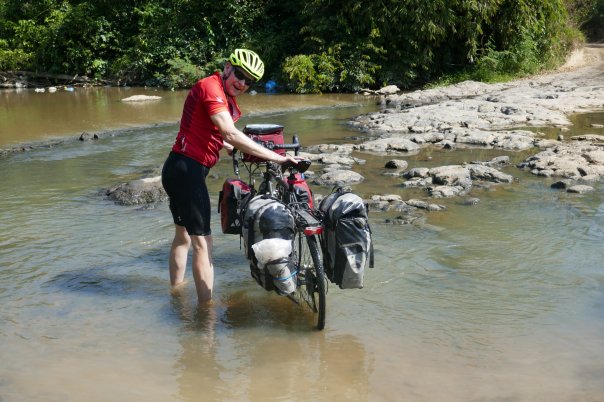
The walking route took us along a narrow lane towards the DL 1275. It was paved for the first 100m, but a chap on a motorbike tried very hard to persuade us not to go down there with our bikes. We could soon see why as it became hard sand – just about possible to cycle but then a bit hairy. However that was nothing compared to the “ford” we had to cross next. As we looked at the ford a truck came along with pigs in the back. The truck ploughed through the fairly deep water and swung from side to side – with the pigs squealing their objections as this lorry nearly turned over altogether. Daunted but not totally put off, we removed our shoes and socks and walked the bikes across – bit by bit. The road on the other side was paved and within a few km we were on the main DL 1275 road.
We knew we had loads of climbing ahead but it took an age before it started. We broke for banana sandwiches for an early lunch and then found the pleasant town of Da Teh. There is clearly lots of money in this area – fertile land, lots of water and easy reach for major markets. So the cars and motorbikes seemed new, there were fashion shops for women’s clothes and (of course) endless mobile phone shops with a dazzling array of new phones for their customers. We stopped at one to swap Bernie’s Sim cards between phones and the women attendant was hugely efficient and refused to take any money for her work. Her male assistant spoke some English and gave us directions out of town (Garmin maps had failed at this point but now restored). It was clear that foreigners were unusual but very welcome.
After Da Teh the road went more or less straight and slightly up, but then (at about 70km for us) the climbing started in earnest. We had done one climb to the Kaio Hai national park in Thailand but it had all been pretty flat since then. This was a steady 500m climb at between 5% and 10%. Progress was slow but, as we climbed, so the views appeared. It was spectacular and beautiful but was also the heat of the day – about 38C. That would have been oppressive a few weeks ago but the humidity was OK and we are getting acclimatised.
At about 400m we saw a stream and so filtered water to replenish the water bottles. A lorry stopped with some guys who clearly thought we were slightly mad filtering fresh mountain stream water – which they just drank from the stream. Eventually we topped out at about 600m and then had a series of 50m ups and downs for the next 25km. We were passed by lots of locals on motorbikes who gave us a variety of thumbs up – and by some tourists who were motor biking the road on their way north.
About 3.30pm we got to our destination, Loc Bao – a small town. By then we had done 108km and 1050m of climbing, and were pretty whacked. As we came into town there were a group of men eating an extended (and liquid) lunch who enthusiastically hailed us. We stopped and, via googletranslate, exchanged pleasantries and said where we had cycled from. They gave us coke to drink and offered us food, but we wanted to get sorted so we just accepted the drink. But they explained that we did not need to camp as there was a guesthouse 2km up the road. We said our thanks, took photos and then moved on. They were so, so enthusiastic to meet us – even though language is a major obstacle – and probably would have fed us and put us up for the night if we had wanted it. There was no end to their hospitality, even though, as an all male group, they did not quite know what to make of Bernie. She qualifies for hospitality because she is a foreigner!
The guest house was 2km away – as predicted – and within 10 minutes we had secured a room and were under hot showers – all for 7 pounds a night. All in all, a brilliant day.
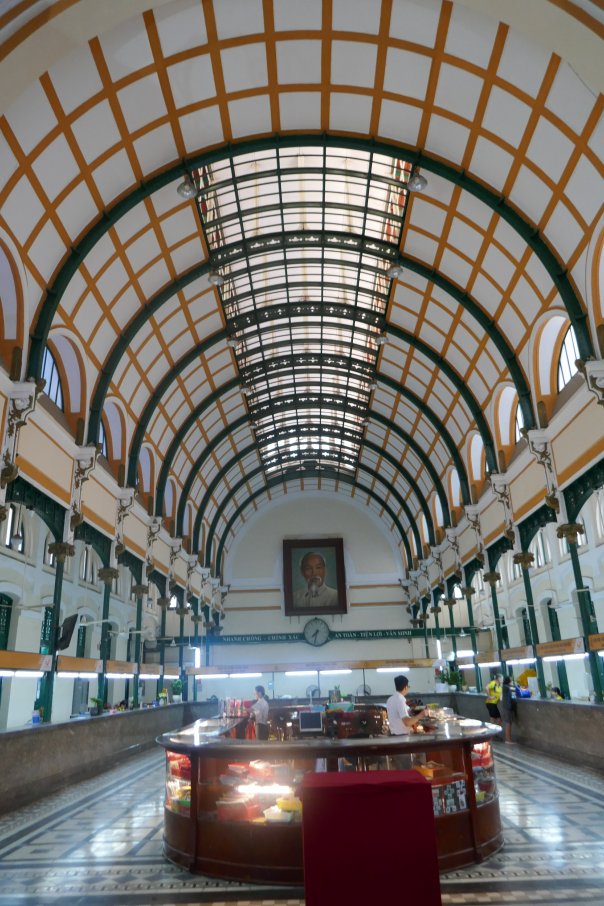
Today was a crazy cycling day and not one we are going to repeat in a hurry! First things first though. Our first port of call was the central post office in Saigon to post a parcel home. The building itself is a tourist attraction.
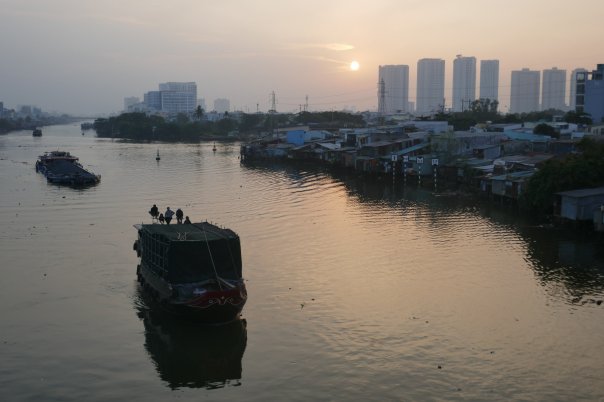
With it’s impressive frontage and airy ceilings, it is probably the most impressive post offices I have ever sent a parcel from. It opened at 7am and, being early birds, we were there at 7.02. We had seen the sun rise over the river and battled the early morning motorbikes, of which there were thousands. We filled in forms in triplicate and eventually the parcel was sorted. We felt quite pleased as even the simplest tasks can be daunting when you have no idea what the system is and you cannot speak the language (luckily they were able to speak English).
H
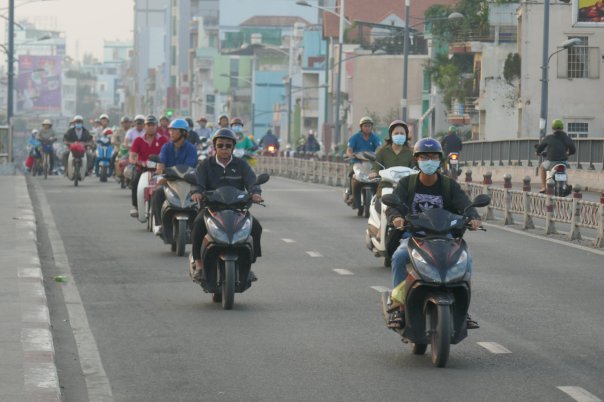
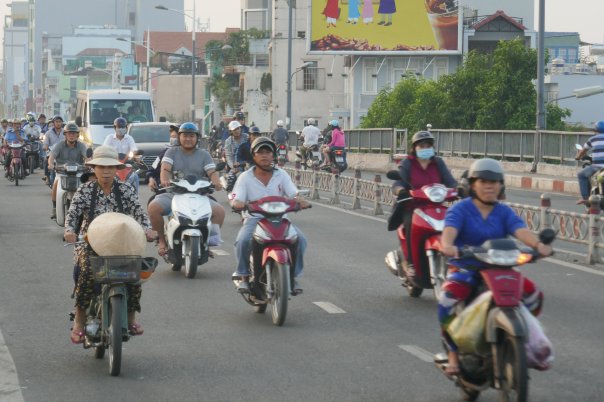
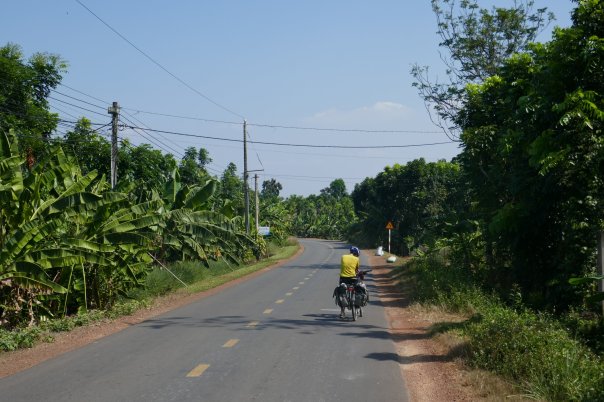
owever the parcel posting meant that we only really set off at 7.45 when the rush hour was well into full swing. The route out of Saigon involved several bridge crossings so the only option was to take main roads to get across the rivers. Luckily, most of the time there was a separate motorbike lane – but even that was hairy enough. Main junctions were completely crazy – if you had to cross them. Motorbikes swarmed across in every direction (traffic lights not seeming to apply to them). You just picked someone to follow and hoped that everyone else would go round you (which they did). It seemed impossible that there weren’t crashes. I am sure there are occasionally but we did not see any. At times there was a 3 line highway for cars, buses and lorries and 3 motorbike lanes – with little old us tucked into the side! It went on for km after km but we just had to grit our teeth and keep going. We ducked out at about 35km for a cup of coffee to calm out nerves but our turn off onto what we thought might be a quiet road was onto the old Highway 1, and was only marginally less busy.At about 55km we were finally able to turn off onto a genuinely quite road. It was astounding as, within a few hundred meters, we were in another world. By 60km it was definitely rural and by 70km we were cycling along a gloriously quiet road through banana and pepper plantations. Pepper was laid out on the roadsides drying.
By 80km I was faint with hunger. At last a little place had signs for ‘Pho’ – the ubiquitous noodle soup. We in fact rejected the Pho as it was going to have an enormous pigs trotter in – which may be delicious to some but not what we fancied. So we pointed to a few things and had a simple but very welcome simple meal of beef, rice and a broth. We settled into small plastic chairs in the shade and filled ourselves up – splashing out as it cost 4,000 dong for us both (that is about 80p). For that we also managed to fill up our water bottles – so a bargain lunch.
We then realised that we had made a mistake on google maps. Although we had put in the destination town the route had stopped somewhere well short of that for reasons unknown and we had an extra 25km to do. We had plenty of time but we had been hoping for a short day after the emotional rigours of the morning, which was really quite draining even when safely through the other side.
We soon had to leave our lovely quiet road back onto a busier road, namely R20. It was much busier than we were expecting. Loads of lorries and almost continuous ribbon development. The shoulder was wide so it did not feel unsafe but the perpetual noise and fumes were unpleasant. The road also started to significantly undulate – going higher with each ripple. We were soon higher than anywhere we had been in Cambodia.
At last we were into the last few km, but as often seems to happen we ended with the biggest climb of the day when we were most tired.
We found the only guest house that was marked on the app Maps.me (and it really did seem to be the only place in this quite sizable town). We were shown a very basic room with fan and its own little shower and toilet. It was clean and even though the bed was pretty lumpy we were happy with the price of 120,000 dong (4 pounds!).
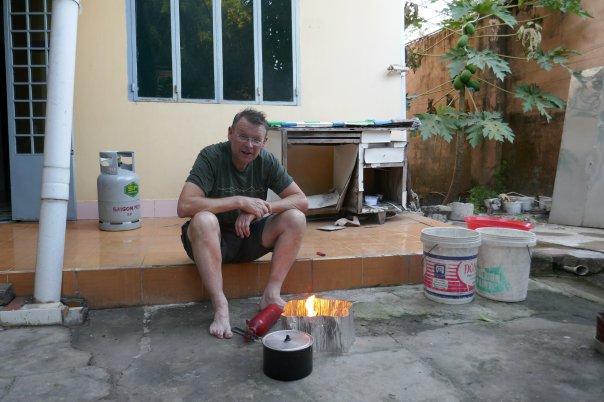
The advantage of ‘basic’ accommodation is that there was no issue of us brewing up our reviving cup of tea in the back courtyard. Later we strolled into town which was already festooned with lights for the upcoming Chinese New Year (Tet) on 5th Feb. We at last found an ATM that gave us some money (2 earlier in the day had no money) and we ended up have Pizza – because there was a little Pizza place and we just fancied it after the long day.
Tomorrow we head into the mountains but the 117 km we had covered was more than enough for today.
BY BUS (and no pictures)!! I hear you say in disgust – but there was a reason for the bus ride. The road between the Cambodian capital and the Vietnam capital is almost entirely flat, very busy and dusty and wholly without interest. So we had a choice of 3 days tedious cycling or a 7 hour bus trip. Not a tough choice really – we opted for the bus. So sorry for those of you who were expecting us to cover every centimetre of this trip under our own steam but we have disappointed you. But then the first rule of this trip is “there are no rules” and so there is nothing stopping us catching a bus if that seems the sensible thing to do. There was less reason for no pictures – we just never got the camera out!
The bus journey passed and we negotiated our way over the border. It was frankly easier being in a big group on a bus as the bus crew do this every day and so shepherded us through the stony faced officials at the border. There must be a “border guard” face just as there is an “Anglican voice” (“Let us pray …” is always said in the same tone). The border guard face is a mixture of disbelief, distrust and boredom – assuming a stern disposition based on the idea that everyone trying to come into a country has ill-intent, bored as hell and just waiting for someone who has their stamps in the wrong place on their passport so they refuse entry. Luckily boredom won out over malice and we got through without difficulty.
And so the bus proceeded to Ho Chi Minh City – formerly known as Saigon – and now referred to universally as HCMC. Wow – the number of motorbikes is mind blowing. Hundreds line up at every junction or traffic light. The Tom Robinson song about “stop on red but leave on amber” does not work here. Motorbikes (occasionally) stop on red and leave when the red light is still on but it is counting down to a green. 5 seconds early seems standard. And we arrived at Sunday lunchtime when the city is “quiet”. We have not yet experienced the traffic during the week.
We worked our way around to Mr Biker Saigon who we had been corresponding with, and met the wonderful June who helped us find our way around. After depositing our panniers we went to a mobile phone shop to sort out credit for our Vietnamese Sim Card – inherited from a fellow biker who was going the other way – and then found an ATM. There are about 30,000 Vietnamese Dong to the pound so calculating the price of things is not going to be straightforward.
Then to the War Memorial Museum – which tells the story of the Vietnam War(s) of the 1950s, 1960s and 1970s from the perspective of the victor: i.e. the Viet Cong. The message was that this museum commemorates the sacrifices of the Vietnamese people in achieving their independence from colonial rule. Whilst all of that is true, it is not the “whole truth” but then that is impossible in war.
It is probably fair to say that neither France nor the US comes out of the story told by this museum with any credit or dignity. The overall message is not subtle – the US and France (supported by troops from New Zealand and Australia but, of course, not the UK since Wilson said “No” to US and French demands on repeated occasions) backed the oppressor against the people and the people fought back and won.
All war is tragic, horrid and many of the victims were either civilians or conscripts. The average age of a US dead soldier was 19, and many had little, if any, idea why they were there apart from the fight the spread of “communism”. The fact that they were fighting to support a corrupt but western supported regime which violently oppressed its own people was not highlighted. They were fighting against Vietnam being taken over by a corrupt communist regime which would oppress its own people. It is easy now to sit back and reflect on the pointlessness of the war and on the flaws in the “communism domino theory” which drove it. The fact is that many young men died fighting, a nation was nearly destroyed by Agent Orange deforestation and hundreds of thousands of civilians were killed, died of disease, starvation or worse. Today, Vietnam remains a “communist” country in the sense of having a one-party system, but that is the norm of much of the world. Its economy is thriving and its people are largely free to decide their own futures (as long as they do not take to criticising the Party).
The grim history of the Vietnam war was terribly depressing. For me the strongest message was a contemporary political one – the need to avoid political dogma blindly driving policy decisions. I worry that precisely the same right wing “think-tank” thinking that foresaw communism spreading through Indochina in country after country if battles were not fought drove the invasion of Iraq, and is now dominant again in the Trump White House. It is sadly one to watch.
Today was a rather odd day and somewhat of an emotional roller coster. We spent the morning at the Genocide Museum, a memorial to the terrible Pol Pot years 1975-1979. This heartrending place had a brilliant audio tour which calmly led you round the High School that became the notorious S21 torture prison. The fact that the buildings were clearly school buildings running 3 sides round a peaceful shady courtyard emphasised the terrible contrast of what went on inside even more. We spent 2 hours slowly going round, not shirking any of the items. By the end we were completely emotionally spent.
The memorial stone at S21 – fittingly funded by the German Government in solidarity for past genocides
We sat and had a cup of coffee while we tried to start processing what we had seen and learnt. By terrible coincidence I was also in Rwanda just 3 months ago, going round the Genocide Memorial in Kigali, that similarly took you through the build up and the terrible 100 days of mass slaughter by Hutus or the Tutsi ethnic group (or anyone perceived to be or sympathetic Hutus). It is hard to comprehend such inhumanity. It was a ‘must see’ to put Cambodia into some sort of context and made it all the more amazing to see what has been achieved since then (albeit with the current political situation – see David’s blog yesterday).
We carefully cycled back to the hotel, aware that our brains were not functioning on full alert. We could not decide what to do with the rest of the day. We weren’t in the mood for sightseeing. In the end we decided the only approach to take was that life is for living and went out for a lazy lunch. We found a great restaurant run by a Frenchman but offering a really interesting menu from across continents. He had only been open a few days and we were one of his first customers. The food was delicious.
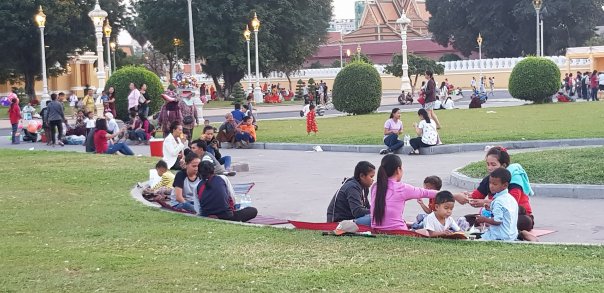
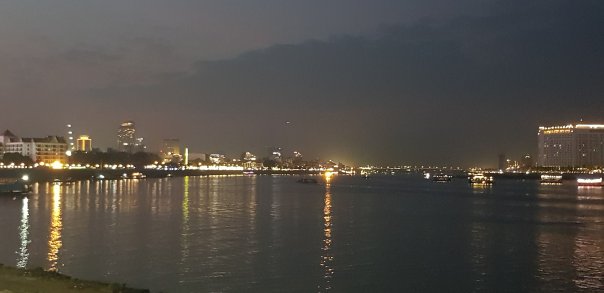
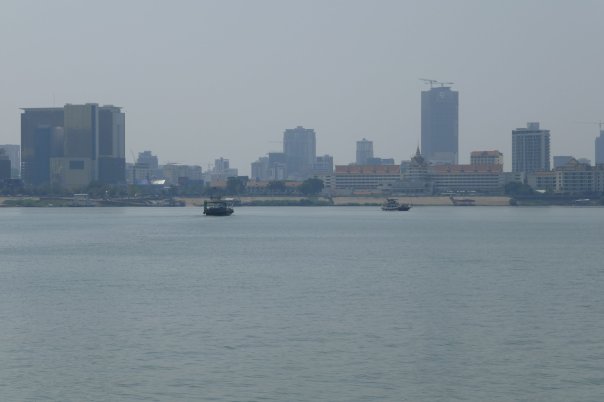
Later we took a last stroll around Phnom Penh. The world was out strolling along the riverfront on a Saturday evening, families were having picnics on the grass in front of the royal palace and a row of fortune tellers were predicting the future to eager young people. We hit a part of town with neon bars full of young Cambodians. We managed to find a slightly quieter one for a beer before strolling back to the hotel.
The events at the Genocide museum had affected us deeply but we were determined to have a positive day and did so, our final day in Cambodia.
While we were resting at the hotel I wrote the following to help me make some sense of the what the genocide meant. I include here for anyone who is interested.
****
Where does this terrible inhumanity come from? The German Holocaust of the 30’s and 40’s, the Cambodian Pol Pot years of the 70’s, the Serbian genocide of the 80s, the Rwandan genocide in the 90’s, the Rohingya genocide just last year, just to name some of the terrible instances of people’s inhumanity against other groups. Has the world learnt nothing? It seems to show that dehumanisation and brutality are possible in any era and any culture if the circumstances are right. None of these came out of nowhere but occurred because of circumstances over years or decades that engendered hatred to such a degree that the subjects of that hatred are not seen a human beings. Some come from understandable beginnings . In Rwanda there was huge inequality between the minority Tutsis who had power and wealth and the majority Hutus. Throw in the influence of colonialism, that over decades promoted the idea of difference between ethnicities and a media that promoted a propaganda of hatred. In Cambodia the US had carpet bombed swathes of the country in the name of the war in Vietnam, killing hundreds of thousands of innocent people and riddling the country with unexploded ordinance that has killed a further 40,000 people – fertile ground for a hatred against the west and desire to formulate a new society.
What changes an understandable beginning into a brainwashed psychopathic madness? How can we prevent this? Bearing witness to these events, remembering, constantly promoting human rights, freedom of speech, fighting for dialogue and respect for all peoples is a start. The frightening things is that the world is turning in the other direction. Even Cambodia, with such recent history, is rapidly turning from a supposed democracy to a one party start riven by corruption and oppression of any expression of opinion against the ruling party.
Pol Pot shows how a political ideology can quickly morph into something so incomprehensibly bad. The idea of year zero and starting a new society was an understandable starting point. They observed the failing years of the Mao cultural revolution and concluded that the Chinese had not implemented the ideology enough, rather than concluding it was a terrible ideology in the first place. Therefore this time the intellectuals and everyone associated with them had to be slaughtered (with an intellectual being defined so widely it even encompassed anyone who wore glasses). To justify this the people first had to be tortured in camps such as S21 to coerce them into signing a confession. Great care was taken to keep people alive during the torture and anyone who died during torture was seen as a failure as the confession had to be sought. Once this was obtained it was therefore justifiable to authorise their execution. 20,000 were taken from S21 (0ne of 200 similar camps across the country) after the torture and executed in the killing fields.
All others from the cities and towns that were not targeted for extermination were forced into the fields to create and class-free agrarian society. Pnomh Penh was a city of up to 3 million people and was virtually emptied within 3 days of the Khmer Rouge marching in (under the lie of being taken somewhere safe as the city was about to be bombed). Neither the city folk or the Pol Pot elite had any idea how to till the land (Pol Pot was a maths professor). Both the urban and peasant peoples were worked as slaves for up to 19 hours a day and many millions died through starvation and disease. Overall one in four Cambodians lost their life. Ironically it was only the intervention of the communist Vietnamese who brought the Khmer Rouge to a halt.
These events are not things of the past. The Rohingya genocide tells us this and torture goes on unabated in many countries of the world. In my work at Freedom from Torture I have heard the testimonies of many torture survivors and recognise the conditions people were held in and all the torture methods described at S21 in these testimonies from men, women and adolescents. We have to keep fighting, keep talking, never compromise or turn a blind eye to torture or genocide in the name of a greater economic good. The incredible people I have had the privilege of speaking to directly as survivors of torture have taught me the immense resilience of human beings. Of course the scars are there for life but they have shown me that people can come through with their own identities and humanity intact, still believe that there is good in the world and even have the power to forgive. It is incredibly humbling and gives me strength not to despair and to try my best to redouble whatever individual efforts we can make, in however small a way, to make the world a better place.
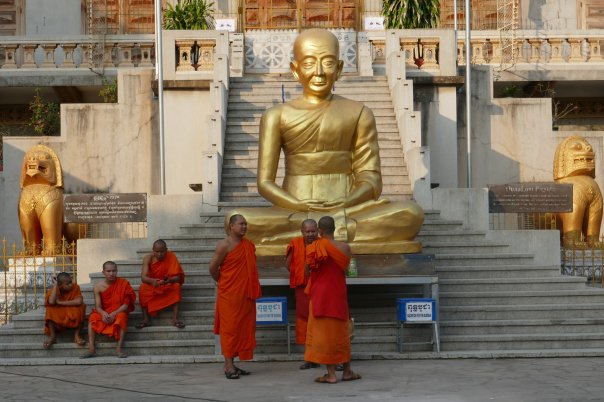
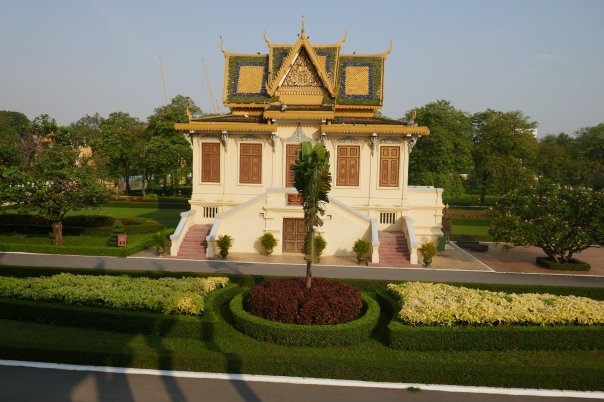
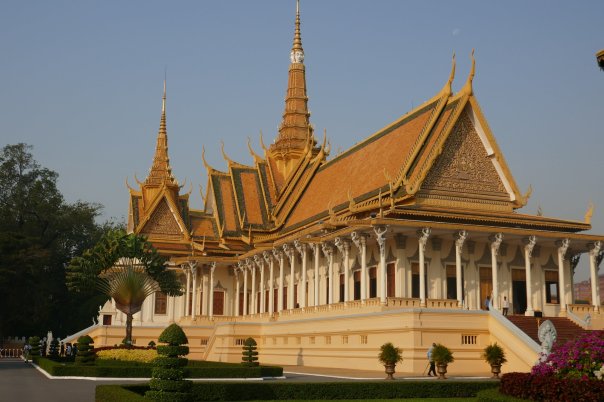
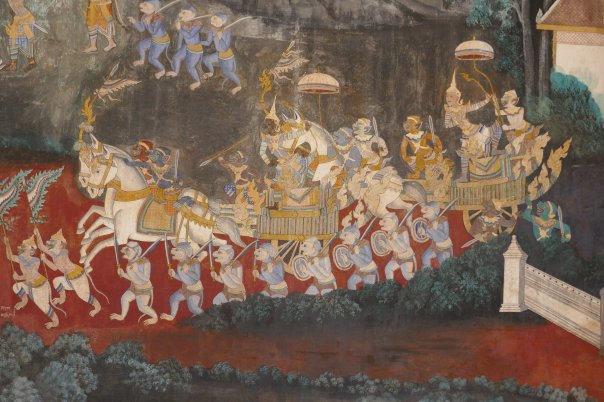
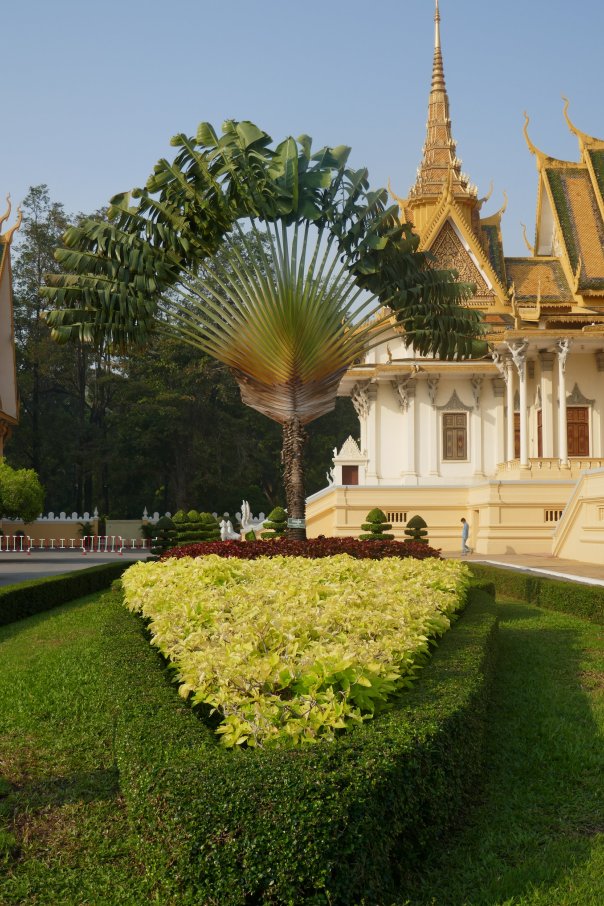
Today was a holiday day – a day (almost) off the bikes and trying to be proper tourists in a tourist city. We started by trying to visit the Royal Palace when it opened at 7.30am but spent 15 minutes walking around a collection of impressive buildings wondering why there was no ticket office, no other tourists and lots of monks around. The reason was that we had wandered into Wat Ounalom, the centre of Cambodian Buddhism, not the Royal Palace. Feeling like total chumps we ambled along the waterfront to a set of buildings that any idiot could see were much more likely to be a Royal Palace.
The pictures tell the story of the buildings, but the history of the monarchy is more interesting. The monarchy was dissolved under the Khmer Rouge but restored in 1993 following the collapse of the Soviet Union and hence the reduction in Vietnamese influence in the country, leading to an agreement in Paris. The previous king was reinstated and reigned as a constitutional monarch (but with real political influence) until abdicating due to ill-health in 2012. The present king, his son, lives mainly in France (at least according to Wikipedia).
Cambodia has a semi-functioning democracy is listed as one of the most corrupt countries in the world on Transparency International’s List – coming in at no 154 out of 187 – equal with the DRC and below Zimbabwe. There are political posters everywhere in the country which are still up from the August 2018 elections, but that election saw the incumbent Cambodian People’s Party win 125 out of 125 seats in the National Assembly. That result was assisted by the arrest of the main opposition party leader on treason charges and the dissolution of the main opposition party by the courts. Hence this is a country with major governance challenges that is not, in reality, following a multi-party democratic model despite the constitution.
All that seemed fairly remote to our minds as we ambled around the Royal Palace (having finally found it) slightly ahead of the major tour groups.
After that we spent the day planning, I did a little work and we then set out to find out if Vietnam would be kind enough to grant us visas. Yes – we got visas! It was all very efficient. We then set out to explore the “Russian Market” which is an astonishing complex of stalls in a building where you could buy nearly everything. We parked out bike at the “motor parts” entrance and passed numerous stalls selling an astonishing array of motor bike bits. The equation between time and money here means that nothing goes to waste. Bikes that die a death get broken up into minute parts and get recycled, sold and reused.
Eventually we found the shopping parts that we came for. No clues because some reading this might just be beneficiaries. Then we braced the traffic to cycle to the bus depot to get tickets for the Saigon bus. Traffic in Phnom Penh has its own set of bizarre rules but it all sort of works. Hold your nerve, cycle with the traffic flow and it will all be fine!
Getting bus tickets for us and the bikes was remarkably easy, and so we felt we had achieved our goals. Back to the hotel to relax, read and then amble out for a meal. Walking around teh centrre of the city, it becomes obvious that there is a rather unpleasant and visible sex tourism presence in Phnom Penh – with a significant number of western middle aged men (or older) coupled with younger Cambodian women (some very young). The economic drivers for this trade are obvious and it is pretty open. But these appear to be a minority of tourists. There are many “gap year” young travellers and large numbers of middle aged and older culture tourists (who I suppose we are part of). But the sex trade is a loud and visible part of the economy here, just as it was in Bangkok.
Earlier in the day we spent an hour at a cafe which was run by a charity that rescued women who had been trafficked, often from Vietnam and retrained them to work in a less exploitative part of the hospitality industry – namely in the cafe. This is a side of Cambodia that sadly thrives in an environment of corruption and poor governance. The government does appear to be committed to improving the situation but building the culture to prevent this has been a major challenge in the West (and one where frankly we still have a long way to go). Doing the same effectively in a country like Cambodia must be even more of a challenge.
Today we reached a major milestone and made it to Phnom Penh. 1621km cycled so far this trip on 3 weeks of cycling. However more on our destination later. Our day started as usual with the 5.15 alarm and on the road by 6.15. We cycled out of Kampong Cham along the river road with some early morning traffic. We brought our bread and snacks from a passing motorbike man and cycled 18km to a ferry point to cross back to the east side of the Mekong. We could see the ferry coming over and chatted to a woman running a little drinks stall – well chatted might be an exaggeration but she got the gist of where we had started and where we were going and she found it all hilarious. She got quite over excited seeing the Km distance on the Garmin as if to prove we had cycled from Kampong Cham that morning.
Quite a few motorbikes, cars and lorries came off the ferry – clearly rush hour into the town. We rolled our bikes on and sat in the early morning sun, and sat…and sat. Gradually a few more people arrived and about 40 minutes later when presumably the driver thought there were enough people chuntered over to the other bank. It was still only 8.30 and we were in no hurry.
Our aim for the day was to try and take a quiet back route into Phnom Penn. Roads were marked on Google maps but we had no way of knowing whether the road was paved or not. The first few km we bumped along a hard packed dirt road and then at the next village hit some tarmac – or rather one half of a concrete road as they were still laying the other half. The road soon converted to tarmac across the whole road and we were moving along nicely, the wind still behind. We were congratulating ourselves that we had got to the road just as it had been surfaced and that it was likely to get better and better as we got towards the capital. Wrong! The road reverted back to dirt track…but even worse being prepared for the road building so rather than being hard packed it was covered in loose gravel, almost impossible on a bike. There was a small rim without gravel on the side left for bikes and motorbikes – at times only about a foot wide. We wiggled and bumped along getting covered in dust as the occasional vehicle went by. Our average speed halved and we wondered whether we would get to Phnom Penh today. Luckily it only lasted about 10km and then we were back on paved road the rest of the way. Relief!
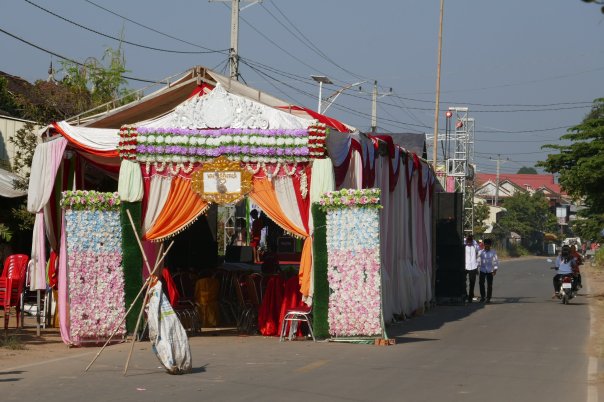
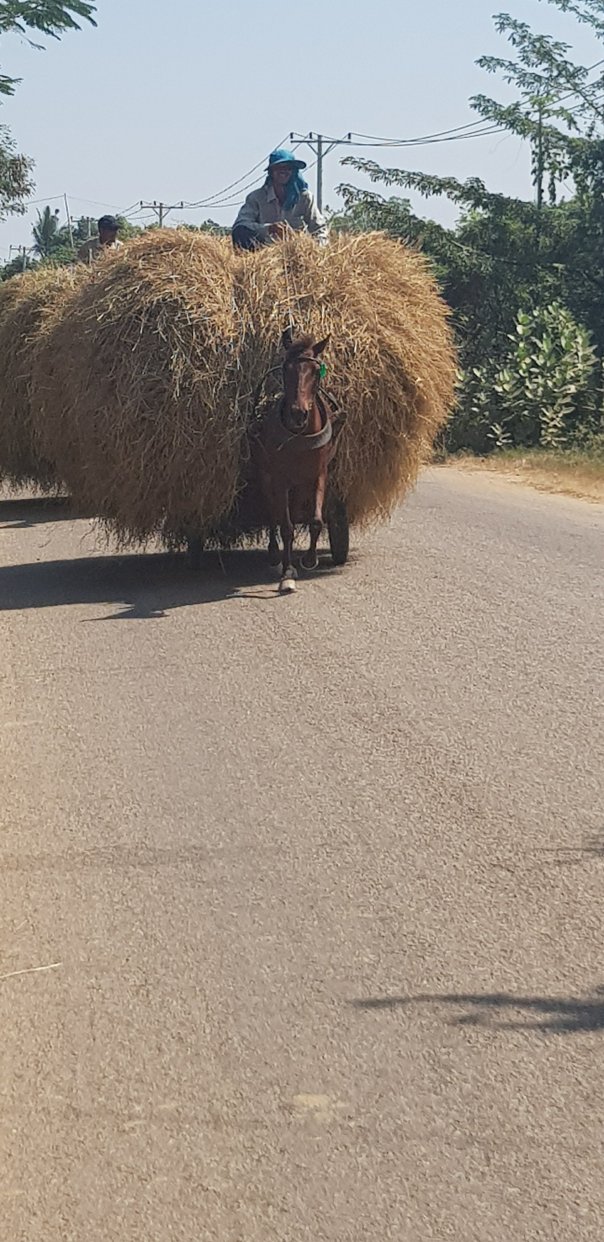
The road hugged the Mekong passing through rural villages. Wedding tents were seen on the side of the road at frequent intervals, horses and carts with enormous loads of hay, amazing temples in small villages. Always something to see so although the cycling as again flat, flat, flat we weren’t bored.
Finally we could see Phnom Penh in the distance but we continued on the quiet bank with only a slight increase in traffic for the last few km to a ferry which took us into the heart of the city. A great way to arrive.
We went straight from the ferry to the Vietnamese embassy to sort out our visa. Suddenly we were surrounded by chaotic traffic…but by now we were quite used to things coming at us in the wrong direction – apart from that it was much like cycling in London or any large city – you have to have our wits about you. The first impression was of a clean, modern city.
We found the embassy and sorting the visa was straightforward (unlike trying to arrange an e-visa where you are only allowed particular points of entry and exit). We can pick it up tomorrow afternoon so it will be sorted before the weekend.
Then last few km to our hotel. We have treated ourselves to a bit of 4* luxury (booking.com last minute deal!) so we had flunkies opening all the doors, carrying all our (filthy) panniers and bringing us orange juice. The check in staff were rather taken aback when I said we did not have our passports because they were at the Vietnamese embassy. “how can we check you in?”. Luckily I had copies and they decided that would do.
After a long, very hot shower (what joy) and a rest we took a stroll round the locality taking in the amazing art deco building of the central market (that was packing up for the day), down to the river front along the back streets then circling back to the hotel. There were a few tourists about but this is a living thriving city with activity going on everywhere. It had a good feel.
We then counted up the km and it came to 1691km from Bangkok – so that felt as good a reason as any to have a decent meal. We went to a French Restaurant opposite the hotel which was located in an old colonial mansion with a terrace overlooking the street. There we had a fantastic meal with a bottle of wine, as well as indulging in a little people watching. Then, unused to wine, we ambled back to the hotel – still in bed by 9pm though!
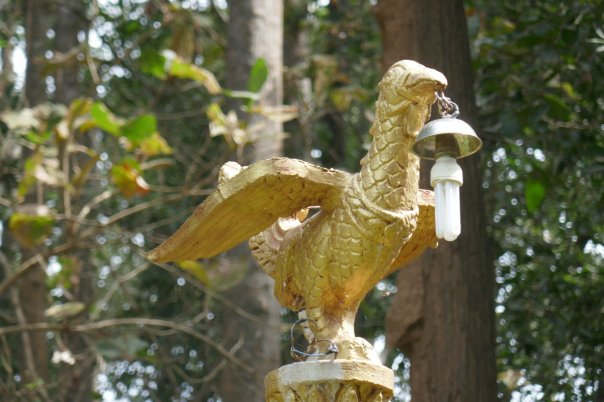
What else would a golden griffon have hanging from its beak?
Today was a lovely cycle along the river Mekong, with villages all the way, plenty of interest and timely food stops. The temperature was not too bad, the road surfaces were good and we had a following wind. Nothing is perfect but this was pretty good.
We woke with the alarm at 5.15am and were on the road by 6.30am – slightly delayed by pumping up tyres and having coffee. We were conscious that our bikes were beginning to look rather shabby after all the dust we had but, heh hoh, this was not a beauty contest. Our thoughts were dominated by my brother’s illness but he wants us to keep travelling and keep sending him updates, photos and travelling tales as they mean so much to him. So Pete, if you are reading this, we are doing so!
The road meandered around the East bank of the Mekong, sometimes next to the river and sometimes a few km away in paddy fields which were fed by river water. The road was quiet and we were overtaken by a range of vehicles – including a bullock cart with 2 huge bullocks on board, pulled by a motorbike. However the prize of the day goes to the motorbike with ice-cream side car which had a horn that was adapted to play “My heart will go on” from the movie, Titanic, at a very slow pace as if it were a funeral march. It took a long time to work out what the tune was but, of course, once it got into our heads it stayed there for much of the day! I will never hear that song again without thinking of the ice-cream salesman on the Mekong River highway.
Don’t step out of line as I am watching and listening to your every movement.
We turned off the main road to follow the river. The side road was usually one field away from the water, and was continually populated with houses for almost all of the next 40km. The houses are mostly on stilts – to protect against the flooding when the river rises in the wet season. Lucky told us yesterday that there were bad floods this year and hundreds of people had died. The Mekong in flood must be terrifying. The river has a mixed status – being both the great benefactor for this region and the cause of so many deaths.
A lady who sold us fresh peanuts
This is “Cham” territory, with a number of Cham villages. These are ethic Khymers who are mostly Muslim. There was an increase in mosques, veiled women (but very few fully covered) and men with Islamic head coverings. We stopped at a Muslim eatery for lunch and the local Imam helped us get some excellent Chicken and rice, as well as topping up our water bottles. All very friendly and – of course – our meal cost $1. Everything seems to add up to $1 – vegetables, multiple soft drinks or even a beer. It is always mysteriously $1. Whilst I am confident we are charged more than the locals, I do not resent an informal tourist surcharge. It is a way of delivering value directly into the local economy and seems to be fairly well established. We are rarely charged any more than $1, and even with the tourist surcharge, things are far more affordable for us than for the locals given their incomes. So we smile, treat the price asked as fair and pay up.
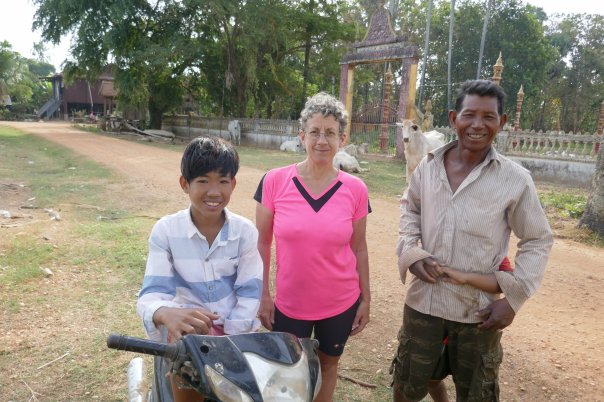
New friends along the way
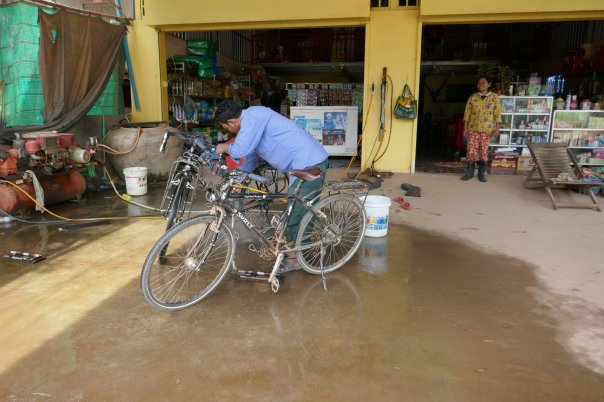
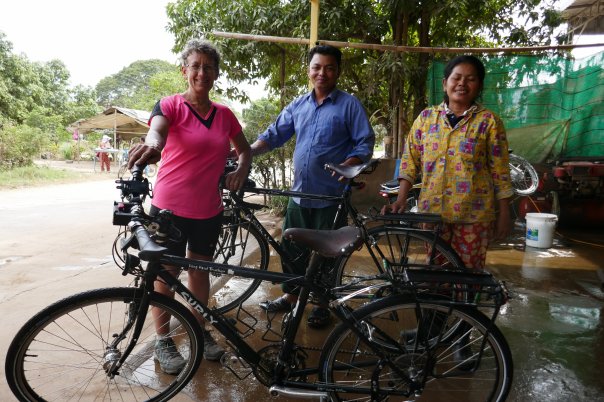
We took lunch having covered 85km – not a bad morning. But we both felt slightly heavy legged and so stopped for a soft drink at about 103km. This produced one of the major amusements of the trip. The soft drink seller we stopped at had no cold drinks, but directed us to a store opposite who did. The couple who ran the store doubled up by cleaning motor bikes – with a water spray until and cleaning cloths. So we tentatively asked about this service for our bikes and – surprise, surprise – it cost $1.
Clean bikes and the bike cleaners
Fantastic value as we watched them expertly clean every part of the bikes, getting the mud, dirt and grime out of all the crevices. But they thought it was hilarious that anyone thought a bicycle was worth cleaning. This gathered quite a crowd including a lady of about our age who was fascinated by the whole process; no translation needed to understand that she wanted to know where had we come from, where were we going and when did we not have sore bums. The last question involved her feeling Bernie’s padded trousers and then carefully feeling my posterior as well – to the further huge amusement of the onlookers. She was quite a character and we were happy to play along. The sub-text was “Well they are mad of course – not only having their bikes cleaned but also cycling all this way – you think they could afford a motorbike but poor things have to cycle”.
This really cheered us up and we ambled along the last 23km, finally crossing over the river into the city of Kampong Cham at about 3pm. There was not a single hill all day and the only time we registered any height gain was to climb the few metres needed to a bridge. I have never done such a sustained flat ride with the wind behind me. Such a change from Northern Cambodia where we battled against the wind day after day. So a lovely day on the bikes – just 1 more day to reach the capital.
Although I am sure the monks were praying early it mercifully was not broadcast across loud speaker as with some other temples so we woke gently in our temple camp site. As I stirred outside the tent for an early morning brew at dawn, so the monks were also stoking the fire in their kitchen area and preparing breakfast. We slowly broke camp and headed off (having persuaded the monks to accept a donation) to meet our guide for our kayaking trip (booked through Cambodia Discovery Trail). This part of the Mekong is famous for a pod of rare Irrawaddy fresh water dolphins and we were hopeful of spotting them.
First they strapped our bikes and panniers onto a motorbike trailer to transport them to the finishing point so that we could continue cycling from there. Everything can be carried on a motorbike in some sort of trailer or other. The most impressive so far was a very large wooden bed!
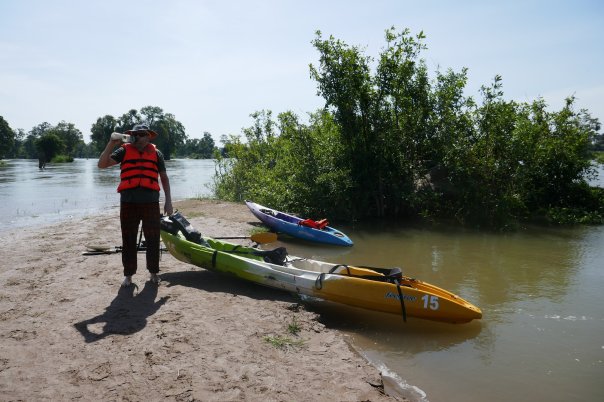
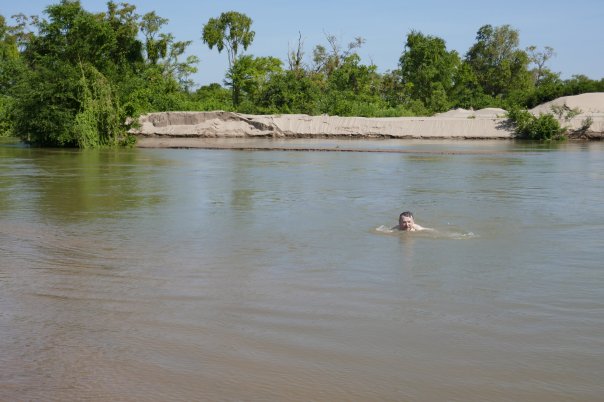
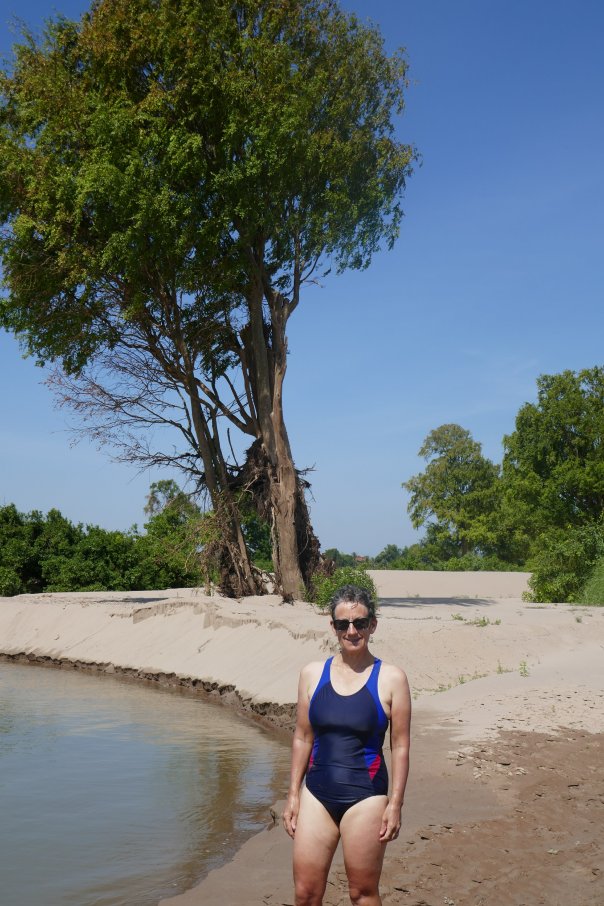
Our guide, Lucky Kip, was a pleasant softly spoken local man whose family were fishermen and knew this bit of the river like the back of his hand. We were in a tandem kayak while he had his own single. We were soon installed and pushing off onto the mighty river. Anything else aside it was incredible kayaking across to the other side first and then drifting downstream on the swirling currents. As it is dry season the river is scattered with trees and bushes and small islands poking out of the water. During the wet season the river rises by 35m and all these are submerged. It was both peaceful and but quite scary with the power of the river. We saw cormorants and king fishers then pulled up onto a small island and swam in a small protected bay.
We then paddled through an area called the floating forest – large trees looming out of the water with elaborate root systems.
We were then on open water and into the dolphin area. We were making our way to the opposite bank when lucky suddenly stopped and paddled rapidly to the other bank with us following as fast as we could. We pulled the boats onto the bank and soon saw a couple of the dolphins coming up for air then diving down again. These dolphins are shy and easily scared off but we watched for 20 minutes or so as they rose up and down. Glimpses only each time but as there are only 80-90 left in the whole Mekong river it was a privilege to see them. The fresh water dolphins have flatter noses and larger rounder heads compared to the ocean dolphins. There were around 2000 on the river but during the starvation of the Pol Pot years the local people killed them to eat and for oil – often shooting them or dynamiting them out of the water. In spite of concerted conservation efforts their numbers are still precarious but thought to have raised to around 90 last year because of good rains. With females only giving birth every 3 years if there is a year of a lot of pollution it makes a significant difference.
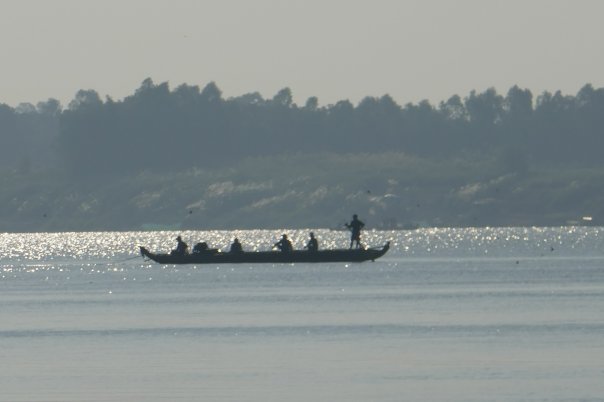
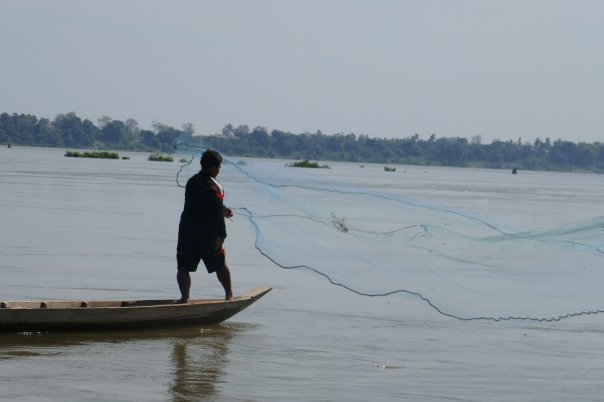
While we were watching the dolphins we were also watching fishermen on small boats casting their nets and pulling them in, catching small fish. 1 kilo is 5000 rials (about 1 pound) – that’s a lot of fishing for not much money.
We then had a final hard pull directly across the river to the other bank to finish our trip. Out bikes were there waiting for us and we had just 15km along a small paved but bumpy road into the town of Kratie. We treated ourselves to a room with A/C and felt exhausted. We thought we were fit but suddenly using totally different muscles and we were wiped out again!
Kratie felt a step different from the more remote north east. More affluent, more touristy (lots of places with burgers on the menu), nearer to Pnomh Penh. It had a long and pleasant river front but to us not nearly as charming as the little villages we had seen (or are we getting ‘tourist snobby’ again). A good place to rest and do some onward planning.
One of the features of affluent, western life is the distance between individuals. We sleep in our own rooms (possibly with a partner) with thick walls between us and other members of the family. This is pretty uncommon for the rest of the world where families live on top of each other, sleep within the same area and live in far closer contact with others.
We felt this as we rose before dawn this morning, with both Sorrany and her husband and Veronica and Allessandro sleeping in the next door room (although Veronica and Allessandro were under a mosquito net which offered some demarcation). We crept about as we packed up but our efforts at being quiet in this wooden house were pretty unsuccessful. Both Sorrany and Veronica were soon up – and we had exchanges with them both before leaving. We wish Veronica and Allessandro well on their bike trip. It had not begun well but they reached the delights of Kop Preah and decided (very sensibly) to spend an extra day there).
We picked our way across the island in the early morning light. The road was loose stones and so it was hard to keep balance with any weight on the front wheel, but I managed not to fall off (just). Then, as we got to the tiny ferry we saw it had just left! But, not wishing to loose the prospect of another paying customer (and with the chance of doubling the number of passengers for this trip), it did a loop and came back to the bank to pick us up – a result that saved us a hour’s wait! So we sat as the ferry chugged across the river to the mainland.
We retraced our steps along the road going north to the temple, and then left the dirt to turn East onto a sealed road. The joy of tarmac after bumping along the dirt roads is a simple pleasure. That road took us up and over a 100m hill to join the “no7” road which was one of the main routes from Cambodia to Laos. But it was quiet! There were a few trucks but not many. Lots of minibuses use this route – stopping to pick up passengers as a substitute for buses. They were held together with string – literally – as many had parts such as exhausts kept in place by string or rope, and had motorbikes strung with rope off the back. It was not clear whether the motorbike was being transported for a passenger or was a back-up to be used to go to get help when the minibus broke down.
The road surface was initially not great and it ambled up and down for the next 20km, as the temperature gradually climbed. This is scrubland and was thinly populated – and only then along the road. I am pretty confident there is mostly uncultivated bush for miles and miles away from the road. But then the surface dramatically improved. The Chinese have built a brand new road in the last few years and we whizzed along. As the day heated up, so the wind got up but it was in our favour. So we sped along at about 22kph. The road undulated but there were no big hills and we made great progress. We got to the village where we originally planned to camp at about 11. So we changed plans, had a quick soft drink and carried on. The scrubland continued and, as if from nowhere, we met a cyclist coming the other way.
Paul is retired, lives in South Yorkshire and cycles the world when he can. We exchanged pleasantries and went our separate ways – with our southward journey being fuelled by peanut butt sandwiches. Almost as much a delight as the Chinese road.
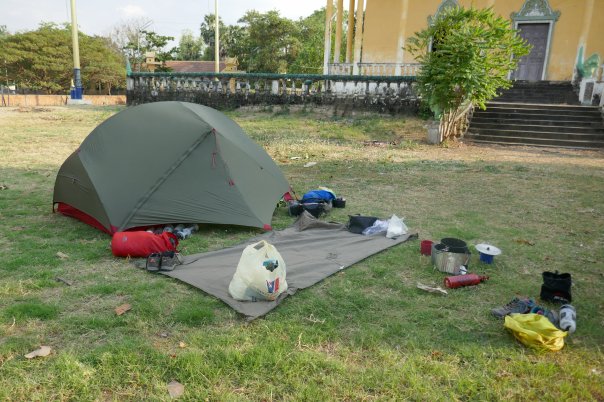
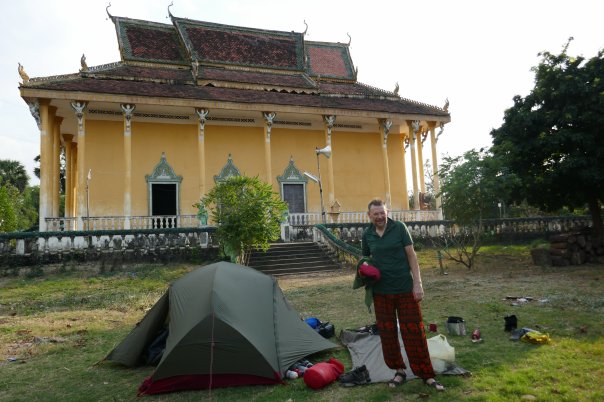
By about 3pm we had got to the turning to bring us back to the Mekong. 14km later (and countless wave and “hello – what is your name – goodbye” from passing children) and having covered 122km, we re-joined the river at the village of Sandan. We found a small Buddhist temple and easily got permission to camp in the grounds. There were plenty of monks around but our efforts to make a contribution to the monastery were rebuffed.
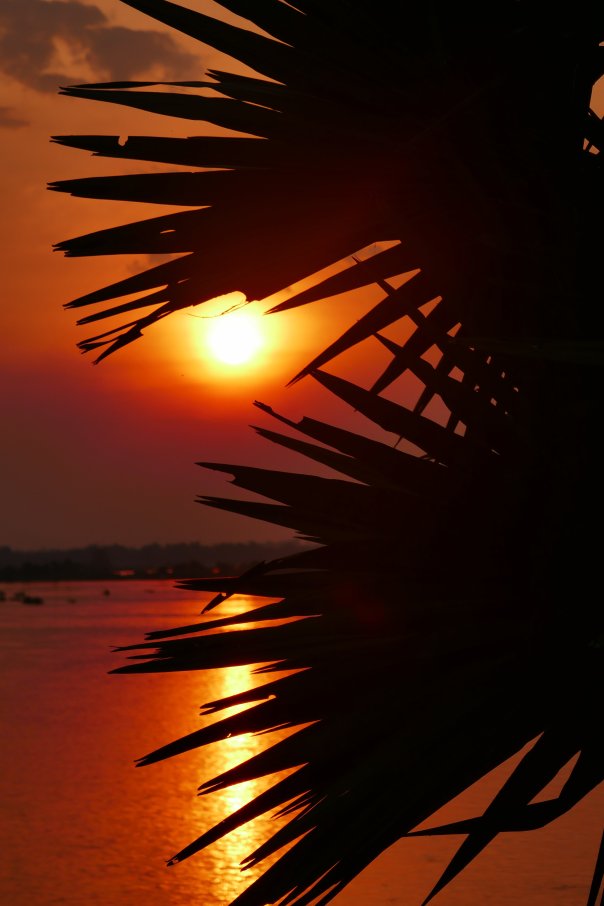
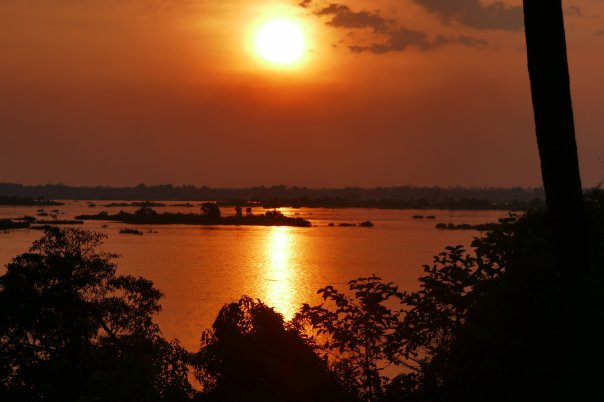
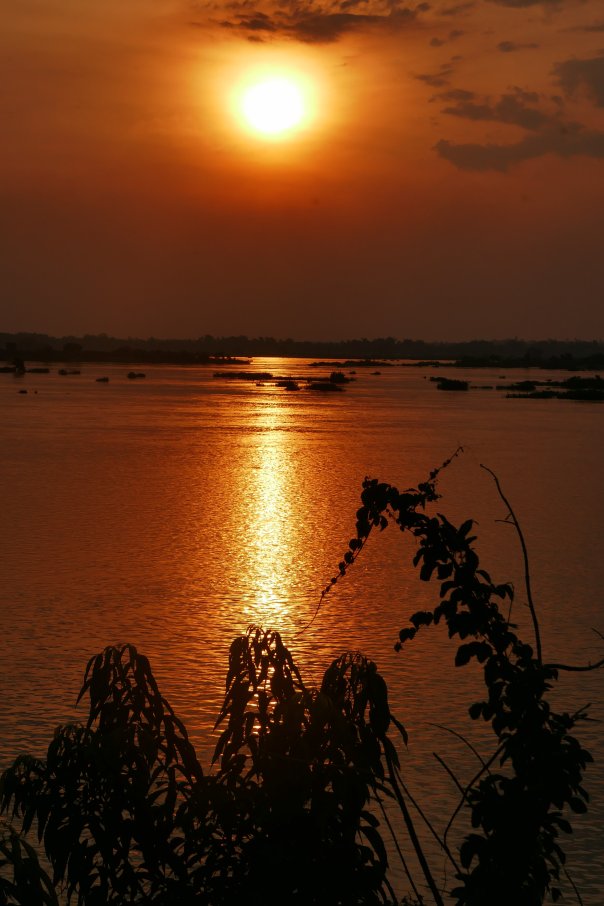
Then we set up camp, brewed and ambled into town to try to buy coffee (failed as the Cambodians do not seem to drink either tea or coffee on a regular basis) and watched a spectacular sunset over the river. We cooked our one-pot meal and then ate to the background of junior monks practising their chanting. The words for the chant were on a mobile phone and the young monk was scrolling through the text on his phone as he chanted. It all felt very strange and yet very familiar at the same time.
We exchanged a few words with some of the monks who spoke a little English but the extent of their English meant it did not get beyond exploratory questions – but was till far better than our Kymer. The limited conversation made it clear that we were welcome here, and that felt good. Finally we went to bed in our tent – driven there by the mosquitos – and watched an orange moon rising in the East.

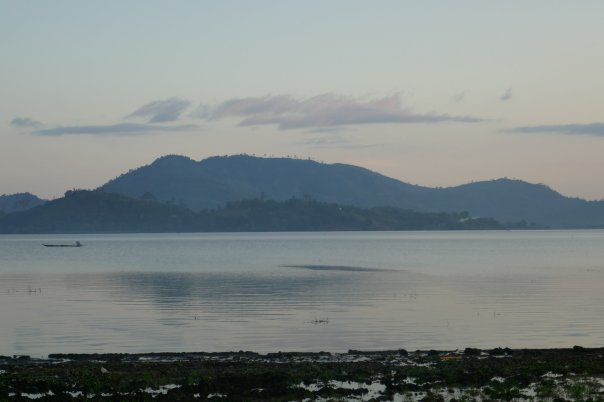
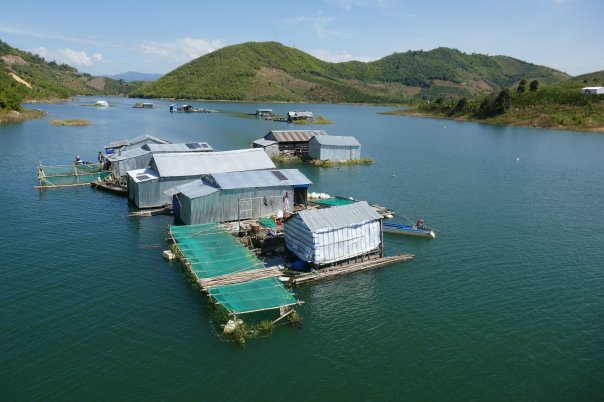
 By the time we got to the Lake– about 3.30 – we were wiped out. But tea with lemon and a shower revived us. Lake Ho is the largest natural lake in Central Vietnam. There are bigger reservoirs but this lake has supported fishing communities for generations. They belong to a minority tribe and live in long houses, which we saw on an early evening stroll. Unfortunately, by the time we had recovered, the wind had got up and was blowing a gale and it was overcast. It made the lake look pretty uninviting, with only brave souls venturing out on boats into the wavy waters. However I can see that, on a calm summer’s evening, it must be delightful.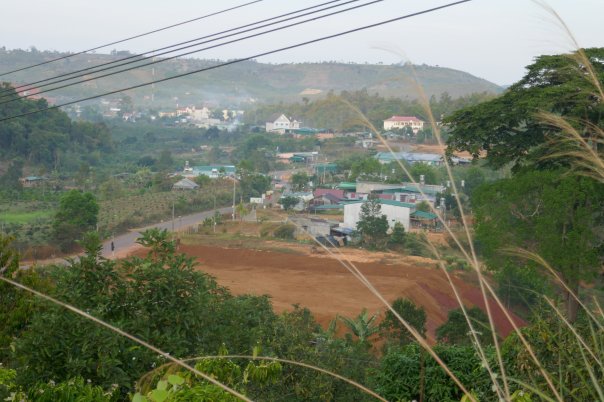

 Into the final section – the last 20km. Nothing is flat so there were still undulations all the way – none severe but legs were definitely tiring. We crossed the threshold of our previous highest amount of climbing in 1 day and still had 15km to go. Head down and keep going. In the final 10km the road surface deteriorated just to make it a bit more trying then at last into the final 150m descent into Dinh Van – a pleasant thriving town with a small central square around a lake. We found a guest house on the square and finally collapsed!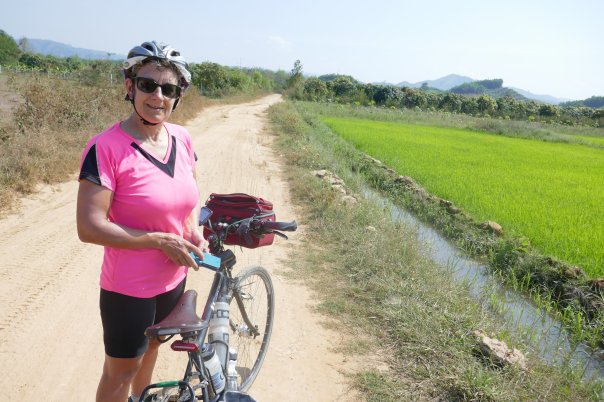
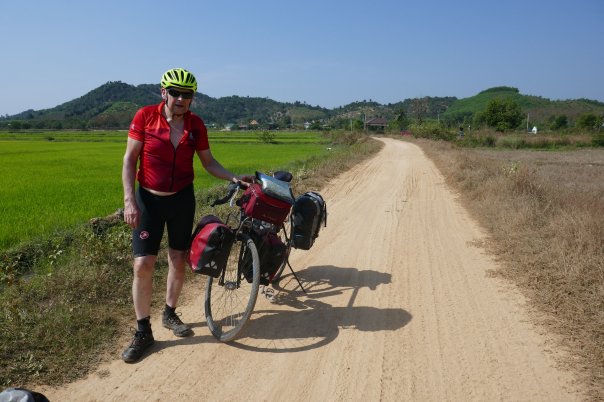
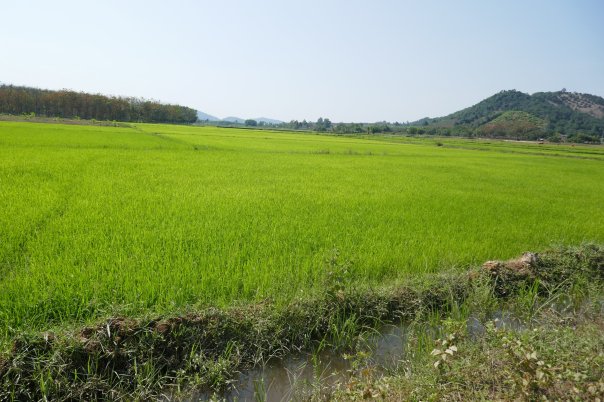

 Tomorrow we head into the mountains but the 117 km we had covered was more than enough for today.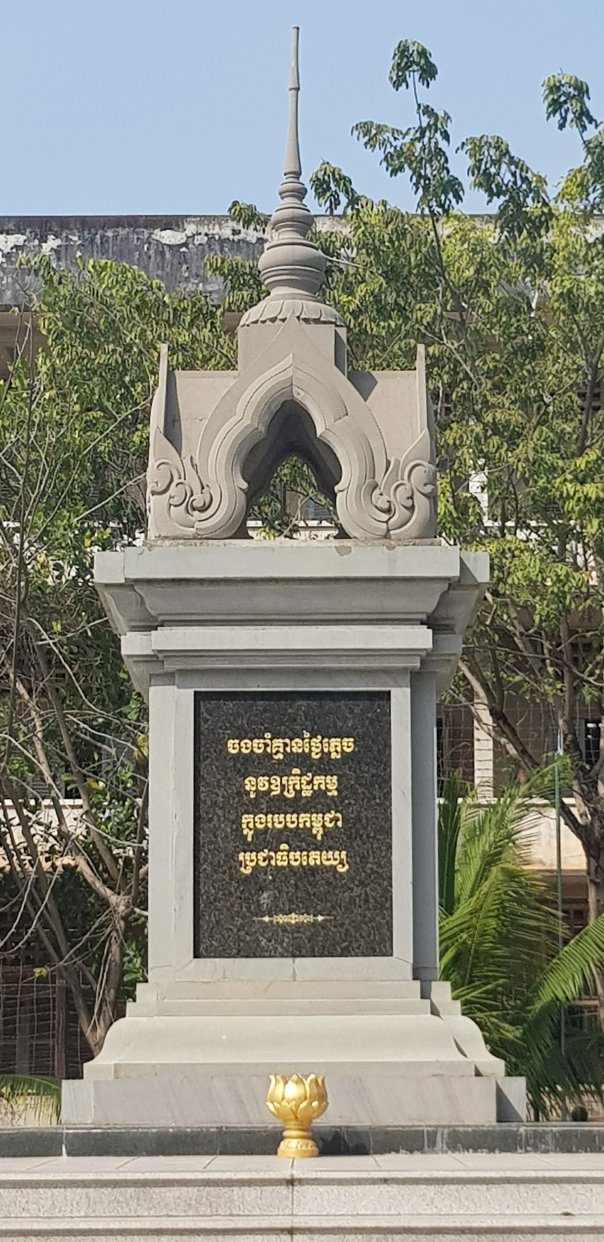




 The Slow Cycling Blog